Friday, November 30, 2012

Go! Write! Fail!


I recently read a story attributed to the book Art & Fear by David Bayles and Ted Orland.  It recounts an experiment by a ceramics teacher, who divided his class into two groups.  The first group was to be graded on quantity.  They were to focus on making as many pots as possible by the final day of class.  The second group was to be graded on quality.  They only had to make one pot, so they could pour all their time and focus and energy into this one pot--but yes, it had to be of utmost quality to get an "A."

Now, my first thought upon reading this was to think, Well, of course, the students focusing on quality are going to have the better pots.  They get to spend the entirety of their class time getting their one pot just right.  But the curious thing is that by the end of the class, the students focusing on quantity were actually the ones producing the pots of the best quality.  It turns out that even though they were focused on making as many pots as possible, these students couldn't help but learn from the process of doing so.  They had the benefit of making mistakes and learning from trial and error.  In the end, this was enough to put them ahead of the group focused on quality.

As writers, we face the equivalent of a lot of lousy pots.  How many times do you end up tossing paragraphs, pages, chapters, or even entire manuscripts that just aren't making the grade?  But the simple fact that we're writing means we're learning and honing our skills.  Quantity leads to quality, which is why we must write, write, write.

So . . . go, write, fail!  Fail a lot if that's what it takes.  There is great value in mistakes.  The most important thing is to keep writing.

Wednesday, November 28, 2012

When a Good Series Goes Bad....


I'm always up for a good series. I like them because if I'm really fond of a book, I don't want it to end! Since I writing Book III of the Nightshade Chronicles, I've been thinking a lot about series, and what makes one successful against another.

Recently, I read a five book middle-grade series that started off great. The first and second books were really entertaining, and the third book was pretty good, though I did skim some with that one. By the fourth book, the writing felt completely different--and not in a good way. The author seemed genuinely bored with the plot, and the writing was rambling and clunky, not to mention the book was over 500 pages long (and no, it was not a Harry Potter book, I just like silly cat pictures). The storyline actually felt like it was copied from the earlier books, just with different characters and settings, even the action sequences reeked of past scenes I already read. It was a real disappointment, at least to me, though I'm sure others loved it.

When I wrote the sequel to my debut, my editor flat out told me the book had to be super special, perhaps whatever made the first book work had to happen on an even bigger scale. Now that doesn't mean lots of explosions or anything, it just means book II really had to bowl the readers over. That was kind of a light bulb moment for me. Readers want what they read in the first book, but they don't just want a continuation; the book needs to be extraordinary on its own. I think if you're going to write a series, each book needs to be standalone great! Characters need to evolve, as does the story...not just continue.

What is your take on writing an amazing sequel or series? What are some series you've read that were in your opinion successful from the first book to the last? Without naming names, what were some mistakes you think some authors have made in series of theirs that you've read?

Thanks for reading!

Hilary

Monday, November 26, 2012

MG House of Cards: Build Wisely


First things first: It’s my son AJ’s second birthday today. So HAPPY BIRTHDAY, BUDDY! This one’s for you.

Happy Birthday, AJ!
And when I say “this one’s for you,” that is kind of the point to this post, as in, books FOR kids. Not for adults (writers like us, or librarians, or agents, or editors), but books FOR middle-grade kids. If you are involved with this writing/publishing thing for long enough, you start to see the difference between what adults like and look for, and what kids like and look for. There, indeed, is a big difference. Where you sometimes find an agent or editor who might comment “I didn’t connect with this” or “it wasn’t my thing,” it’s important to realize that you’re writing not for them, but for your MG readers. We mustn’t forget who we are writing and publishing for, and that’s the MG reader. I believe we do miss that critical point quite often, and this is why (1) we lose a plethora of middle-graders as readers who stop reading completely, and (2) why many books, even those that receive big advances, don’t sell that well when on the shelves.

That first point, losing middle-graders as future readers, is something teachers like me see quite often. If we don’t offer an enticing selection, we turn their taste buds off and they end up turning away from books. Here is an example. I saw an adult’s review (on Amazon) for Anthony Horowitz’s STORMBREAKER, a favorite for MG boys, that commented: “There are often long action sequences which, although entertaining, add nothing to the story. It's almost as if ‘Stormbreaker’ was written as a film script rather than a novel. I mean, at the end of the day, was it really necessary for Alex to get stuck in that car crusher? Didn't think so.” Then I turn away from this review, in the direction of my MG boys (students), and ask them what their favorite parts were, or better put, what they loved about the book. You guessed it. The car-crusher scene always comes up, and then they rattle off the other action sequences that, according to the adult reviewer, “add nothing to the story.” These MG boys then proceed to get all giddy when discussing the idea of reading the rest of the books in the ALEX RIDER series. The next domino to fall is when these kids ask me (or someone else) for books like the ALEX RIDER books. In other words, WE JUST HOOKED SOME READERS, and this is friggin’ awesome, people! A reading community has just been built, and all with a book that an adult thought was just a series of "things that happen" with little substance to it. In this case, as is often the case, the things adults think are “just there” are actually the things MG readers crave.

Another example is with a movie GOONIES. It’s a staple MG story that many writers aspire to capture in their own stories. Here are a number of questions: Why is Mikey (the MC) so in love with pirates? Why is there a piano made of bones that the kids have to play? Why is Mouth such a wise guy? If you were a middle-grader yourself, the answer to all of this would be: "Who cares? It’s all part of the awesomeness!" Whereas adults might ask for the meaning behind it all, and want to contemplate it deeply, kids just love it for the pure entertainment value. To them, there doesn’t have to be a “point” to hook them as a reader (or a viewer). And like I said, we mustn’t forget that THAT’S THE WHOLE POINT!

Finally, let me tackle the second point I made about the fact that many books don’t sell when on the shelves, even those that had a ton of hype and huge advances. And the reason for this is simple: the adults who play a role in putting the package together, oftentimes, don’t know what kids want to begin with. Instead, the adults used THEIR opinions and desires—their tastes—in choosing the product to put out there. And when it hits the shelves, despite the many adults who might supply reviews galore about its “beautifully-crafted prose” and the adults who market it as a masterpiece, kids simply are bored with the product on the shelf or they don’t “connect” with it. That’s the true disconnect that leads to weak sales, and loss of readers. It’s a serious concern for all. We mustn’t view things through our lenses, but through kids’ lenses. It’s a different perspective altogether.

In the end, all adults involved (writers, agents, editors, librarians, book sellers) need to start viewing things through the eyes of MG readers. Ask not what you like and connect with, but what a MG reader would like and connect with. And make decisions accordingly. If not, the house of cards will come crashing down on top of all of us.

Thoughts?

Friday, November 23, 2012

INTERROBANG


It’s an onomatopoeia. You know what it is and you likely crave it as much as the rest of us.

 
I have a son who loves Bill Bryson’s A Short History of Nearly Everything. “Now I know how to make a universe,” my son told me. Last night, we read If I Ran The Zoo, by…do I need to even say? My son is eight years old.  True, what excites him is not necessarily what an average eight-year-old might find intriguing (he reads books on the periodic table! But still loves Seuss!) but he is like everyone else in that he thrives when given the chance to catch his breath on a page.
 
I can’t pretend to say that Bryson and Seuss have a lot of overlap. But there is something magic in each. Dwelling on either end of the reading spectrum they still share a certain magic, something we discover on pages contained in both books. They give us the interrobang! And, yes, it is, more or less, a real word. The ‘interrobang’ is a construct intended to combine both the ! and the ? into one very fuzzy (imagine this at 12 font! ) and almost impossible to discern ( ‽  ) punctuation mark. It never really caught on, but it says A LOT!  It is a vital and integral part of MG lit and often present in books that endure and that we love, over and over. When given literature that provides the opportunity to have our own discovered interrobang, not force-fed, overly-intentional, or otherwise clearly attempted without merit, we can feel that interrobang and we love it. MG lit seems to contain loads.

J K Rowling gave a generation (or several) a new sense of that experience and brought back reading to the world of kids. While there were always great works, reading had lost its luster, somehow, and was not considered cool. Now, thanks to her, people are reading our works with vigor (and hopefully some interrobanging) it spreads. There seems to be lulls in the capacity for generations to achieve the interrobang, almost like people who become acclimated to athletics or medications or spicy foods and need more intensity than they once did to get it to work. But it does work and those waves bring new and exciting things. Boredom only happens when there is lack of interest, since there is always something interesting out there.

We have a saying in our family- only boring people get bored. I suppose we must all find the interrobang within and, as writers, put that interrobang on the page to share.


Wednesday, November 21, 2012

Middle-Grade Novels About Foster Kids

Every once in a while, I notice patterns in the books I'm reading. Lately I've come across three that deal with foster kids and and their families (or in some cases, kids' attempts to hide their need for social services to step in). I've added these new titles to some classics, refreshed my memory on a few other books, and came up with this list: Middle-Grade Novels About Foster Kids.

Why are there so many books on this topic? Here's my take: A child finding her way in a new home setting is probably vulnerable, guarded, out of place and in need of love. And really, even if we've never been in a similar circumstance, can't we all relate?

All descriptions have been taken from Amazon and Goodreads:
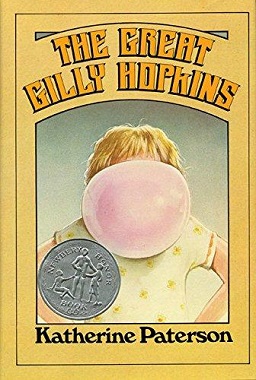
THE GREAT GILLY HOPKINS - Katherine Paterson
Eleven-year-old Gilly has been stuck in more foster families than she can remember, and she's disliked them all. She has a county-wide reputation for being brash, brilliant, and completely unmanageable. So when she's sent to live with the Trotters -- by far the strangest family yet -- Gilly decides to put her sharp mind to work. Before long she's devised an elaborate scheme to get her real mother to come rescue her.

But the rescue doesn't work out, and the great Gilly Hopkins is left thinking that maybe life with the Trotters wasn't so bad ...

TOUCH BLUE - Cynthia Lord
Touch Blue and your wish will come true.

The state of Maine plans to shut down Tess's island’s schoolhouse, which would force her family to move to the mainland--and Tess to leave the only home she has ever known. Fortunately, the islanders have a plan too: increase the numbers of students by having several families take in foster children. So now Tess and her family are taking a chance on Aaron, a thirteen-year-old trumpet player who has been bounced from home to home. And Tess needs a plan of her own--and all the luck she can muster. Will Tess’s wish come true or will her luck run out?


SUMMER OF THE GYPSY MOTHS - Sara Pennypacker
Stella loves living with Great-aunt Louise in her big old house near the water on Cape Cod for many reasons, but mostly because Louise likes routine as much as she does, something Stella appreciates since her mom is, well, kind of unreliable. So while Mom "finds herself," Stella fantasizes that someday she'll come back to the Cape and settle down. The only obstacle to her plan? Angel, the foster kid Louise has taken in. Angel couldn't be less like her name—she's tough and prickly, and the girls hardly speak to each other.

But when tragedy unexpectedly strikes, Stella and Angel are forced to rely on each other to survive, and they learn that they are stronger together than they could have imagined. And over the course of the summer they discover the one thing they do have in common: dreams of finally belonging to a real family.

ONE FOR THE MURPHYS - Lynda Mullaly Hunt
A moving debut novel about a foster child learning to open her heart to a family's love.

Carley uses humor and street smarts to keep her emotional walls high and thick. But the day she becomes a foster child, and moves in with the Murphys, she's blindsided. This loving, bustling family shows Carley the stable family life she never thought existed, and she feels like an alien in their cookie-cutter-perfect household. Despite her resistance, the Murphys eventually show her what it feels like to belong--until her mother wants her back and Carley has to decide where and how to live. She's not really a Murphy, but the gifts they've given her have opened up a new future.

HARRY SUE - Sue Stauffacher
Harry Sue Clotkin is tough. Her mom's in the slammer and she wants to get there too, as fast as possible, so they can be together. But it's not so easy to become a juvenile delinquent when you've got a tender heart.

Harry Sue's got her hands full caring for the crumb-snatchers who take up her afternoons at the day care center, and spending time with her best friend Homer, a quadriplegic who sees life from a skylight in the roof of his tree house. When Harry Sue finds an unlikely confidante in her new art teacher, her ambitions toward a life of crime are sidelined as she comes to a deeper understanding about her past--and future.

BUD, NOT BUDDY - Christopher Paul Curtis
It's 1936, in Flint, Michigan. Times may be hard, and ten-year-old Bud may be a motherless boy on the run, but Bud's got a few things going for him:

1. He has his own suitcase filled with his own important, secret things.

2. He's the author of Bud Caldwell's Rules and Things for Having a Funner Life and Making a Better Liar Out of Yourself.

3. His momma never told him who his father was, but she left a clue: flyers of Herman E. Calloway and his famous band, the Dusky Devastators of the Depression!!!!!!

Bud's got an idea that those flyers will lead him to his father. Once he decides to hit the road and find this mystery man, nothing can stop him--not hunger, not fear, not vampires, not even Herman E. Calloway himself.

THE PINBALLS - Betsy Byars
Carlie knows she's got no say in what happens to her. Stuck in a foster home with two other kids, Harvey and Thomas J, she's just a pinball being bounced from bumper to bumper. As soon as you get settled, somebody puts another coin in the machine and off you go again. But against her will and her better judgement, Carlie and the boys become friends. And all three of them start to see that they can take control of their own lives.


PICTURES OF HOLLIS WOODS - Patricia Reilly Giff
Hollis Woods has been in so many foster homes she can hardly remember them all. She even runs away from the Regans, the one family who offers her a home.

When Hollis is sent to Josie, an elderly artist who is quirky and affectionate, she wants to stay. But Josie is growing more forgetful every day. If Social Services finds out, they’ll take Hollis away and move Josie into a home. Well, Hollis Woods won’t let anyone separate them. She’s escaped the system before; this time, she plans to take Josie with her.

Yet behind all her plans, Hollis longs for her life with the Regans, fixing each moment of her time with them in pictures she’ll never forget.

KEEPING SAFE THE STARS - Sheila O'Connor
When crisis hits, a young girl becomes the only one left to take care of her family.

Pride, Nightingale and Baby are the Stars. Orphaned and living with their grandfather, Old Finn, in rural Minnesota, the children, like their grandfather, are wary of outsiders. They believe, as Old Finn taught them, in self-reliance.

But then Old Finn falls seriously ill and is taken to the hospital all the way in Duluth, leaving the children to fend for themselves. Pride, as oldest, assumes the lead. Though she makes mistakes, she keeps them afloat; they even earn money for the bus trip to Duluth. But when they finally see Old Finn, he can't walk or even say his own name, and Pride knows her days of keeping safe the Stars are drawing to a close. Self-reliance can't make Old Finn well again. But maybe, just maybe, a secret from Old Finn's past might make a way for them to stay together after all.

Any books to add to the list? Leave them below!