Showing posts with label Characters. Show all posts

Monday, January 30, 2017

What's in a Name? by Dianne K. Salerni

Shakespeare’s Romeo said that “a rose by any other name would smell as sweet.” But I wonder, would a character named Rose have the same personality if the author changed her name to Daisy?

In 2011, when I started planning a story about a secret dayof the week, the protagonist came to me with his name already selected. By him. “I’m Jax,” he said, and since I was toying with the idea of setting the story in a fantasy world, I didn’t object at first. But when I decided to set the story in modern day U.S.A, I thought I needed to change his name. American boys weren’t named Jax. (In 2011, I had never heard of that name.)

The problem was, Jax wouldn’t change his name. Not even to something close, like Jack. Somehow, an entire personality had become attached to that name. Jax was stubborn and had a smart mouth on him, but he was also good-hearted and likeable and loyal to a fault. He was impetuous, prone to making mistakes, but always willing to take responsibility for his actions and make things right. All those things had somehow become uniquely tied to three letters: J-A-X.

(Of course, by the time the book was published, I found myself encountering the name Jax or Jaxon everywhere. So, he was right all along.)

I’m not the only author who’s experienced this name-character connection.  Susan Lynn Meyer reports that after hearing the name September Rose (a friend’s daughter’s friend), she immediately knew she had the name of the MG for her book Skating with the Statue of Liberty. She tells me, “I can't exactly say why, maybe because it is such a vivid and unique name, but the name September Rose (Seppie for short) conjured up to me an African-American girl who is full of confidence, energy, and joie de vivre, even in the face of discrimination. She wants to be a singer and dancer, like her idol Josephine Baker.”

In Diana Peterfreund’s Secret Society Girl series, a character with the code name Poe is eventually revealed to have the real name of James. However, when the protagonist first called him by that name, the author got a surprise. He shouted that nobody called him James; his name was Jamie. “The scene took ME by surprise,” she says. “I didn't even think of trying to change it. He was so certain.”

Another character who chose her own name is Fairday Morrow. In the book, The Secret Files of Fairday Morrowreaders find out that her mother, Pru, grew up in Nantucket. Because her baby daughter’s gray eyes reminded her of the ocean, Pru named her child after a phrase local fishermen said to tourists. Authors Jessica Haight and Stephanie Robinson say that Fairday’s name inspired her character: “Fairday has an even-keeled personality that built up around her name, though we'd say she does have her own style!”

I could share countless other stories of how my characters’ name choices drove the development of their personality, such as my feisty and ever-truthful Verity Boone and Riley Pendare—who in my original story notes was named Wiley, but who changed his name and hijacked his intended role just before I started the first chapter. Rather than recount them all, I’ll leave you with some writing advice from Diana Peterfreund. When it comes to characters’ names, the characters know best.  

“Follow the names,” Diana says. “Always follow the names.”


Thursday, April 14, 2016

The Enneagram for character development by Joanna Roddy


I have to confess, I put little stock in personality tests. They seem too generic, like magazine horoscopes that, with a little finagling, could apply to anyone. The tests are fun to take, but they're more like acceptable vanity exercises. Only the saints and psychologists among us really dig into understanding types other than their own. At best we say: "Oh you're an INFJ? I'm an ENFJ!" and remark on our shared traits and the differences between introverts and extroverts. 

But recently a psychologist friend introduced me to a personality system she uses in her practice, and I have found it incredibly helpful, both personally and in my relationships. Recently I decided to use it in my writing as well. I was having a hard time making certain characters distinct and clear. Using this system, two-dimensional characters suddenly popped up off the page. I began to understand what motivated them, how they would react in situations, what they might say (or not say), what vice they might gravitate toward, and what core virtue would emerge under the right circumstances. In short, it was character development magic. 

The Enneagram:

The personality typing system is called the Enneagram, and it articulates nine personality types that are interrelated. In an extremely condensed form, here are the nine types and their core motivations:

Type 1: The Reformer/ Perfectionist. "I must be/ do right."
Type 2: The Helper/ Giver. "I must help others."
Type 3: The Achiever/ Motivator/ Performer. "I must succeed."
Type 4: The Individualist/ Artist/ Romantic. "I must be unique."
Type 5: The Observer/ Investigator/ Thinker. "I must understand the world around me."
Type 6: The Loyalist/ Skeptic. "I must be secure."
Type 7: The Enthusiast/ Adventurer. "I must seek new experiences."
Type 8: The Challenger/ Leader. "I must be in control."
Type 9: The Peacemaker/ Mediator. "I must have/make peace."

Each personality type perceives these motivations as the means for them to be safe, to have meaning in their lives, or to be loved.

There are a lot more details to each type, like key fears and desires, and basic virtues and vices. Check out this cheat sheet from Wikipedia (click to enlarge):


Integration/ Disintegration:

What I like about the Enneagram is its nuance and complexity. We all know that a healthy or growing person and an unhealthy or stressed person behave in totally different ways, even if they share personality traits. The Enneagram predicts what traits emerge under stress and during personal growth.  Every Enneagram type uniquely integrates to the healthiest characteristics of another type and disintegrates to the least healthy behaviors of a different type.


For example, threes integrate to a six and disintegrate to a nine. Achieving threes can be self-focused, but with maturity, they look more like other-focused healthy sixes. Threes can be driven, but under stress they begin to look like unhealthy nines: disengaged and apathetic.

Wings:

Enneagram types can have an even greater degree of complexity by demonstrating traits from one of the numbers adjacent to them, which are called wings. The wing augments the primary personality. So you can have an observant five with an artistic four wing, which might produce a professorial art school type, or an achieving three with a helpful two wing might be an front-person for a non-profit organization. These are gross generalizations, but I find the flexibility of wings accounts for a wide array of personality manifestations, even among people who share a primary type. It keeps it all from becoming too canned and stereotyped, but not so general as to become meaningless. 

In Writing:

The Enneagram goes much farther and deeper than this crash course, and those who are interested could spend a lot of time learning about it. I think most of us instinctively pick up on others' personalities, especially writerly types who want to write believable characters. If people were clocks, we immediately perceive the difference between a cuckoo clock, a grandfather clock, a digital clock and an alarm clock. We get, on a basic level, what makes them tick. The Enneagram, then, is effectively like a screwdriver that removes the backing so we can see the actual mechanics at work. 

The most helpful aspect of the Enneagram for me is the basic fears and desires. It helps me to know how a character is going to react to the sticky situations I put them in. For example, one of my characters is an adventurous seven. When his parents want him to go into the military for a war he doesn't agree with, his response is to hop a plane out of the country. A seven's core fear is being trapped or in pain and their spontaneity can make them impulsive, so this response makes sense for him, drastic though it may seem. Another of my characters is a loyal six. A six's basic fear is making the wrong decision. They need guidance to orient themselves. In this situation, my six character would have struggled with living up to his parents' expectations. In fear of making the wrong decision for himself, he probably would have enlisted despite his own reservations. And that would have made for an entirely different plot.

A Warning: 

Fully fledged characters will still surprise us. They should never act against their own character, but they might step out of the box that a personality type wants to put them in. A challenger-leader eight who tends toward domineering might unexpectedly resist the urge to step into an argument, which would mean something substantial for that character. Perhaps they are moving in their direction of integration to look like a helping two, or they've newly realized that winning a fight is less effective than leading by example. This flexibility is how we avoid stereotypes and wooden characters. I like that the Enneagram allows for the changes brought on by maturing or devolving or blending a couple of personality types together. But once these type of tools have helped you build your writing, like scaffolding, they should fall away and let the real, living world on the page play itself out as it must. Using the Enneagram as a tool, not as a law, is the best way. 


Resources:

Start with the Enneagram Institute site and the Enneagram of Personality Wikipedia page. From there, there are lots of books, sites, and articles available to learn more about the Enneagram. And here's a link the the long version of the test if you want to find out what Enneagram type you are and to a shorter version and another type of short test. The last one is my favorite. I apologize in advance for the productive time you will inevitably lose on those tests, but if it gets you to an understanding of good character building, then I think you don't have to feel too guilty about it. 

Please leave a comment if you've used the Enneagram or other personality typing for character building! I'd love to hear your insights. And here's something I'm deeply curious to know: do the main characters you write have the same personality type as you do? Happy writing!

Monday, April 11, 2016

Beverly Cleary at 100: 5 Things I've Learned about Compelling Characters from Ramona Quimby

Tomorrow is Beverly Cleary's 100th birthday. In celebration, I'm sharing a post that first published in 2011. Three cheers for the wonderful Ms. Cleary!

I loved the Ramona books when I was a girl, but if it's possible, I love them even more as an adult. Re-reading these books has taught me a lot about writing compelling characters. Here are a few things I've learned from Ramona Quimby:

  • Make them real: Ramona feels like a real pesky kid sister; she's as familiar as our own siblings or neighbors.
  • Make them realer than real: Ramona is a bigger-than-life character, the type that does and says things beyond the regular, everyday world. Somehow, this over-the-top aspect of her character is what makes her seem most like an actual kid: the more unique and outrageous she acts, the more she reminds us of real life.
  • Make them sympathetic: It would have been easy for Beverly Cleary to create a character whose flaws made her unattractive, like good ol' Bugs Meany in the Encyclopedia Brown books (has there ever been a better mid-grade villian's name, by the way?). But those flaws are precisely why we love Ramona -- we feel for her in the midst of her problems because we see our own selves in her experiences.
  • Make them logical: Part of Ramona's appeal is the way she makes sense of the world: the time she walks to school at 25 after the hour (because she was supposed to leave her house at the quarter hour), the time she is convinced her teacher is going to give her a gift because she tells her to sit for the present. Even when she's wrong we can relate to her logic because we're seeing her world through her young eyes.
  • Show them respect: The thing that has really struck me as an adult re-visiting the Ramona books is the compassion Beverly Cleary has for her character. Though she doesn't shy away from awkward moments, there is a tenderness in the way Cleary deals with Ramona when she throws up in class, when she kicks her bedroom walls in anger, when she names her doll the most beautiful name she can think of -- Chevrolet. 
These books have reminded me what it was like to be a child. They've nudged me to be more patient with my own children. They've encouraged me to treat my characters with compassion. 

Thank you, Beverly Cleary, for creating such a memorable, remarkable character. My writing -- and living -- are better for it.

Thursday, February 18, 2016

Marrying Story Structure and Character Arcs by Joanna Roddy


I'm a natural planner, but over the past year or two, I've been trying to loosen up and just write, as I've shared here before. But, at least for me, even when I'm letting the story lead me step by step as I'm writing it, I like to still have in my head the big beats I need to hit and where I hope to arrive at the end. I've also tried to press into character arcs as an equally important motion of the plot. 

As I've been working on my current project, I've discovered an approach that is giving me what seems to be the perfect balance between plan and discovery and between plot and character. I've been wanting to share this technique with you, and it makes a nice dovetail to Chris's post last week on layering plot and character in story. 

You may have heard about seven point plot structure before. It's kind of a hero's journey lite, if you're familiar with that approach. I heard about seven point plot structure from a writer friend, but when I looked it up, the blogs I found only confused me. Hook? Pinch Point? Plot Turn? The descriptions were vague and uninspiring. 

But then my friend directed me to the videos of Dan Wells presenting at a writing symposium using the seven points for story structure. If you want a quick master class on writing, I encourage you to set aside forty-five minutes and take yourself out to coffee with headphones, a laptop, and this link

In the case that you don't have time to go watch the whole thing right now, I'll give you the one paragraph summary in the order Wells directs you to plan the points (which is not the order they will happen in your story): 

1. Figure out how you want the story to end (Resolution). 
2. Create a beginning with an opposite status quo (Hook). 
3. The middle should be when your character makes the deliberate choice to pursue the Resolution (Midpoint). 
4. Set the character in motion from the Hook toward the Midpoint. Call them out of the status quo and introduce conflict (Plot Turn 1). 
5. Get the character the last and most important thing they need to accomplish the Resolution (Plot Turn 2). 
6. Apply pressure, force your characters to action, and create hurdles to their goals on either side of your Midpoint (Pinch Points 1 and 2). 

So now you have your seven points. This is the order they'll occur for your reader:


This is pretty straightforward stuff. It's a way to do it, and it pretty nearly encompasses most story-telling from a western worldview. What I like most about Wells's presentation is when he takes the character arcs, main plot, and subplots (using The Matrix as his example) and charts where each point of the the story structure occurs for each one and how they then weave together in the chronology of the story. 


This got me excited and it got me thinking about how seven point plotting takes shape for characters, something Wells doesn't have time to fully unpack during his presentation.

I understood the idea of a Hook to Resolution arc for any character, but the finer details evaded me. I had to dig a little deeper to understand what a Midpoint would mean for a character arc. That's when I discovered this excellent series of posts by K.M. Weiland


She argues that in the beginning of a story, the hero is operating from a lie about who they are, what they are capable of, or what the world is like. This lie shapes who they are and how they are. The Resolution for that character will be to reject the lie and learn, accept, and live out the truth instead. So, then, the Midpoint is when the character is able to finally see and accept the truth, but still has not rejected the lie or its effects on their choices. This enlightens the rest of the seven points for character arc. The Plot Turns introduce the truth, expose the lie, and give the character what they need to reach the Resolution. The Pinch Points refute the truth, reinforce the lie, and create barriers to the character's journey to truth. 

Brilliant stuff, right? To have this internally-driven structure woven into the externally-driven one allows for complexity, ingenuity, and well-rounded characters amidst a satisfying story. 

As I'm drafting a novel right now, the seven plot points are really helping. Some of the story points will happen simultaneously with character points, but some will occur separately. Many of the points are already clear scenes in my mind. But there are so many other scenes and so much happening between the points in order to get the story there, they serve more as guideposts than outline. It's definitely pacifying my inner Hermione Granger who needs to have answers, but it's giving spaciousness for the story to open itself to me as I write it. I'm loving that balance.

Have you used seven point plot structure before? Have you applied it to character development? Have you encountered other teachers/bloggers/writers who have an approach to it that you've found helpful? Please share in the comments below!

Monday, August 10, 2015

In Praise of Prickles by Kell Andrews

Not every thorn has its rose.
Nobody wrote prickles like Diana Wynne Jones.

I'm reading her Dalemark Quartet for the first time, and it strikes me again how prickly her characters are. From The Spellcoats (Book Three):
Robin wrung her hands. ... It annoys me when she does.

"We can go away down the River and find somewhere better to live," I said. It was the most exciting thing I had ever said. I had always wanted to see the River. ...

"But the Heathens!" Robin said, wringing away. I could have hit her.
The narrator Tanaqui is not nice. She isn't patient or kind. She sulks when she doesn't get her way, she teases her brother and snaps at her sister, and she turns out to be a hero in the end. Even then, she's still not nice.

In Jones's most popular novel, Howl's Moving Castle, Howl is vain, lazy, and not very brave, but it's Sophie who we root for as she becomes less nice.  Disguised as an old woman, she discovers her inner curmudgeon -- commandeering and no-nonsense, where once she was timid and compliant. She gains an edge. This is character growth in the world of Diana Wynne Jones, and that's why I love it.

Middle-grade characters are often so nice. They do the right thing. They even feel the right thing. They have flaws, but their flaws are the kind of answers they could give to a potential employer who asked them their biggest weakness in a job interview.

"I'm too much of a perfectionist."
"I care too much about how others think and feel."
"I have many unique qualities and quirks that are not always appreciated."
"Other people are intimidated by my intelligence and competence, as well as my world-saving magical gifts."
We have a higher expectation of morality from children. Everyone must play together, everyone is invited, everyone should be nice. This higher expectation is doubled for child characters -- there is a lot of "should" in children's literature, and readers like it too, and not just parents. When I was a kid, I adored perfect princess Sara Crewe but couldn't warm to sickly, fretful Mistress Mary Quite Contrary.  And I still love a transcendentally good character --  Auggie Pullman in Wonder, Felicity Pickle in A Snicker of Magic.

Readers want to spend time with likeable characters. They want to see themselves in characters they wish they were -- mirrors and windows, yes, but mirrors that show a particularly flattering reflection or a windows that let in the most attractive light.  Who wouldn't rather be Harry Potter rather than jealous, dim Ron or know-it-all Hermione? Ron and Hermione have prickles. Harry is nice, as well as being the Boy Who Lived, Hogwarts Champion, the Griffindor Seeker, and all-around BMOC. Maybe that's why Rowling's Harry Potter is more popular than Jones's Christopher Chant.

Children's literature past and present has its share of Pollyannas, including the title character from Eleanor H. Porter's novel whose is synonymous with unshakeable optimism and goodness. Maybe that's why middle-grade characters with prickles stand out, and why I like them so much. Even when you're saving civilization, your little brother might still get on your nerves. Probably especially then.
Who are some of your favorite prickly characters?


Wednesday, March 18, 2015

Finding the Perfect Name, by: Marissa Burt

Naming characters is one of my favorite things about the writing process. Sometimes characters pop into my head with a fully formed name. Other times, it takes some time to get to know them first. I am drawn to unusual names, old-fashioned sounding names, or names with specific meanings. Often, names that were on my potential-baby-names list while pregnant make it into my books. :)

Today I wanted to share my favorite go-to name sites. First, The Baby Name Wizard. This is full of a wealth of information: suggestions of what names pair well together, popular meanings of names, and my favorite, the Name Voyager, which graphs the popularity of names over time.


The Social Security Website also has popular name lists by year, so you can see if a name you've chosen would fit in well with your story.


The public library is also a good source for naming resources. They have fat stacks of topical baby-name books, so you can find names with mythological roots, for instance. 

What about you, fellow Mayhemers? How do you find the perfect name for your characters? Any go-to resources to share? 

Monday, January 19, 2015

A Writing Exercise from HARRIET THE SPY by Joanna Roddy


I was reading HARRIET THE SPY the other day and was absolutely smitten with Harriet's writer's game from the beginning of the book. Check it out:

Harriet was trying to explain to Sport how to play Town. "See, first you make up the name of the town. Then you write down the names of all the people who live in it. You can't have too many or it gets too hard. I usually have twenty-five....Then when you know who lives there, you make up what they do. For instance, Mr Charles Hanley runs the filling station on the corner."

She goes on to explain that once you know the names of all the families and how many kids they have and what they do for a living, that's when the fun begins. She starts imagining situations that happen in the town and how the people's lives intersect. While one farmhouse is getting robbed in the dead of night, a baby is being born in the hospital and the police chief is strolling down Main Street and senses that something is amiss. And so on.

I thought to myself, now there's an idea. 

So many children's books happen in the center of a community: TO KILL A MOCKINGBIRD, ANNE OF GREEN GABLES, and HARRY POTTER, to name a few. The setting could be a town, a school, a secret government training facility, or a summer camp, but when there's a cast of characters around your heroes, it's good to know who they are and where they come from right off the bat. Then you can start imagining situations that would arise between these characters in this setting, instead of (as I so often do) waiting for scenes and characters to present themselves as you write or outline. I would imagine that this is where great subplots, interesting characters, and plot complexities can emerge. Kind of like real life. 

Anyone want to play town?


Let us know if you have any great exercises for constructing characters, world-building, or beginning a new story idea. We'd love to hear from you!

Tuesday, June 3, 2014

How Far Will You Go For Middle Grade? by Joy McCullough-Carranza


Recently I encountered a child named Anakin – a girl, in fact, and I mused what rabid Star Wars fans her parents must be to give their child this name. (Although, Star Wars associations aside, I actually think it’s quite a pretty name.) But then I realized that if my son had been a girl, I totally would have lobbied for the name Hermione. I really would have. I don’t think I would have won, but I would have had my arguments lined up. The name actually comes from A Winter’s Tale, which would go nicely with our other daughter, whose name is Shakespearean.

But let’s be honest—I really would have been naming her after Hermione Granger.

It got me thinking about how memorable a character must be, how strong a love for a book or a film, to name one’s progeny after this made up being. What an effect those authors or filmmakers have had, to inspire the names of actual people in the world. It made me wonder if there’s been a boom of Harrys or Percys over the last decade. If children were named Matilda or Harriet or Lucy because of a parent’s love for a book.


We’re coming up on our one year anniversary of getting our dog. I lobbied to name her
Luna, because she is white and strawberry, with these giant, unnerving blue eyes, and frankly, she’s kind of spacey. But my daughter was heavily into a Greek mythology phase at the time – we read Anne Ursu’s Cronus Chronicles, Kate O’Hearn’s Pegasus series, and the Percy Jackson books – and ended up naming the dog Athena. We agreed begrudgingly that this might be a good fit, since she is an Australian Shepherd, and they are supposed to be very smart. Emphasis on supposed to be. (Our previous dog, who I’d had for thirteen years, was named Owen, for John Irving’s adult novel A Prayer for Owen Meany.)


And also under the heading of permanent life choices inspired by books, I love this collection of tattoos inspired by children’s books. I especially love the Ramona and Matilda ones! I have two literary tattoos myself, though they are not middle grade. (I am planning a Harry Potter tattoo, though. Shh.)


So have any middle grade books or characters inspired you to make a permanent life choice? Name a child or a pet? Burn something into your skin? Choose a spouse based on a shared love of Roald Dahl?

What lengths will you go to for middle grade?

Monday, August 19, 2013

Times They are a Changing - Kids' Lives in 2013


We writers for middle grade aged readers try to portray contemporary characters accurately in our fiction, but it takes careful work not to confuse our own memories of being children with the actuality of kids’ lives in 2013. Yes, kids are still kids, and friendships and family relationships haven’t changed all that much, but day to day life has changed. I’m always fascinated by museum displays of artifacts from different time periods, those everyday objects common then, but largely gone now, and with them, the time people spent using them. How many kids these days have sling shots or decoder rings or even baseball bats?
My observations only deal with what I see in my world, which is largely made up of suburban middle class families, so the following won’t hold true with large parts of the U.S., and certainly not of the bigger world. I thought it was important to consider these things though, because when I write a collection of characters, I want them to seem as real as possible. So here are some of the differences I’ve noticed in many kids’ lives now versus even ten years ago:
Luckily, kids still play with Legos. Legos made up an important part of WILDFIRE RUN and I based that on knowing just how many kids were and are obsessed with them. Kids still play with other toys too, but toys are competing with other distractions and scheduled lessons and practice.
There is more time on organized sports and more concentration on doing just one type of sport. It used to be that soccer or swimming had a season, and when the season was done, the child was done with it for the year. Now, even ten-year-olds can and do play soccer or swim all year on leagues and elite teams. If you have a character intensively involved in one of these sports, you’ll have to figure out to work in the time commitments in your stories.
The same holds true with dance, gymnastics and ice skating. For example, by the time a dancer is about twelve, there is quite a lot of pressure from most dance studios to commit to coming two or three times a week, and to participate in extra shows or competitions. Skipping a practice is greatly frowned upon, and kids are supposed to manage their homework so they don’t need to take a night off from dance to study.
Family involvement in sports is often a requirement as well, as parents coach and sell snacks and monitor their offspring at all day meets. I’m always trying to figure a way to get parents out of the picture when I’m writing a story, but parents are far more present now than they used to be, especially in sports.
When kids do get together for some free time, what they do in that time has changed too. Group video game playing is a very common activity, particularly for boys. It used to be years ago, a kid who wasn’t good at basketball or baseball could often feel left out. Now it’s the kids who don’t have the latest video games or who aren’t good at them.
Then there is youtube. A group of kids together with a computer will often end up watching youtube videos as a social activity. I was just recently clued in to the existence of youtube stars, ordinary people with entertaining vlogs who have collected huge followings.
There are more ways for kids to find things that interest them. While you can view the time they spend on the internet as a curse, for some kids, it opens up a world to them they might not have discovered otherwise. I know kids who have become fascinating by cartooning, writing fan fiction, making short films, learning how to decorate cakes, even making their own chain mail for fun, all by discovering other people doing the same thing on the internet.
These things are only a few observations, and I know I’m missing many. So if you are writing contemporary kids, what else have you noticed about their lives now that could add believable details to your stories?
~ Dee Garretson

Friday, August 16, 2013

Diversity & naming your characters, by Yahong Chi


There's a reason why I chose a French class student list for that image up there, and you can guess why by taking a peek at the title of this post. Need a hint? It's the first word.

[Edited 17/08/13]

It has been a common practise for non-Western families to name their children common Western names so as not to ostracize their poor children in school, and to allow them to adopt a presentable name to ease their way into Western society. But more and more, I'm seeing students bearing (both with pride and with resignation) names of their own ethnicity, of their own culture—at least here in Canada. As multiculturalism moves away from being a fad and toward being an unquestioned part of society, names that would previously have made their bearer a bullying victim are now being normalized.

I'm not talking about exotic spellings (how many ways can we think of to spell "Caitlin" "Kaitlyn" "Catelyn" anyways?). I'm talking about names like "Churan". Like "Kalika". Like, hmm, I don't know, like "Yahong".

"Churan" and "Kalika" are actual names of POC (people of colour) kids I am acquainted with, and seeing how I am Chinese, I could list you a dozen Chinese acquaintances who have chosen to keep their original names rather than take the "easy" way out and go for a more "socially acceptable". Why are those words in quotation marks? Because—good news!—now other kinds of names are socially acceptable too, not just Molly or Abigail or Heather or other "white-sounding" names.

But wait! you say. What's wrong with POC kids having commonplace names? And I say: nothing. I am certainly not condemning any parent who chooses to name their kid "Jacob" or "Edward" or "Bella". Rather, what I'm saying is: if you're going to include a POC character at all, make sure you get them right. This includes making decisions on what kind of name to give them, just like you decide on any character's name. (Pro-tip: Do not use "Wang" as a Chinese boy's first name, when it is predominantly—as in, approximately 99% of the time—a last name.)

Writing diversity might be harder than normal, since we all tend to default to white male characters (check out Megan Crewe's great post on defaulting to white male characters). But is that an excuse for avoiding diversity? Well, in the words of Ellen Oh: "Being called a racist is nowhere near as painful as dealing with actual racism." We all can stand to be a little more thoughtful when it comes to diversity. So why not start with the names?

--Yahong

Wednesday, August 14, 2013

Book World by Caroline Starr Rose

My reading life began with a picture book called The Littlest Rabbit. I would solemnly quote the first page, “Everybody is bigger than I am,” entertaining my family by (unknowingly) speaking the truth about my place in the big, wide world. That world placed limitations on what I could do and where I could go, but the book world — my world — was simultaneously about discovery and adventure, safety and familiarity, a place I could set the rules and make the boundaries, carry the flashlight and lead the way. My book world was a place I could revisit as often as I wanted, relaxing in the steadiness of treasured words and friends.
In that place I encountered Little Bear and his birthday soup, Timmy Tiptoes and his terrifying entrapment in a tree, and Pooh and Piglet singing through a snowstorm (tiddley pom). I devoured books about Aslan, that lion who wasn’t safe but good, and Laura, a girl who lived so very long ago bears and panthers lived outside her door, and a penny in her Christmas stocking was worth celebrating. There was Ramona (a girl who said exactly what she thought, bravely doing the things I didn’t dare try on my own), Nancy Drew, and the boy wonder, Leroy Brown, who figured out the most puzzling mysteries and put the world to rights. There was Anne Shirley, who imagined and dreamed and long for puffed sleeves. And Arriety, with her Borrowed name and cigar box bed.

I loved Charlie, with his hard-won golden ticket in hand; Taran, the pig boy turned hero; and Edmund Dantes, the innocent imprisoned in the Chateau D’If. Doctor Doolittle and Scarlett O’Hara. Guy Montag and Mary Poppins.

I learned about the Holocaust while reading When Hitler Stole Pink Rabbit, about the middle ages while reading Katherine, and the French Revolution while reading Desiree. I learned about heartache alongside Jody when he lost his beloved Flag. (Rereading The Yearling as an adult, I ached in a new way — as a parent watching a child face hardship for the first time). I learned compassion reading Follow My Leader and Mine For Keeps.

“I am a part of everything that I have read,” John Kieran said, and my life echoes this truth, for who I am is richer, broader, and kinder because of my book world and the characters who’ve met me there.

What books have shaped your Book World?

Monday, April 1, 2013

Slipping on Your Character Mask by Dawn Lairamore


There are lots of useful, interesting, and just plain odd character exercises out there, all aimed at helping you get to know your characters better so you can write them more effectively.

Some are pretty standard:

  • Give your character a job interview.

  • If your character emptied his or her pockets or handbag, what would they contain? Why do they carry these things and what do these items say about them?

Some are a little more in depth:

  • Describe a room in the home of your character. Only the room—no dialogue, commentary, etc. Just what the room contains. The idea is to get to know your character through their personal belongings, their choices in décor, the color palette they pick, etc.

  • Write a speech your character would give if he or she was speaking in front of a large group of people.

  • Write an online dating profile for your character. (I’m assuming actually posting it online is not required, although you never know . . . you might get some hits.)

Some are pretty involved and really require you to immerse yourself:

  • Spend a day as one of your characters. Dress like the character, go to a restaurant and order the kind of food this character would eat, go to a park and make observations about the people and environment that this character would make, etc.

  • Go to a store and only add items to your cart that your character would buy. (This one could be really interesting. If your character is a serial killer, you could be filling your cart with things like meat cleavers and rat poison, lol! I take it you’re not actually supposed to buy these items. Hopefully you’d put them back on the shelf yourself and not abandon your cart somewhere, forcing an unlucky store employee to do the re-shelving.)

I like character exercises as much as the next writer, but I’ll confess, I have yet to dress up like any of my characters, head to the local pizza parlor, and ponder what kind of toppings they’d order (hopefully it wouldn’t be anchovies—eww!). But who knows—maybe I’ll work up the nerve to do that one day.

In the meantime, please share—what are the most useful and/or weirdest character exercises you’ve come across?

photo credit: ~jjjohn~ via photopin cc

Tuesday, February 5, 2013

The Art of Inconsistency


As writers, we hear a lot about the importance of consistency. A character who is cowardly on page 1 shouldn’t suddenly turn into a reckless daredevil on page 30. Or should he? I personally think there’s a lot to be said for inconsistencies. They’re a wonderful way to add richness and dimension to any character. I think they make characters a little more genuine, too. No one is one hundred percent consistent and predictable in everything they do. Even the nicest person in the world has a bad day once in a while or can encounter a situation that pushes them to a breaking point. This is not necessarily a bad thing. If a nice person is being taken advantage of or treated poorly, then perhaps it’s time they did speak up for themselves. Inconsistencies are a great way for a character to grow.

But yes, you have to use them carefully. If inconsistencies are too wild or extreme, or happen too frequently, they don’t come across as natural. (In fact, your character might just seem a little unstable if you get too carried away.) Even when used judiciously, inconsistencies can still feel a little out of place. I’ve found the best way to deal with that is to address them directly in the narrative:


On any other day, Marvin would have never, ever considered venturing into the old abandoned house on Maple Street—especially on a day like today, with dark clouds gathering on the horizon, a sure sign of a storm blowing in. But Emma and Jesse’s laughter still rang sharply in his ears, and he cringed when he thought of the looks on their faces as Brandon had shoved him to the floor outside the cafeteria that afternoon. Again. Wimp, they’d called him, their singsong voices making it into a kind of chant. Teeny-tiny, little scaredy cat wimp.

I’ll show them, he thought, trembling as he climbed the crumbling stone steps leading up to the crooked door. No kid in town has ever been brave enough to set foot inside the old Stallworthy House.

They said the Stallworthys disappeared so suddenly all those years ago, a teakettle was still whistling on the stove when their housekeeper came back from the market, but the family was never seen again. Nothing, not even the shoes in their closets, had been touched.

Maybe some of their old stuff is still inside the house, thought Marvin. If I can grab something to prove I’d been there—an old photograph in a frame or a knickknack off a shelf—no one would laugh. No, they’d never be able to call me a wimp again.


By acknowledging that your character is acting out of nature and giving a reason for it, you take away the awkwardness.

What do you think of inconsistencies in characterization? And how do you handle them?

photo credit: Big Grey Mare via photopin cc

Wednesday, November 21, 2012

Middle-Grade Novels About Foster Kids

Every once in a while, I notice patterns in the books I'm reading. Lately I've come across three that deal with foster kids and and their families (or in some cases, kids' attempts to hide their need for social services to step in). I've added these new titles to some classics, refreshed my memory on a few other books, and came up with this list: Middle-Grade Novels About Foster Kids.

Why are there so many books on this topic? Here's my take: A child finding her way in a new home setting is probably vulnerable, guarded, out of place and in need of love. And really, even if we've never been in a similar circumstance, can't we all relate?

All descriptions have been taken from Amazon and Goodreads:
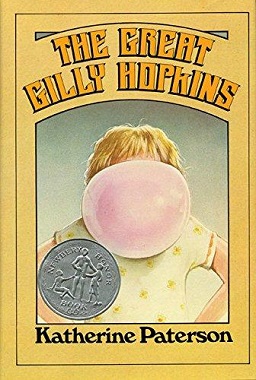
THE GREAT GILLY HOPKINS - Katherine Paterson
Eleven-year-old Gilly has been stuck in more foster families than she can remember, and she's disliked them all. She has a county-wide reputation for being brash, brilliant, and completely unmanageable. So when she's sent to live with the Trotters -- by far the strangest family yet -- Gilly decides to put her sharp mind to work. Before long she's devised an elaborate scheme to get her real mother to come rescue her.

But the rescue doesn't work out, and the great Gilly Hopkins is left thinking that maybe life with the Trotters wasn't so bad ...

TOUCH BLUE - Cynthia Lord
Touch Blue and your wish will come true.

The state of Maine plans to shut down Tess's island’s schoolhouse, which would force her family to move to the mainland--and Tess to leave the only home she has ever known. Fortunately, the islanders have a plan too: increase the numbers of students by having several families take in foster children. So now Tess and her family are taking a chance on Aaron, a thirteen-year-old trumpet player who has been bounced from home to home. And Tess needs a plan of her own--and all the luck she can muster. Will Tess’s wish come true or will her luck run out?


SUMMER OF THE GYPSY MOTHS - Sara Pennypacker
Stella loves living with Great-aunt Louise in her big old house near the water on Cape Cod for many reasons, but mostly because Louise likes routine as much as she does, something Stella appreciates since her mom is, well, kind of unreliable. So while Mom "finds herself," Stella fantasizes that someday she'll come back to the Cape and settle down. The only obstacle to her plan? Angel, the foster kid Louise has taken in. Angel couldn't be less like her name—she's tough and prickly, and the girls hardly speak to each other.

But when tragedy unexpectedly strikes, Stella and Angel are forced to rely on each other to survive, and they learn that they are stronger together than they could have imagined. And over the course of the summer they discover the one thing they do have in common: dreams of finally belonging to a real family.

ONE FOR THE MURPHYS - Lynda Mullaly Hunt
A moving debut novel about a foster child learning to open her heart to a family's love.

Carley uses humor and street smarts to keep her emotional walls high and thick. But the day she becomes a foster child, and moves in with the Murphys, she's blindsided. This loving, bustling family shows Carley the stable family life she never thought existed, and she feels like an alien in their cookie-cutter-perfect household. Despite her resistance, the Murphys eventually show her what it feels like to belong--until her mother wants her back and Carley has to decide where and how to live. She's not really a Murphy, but the gifts they've given her have opened up a new future.

HARRY SUE - Sue Stauffacher
Harry Sue Clotkin is tough. Her mom's in the slammer and she wants to get there too, as fast as possible, so they can be together. But it's not so easy to become a juvenile delinquent when you've got a tender heart.

Harry Sue's got her hands full caring for the crumb-snatchers who take up her afternoons at the day care center, and spending time with her best friend Homer, a quadriplegic who sees life from a skylight in the roof of his tree house. When Harry Sue finds an unlikely confidante in her new art teacher, her ambitions toward a life of crime are sidelined as she comes to a deeper understanding about her past--and future.

BUD, NOT BUDDY - Christopher Paul Curtis
It's 1936, in Flint, Michigan. Times may be hard, and ten-year-old Bud may be a motherless boy on the run, but Bud's got a few things going for him:

1. He has his own suitcase filled with his own important, secret things.

2. He's the author of Bud Caldwell's Rules and Things for Having a Funner Life and Making a Better Liar Out of Yourself.

3. His momma never told him who his father was, but she left a clue: flyers of Herman E. Calloway and his famous band, the Dusky Devastators of the Depression!!!!!!

Bud's got an idea that those flyers will lead him to his father. Once he decides to hit the road and find this mystery man, nothing can stop him--not hunger, not fear, not vampires, not even Herman E. Calloway himself.

THE PINBALLS - Betsy Byars
Carlie knows she's got no say in what happens to her. Stuck in a foster home with two other kids, Harvey and Thomas J, she's just a pinball being bounced from bumper to bumper. As soon as you get settled, somebody puts another coin in the machine and off you go again. But against her will and her better judgement, Carlie and the boys become friends. And all three of them start to see that they can take control of their own lives.


PICTURES OF HOLLIS WOODS - Patricia Reilly Giff
Hollis Woods has been in so many foster homes she can hardly remember them all. She even runs away from the Regans, the one family who offers her a home.

When Hollis is sent to Josie, an elderly artist who is quirky and affectionate, she wants to stay. But Josie is growing more forgetful every day. If Social Services finds out, they’ll take Hollis away and move Josie into a home. Well, Hollis Woods won’t let anyone separate them. She’s escaped the system before; this time, she plans to take Josie with her.

Yet behind all her plans, Hollis longs for her life with the Regans, fixing each moment of her time with them in pictures she’ll never forget.

KEEPING SAFE THE STARS - Sheila O'Connor
When crisis hits, a young girl becomes the only one left to take care of her family.

Pride, Nightingale and Baby are the Stars. Orphaned and living with their grandfather, Old Finn, in rural Minnesota, the children, like their grandfather, are wary of outsiders. They believe, as Old Finn taught them, in self-reliance.

But then Old Finn falls seriously ill and is taken to the hospital all the way in Duluth, leaving the children to fend for themselves. Pride, as oldest, assumes the lead. Though she makes mistakes, she keeps them afloat; they even earn money for the bus trip to Duluth. But when they finally see Old Finn, he can't walk or even say his own name, and Pride knows her days of keeping safe the Stars are drawing to a close. Self-reliance can't make Old Finn well again. But maybe, just maybe, a secret from Old Finn's past might make a way for them to stay together after all.

Any books to add to the list? Leave them below!