
As the sole librarian amongst Team Mayhem, I have a unique perspective on the world of middle grade books. I read them, I teach about them, I champion them, and I buy hundreds of them every school year. I’m able to develop an insight into what kids like, based on their reactions when I read to them and on what they check out. That’s not to say I have the finger on the pulse of middle-graders everywhere. What’s popular in Fairbanks, Alaska is not necessarily what’s going to be popular in Des Moines or Birmingham or Spokane. But it does give me a good general idea about what interests your average 8-12 year old.
I’m not a librarian with a capital “L”; I don’t have a Masters of Library or Information Science. I grew up in a reading family, and both of my sisters are also librarians, so you might say library work is in the blood. I came to this job with a degree in business, extra classes in library science and children’s literature, and a deep and abiding love for children and books. They are what my whole life revolves around Here’s a glimpse into my world:
The absolute hardest part of my day occurs from 6:30-7:45 a.m. This is the magical hour in which I awake my four children who currently live at home. I then must spur, wheedle and cajole them to “get ready, for the love of God and don’t make me late for work.” Prior to that time of chaos, I’ve usually enjoyed a couple quiet cups of coffee, and God willing, managed to get a little writing in.

My husband rises and joins me in the kid rodeo before zooming our oldest son off to the high school, while I wrangle the other three into my gas-guzzling old Suburban and on the short drive up into the birch-covered hills where my school is nestled. The two youngest attend there, while the third catches the bus from there to the middle school.
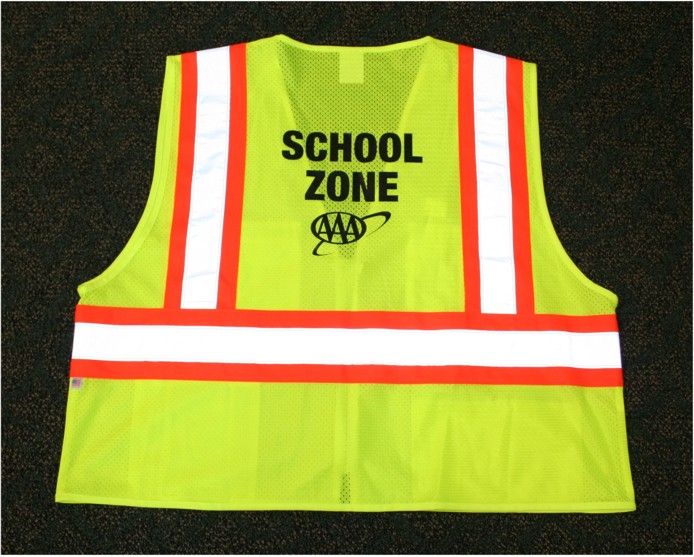
The first hour of my day at work often involves tidying up from the night before, and always there is the checking of emails and other daily prep work. Three mornings a week I have curb duty – I stand on the sidewalk in front of the school with a radio and a nifty safety-yellow vest and greet students as they arrive while also trying to keep the adults in the cars civil, and moving along in an orderly fashion.
And then it’s on to the students. Each day I see between three and six classes of students, depending on that day’s schedule. The days with three classes are a breeze, with plentiful time for the never-ending tasks of library maintenance. The days with six classes are so busy, I’ve barely got time to refill my water bottle or hit the bathroom between groups. Over the course of the week, approximately 500 students pass through my door as part of scheduled library classes. But I have an open-door policy, so there are also the students who come in throughout the day; to grab another graphic novel to tide them over, to find out if I’ve got the latest book they are looking for, to find a quiet corner to finish a paper, or to pull a pile of books for their ancient civilizations research project. Teachers drop in regularly too. They borrow books, videos and equipment, let me know about upcoming projects, and look for book recommendations. I end my day with more tidying, tying up loose ends, and preparing my heart and mind for the next day. Then the final bell rings, my two youngest show up in the library, and I put my Mom hat back on. Go home, feed people, work out, clean, supervise homework, drop-off/pick-up for ballet/soccer/math tutor, then get up and repeat the next day.
Regular maintenance of the library and its collection takes up the majority of my non-instructional time. The books must be weeded constantly. When they become damaged, irrelevant, outdated, or just aren’t moving anymore, out they go.
What to do with the books that have been weeded is a constant problem. Believe me, I do all that I can to keep them from ending up in the landfill. Next, research must be done on newer, better items to take their places. All the books I want to purchase go on to a list. Currently, the value of that list is about $6000; my budget for this school year is already gone and next year’s budget won’t begin to cover that amount. So, I start looking harder at each book, checking reviews, thinking of my patrons, narrowing my list. And in the meantime, more wonderful, attractive, tempting titles are published. Over time, I’ve learned (and am still learning!) what my school population wants. Here’s a hint; it’s not always what I want.
I’m tasked with teaching students all they need to know about our school libraries. How to access and search the catalog, how to utilize features on the catalog to organize and improve their research. I teach them how libraries are organized and how to find what they’re looking for. We talk about categories, genres and sub-genres. I do a big unit on Newbery and Caldecott books. Currently, I am running a poetry contest in conjunction with National Poetry Month. And, of course, I introduce them to the latest titles with book talks.

But mostly, I read to them. That is the heart of what I do. I believe that my core function and my mission are to help every child who passes through my door discover a love of reading. Sometimes it’s easy. Some kids are born book lovers. They’ve got parents who read, and who have read to them from birth. They gobble up everything I put in front of them. For some it’s harder. For kids who struggle with reading, it’s about finding a book within their abilities that also interests them. And in this distracted age, there are kids who simply would rather be doing other things. A book seems boring in comparison with Minecraft or Netflix. For these kids, it’s about putting the right book in their hand at the right time. Show me a kid who says “I don’t like reading,” and I will do everything within my power to change that statement. I’ve discovered that even those kids still enjoy a well-told story, even if they don’t want to bother reading it themselves.
:max_bytes(150000):strip_icc()/Wimpy1-5708869f5f9b58140805600a.jpg)
As with any avid reader, I have certain book tastes. Fantasy is delicious; romance is required. But these tastes must be set aside. Perhaps the Wimpy Kid books and Captain Underpants aren’t my thing, but they may be just the ticket for one student. While not my first choice to read, I have developed a certain enjoyment for graphic novels. Graphic novels are pure magic in pulling reluctant readers into the realm of books. It doesn’t matter if I like it. It matters if they like it. A statement that I live by comes from the always quotable Neil Gaiman: “The simplest way to make sure that we raise literate children is to show them that reading is a pleasurable activity. And that means finding books that they enjoy, giving them access to those books, and letting them read them.”
 |
| Kristen Zayon |


