Showing posts with label Comedy in MG. Show all posts

Monday, October 3, 2016

Writing Funny on Purpose by Jim Hill


“Humor can be dissected, as a frog can, but the thing dies in the process, and the innards are discouraging to any but the pure scientific mind.” – E.B. White 

Writing funny takes a knack, but like any craft, there are techniques you can learn to let your silly out. The trick is, well there are a lot of tricks, but maybe the most important one is listening. Listening to what makes you laugh, and how that might be a bit different than the gut-buster your friends and family love.

What I'm saying is, humor is subjective with a side order of formulaic and a twist of the absurd. Like the infamous line about obscenity, "I know it when I see it."

[INSERT FUNNY CAT VIDEO HERE - Ed.]
[No. - Jim]

Maybe funny is a mindset. A way of looking at and responding to the world that is intentionally off-kilter. If writing reflects the real world–art imitates life–then writing funny on purpose breaks the rules of physics. The angle of incidence does not equal the angle of reflection. The degree to which you alter that formula defines the humor, taking it from the subtlest satire to the broadest slapstick. The world recorded by way of a funhouse mirror.

Back to listening. And by listening, I mean reading (but also I mean listening). Learning to be funny means exposing yourself to the funny. Fortunately, we live in a golden age of exposing yourself. [JIM! - Ed.] With content-on-demand finding comedy has never been easier. Better still, the spectrum of comedic voices is much broader than it was back in your grandparent's day when Uncle Milty was "the man" on that one TV channel. Which means you can find the things that make you laugh and learn from them, the same way you discover how to be a Newbery Award winner by reading your Kate DiCamillo collection into dog-eared, high-lighted, broken-spine relics of devotion. Or is that just me?

I'll get you started with a few of my favorites.

Finally, The Funny Links

The Comic Toolbox – Although it fulfills its promise to provide the rules and structure of comedy, this book also sneaks in quite a bit about writing in general. Vorhaus' light tone and banter walk the reader through a progression of comic tools to instruct on the techniques and provide the vocabulary of critique and analysis.

What Are You Laughing At? – If you've ever wondered if comedy can be scientifically analyzed, this is the book for you. Dan O'Shannon breaks down the ha-has of humor the same way Nate Silver attacks polling data. It's a deep study, but well worth the time. Perfect for the Ravenclaw that wants a little more Hufflepuff in their writing.

(Not So) Rando Resources That I Found

Now that you're a comedy expert, in the same way that you're an architect because you built that LEGO Fallingwater with your nephew, it's time to hear from the professionals.

Poking a Dead Frog – In this book, Mike Sacks interviews a wide array of comedy writers. There's a lot of background on breaking into TV or film, but there's also kernels of humor truisms and nuggets of hilarity. Most of the interviews are short, perfect for my attention span, so this book makes an excellent bathroom reader. [Jim, I'm scheduling a meeting for you with HR. - Ed.]

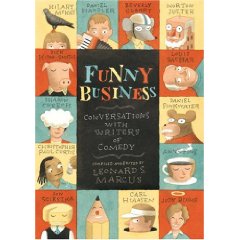
Funny Business – Subtitled "conversations with writers of comedy," Leonard Marcus pitches this collection at younger readers and includes many favorites of the middle-grade set. Beverly Cleary, Norton Juster, Daniel Pinkwater, and Jon Scieszka, to list a few.

By Ken Levine – Ken Levine wrote episodes of MASH and Cheers. That ought to be enough of a comedy pedigree to get your attention. His blog features a lot of behind-the-scenes craft-based stories about what goes into writing sitcoms, and that stuff translates into middle-grade humor very easily. Worth checking for his Friday Questions, if nothing else.

The Writers Panel – This podcast isn't always focused on comedy, but there are almost always great insights into serving an audience well-crafted stories. And even when something isn't a straight-up comedy there's often humor in the mix. Ben Blacker and the panelists dig deep. Have a notebook handy.

WTF with Marc Maron – NSFW, but if you can get beyond that issue, Maron's interviews with comedians both contemporary and legendary are fantastic. Almost never craft focused, but if you're wondering about how to be funny, getting a look into the mind of funny people might help.

Congratulations, You Are Now Hilarious


So that's it. Go forth and be funny.

[Really? That's it? - Ed.]
[Fine. - Jim]

What's Made You Laugh Lately?


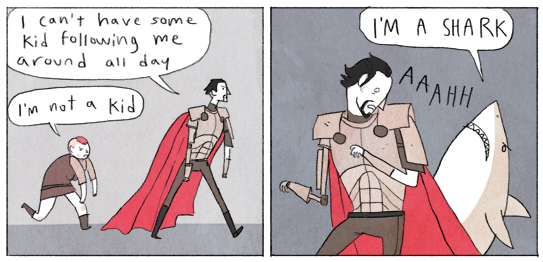
Wait! Before you go, tell me the last book you read that made you laugh out loud. For me, it was Nimona by Noelle Stevenson. Okay, your turn.


It's Cat Video Time!

Play me off, Keyboard Cat!


[Thank you! - Ed.]
[You're welcome. - Jim]

Wednesday, September 3, 2014

Constructing a Comic Character


Humorous writing comes naturally to some, while for others even the idea of “writing funny” causes stress. Humor, like any other literary technique, can be an acquired skill when a thorough understanding of the rules and tools available are understood.

The most basic building block of humor is that of the comic premise. In The Comic Toolbox, John Vorhaus states: “The comic premise is the gap between comic reality and real reality. Any time you have a comic voice or character or world or attitude that looks at things from a skewed point of view, you have a gap between realities. Comedy lives in the gap.”

In his 2012 novel, The Hero’s Guide to Saving Your Kingdom, Christopher Healy sets his comic premise within an epic fantasy world populated by the princesses and princes from traditional fairy tales, with an enormous twist that is very accessible to young readers coming of age post-Shrek. Every convention and expectation of the known characters are turned on their heads.

Healy’s story features the princess heroines Snow White, Sleeping Beauty, Cinderella, and Rapunzel. In the traditional telling, each heroine is rescued and falls in love with the handsome, but non-descript, Prince Charming. In Healy’s world, there are four separate Princes that have been lumped together under the generic title Prince Charming by bards that have spread the stories, and each Prince wants his own name recognition. That’s the foundation of the comic premise. The reader is immediately presented with the gap between the expectation that Prince Charming is one perfect, heroic, and handsome man, and the reality of the story, where four Princes are flawed individuals quite removed from the handsome heroic ideal.

The comic premise is given even greater depth by crafting the princesses with personalities and characteristics far different than the traditional. Pushing it further still is the comedic tension created by the oppositional characteristics between each pairing.

For example, Cinderella, having been raised in near captivity by her step-mother, is a young woman who desires action and adventure now that she is a princess. Her Prince Charming, Frederic, is an endearing, but cowardly, fop brought up under fierce protection by a doting father. He has no interest in adventure, but loves Cinderella with true devotion. When Cinderella leaves to seek adventure in the wilds on her own, Frederic, worried for her safety, musters the courage to follow her. Ultimately, Cinderella ends up saving him (and the other Princes Charming), once again reinforcing the gap between comic reality and real reality.

What keeps comic characters interesting, and moves them beyond one-note jokes, is the layering of other elements over the premise to give them depth. Vorhaus provides four specific elements that go into the construction of a comic character.

The first is the Comic Perspective, defined by Vorhaus as, “a character’s unique way of looking at the world, which differs in a clear and substantial way from the ‘normal’ world view.” If we continue looking at Prince Frederic, his Comic Perspective would be that the world is a dangerous place, best avoided at all costs. In contrast, Cinderella’s is that the world is a wonderful place where anything can happen.

The second element is exaggeration. A character that is afraid of the world isn’t in and of himself very funny, but if a writer pushes the limits of that fear so that normal situations become farcical, a space for comedy is created. This description of Frederic from The Hero’s Guide is a fine example of comic exaggeration: “For most of his early years, Frederic was perfectly happy to skip out on pastimes like tree climbing (twisted ankles!), hiking (poison ivy!), or embroidery (pointy needles!).”

Flaws are the third element. These are negative characteristics that create distance between the reader and character, allowing the reader to comfortably laugh at the character without feeling bad. Flaws can also be positive characteristics taken to an annoying extreme. Frederic’s flaws fall into the latter category, as his worst trait is an almost unbearable friendliness and openness to strangers. This might seem to be in opposition to his view of the world as a dangerous place, but again, this creates an interesting conflict within the character. Even when faced with villains, monsters,  and impending doom, Frederic can’t help but be polite. Charming, even.

The final element is Humanity. The character’s humanity gives the reader a reason to care about his outcome. It balances the flaws to enable readers to emotionally engage with the character. Frederic’s humanity is grounded in his romantic love of Cinderella, and the lengths he goes to try and find her. He travels the world, faces battles, giants, and witches and gets so far outside of his comfort zone that readers can’t help but feel for the poor guy, even as they laugh at his total lack of traditional heroic qualities.

Healy does an excellent job of creating complex comic characters, and Frederic is just one example within that story. The characters, both Princes and Princesses, because they are drawn with such specificity, play off of each other in a web of well choreographed, and highly comical, relationships. In the end, Frederic may come the closest to laying claim to the name Prince Charming, but by embracing his entire character he earns a recognition all his own. And gives the reader plenty of laughs while doing so.

Friday, June 29, 2012

How and Why I Write Humor -- a Guest Post by Joanne Levy

So here I am writing a post about writing funny. There isn’t much funny in writing about humor. Even the word funny stops sounding funny if you type it enough times.  There.  It’s gone.  Funny is no longer so.  


On to the serious business of writing humor. 

I’ve been told I’m funny person (despite the above, which strongly indicates to the contrary).  In my opinion, that’s a pretty good place to start if you’re looking to write humor—you kind of need to know what makes people laugh.  I write my funny on instinct and don’t really think about it too much, so it’s hard for me to talk intelligently about how I write funny.  But I’ll give a shot.
SMALL MEDIUM AT LARGE, my middle grade debut, is about Lilah Bloom, a girl who gets hit by lightning and can then suddenly hear ghosts.  I guess it’s not a very funny premise, but trust me; there are a lot of funny moments in it.  Lilah is twelve, so that means there is a lot going on in her life, from puberty to starting to think about boys. Then you throw in some mischievous ghosts, including a meddling dead grandmother, and you’ve got the potential for a lot of really funny scenes. One of my favorites is when Lilah is at her friend’s birthday party. The girls are consulting a Ouija board:
     “Okay,” Alex said, obviously taking over. “Everyone put your fingertips on the thingie.”  
     We all did. Of course, except Anita, who was watching from her spot in the corner.  
     “Okay, Tamsin. What’s your question?” 
     Tamsin took a breath. “Who will I marry?”
     Everyone gasped. We all knew Tamsin was currently crushing on Tyler Landis, an eighth grader. He was an excellent hockey player who hoped to one day make it to the NHL. Alex liked to tease Tamsin that her future boyfriend wouldn’t have any teeth, but Tamsin said with his NHL contract, he’d be able to buy himself a whole mouth full of teeth.
     Personally, I’d rather my husband have his own natural teeth, thank you very much. But I guess Tamsin wasn’t bothered by dentures.  
      All of a sudden, the plastic thing started to skitter and move under our fingers.  
     “Oh!” Anita yelped.
      It was moving over towards the left side of the board.  
     “Where’s the T?” Tamsin said. “Oh. Never mind.”
      Suddenly the piece started moving back towards the center.  Toward the T. 
      I glanced at Alex, who looked at me and we both knew: it wasn’t being guided by any spirits.
I love the banter between the girls.  This is not a homogenous group of tweens—they are all different, bringing their own personalities to the table, making them a dynamic group to watch.  Their differences make their interactions a lot more interesting than if they were all similar personalities.  I think this is an important part of writing characters—make them different from each other to give opportunities for banter and conflict.  Even small conflicts, like discussing which boy is cute and why, can bring about funny conversations.
What makes me laugh most about this scene is Tamsin obviously moving the pointer. And she gets it wrong the first time, so has to adjust and start pulling the pointer the other way, still under the ruse that it’s the spirits moving it.  She’s not fooling anyone, but Lilah and Alex play along, letting her make even more of a fool of herself to ensure her crush’s name is spelled out by the ‘spirits’.
What inspired this funny scene?  Well, what inspires a lot of my funniest scenes: real life.  A very similar experience happened to me when I was a kid, probably about Lilah’s age.  A group of us had come upon a Ouija board and were asking it what boys in our class liked us.  I’m sure we were all moving the pointer around, and I even remember one girl trying so hard to discreetly move it to spell out her crush’s name, that her knuckles were white*.  Looking back, that scene is very funny to me, so of course I had to put it into a book.  
* (there is a chance that girl may have been me)
What about you? How do you decide what funny things make it into your book?


Visit Joanne at her website, www.joannelevy.com

Wednesday, January 18, 2012

How Do You Put The Fun In Funny?


Have you ever told a joke and no one laughed? Or have you ever laughed uproariously at something, and everyone else was sitting about in stony silence? Yup, humor's tricky. One man's yee-haw is another man's yawner.

Which makes "writing funny" really hard. However, for our middle grade audience, it's imperative. Kids love to laugh--and they do so far more than most grown-ups. So bring on what my friend Barbara Watson calls "the goof."

Barbara is doing this cool Middle Grade from A-Z on her blog, and last week she reached "G is for Goofy." She wrote, "middle grade magic happens when writers weave humor and silliness with very serious issues." That rang a huge bell for me. Incidentally, at the same time, I was also reading Funny Business, Conversations with Writers of Comedy compiled and edited by Leonard S. Marcus. In his introduction, Marcus writes "humor can also be a way of talking about things too hard to talk about any other way."


I have to admit that, although I loved this book as an insight into the childhoods and work habits of some of my favorite children's writers and humorists, (Louis Sachar, Jon Scieszka, Carl Hiaasen), I have to agree with Harold Underdown's comment on his review of Funny Business.

Harold Underdown:


In all of this, I didn't find the answer to the rhetorical question asked by Marcus in a brief introduction: "What makes funny funny?" And perhaps that's the point; writing humor doesn't follow a certain formula or set number of steps. As we learn in the interviews, writing humor springs from who we are and from our own experiences.


So, the mystery of how to put the fun in funny continues. We know it's important, and we know what we like--but how to get there? Early middle graders love potty humor (Captain Underpants, anyone?). I have a penchant for grandiosity and skulduggery (Josh Lieb's I Am a Genius of Unspeakable Evil and I Want to be Your Class President nearly caused me to blow my chocolate milk through my ears, which would have been a funny sight in its own right.)


The cause of the chocolate milk near-disaster

 Help me, Mayhemmers! Tell me what makes you laugh, or leave a list of your favorite funnies. We all could use a good laugh!