Showing posts with label The Orphan Band of Springdale. Show all posts

Thursday, June 7, 2018

Let's Talk More About . . . Fear, by Anne Nesbet

I've been putting together a set of teaching materials (under the rubric of "History through Primary Sources") to accompany The Orphan Band of Springdale, which tells the story of 11-year-old Gusta Neubronner's arrival in the rural town of Springdale, Maine, in 1941, and so I find I've been thinking a lot about a topic that doesn't get an enormous amount of treatment in middle-grade books: fear

"Wait!" you say. "There are lots of scary books out there! And--ahem--look at your cover, Nesbet--that does NOT look like a book about fear--"


 Well, right. I don't mean the kind of fear that makes a zombie story so delicious. I am interested in exploring the way "fear" wriggles into our brains and gets us to do sometimes hurtful things, as if fear itself were a rational reason.This sneaky, powerful kind of fear is very much at work today--and it was very much at work in 1941.

Here's the basic blurby version of what The Orphan Band of Springdale is about:

It’s 1941, and tensions are rising in the United States as the Second World War rages in Europe. Eleven-year-old Gusta’s life, like the world around her, is about to change. Her father, a foreign-born labor organizer, has had to flee the country, and Gusta has been sent to live in an orphanage run by her grandmother. Nearsighted, snaggletoothed Gusta arrives in Springdale, Maine, lugging her one precious possession: a beloved old French horn, her sole memento of her father. Gusta finds herself facing patriotism turned to prejudice, alien registration drives, and a family secret likely to turn the small town upside down.

In Springdale, Maine, in 1941, people are afraid of a great number of different things:

--having family secrets exposed;
--labor organizers and Communists;
--vision charts (and other tests they cannot pass);
--Germans and in general anyone with "foreign" names;
--aliens;
--cows.

The fear of cows doesn't necessarily cause a lot of harm (though it's embarrassing if your family runs a dairy), but some of these other fears can reshape our view of the world and affect the way we treat the people around us. 

In 1940 the United States passed a law known as the "Smith Act" or the "Alien Registration Act." One of its provisions was that all non-citizens ("aliens"), no matter how long they had been living in the United States, had to go in to an official place (often the post office), fill in forms and be fingerprinted. 

The local effects of this new law can be seen in the Sanford Tribune (the real-life newspaper covering the area of my fictional "Springdale"):


In my teaching materials about the Smith Act, I ask some questions about this article, and the way it must have affected the residents of Sanford-Springvale when they read it:

What word is used here to describe people who are not United States citizens? What effect does that word have, do you think?

If you came from a French-Canadian family and had been living in the Sanford area for a long time (generations, perhaps), but had not switched your official citizenship to "United States," what did the new law make you do?
                               
What words in this article might worry you, if you were a non-citizen in 1941?

What would the effect of this article be on someone who WAS a citizen in 1941? What new thoughts about their non-citizen neighbors might the article make them have?

Notice how the words "person" or "people" do not appear once in this article. The people without U. S. citizenship--the same people who used to just be your neighbors on the next street--have been entirely transformed into "aliens."

In The Orphan Band of Springdale, the characters are afraid of all sorts of different kinds of things. At one point Molly Gowen, one of Gusta's classmates, argues that registering "aliens" is "just trying to be careful": 

As the narrator comments, "Some conversations are like two people picking their way toward each other across a swamp." And fear is very hard to talk about. Some of Molly's fears seem pretty reasonable, right? But some of them have serious side-effects, like getting the Sheriff wondering whether Gusta or the German refugee oculist Mr. Bertmann belong in town at all.

Here's how Gusta responds to Molly: 

"Even if my papa came here from Germany, haven't you ever thought for one minute that some people might leave Germany becausethey don't agree with what the Nazis are doing? Haven't you thought for a moment how dangerous it would be, to be someone who disagrees with what the Nazis think? If someone like my father put his foot into Germany, you know what they would do? They would lock him up! And then they would probably kill him."

Fear is a complicated feeling with complicated effects--which I guess means it is exactly the sort of thing middle-grade fiction should bravely explore. Fear can make us do hurtful things--but it can also make us cautious (which isn't always bad)--and it can even inspire us to be brave, despite our fear.  I realize now, thinking it over, that there are examples of all sorts of different reactions to fear (hurtful actions, cautious actions, brave actions) in The Orphan Band of Springdale. I didn't know this book about love and family and courage and music would turn out also to be a book about fear, but I'm glad it did.

Let's dig thoughtfully into ALL the tangled feelings and emotions and motivations in our books--in our reading and our writing!

Tuesday, April 10, 2018

Happy Birthday to THE ORPHAN BAND OF SPRINGDALE! by Anne Nesbet


I thought  that to celebrate the birth of my new book, The Orphan Band of Springdale, I would share a special, ILLUSTRATED edition of the Author's Note! 

But first I must thank two people in particular: Josie Portillo, for creating the beautiful, heartfelt cover, and Kaylan Adair, my wonderful editor, for her faith in the story--and in the power of revision.


"Oh, this reminds me of Maine!"
--my mother, in front of any beautiful landscape anywhere

            There are stories that come from the heart, and others that come also from the very bones that give us shape. THE ORPHAN BAND OF SPRINGDALE is one of those bone marrow tales. It is my echo of a story that I wish my mother had been able to finish telling me--the story of her childhood, which was so hardscrabble and tough that she could only bear to give us scraps and pieces of it when we were little.
            We knew that she had to go to a new school in a new town every single year, because they could never afford to pay the rent.
            We knew that her father was mostly not around.
            We knew that during particularly hard times she would be sent to live in the orphan home run by her grandmother up in Maine--an orphan home that had been started in order to keep a family secret.
            

            And we knew that somehow out of all this trouble, our mother emerged with some enduring and fine things: how to tell a good story, how to bring extended family together around a table, and how to play the French horn.
When summer came, she would take us back to the farming country of southern Maine, and we camped on a hill that had been allowed to go back to woods, and from the top of which all the grown-ups insisted that with a good telescope you might be able to see sails off the Portland coast, maybe.
            

            This was not the Maine of fishermen and saltwater. Instead of the ocean, we had occasional treks to Square Pond.  The mosquitoes kept us on our toes.
            The cousins would gather at the end of the day, and over long afternoons my mother and grandmother and aunts and uncles and cousins would share epic stories in few words, while we kids ran around creating small kingdoms in the woods.
            
(I'm the awkward one on the right.)
            I would have eavesdropped better if I had known I would lose my mother early. But of course I didn't know.
            But it happened: my mother died too young, and years passed, and all the stories about Maine kept wriggling and whispering inside me, and eventually I realized I was going to have to give some voice to them. I couldn't ever know the whole truth about my mother's childhood, true--but that just meant I would have to write it anyway, as fiction.
            To make that fiction as true as possible, I went back to Maine and spent some time at the Sanford-Springvale Historical Society, reading through old issues of the excellent local paper, the Sanford Tribune.


The flavor of 1941 comes through those newspaper pages: anxieties about drought and the war in Europe, "alien registration" drives,


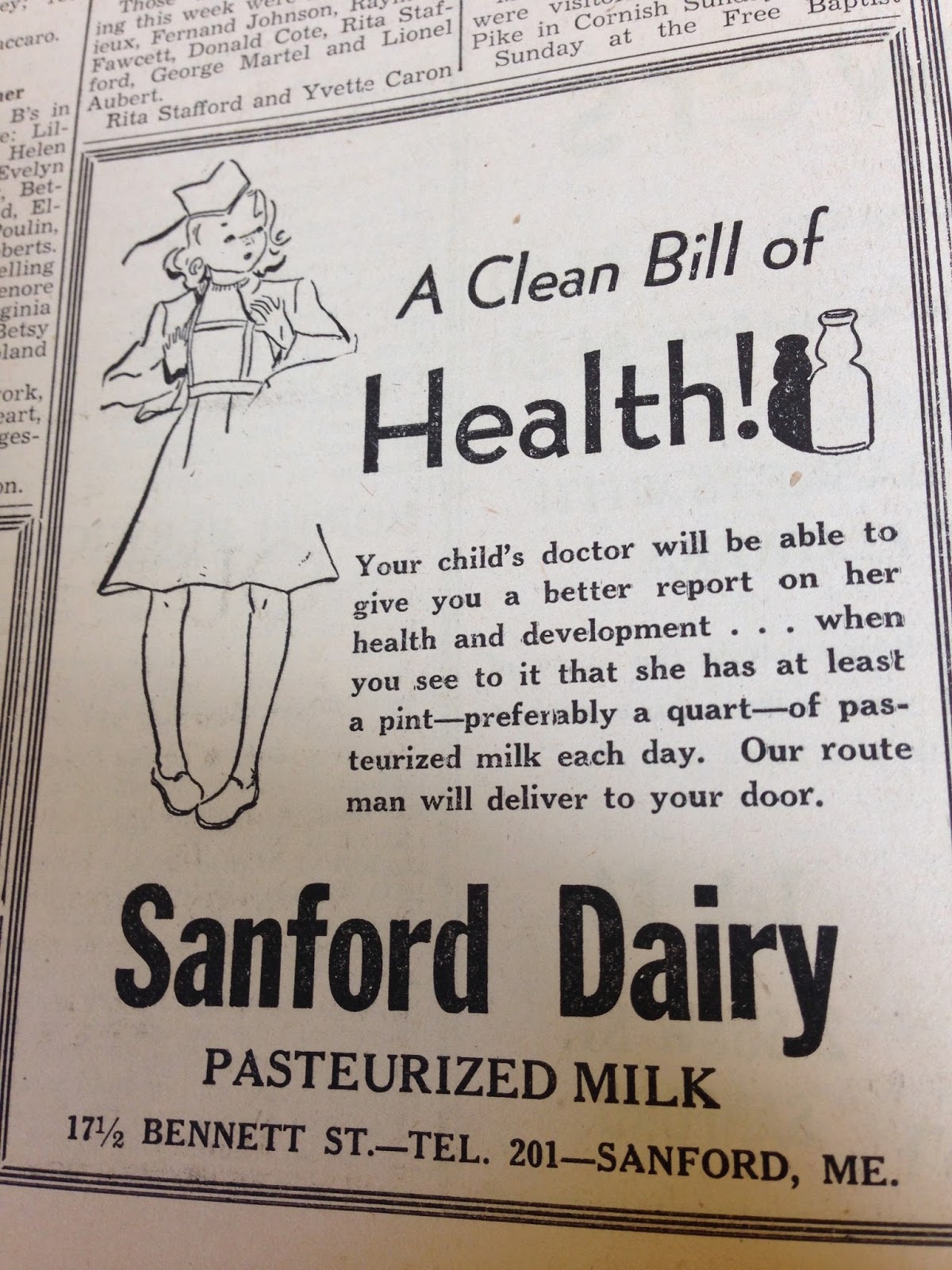
Union elections in the local mills, a "7-Point Health Certificate" school campaign waged with vigor against bad eyes, crooked teeth, and malnutrition, all garnished with competing hyperbolic ads from the local dairies . . . .

So the seeds of this story are true, but the resulting crop is fiction. I changed the identities and biographies of my characters and even tweaked the names of the local towns, out of respect for the difference between Gusta's fictional world and the real childhood places of my real mother.
           My mother did love a good story, and I hope she would have been tickled by this one. In the heart-and-marrow of my dreams, sometimes she even looks up from the pages and smiles her wonderful, crooked grin and says, "Oh, Anne, this reminds me of Maine!"


Friday, July 28, 2017

All the Many Kinds of Musics, by Anne Nesbet

I've been thinking a lot about music recently--and also learning how to think a little less, as I music a little more. Here's how that goes:

When I was a kid, my life orbited elliptically around two centermost things: books and music. I loved belting out folk songs in made-up harmonies with my sisters in the back seat of the car. Then came actual real music lessons (on violin! and piano!), and I discovered that learning to practice with a metronome (a Heathkit metronome! which I built myself with my Dad!) made me feel serious and grown-up, and I spent hours working through pieces line by line or measure by measure, following super strict rules: three-times-in-a-row-perfectly to move the metronome speed up one notch. Any error moved you back a notch--no mercy. I discovered I really liked the discipline of this; it was (I see in retrospect) almost a kind of meditation: a practice practice.

BUT! Although I became a decently competent musician in some ways through my metronomic practice, there were gaps in my music life. I mean, enormous huge gigantic gaps, involving perhaps the heart of the whole "music" thing. Playing a page of Beethoven without missing any notes is nice, but what do you do if music starts happening around you, and there isn't a score, and you haven't had a chance to practice?

In college I made a friend who played the concertina--a wilder, more portable relative of an accordion--and she introduced me to contradance tunes, to jigs and reels and waltzes. My sister, who was and is a real violinist in every sense, played the fiddle part, and my job was the piano. But here's where things got interesting for my rigid, metronome-trained self: the job of the pianist in a string band is not to "play the music" as written, but to play everything NOT written!

What do I mean? Well, here's the music for a traditional old tune called "Over the Waterfall":


That's the melody line, and the fiddle and the concertina got to do what they wanted with it. My job was to get us into a good rhythm, figure out chords that sounded cool with the tune, and get a nifty bass line going--all on the fly. It was terribly hard at first--and then it became exhilarating. I was learning to let go, learning to improvise.

I still had much, much more to let go of, however. Let's switch instruments for this next part of the story: let's bring out the fiddle.

I have played viola or violin in orchestras most of my life, and I've learned to be pretty good at sight-reading and playing the notes and so on. Not bad. But what about, you know, playing other sorts of music? What about bluegrass and pop songs and and and?

My secret shame from childhood on has always been that I don't know the right songs. I have never known the right songs. "Popular music" was absent from my childhood: we had one album from the Beatles and one Grateful Dead record (almost by accident), and that was it. I have a bad memory for pop songs. But friends, I'm here to tell you that we shouldn't let bad memories and lack of knowledge hold us back! The music's playing--jump in, jump in, jump in!

In my case, my musically courageous and gifted friend Jayne invited me to come jam with some buddies of hers. We are the most motleyest of bands! Tuba, ukuleles (plural), guitar, toy piano, kazoo, voice, jar of dried beans, banjo, accordion, bass, and fiddle! Here's a photo from last night's practice (unfortunately missing the Tuba, who was out of town):


Now these people are all infinitely cooler than I am, and they know, seems like, every cool song ever written. There isn't sheet music at all for the songs we play, and guess what? IT DOESN'T MATTER. It turns out that if I let go properly of my hang-ups, I can noodle my way around any song, any kind of music. And there is nothing more wonderful.

My new book, coming out early in 2018, is called THE ORPHAN BAND OF SPRINGDALE, and it tells the story of a motley band--French horn, ukulele, and bean jar--inspired partly by my mother's hardscrabble but horn-playing Maine childhood and partly by all the wonderful people who have taught me and are still teaching me to let go of my sheet music and jump into tunes that are (as my characters might say) "as real as jam."

Needless to say, this isn't just about music. Writing, too, benefits both from our learning the rules and from learning to let go. "Over the Waterfall" with all of us, again and again and again!

p.s. The cover for THE ORPHAN BAND OF SPRINGDALE is going to be revealed this coming Monday (July 31st) on Betsy Bird's Fuse#8 blog (http://blogs.slj.com/afuse8production/), so give it a look! You'll see some lovely motleyness there, I do believe.