Showing posts with label middle school. Show all posts

Monday, March 20, 2017

FOR MIDDLE GRADE WRITERS: 5 GEMS FROM A SCHOOL COUNSELOR by Mary E. Cronin


If you write middle grade fiction, it can be difficult to keep track of the ebbs and flows of a middle schooler’s daily life if you are not the parent or teacher of kids this age. I interviewed a middle school guidance counselor (I’ll call her Ms. Counselor) for insights—some granular details ranging from school day schedules to substance use to gender, sexual orientation, and the beginnings of romance. These insights are specific to a community on Cape Cod: a community with a seasonal economy and a wide range of socio-economic status that is majority-white and in a semi-rural setting that requires that kids take buses or get rides from parents to school and activities. These details (some can be generalized while others are specific to our location) may be useful as you craft your middle grade story.


1) Scheduling
Middle schoolers (grades 6-8) don’t sit in the same classroom all day. They change classes for subjects such as English, Math, Social Studies, and Science, and they have different teachers for these subjects. Kids are generally on teams, which enables their teachers to get to know them better. Schools use different methods to coordinate schedules; for instance, one school may use an A day-B day pattern, or a ‘rotating block” system. It can be confusing, especially for sixth graders, but they tend to learn it fast. (The adults may have a harder time catching on than the kids!) Also, they cannot go to their lockers whenever they want: there are prescribed times of day for going to lockers.


2) Substance Use
Sixth graders tend to be rule followers. Most of them will think that substance use is “icky and wrong,” but there are always outliers who will start experimenting on the early side. Ms. Counselor says that seventh graders start experimenting more, trying alcohol or cigarettes over the summer between sixth and seventh. In seventh grade, there are relatively few kids using substances, but they loom large in the consciousness of the peer group, leading to an “everyone is doing it” narrative and a skewed sense of proportion for kids. Finally, substance use increases in eighth grade (dabbling in alcohol, cigarettes, or pot).  Ms. Counselor points out that extra-curricular activities serve as an interesting “zone” in which there might be some of this experimentation going on. It’s a time when parents think kids are being supervised (ie team sports, dance, theater), but these activities are not as rigid and scripted as the school day. This is especially important for writers to consider; these activities can serve as a “gateway,” where a kid might be faced with substance experimentation and accept/reject that option. At the same time, these activities form a social support network of both peers and adults that Ms. Counselor sees as an important ingredient for well-functioning middle-schoolers. As you craft your story, it's important to figure out how your middle graders are getting from place to place, and what activities they might be participating in. This can have a big impact.


3) Cross-gender friendships
In sixth grade, boys and girls generally separate by gender in places like the cafeteria, especially in the fall.  By spring, there is more mixing—there are still all-boy tables and all-girl tables, but lots more mixed tables; this keeps increasing in seventh and eighth grades. (One interesting note from Ms. Counselor: this year, a sixth grade transgender student started a trend of bringing a book to lunch and reading. He was quickly joined by two other boys, and now there is an informal “reading table” in the caf where kids congregate to eat and read quietly.) There are boy/girl friendships that survive the social pressures of middle school. These friendships seem to ebb and flow over the school year in all three grades, indicating cycles of equilibrium and disequilibrium in gender-friendship dynamics.

4) Middle school romance
Some use the term “going out” or “with”—“are you still with Laura?” This starts in sixth grade slowly, increasing each year. Ms. Counselor notices that all the social groupings and boundaries seem to blur and morph in the outside-of-school social context of texting and group chats. Kids who don’t seem to associate in school are part of the same group chats/texts outside of school. (Group texts and chats are BIG! A lot happens and there can be lots of drama.) One thing that has not changed is the tension around revealing a crush—that is a very big deal. Disclosing a crush is still huge, and having knowledge of who likes who gives a kid a lot of power and sometimes leads to betrayal and teasing. There is not much PDA (public displays of affection) in middle school. It happens the most in eighth grade, and kids in same-gender relationships seem to be able to get away with it the most.


5) Sexual Orientation/Gender Identity
There is so much more awareness on the part of kids, and more parental awareness and acceptance, when it comes to kids and their sexual orientation and gender identity now. Ms. Counselor runs a gay-straight alliance and it is very active at her middle school. The older generation’s binary thinking about “in the closet/out of the closet” is dated and obsolete. Ms. Counselor says that framework does not apply anymore, “not even close.” Kids talk about their preferred pronouns, and these pronouns may shift week to week. Kids in the GSA consider their identities to be fluid; they identify as bi (bisexual), pan (pansexual), “a” ( asexual), trans (transgender), and gay. This can also shift week to week or month to month. Girls don’t tend to use the word lesbian but will declare that “I like girls.” Ms. Counselor says the kids don’t attach permanence to their labels, saying things like, “I’m calling myself pan right now,” or “I like ‘a’ because I don’t see myself with any specific gender” or “I’m attracted to the person so I’ll go with pan or bi.” There are trans kids in middle school, as young as sixth graders, who are actively working out how they want to present themselves to the world. It can vary day by day, or week by week,  in terms of wearing male- or female-signifying clothing and accessories. All of the trans students who Ms. Counselor has worked with in the past few years have been female to male. There is no “old-fashioned clarity” (as Ms. Counselor calls it) about these labels and identities, and she says that kids are perfectly fine with this fluidity, able to talk and ask about it, while adults are sometimes confused and unsure, trying to understand and do/say the right things.

Finally, Ms. Counselor stuck up for middle schoolers: “People think middle school is horrible, full of drama and hormonal changes.” She says kids at this age turn themselves into “porcupines,” using distancing behaviors like eye rolling and sarcasm to hold adults at bay. They need this distance developmentally in order to individuate and develop. At the same time, “as soon as you step around their defenses, you realize that every kid needs connection. Those defenses are empty. In reality, they need adults.” This is pure gold for writers to consider: how does my character both crave connection and create distance from sources of support as they navigate the bumpy ground of early adolescence? They are dealing with a lot, presented with lots of choices, conflicts, and closeness.  These pushes and pulls, ebbs and flows present endless possibility for the writer creating middle grade fiction.


Thursday, September 17, 2015

A Review of Fuzzy Mud + Back-to-School Reads! by Donna Galanti


"Be careful. Your next step may be your last."

In Fuzzy Mud by Louis Sachar, fifth grader Tamaya Dhilwaddi and seventh grader Marshall Walsh have been walking to and from school since forever. But when a bully challenges Marshall to a fight, he avoids the conflict and takes a shortcut home through forbidden woods. Tamaya, a good girl who always follows the rules, reluctantly follows.

They soon get lost, and walk into big trouble with fuzzy mud that holds a dark secret. Even bigger trouble unravels in the days to come when the government gets involved. A scary new disease, an experiment gone wrong, an eccentric scientist. It all comes together to change their world. Can one little girl make a difference?

Beware the fuzzy mud!


via GIPHY

MY REVIEW:
I am a huge fan of Sachar’s Newbery Medal Winner Holes, so was eager to read this book and was lucky to get an advanced reader copy. This book has the flavor of a horror book for kids but without the full-on scary – meaning no nightmares.

This book is much shorter than Holes, and I would have liked to see the horror, mystery, and character development deepened for a more satisfying journey. There was so much more to expand on.

That being said, Sachar packs a lot of story in a short time. You'll fall for Tamaya, the quiet girl with the big heart. While fairly predictable, the story is more about the journey and the cast of characters each facing their own challenges.

Sachar does a good job of getting us up to speed with the science behind the "fuzzy mud" in short bursts that ratchets up the tension and leads us to wonder about the fate of the characters, although the eccentric scientist seems a bit cartoonish. Overall, an entertaining tale! I recommend for kids of all ages (even the grown-up kind).

Check out eight of my back-to-school recommendations for middle-schoolers to "fall" in love with reading - from classic to fantasy to contemporary (including one by a Mayhemmer here!).


#1 SURVIVING BEAR ISLAND (contemporary) by Paul Greci
This thrilling adventure begins after a sea kayaking trip takes a dangerous turn and Tom Parker is stranded on the remote, outer coast of the unpopulated Bear Island in the rough terrains of the Alaskan wilderness. He must put his skills to the test as he fights to reach safety through a wilderness full of bears and other dangers.

MY REVIEW
This book is a new classic I thought better than Hatchet! Surviving Bear Island is a story you won’t want to put down. I found myself thinking about it when I wasn’t reading it – I had to know what would happen next to Tom. Armed with only a small survival kit and his will to find his father, 12-year-old Tom must put his wilderness survival skills to the test if he wants to live. Each day brings new challenges to find food, make fire, and avoid death by starvation, injury, hypothermia – or bear. Tom may have only himself to count on in this harsh landscape, but he is not alone. His mother’s songs and father’s words of wisdom, come to him as he faces life and death each day. We watch him go from the reluctant hero of his own adventure tale to a young man, strong of heart and spirit. A beautifully written novel of love, loss, faith, and survival that will stay with you long after you’ve cherished the last word.

#2 WONDER (contemporary) by R.J Palacio
August (Auggie) Pullman was born with a facial deformity that prevented him from going to a mainstream school—until now. He’s about to start 5th grade at Beecher Prep, and if you’ve ever been the new kid then you know how hard that can be. The thing is Auggie’s just an ordinary kid, with an extraordinary face.

MY REVIEW
R.J. Palacio has created a character to love and admire in 10-year-old Auggie – along with his loyal friends. You will laugh and cry as Auggie navigates a new world that is often cruel and embracing. As the mother of a young boy, I so felt the pain of Auggie’s rejection and unfortunate disfigurement. I wondered how I, or my son, would react in such a situation. A great topic for discussion between me and my son. This book is a “wonder” and so is Auggie.

#3 HOLES (contemporary) by Louis Sachar
Stanley has been unjustly sent to a boys’ detention center, Camp Green Lake, where the boys build character by spending every day digging holes exactly five feet wide and five feet deep. The boys are digging holes because the warden is looking for something. But what could be buried under a dried-up lake?

MY REVIEW
This is a gem of a book I wish I’d read sooner. My son brought it home and sucked it down in one sitting. It’s super fun how the author, Louis Sachar, masterfully intertwined the story from the past with the current tale and tied it up perfectly at the end. It held hope and joy in the most barren and dark conditions where the faces of evil shone bright. Stanley and his friend Zero are unlikely heroes that tell a tale of true friendship.

#4 THE MAGIC THIEF (fantasy) by Sarah Prineas
In a city that runs on a dwindling supply of magic, a young boy is drawn into a life of wizardry and adventure.

MY REVIEW
The Magic Thief is a flash-bash of a magic tale with a humble boy, Conn, who simply knows he is destined to be a Wizard – and maybe the only one to save his town from its un-magic demise. Conn’s determined voice shines through with flinty-glinty fun and grit as he navigates his new role as an unlikely apprentice to Nevery (a stern, serious wizard with a hidden good heart). Add some unusual sidekicks (like a bruiser of a body guard who loves to knit, make biscuits and pie), dark villains and creepy, twilight places and you’ve got a mish-mash mosh of adventure with just enough intrigue and wonder – and of course, magic. Looking forward to Conn’s next adventure!

#5 SPARROW ROAD (contemporary) by Sheila O’Connor
It’s the summer before seventh grade, and twelve-year-old Raine O'Rourke’s mother suddenly takes a job that’s hours from home at mysterious Sparrow Road - a creepy, dilapidated mansion that houses an eccentric group of artists and an unexpected secret from Raine’s own life that changes her forever.

MY REVIEW
I wish I could give this book a “blizzard of stars”. This is the book that made me fall in love with reading middle grade again. Raine has an unexpected summer that at first she resists, but as she transforms, and the people she meets transforms, it changes her life forever. O'Connor creates a colorful scene and set of many characters with sparse, poetic prose. We see and feel all the characters through Raine’s eyes and heart. I flipped back to pages to re-read the scenes that painted my heart with wonder and feeling. It’s a book about searching for something you don’t know. It’s about love, hope, redemption, getting left behind – and doing the leaving yourself when ready.

#6 THE ONE AND ONLY IVAN (magical realism) by Katherine Applegate
Ivan is an easygoing gorilla. Living at the Exit 8 Big Top Mall and Video Arcade, he has grown accustomed to humans watching him through the glass walls of his domain. He rarely misses his life in the jungle. Then he meets Ruby, a baby elephant taken from her family, and she makes Ivan see their home through new eyes.

MY REVIEW
Katherine Applegate blends humor and poignancy to create Ivan’s unforgettable first-person narration in a story of friendship, art, and hope. This story of Ivan the gorilla broke my heart – and then mended it again…over and over. This tale is a testament to the transformative power of friendship and love, and reveals that nothing is impossible if you want it badly enough. We see more deeply the strengths, and weaknesses, in our own humanity from one gorilla than from a cast of humans. And we can celebrate the hope in all of us that remains even in our darkest hour and in a place where the dimmest of lights can power the brightest of change. This simply written yet powerfully poetic story will stay in your heart forever – and so will its hero, Ivan.

#7 THE FALSE PRINCE (fantasy) by Jennifer A. Nielsen
In a discontent kingdom, civil war is brewing. To unify the divided people, Conner, a nobleman of the court, devises a cunning plan to find an impersonator of the king’s long-lost son and install him as a puppet prince.

MY REVIEW
Couldn’t put this one down! I’m a sucker for a medieval setting of kings and commoners, paupers and princes, castles and dungeons, and championing the underdog. You’ll want to follow the adventures of Sage from orphan to would-be prince laced with intrigue. Nielsen drops clues along the way making you wonder just who this orphan Sage is, and it’s just enough to pack a powerful punch at the end when it all wraps up. And when you think you know what’s going on actually comes true, you’ll be cheering on the good guys and giving the bad guy a good kick along with his most welcome comeuppance. Can’t wait to read the next book in this trilogy.

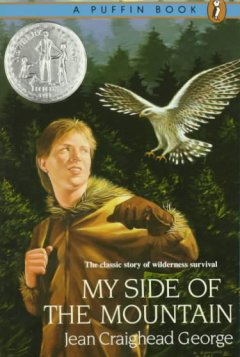
#8 MY SIDE OF THE MOUNTAIN (classic) by Jean Craighead George
Terribly unhappy in his family’s crowded New York City apartment, Sam Gribley runs away to the solitude and danger of the Catskill mountains, where he finds a side of himself he never knew.

MY REVIEW
This book was written in 1959 but there are still lessons to be learned today of achieving independence, making your dream a reality, finding your own way, and solving problems. Most of all, it shines a light on how we can still appreciate the grand beauty of nature all around us and live in harmony with it. Follow a year with Sam as he makes a home in the old woods of his grandfather and teaches himself to live off nature’s resources, make friends in the wild…and most importantly learn to love his own company. I didn’t want his adventure to end. I like to think of Sam still there living in his tree home as I come whistling up the glen to visit him for a dinner of fresh caught fish and acorn pancakes with homemade jam.

What are some of your favorite back-to-school reads?