Today is the first post in the series.
Villains and Antagonists have long been interwoven in the annals of fiction, and while they're not always the same thing, sometimes they are, sometimes they aren't, sometimes it matters and sometimes it doesn't. Point is, they're awesome characters (or entities) and often play a pivotal role in that old muse-esque keystone: STORY.
Myth and tale and epic and adventure, what we really do, all of us, is tell stories. And what's the most important part of any story? Well, characters, obviously.
Carl Jung wrote a lot about archetypes in his studies of the human psyche, and of course the human psyche is tightly knotted up with the psychology of story, (and I covered some of his archetypes on my personal blog, reverse order search link). However, this post will be more about my own inventions, not based on any truly empirical study of the topic, but more on my own anecdotal experience as an avid reader.
And with that, here is an unofficial of the four most common (arche)types of villains I have found in (mostly) middle grade novels:
- The False Villain (actually this one needs to come last, because it's the best)
- The Sympathetic Humanized Antognist
- The Beast
- The Entity
THE ENTITY.
 |
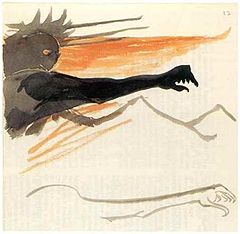
| Tolkien's own Drawing of Sauron, creative commons license |
So, on to our (arche)type. Sauron has always represented to me a very universal example of evil, villainy, and antagonist-hood. He is the perfect non-character example of a villainous entity, because his presence permeates the books, even though he never really exists on page. I loved what he stood for as a boy, and I love it still, but now that I'm a professional writer, I'm begrudgingly willing to admit there is a certain weakness to this kind of villain.
For one thing, he's not a person. He's not even personified, beyond a minor (ahem) attempt at giving him an eye, but more importantly (and this somewhat more broadly applies to modern fiction than to its historical counterparts like Tolkien) he's never even given a chance to be sympathized with. This makes for far too simple reading in modern times (note that with some background research into Middle Earth, one discovers a bit more of Sauron's past and motivations, but one basically still hates him).
Next?
THE BEAST
 |
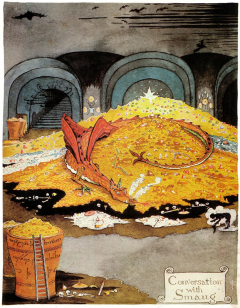
| Tolkien's own Drawing of Smaug, also creative commons license |
What makes him a Beast type? Well, technically Tolkien personified his most famous dragon in a lot of ways, giving him speech, giving him cunning, giving him even riddles, but Smaug never fully equates with the humanity of a human villain, because we never really sympathize with him to the level that we otherwise might.
Next?
THE SYMPATHETIC HUMANIZED ANTAGONIST
 |
| Ralph (pronounced Rafe) Fiennes (pronounced Fine) as Voldy, another common license image |
He's a monster, to be sure, or at least he becomes one during the historical parts of the Harry Potter backstory, but he's also a human being, or starts out as one (a twisted, warped individual example perhaps, but a human being nonetheless).
Lord Voldemort is probably not the best example of a humanized Major Villain/Head Antagonist in children's lit, but he may be one of literature's best known examples anyway. And even if he isn't the quintessential case, his servant most certainly is:
THE FALSE VILLAIN
 |
| Alan Rickman as Severus Snape in Harry Potter and the Order of the Phoenix (common license) |
SPOILER ALERT: Snape dies at the end. SPOILER ALERT: Professor Severus Snape is not the bad guy. END SPOILERS. He does, however, serve as a great false villain (and sometimes as a great true antagonists--see the difference?) throughout the Harry Potter novels.
I would probably even argue that Snape is the greatest false villain ever written. At least in children's literature (Gollum or Darth Vader might give him a run for his money otherwise). He's perfect because he's nasty, and smelly, and he has greasy hair, but he's even better because especially on a second read through, you discover just how clever and wonderful he is.
Snape is motivated by love (and also a little by hate) but even with his love lost, he still has the loyal dedication to Dumbledore, a man he clearly also loves and respects, and it is this loyalty that drives him to assist Harry when he must, as tedious and annoying as it is for him.
< . . . >
Anyway, that's my little list. Sorry my selections only come from two authors, but those were the best examples that came to mind. Feel free to share your own examples in the comments!