Showing posts with label heroes. Show all posts

Friday, June 23, 2017

Kill the villain? Or save them? by Joanna Roddy


For my last post, I talked about villains and the layering of roles often seen in kids lit: rivals, agents, and the true enemy. I want to continue that discussion and talk about what we as writers do with our villains in the end. 


Disney (and for that matter, most traditional story-telling) tells us that the villain needs to die. Especially the true enemy, especially if they are powerful through magic or supernatural ability. They're too dangerous to live. Lesser villains, like agents, need to be punished, and rivals and bullies need to be humiliated. It's often an eye-for-an-eye system in which just deserts are served up to satisfy the viewer's sense of fairness. In these narratives, good is good, though it may be flawed or misguided; and bad is intentionally bad. The hero must vanquish evil. Ultimately, these stories have a power struggle as the central conflict and the story ends when power ultimately resides with the protagonist. 

Other story-tellers, like Japanese animated fantasy film-maker Hayao Miyazaki, show us villains who are unquestionably bad and clearly set against the protagonist, but the hero's path to overcoming that villain isn't through violence or a show of definitive power. This is because the hero has a different skill-set altogether. Where traditional heroes need to harness their power in physical or magical battle, these alternative heroes are equipped with empathy, loyalty, and kindness. They will still need bravery and perseverance, but the result will be something far different than vanquishing the villain. Rather, the villain can be saved. 


Take for example Spirited Away, Miyazaki's 2003 Oscar-winning film in which the ten-year-old hero, Chihiro, defeats a monstrous spirit feeding on people's greed by simple indifference to its offers of gifts and gold. After returning it to its benign form, she befriends it, taking it as a traveling companion. Later, Chihiro is able to win her freedom from a witch, Yubaba, who is holding her and her parents prisoner, through her wits and monopolizing Yubaba's weak spot: her devotion to her bratty son. Does Chihiro hold the son hostage or threaten him? No. She earlier made friends with him, transforming his selfishness into compassion that then is leveraged in her favor. The story is left with the possibility that Yubaba's love for her ennobled son will lead to her own transformation.


Another example: Tomm Moore's Song of the Sea. Based on Irish folklore, the villain in this film is Macha, the owl witch. She steals people's emotions, keeping them in glass jars while the people themselves are turned to stone. We learn that she does this because her son's broken heart was too painful for her to witness, and, thinking she was giving him mercy, she turned him to stone. Now she is determined to do the same for everyone, including herself. The child protagonists break the jars and the emotions all come flooding out. Macha realizes that allowing oneself to feel things, even great emotional pain, is preferable to feeling nothing and being barely alive. In the end she becomes their ally and her relationship with her son is restored. 
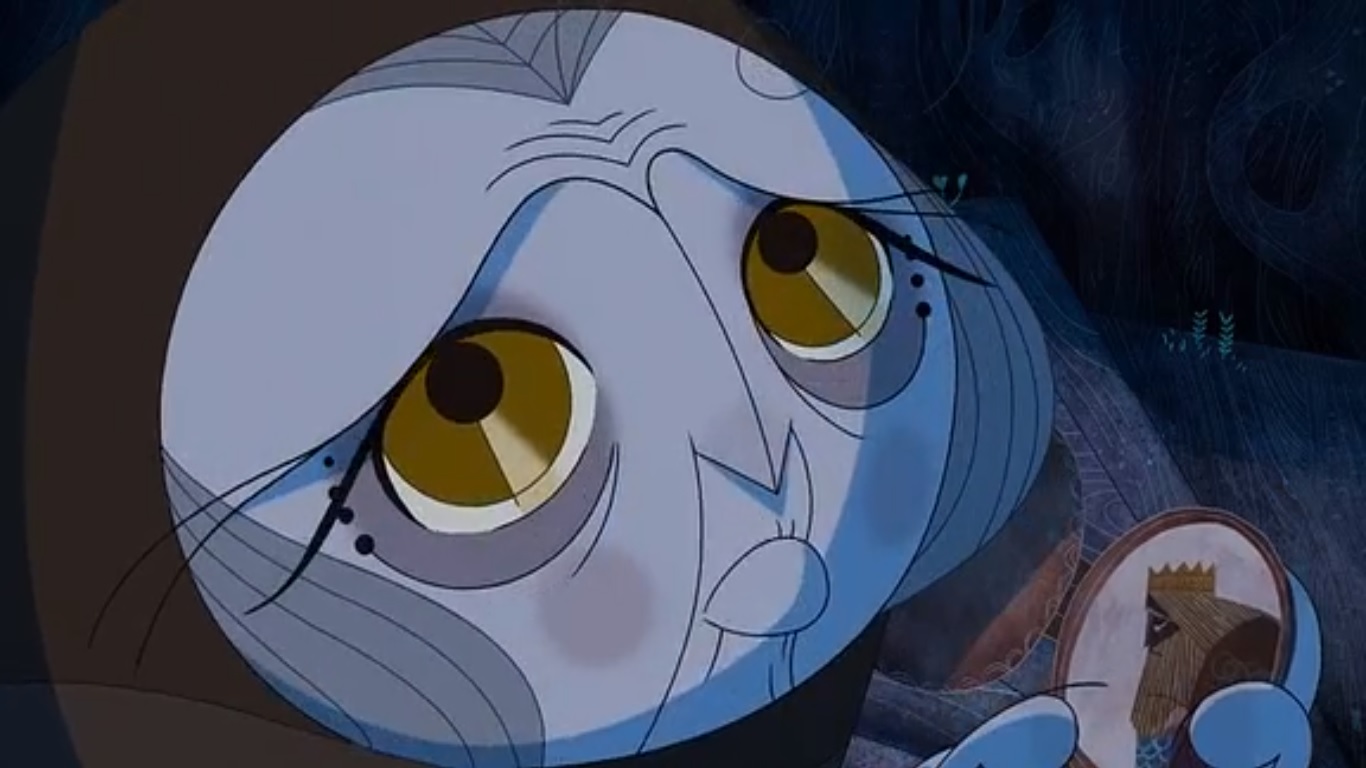
The only irredeemable villains in these films are destructive forces. Miyazaki presents war and pollution again and again in his films as true evils that must be resisted. Moore's Song of the Sea offers only time and the rules of magic as the heroes' greatest enemies. 

I find myself torn. Evil is real. Just look at the news. Kid readers understand this in a pure and simple way, often overlooking the nuance and splitting the world into good guys and bad guys. I think the longing to see justice for wrongdoing is innate. But as writers, I feel we owe it to children to represent the world as it truly is: seemingly evil people have complicated motives, and no one is completely irredeemable. Our choices have power and the possibility to choose good is always there. Some villains will never choose good--that's the power of free will too. 

Typically our heroes destroy the villain in a final showdown in which good prevails against all odds. The hero seems ill-equipped and powerless until that last moment when what is needed to overcome impending doom finally arrives, and they win. But what if instead the thing that arrives against the odds is that elusive magic--the kind we all wish we had--that gives the hero the exact key to unlock the villain's heart and return them to a path of love? Everyone wins. What if we told stories like that, and instilled the belief in children that maybe there's something inside them that can transform the world through love instead of violence? Through peacemaking instead of division. 

Maybe that's idealistic, but doesn't our world need those kind of heroes now more than ever? 

Thursday, March 17, 2016

St Paddy’s Snake Bite Remedy by Eden Unger Bowditch


As today we think everything should be green as the grass is green. Why? And for whom? For none other than St Patrick. Many green-wearing fans think of him as the little buckle-shoed ginger leprechaun with pointy ears and a twinkle in his eye. Sorry folks. That’s not the story.


When we were young, my husband and I were in a band that toured and made albums and did it all with a baby in tow (he took two years off grad school!) One of our songs was inspired by a comment by a friend in the music business. He said, ‘This song reminds me of St Paddy’s Snake Bite Remedy’ and, thus, it was dubbed.

What feels like a hundred years later, I look back and wonder why I never investigated the story. Me? A lover of stories? A teller of stories? And, so, I shall do so today.

St Paddy was not Irish and, in fact, wasn’t even Christian. He never planned to go to Ireland. He was a wealthy young boy in Britain and was kidnapped. St Paddy’s move from the lap of luxury to tending sheep on a rainy Irish hillside was not by choice. But, as he sat shivering while tending his flock, he had a conversion. He heard a voice that told him what must happen. He returned to Britain, became a priest, then went back to Ireland where he lived out his days trying to bring Christianity to the natives. But what about snakes?

Well, the story goes that St. Paddy snake bite remedy was to banish snakes from the island. And, as it stands, there are no snakes in Ireland. Were there ever snakes in Ireland, you ask? Why do you want to trample upon a fabulous tale that has survived the centuries?


We are spinners of stories ourselves, are we not? And we all love a good yarn. Let’s enjoy the magic brought to us on this day. We celebrate in big or small ways- a green scarf or green socks, or bright green-died hair, pick your pleasure- let’s send a cheer to Ireland as we remember the passing of Irish patron and give a nod to St. Paddy’s snake bite remedy.

Wednesday, September 2, 2015

Do kids books have to be about kids? by Joanna Roddy


All hail Flavia!

Flavia de Luce, that is. I just discovered Alan Bradley's delightful mystery series with Flavia de Luce as the 11-year-old chemistry obsessed sleuth. She's equal turns precocious, mischievous, cheeky, brilliant, and spirited:

"I was me. I was Flavia. And I loved myself, even if no one else did. 'All hail Flavia! Flavia forever!' I shouted as Gladys [her bicycle] and I sped through the Mulford Gates, at top speed…"

I adore this character. And I'm mesmerized by Bradley's skill at creating a completely believable 11-year-old as the first-person narrator and protagonist of an adult mystery novel.

The advent of child protagonists in adult fiction has become rather standard lately, I realize. THE SECRET LIFE OF BEES, THE KITE RUNNER, THE GOLDFINCH, LIFE OF PI, THE LOVELY BONES, to name a few. Yet, the idea of it fascinates me, especially with first-person narration. If it's all told from the child's perspective, one could argue, isn't it a children's story? If the protag is well-realized, then the story belongs to a child, fictional though he or she may be. Seems to me the publishing industry classifies novels as "adult" based on vocabulary and mature content, which is understandable, but it can sometimes seem arbitrary.

Consider the fact that Bradley's first Flavia novel, THE SWEETNESS AT THE BOTTOM OF THE PIE, won an armful of trophies for adult fiction, including the Agatha and Macavity, but also found itself on several lists of Best Young Adult Fiction. It was nominated for the Young Reader's Choice Awards and for the Alex Award, which honors "books written for adults that have special appeal to young adults ages 12 through 18."

In addition to the broad appeal of adult books with young protagonist, adults read plenty of straightforward children's fiction too. Just think of many widely read literary classics intended for a children's audience, albeit upper-level readers: A TREE GROWS IN BROOKLYN, TO KILL A MOCKINGBIRD, LORD OF THE FLIES, LITTLE WOMEN, MY NAME IS ASHER LEV. And then there are commercially popular MG/YA books: THE HUNGER GAMES, THE GIVER, ENDER'S GAME, HARRY POTTER and the endless argument about the rise of adult YA readers. (You might recall this controversial article.)

This leads me to wonder: Does it go both ways? Are there books for children with adult protagonists? Are children's writers afforded the same creative license by traditional publishing and readers? And let me be clear: I'm talking strictly about protagonists, the primary character perspective of a novel. Of course there are many sympathetic adult characters throughout children's literature, or adult characters who have select chapters written from their perspective. But are there any books with an adult for the primary protagonist?


I can think of a few titles from earlier eras with adult protags: ROBINSON CRUSOE, 20,000 LEAGUES UNDER THE SEA, THE THREE MUSKETEERS, etc., though I do wonder how many young people these days actually read these novels. And there are young reader classics with quirky adult protagonists, like MRS. PIGGLE WIGGLE, MR. POPPERS PENGUINS, and MARY POPPINS, though none are told from the first person. But I'm hard-pressed to think of recent examples. It seems that the industry thinks if a book is for a child, the protagonist's age should match the reader's. Hence the 14-year-old protag dilemma.Diana Wynne Jones says, "…they [children's protagonists] usually have to be strong, dynamic characters…people that children will follow willingly into the action. For this reason, it was thought at one time that the main characters always had to be children. This turns out not to be true…as long as someone in the story is likable, understandable or a lovable rogue..."“At one time,” eh? I’m not sure that the era of requiring child main characters for children’s books has past.Jones does capture the essence that would be necessary for an adult protagonist: "a lovable rogue," an outsider, someone who doesn’t understand or at least doesn’t follow the unspoken grown-up rules that are often inscrutable to children.

A major exception to the "no adults allowed" rule can be found in animal and fantasy literature. Consider the REDWALL series, where ages aren't mentioned, but the woodland creature protagonists are warriors, monastic apprentices, and in other adult roles. And in THE HOBBIT, which Tolkien wrote for his children as a precurser the more adult LOTR series, Bilbo is an adult, but he’s also something of an ingénue so that he's able to enter the adventure in much the same way the reader does, discovering a new frontier.

But all told, adult protags are hard to find in children’s lit. Perhaps it's easier for an adult to envision themselves young again, granted the freedom to return to the complexities of growing up with the wisdom and experience of adulthood than it is for a child to understand an adult world from an adult perspective. 

Whether or not we're allowed adult protagonists, it's clear that children's books do as much heavy-lifting in the serious subjects department as an adult book can. Children's books often tackle difficult issues in a uniquely insightful way. I'm fond of what Madeleine L'Engle once said about her work: "You have to write the book that wants to be written. And if the book will be too difficult for grown-ups, then you write it for children."

The notion that the reader's age should roughly match the main character's seems narrow to me. A sixteen-year-old can lead a middle-grade adventure and the eleven-year-old reader isn't going to have a problem with it if the story is good, the character rings true, and the subject-matter appeals. Precocious kids read a wider range than their own market demographic anyway. To let the right character with the right skill-set arise organically to meet the challenges of a middle-grade, or young adult, or adult fiction story, regardless of that character's age seems to me to be the logical path. (Flavia, QED.) Adult fiction seems to accept that. Why pigeon-hole kids lit?

"Horcruxes" by Mary GrandPre

Shouldn't we get to know and learn from across generations? Perhaps these false dichotomies and boundaries between ages are why so many of us reach adulthood and are surprised to discover that we're fundamentally the same person as our childhood selves, just with more responsibilities and experiences. Just as adult readers enjoy the chance to live vicariously through a child’s discovery and freedom, so children need proxies in the grown-up world, guides into adventure and discovery in places inaccessible to them. I would be interested to see what would be created if the unspoken "kids POV for kids lit" rule wasn't there.

Have you seen any adult protagonists in kids lit lately? Do you think there ought to be? Leave a comment and join the conversation!


Wednesday, March 26, 2014

Heroes & Villains #1: Four Villain Archetypes, by Matthew MacNish

Here at Project Middle Grade Mayhem, we're starting an informal series focused on Heroes & Villains in Middle Grade Literature. We'll be sharing some of our favorite examples, maybe some poor examples (and why they didn't work), and writing about and discussing heroes and villains, and why they are so important to story, whose most important aspect has always been character.

Today is the first post in the series.

Villains and Antagonists have long been interwoven in the annals of fiction, and while they're not always the same thing, sometimes they are, sometimes they aren't, sometimes it matters and sometimes it doesn't. Point is, they're awesome characters (or entities) and often play a pivotal role in that old muse-esque keystone: STORY.

Myth and tale and epic and adventure, what we really do, all of us, is tell stories. And what's the most important part of any story? Well, characters, obviously.

Carl Jung wrote a lot about archetypes in his studies of the human psyche, and of course the human psyche is tightly knotted up with the psychology of story, (and I covered some of his archetypes on my personal blog, reverse order search link). However, this post will be more about my own inventions, not based on any truly empirical study of the topic, but more on my own anecdotal experience as an avid reader.

And with that, here is an unofficial of the four most common (arche)types of villains I have found in (mostly) middle grade novels:
  • The False Villain (actually this one needs to come last, because it's the best)
  • The Sympathetic Humanized Antognist
  • The Beast
  • The Entity
So reversing that order, because it's becoming a theme at this point, let's get started with:

 THE ENTITY.

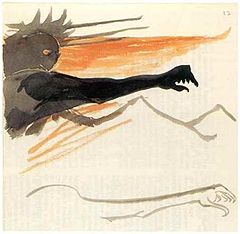
Tolkien's own Drawing of Sauron, creative commons license
Sauron does not technically come from a Middle Grade novel, and while there is some graphic violence portrayed in the film adapations, and the novels themselves are marketed as adult, I feel perfectly comfortable discussing The Lord of the Rings on PMGM, because I read it as a very young boy, and there is honestly nothing in the books that could outdo the imagination of a lad of ten (with the possible exception of Elves).

So, on to our (arche)type. Sauron has always represented to me a very universal example of evil, villainy, and antagonist-hood. He is the perfect non-character example of a villainous entity, because his presence permeates the books, even though he never really exists on page. I loved what he stood for as a boy, and I love it still, but now that I'm a professional writer, I'm begrudgingly willing to admit there is a certain weakness to this kind of villain.

For one thing, he's not a person. He's not even personified, beyond a minor (ahem) attempt at giving him an eye, but more importantly (and this somewhat more broadly applies to modern fiction than to its historical counterparts like Tolkien) he's never even given a chance to be sympathized with. This makes for far too simple reading in modern times (note that with some background research into Middle Earth, one discovers a bit more of Sauron's past and motivations, but one basically still hates him).

Next?

THE BEAST

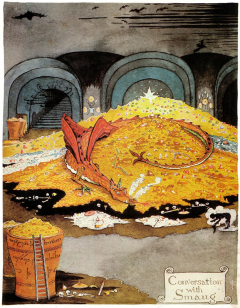
Tolkien's own Drawing of Smaug, also creative commons license
Not to spam this post with Tolkien examples (but I dare you to dare me to come up with one for all four of these archetypes), but I feel that Smaug makes a great example of a Beast type Villain/Antagonist. In an MFA literature sense, he doesn't make much of an antagonist, because he only shows up at the very end of the book, but in The Hobbit, I would argue he very much does make a great villain, because the threat of his presence permeates the entire narrative.

What makes him a Beast type? Well, technically Tolkien personified his most famous dragon in a lot of ways, giving him speech, giving him cunning, giving him even riddles, but Smaug never fully equates with the humanity of a human villain, because we never really sympathize with him to the level that we otherwise might.

Next?

THE SYMPATHETIC HUMANIZED ANTAGONIST

Ralph (pronounced Rafe) Fiennes (pronounced Fine) as Voldy, another common license image
Okay, I get it, you maybe (probably) balk at that description of Lord Voldemort, and I understand that, because Ms. Rowling did a brilliant job of making us earn our right to hate him, but she also sprinkled in a lot of right to forgive him for his wrongs, if you read the Harry Potter series as carefully as I did.

He's a monster, to be sure, or at least he becomes one during the historical parts of the Harry Potter backstory, but he's also a human being, or starts out as one (a twisted, warped individual example perhaps, but a human being nonetheless).

Lord Voldemort is probably not the best example of a humanized Major Villain/Head Antagonist in children's lit, but he may be one of literature's best known examples anyway. And even if he isn't the quintessential case, his servant most certainly is:

THE FALSE VILLAIN

Alan Rickman as Severus Snape
in Harry Potter and the Order of the Phoenix (common license)

SPOILER ALERT: Snape dies at the end. SPOILER ALERT: Professor Severus Snape is not the bad guy. END SPOILERS. He does, however, serve as a great false villain (and sometimes as a great true antagonists--see the difference?) throughout the Harry Potter novels.

I would probably even argue that Snape is the greatest false villain ever written. At least in children's literature (Gollum or Darth Vader might give him a run for his money otherwise). He's perfect because he's nasty, and smelly, and he has greasy hair, but he's even better because especially on a second read through, you discover just how clever and wonderful he is.

Snape is motivated by love (and also a little by hate) but even with his love lost, he still has the loyal dedication to Dumbledore, a man he clearly also loves and respects, and it is this loyalty that drives him to assist Harry when he must, as tedious and annoying as it is for him.

< . . . >

Anyway, that's my little list. Sorry my selections only come from two authors, but those were the best examples that came to mind. Feel free to share your own examples in the comments!

Tuesday, March 25, 2014

Heroes Needed: No Cape Required

The world is filled with heroes.

It's true. And if you're reading this, odds are you're one of them.
I'm not talking about the tights-wearing, cape-clad, witty banter kind of hero (although what you wear in the comfort of your own home, or while grocery shopping, or when feeding your goats, is entirely your business).
No, I'm talking about the kind of hero that takes the time to share a book with a child. I'm talking about the kind of hero that delights in watching the joyful smiles form on little faces when he or she shares the magic of  a story. You don't need tights, or a cape, or some super emblem on your chest...not when you sit down to share a story with a child. The book, your voice, your time and interest and genuine
commitment to your young audience makes you a hero in their eyes. A shared story, a favorite book, a bedside read...these moments wrap children up in love and affection. These are the moments that can put a smile on a child who has had a bad morning, or comfort a kid who is nervous about his first night without his nightlight. Reading a story to a sick child can help soothe their pain and comfort them in time of need.

Trust me, I know. First hand.

March 25th is always a difficult day for me, and for my family. Eleven years ago, on this day, my youngest brother, Jack, passed away. He was 7-years-old. Jack was born with cerebral palsy. And while he couldn't walk, or talk, he knew what was going on. Despite his handicaps, he was a very happy boy. Jack loved to hear me read to him. His favorite was Dr. Seuss's Fox in Socks. The faster I read it (and I can read it quite quickly), the more he'd laugh and smile. We read many books together, but that was our favorite. So on this day, eleven years ago, as he lay dying at home, comforted by his family and a slow morphine drip, I read to him. I read Fox in Socks and I can still see that smile on his face. Even through the medicine, even through the pain, I know that in that last hour my reading to him helped him when he must have been so scared. While it is not my intent to declare myself a hero, it IS my intent to demonstrate that we can help brighten a child's life just by reading a story to them.

But it does not have to be as heavy a moment. I read to all three of my boys each night. Arms laden
with books, I make the rounds. My 10-year-old and I are reading the Harry Potter books. To my youngest, it's a picture book, or some of the Chronicles of Narnia. I sit at the bedside of my middle-schooler and read him a couple of pages of the Percy Jackson books he's devouring. No, he doesn't need me to read them to him (he tears through the books), but he just likes the experience of hearing my voice; of sharing a few minutes with me. It's an important moment for all three of my boys. So, I guess, in a way, that makes me a part-time hero in their eyes. Maybe?

But you're heroes too, or you can be. Make sure you are taking the time to read to your children. If you don't have children, read to your nieces or nephews, or volunteer to read at your local library's story hour, or go to a children's hospital and read to the kids there.

You might be surprised how much of a difference you can make in a child's life just by reading them a story.

Share a book. Be a hero.


Friday, November 25, 2011

Everyday Heroes

Yep, that pretty much sums up a cold snap.

A couple weeks ago the temperature dipped to 40 below. Yeah, our first cold snap of the season came early and broke a bunch of low temperature records.

I love exercising outside. I’ve been running and biking at forty below and colder, but sometimes it’s hard to get motivated to get out the door when it is that cold. I had to do something, so I decided to go for a short walk.

I’d been walking for about ten minutes when I heard footsteps behind me. It was my neighbor. My eighty-two year-old neighbor. Running.


He doesn’t run fast, and he’s always a little hunched over, but he runs every day. It doesn’t matter how hot or cold or snowy or rainy it is—he runs.

We’ve exchanged a few words over the eleven years I’ve lived in the neighborhood, but mostly we just wave at each other. I know he started running relatively late in life, after being very ill.

A day rarely passes when I don’t think about him. He’s an everyday hero who inspires me to keep pushing myself in all areas of my life. I’ve told all my friends and family, near and far, about him.

Even though I barely know him, I am thankful that he's in my life. 

Do you have any everyday heroes in your life who rock your world?

Happy Thanksgiving!!