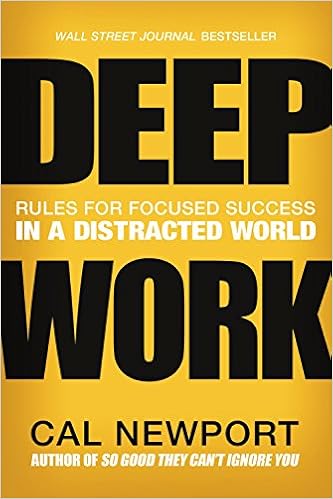
In the fall of 2016, I read Deep Work: Rules for Focused Success in a Distracted World. In it author Cal Newport suggests that many of us are engaged in shallow work — putting out small fires and meaningless wheel-spinning — that keeps us from engaging in the focused, planned-for time that true work really needs.
It was the sort of book I couldn’t keep quiet about. I took notes in my bullet journal, posted about it on my blog a couple of times, talked it up with author friends and even my agent. I also signed up for Cal’s e-newsletter to keep his concepts fresh.
A the end of December, Cal mentioned a Digital Declutter experiment he wanted to conduct to collect information for his next book. The declutter would be about “confront[ing] life directly, without the dulling mediation of a screen, allowing you to rediscover which activities and behaviors really provide value in your life, and which are mindless distraction.”
Well. I love a challenge. I love the chance to try something hard in an attempt to learn something new. Add to this the opportunity to really put into practice the concepts in Deep Work, and I was all in.
The guidelines:
Though the break wasn’t spelled out specifically, participants were encouraged to “interpret [the Declutter] in a way that makes the most sense for both your personal and professional constraints.” However, Cal did suggest these things:
If possible
- “Don’t log into any social media accounts.”
- “Don’t read news online.”
- “Don’t use the internet for entertainment. In more detail: Don’t web surf. Don’t browse YouTube videos. Ignore clever links lurking in email forwards. Though I hate to suggest it, take a break from blogs as well.”
- “If you’re a heavy text message user, consider serious restrictions on when you read and respond to these messages.”
- “It’s likely too prohibitive to ignore personal email accounts during this entire period, but you probably shouldn’t check them constantly.”
I figured a social media break wouldn’t be too hard. I do this already every July. To remind myself of this promise in down moments, I took Facebook, Twitter, and Instagram off my phone.
I rarely read news online, unless I catch sight of important breaking news. I thought this one would be easy.
I follow a handful of blogs via email. All in all, I assumed I’d be fine taking a break.
I really only text two friends (and the occasional family member who needs a ride or sends me ridiculous emojis [the second would be my husband]). I let everyone know I’d check in less often.
Email, I knew, would be a big challenge. I’ve never been good at limiting the number of times I check, and I’ve wanted to change this — have tried to change this often. My goal was to check in after the kids leave for school, before I head to the gym or out for a run. I’d take a quick peek before lunch and a final read before I shut down for the day.
Book stats: This was the hard one. After a wonderful boost in sales last fall from the podcast I recorded at the Read Aloud Revival, I’d fallen back into the (bad) habit of habitually checking my Amazon and Penguin Random House Author Portal numbers. This is not helpful, whether the numbers are “good” or “bad”, and can affect the way I approach my work. I welcomed the break from this information.
Finally, I decided I wouldn’t listen to audiobooks while walking the dog, running, or cleaning. I love getting to read while doing mundane tasks, but I also know this can block out times to think and process. Last fall I took a break from audiobooks when I did my week without reading (as I said, I really like challenges) and had brought back the audiobook with gusto. Ideally I hoped to come away from this time with the desire for silent walks a few times a week.
My ultimate hope was to come out on the other side with new insight and a renewed desire for the focused, planned-for time that deep work (and rich living) need.
The results:
January was a good, good month. In a lot of ways, I feel like I was waiting for the Digital Declutter and just didn’t know it. My overall visceral response to the experiment was relief.
That alone is telling.
The guidelines “protected” me from wasting time and letting my mind feel scattered. My online sessions were quite brief without blogs, social media, or tracking book information. I deleted many more emails than I read (leading me to unsubscribe from a handful of industry reads and blogs I realized I didn’t miss). I had large pockets of time for thinking about my manuscript and life and for not thinking at all, for just being. I’m the sort of person who craves silence, but I discovered last month I’m often quick to drown it out. As much as I missed my audiobooks, the stillness felt like a reintroduction to an old friend.
Did I hold to everything perfectly? Here are some specifics:
social media: Having the apps off my phone was hugely helpful. I’ve gone back to the Instagram app, but have only visited a couple of times. I have no need to reinstate Twitter and Facebook. Looking at them occasionally on my computer will be more than enough.
It was tricky when I got an email saying someone tagged me in a photo. I wanted to see! But I stayed away, logging into Facebook once to download something and another time just to see how many notifications I had. (It was a lot. Further confession: I checked my Twitter numbers once, too). Still, I received several FB group discussion emails, where I could read the discussion starter. I probably deleted 2/3s of these emails and read the rest.
Social media sites are very sly (read manipulative) when your visits slow down. I got numerous emails inviting me to see the notifications I’d missed or asking if I needed help logging back on.
online news: More than once I started reading a story only to realize what I was doing. That’s precisely the point of an experiment like this! I saw how quickly mindlessness can take over. I want to be able to consciously make my own choices online and not feel lured in. Being aware of the autopilot tendency is a good thing. I did allow myself to read a few articles that were industry / work related (like this exciting story!)
email: This was by far the hardest. I had committed to checking three times a day but rarely held to it. More typical was four or five times. Admittedly, this was far less often than usual. I really would like to continue aiming for the three-a-day check, even if I don’t hit the mark. Those messages can wait, and so can I.
audiobooks: I was shocked how little I missed these, as they make up a huge part of my day. Maybe it was knowing I could go back to them this month, but I’m pretty convinced it was the quiet that I needed and appreciated. It was brain rest and brain food. I’d like to keep one walk a day audiobook-free.
book stats: I checked my Amazon and Penguin Random House Author Portal numbers twice. It did nothing positive for me. I know (and have known for a while) how this information is the opposite of helpful most of the time. My goal is to check in once a month, just to get a sense of where things are. These numbers are never the full picture, anyway. They should have no place in my life other than as an occasional tidbit of information.
blogs: I let myself read 3-4 posts that were book / writing related. I really didn’t miss blogs I regularly read, apart from this one, which, I confess, I overindulged in during my first few days out of the declutter.
Moving forward
My biggest takeaway from this experiment is how much influence my digital activities have on my mental state. I have no desire to return to feeling scattered and harried, if I can help it — and I can help it, at least when it comes to my technological choices.
I also want to stay present while I’m online. Too many times I’ve found myself unsure how I’ve gotten to a particular site or why I’m even there.
Finally I want to be sure to allow myself time for quiet, even if I don’t feel I want or need it. This experiment has shown me I definitely do.
Deep work is most possible when I consciously make time and space for it. I’ve had the time, but what I didn’t fully realize was how mentally cluttered my space had become.
Here’s to more purposeful digital choices — ones that enhance life, not hinder it.


