Showing posts with label poetry. Show all posts

Thursday, April 13, 2017

So You Want to Write a Verse Novel by Caroline Starr Rose

April is National Poetry Month -- the perfect time to examine if your manuscript might be right for verse.

The more I write, the more I firmly believe there is no one way to write a book. I have yet to approach any of my manuscripts the same way. Here, though, are some things I’ve learned from both reading and writing verse novels:

Subject matter must be right for poetry

Some topics lend themselves more easily to poetry than others. Some subjects refuse to be written as prose. Many times an author will use verse to mimic the rhythm of the story. Here are a few books that come to mind:
  • Sharon Creech’s HEARTBEAT, about a girl who loves to run
  • Karen Hesse’s OUT OF THE DUST, where the spare language reflects the stark Dust Bowl setting
  • Lisa Schroeder’s FAR FROM YOU, about a girl who sings and and writes songs
  • Kwame Alexander's THE CROSSOVER and BOOKED -- two sports-focused verse novels that move and weave like a kid in motion


I read this dedication and then I died

Protagonists must be right for poetry


Often verse novels are told from a very close first-person point of view. Such writing calls for a lot of introspection on the protagonist's part.  Other times verse is used as a way for multiple voices to be heard, almost like a Greek chorus. Here are some examples:

  • Thanhha Lai’s INSIDE OUT AND BACK AGAIN, about a Vietnamese girl’s efforts to understand her new American home
  • Karen Hesse’s WITNESS, where the Ku Klux Klan moves into a quiet Vermont town, and citizens reflect on the change they bring
  • My BLUE BIRDS, where two girls meant to be enemies instead become secret friends


Poems should be able stand alone

Each poem in a verse novel must capture one moment, scene, idea, mark of change in your character's life. Ideally poems should be able to function separately from the rest of the book.

Poems must contribute to the whole

When I worked through my verse novel, MAY B., I kept a quilt in mind, treating each poem like its own square of fabric. Each patch had to be able to function separately while at the same time move the story forward. I trusted that if certain patterns and shades in my story quilt were repeated (think themes or story strands), eventually the interconnectedness would surface -- a much more organic approach than is normally taken with prose.


I also like to think of verse novels as a photo album, with each poem telling its own story as an individual picture would. When the photos are viewed together, an even bigger story is revealed.

Varied poem lengths

Without the structure of chapters, verse novels are simultaneously abrupt and fluid -- poem lengths can be jagged yet aide the plot in moving through scenes swiftly. It is often difficult to find a place to stop reading, as one poem often bleeds into the next.

Varied line lengths

Verse novelists play with key phrases or words they want to bring to their reader’s attention by the way they arrange words on the page. Stanza and line breaks can be used to slow or speed up reading, to draw the eye to important phrases, and to show readers how to best "speak" the poem.

Emotion and structure

The structure of a poem often communicates to readers a character’s emotional state.

How might fear look structurally? A verse novelist might use little punctuation or words tightly packed together. Maybe the language of the poem will unfold in short bursts, reminiscent of a child peeking into a darkened room and quickly slamming the door.

Poetic form

Some verse novelists use specific types of poetry (sonnets, for example), as Pat Brisson did with her book, THE BEST AND HARDEST THING. In writing about Sylvia Plath in YOUR OWN, SYLVIA, author Stephanie Hemphill chose to mirror the format of several of Plath's poems, giving her readers a sense of the poet's style, subject matter, intensity, and character.

The visual and the aural

When I was a teacher, I used to tell my students that poetry should be seen and heard. There is something special that happens when a reader experiences seeing, hearing, and saying a poem all at once -- the fullness of the poem is discovered this way. 

If you ever feel stuck understanding a verse novel, find a private corner and try reading it aloud.

Listen in

Verse novels are stories best communicated through the language, rhythm, imagery and structure of poetry. Is verse right for your story? Listen to your story. It will lead the way. 


Friday, April 11, 2014

Poetry Isn't Just About Love and Flowers

Happy National Poetry Month! I want to step aside for a moment from our typical discussion of middle grade novels and talk about middle grade kids and their experiences with poetry.
It's interesting to see that at a very early age, kids already form biases about poetry. In my teaching days, when I'd start my poetry unit each year, kids would invariably say all poems were about "love and flowers." It didn't matter where I was teaching or what grade. It didn't matter how immersed kids had been in Shel Silverstein, Jack Prelutsky and the like. I got these answers every time.
A Light in the Attic Special Edition  The New Kid on the Block
Part of my goal in presenting poetry to upper elementary and middle school kids was for them to see poetry is much broader than they'd previously thought.* I shared poems everyday on varied subjects, served as "museum director" in a classroom-turned poetry gallery, assigned secret poetry pals, pounded out the meter of poems we chanted as a class, sang Emily Dickinson stanzas to the tune of Gilligan's Island (it works!), and ended the unit with a coffeehouse, where kids presented their memorized poems and filled up on sugary coffee and cookies.
Before we got very far, I made the point to share a few things with my kids:
Poetry should be seen and heard.
You can understand poetry by listening. You can admire its interesting look on the page, but I think you miss out if you don't blend the visual and aural together. Poetry is pleasing to the ear (word choice, rhythm, repetition, rhyme) but is also pleasing to the eye. A poet uses structure to communicate (line breaks, for example) just as language is used.
Poetry packs a punch. 
Each word counts and better deliver.
Poetry creates mental images.
Words build pictures. Readers must approach with their eyes and minds open. Often readers will be given a fresh way to see the familiar.
Poetry speaks to the emotions.
This fits with the "love and flowers" idea my students were initially sold on. But poetry is so much bigger than one emotion and one topic. A poem is really a request for the reader to respond.
*This is what Sharon Creech tackles so beautifully in her verse novel, LOVE THAT DOG.

What is your gut reaction when someone brings up poetry? Is your response something that formed in your early years?

Friday, May 24, 2013

Title Poetry and Help Choose a Title, Please!


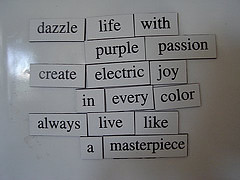
When I first saw samples of poetry from book titles, I knew I had to try one myself using middle grade books. I'm not sure my result is actually poetry, so I’m calling it a micro-story. If you can’t read all the titles, it goes like this:
Girl Overboard
Into the Blue
Dangerous Waters
Secrets at Sea
Tentacles
The Captive
The Quest of the Warrior Sheep
Found
Remarkable

I admit it won’t win an award, but it was a fun challenge
On a slightly different note, I think every writer struggles with titles. I know one writer who can’t start writing until she comes up with the perfect title. I would never write a word if that were me. It takes me forever to settle on even a few possibilities. I first became aware of the importance of titles when I gave a copy of TO KILL A MOCKINGBIRD to my then fourteen-year-old niece. She was an avid reader, but she wouldn’t read the book because of the title. Later, when it was assigned reading in school, she ended up loving the book so much, she named one of her cats Scout.
That was a cautionary lesson for me. Especially as a middle-grade writer, I know the title is all part of the package that makes up why a person will even begin to consider reading a book they know nothing about.
Nowadays, part of the consideration of a title is how it will look on the cover in a thumbnail-size view, because of the importance of online book sales. So we’re left with much shorter titles than before. I understand that, as well as how the title works with the cover image, but sometimes it’s hard to think you have come up with the perfect title, only to realize it’s too long from a graphic design point of view.
So here’s something I need an opinion on. I have two different titles for one of my manuscripts and cannot settle on one over the other. I describe the story as an upper middle grade historical that is somewhat Downton Abbyish, with the addition of spies. It’s set during World War I. Which of the two do you like best?
ESCAPE THE SHADOWS
or
THE FINDING OF SECRETS
???
Thanks!
~Dee Garretson

Monday, April 9, 2012

Please Pass the Poetry: 6 New Poetry Books for Middle Graders

silly poetry...

April is National Poetry Month, but, unfortunately, tell that to a bunch of middle graders, and you just might get a groan or two (or is this only the students at the school where I work as a school librarian?). Anyway, I've found the key to poetry and middle graders is to jump right in. Don't talk about it--start reading! After all, poetry is meant to be heard, not just seen.

Here are some new poetry collections that I am looking forward to ambushing my middle graders with this month.


by Lee Bennett Hopkins, Will Terry (Illustrations). Dial, 2012.
ISBN 0803737165 (ISBN13: 9780803737167)

Bugs and poems! From ticks to bed bugs to lice, the creepy and the crawly are sure to drawn in the middle graders who love the yuck factor. By a slew of illustrious poets such as Marilyn Singer and Lee Bennett Hopkins.


by Douglas Florian, Houghton Mifflin Harcourt, 2012.
ISBN 0547688385 (ISBN13: 9780547688381)

Baseball--the other big April event, right? This book of baseball-themed poems, complete with Douglas Florian's great illustrations will appeal to anyone who's ever spent any time at all at the ball field.

by Susan Katz, Robert Neubecker (Illustrator),  Houghton Mifflin Harcourt, 2012.
ISBN 054718221X (ISBN13: 9780547182216)

Who doesn't love quirky facts about famous people? Especially people as important (and, let's face it . . . stuffy) as the presidents. 43 poems highlight little known facts about all those leaders of the free world. With historical notes, too.

by J. Patrick Lewis, Michael Slack, Houghton Mifflin Harcourt, 2012.
ISBN 0547513380 (ISBN13: 9780547513386)

This is the perfect example of "read it, don't talk about it!" Because these are math riddles wrapped in parodies of classic poems. Yeah, don't say "huh?," just go read them. And you might want to have the originals on hand when you share them with kids because they'll be asking for them for sure. By Children's Poet Laureate J. Patrick Lewis.


by Rick Lieder, Helen Frost, Candlewick Press, 2012.
ISBN 0763656011 (ISBN13: 9780763656010)

This one slows it down a little--instead of rowdy, funny poems, it's one poem, about stopping to really see what's around you in nature. Paired with stunning photographs that get even the most antsy middle grader looking closer.


by Ntozake Shange, Rod Brown, Amistad Press, 2012.
ISBN 0061337412 (ISBN13: 9780061337413)

An example of a picture book made for older kids. This one's free verse poems about the Underground Railroad. Their emotion puts readers (and listeners) right there in that world. Perfect for an immediate taste of history.

And finally,


by Laura Purdie Salas, Capstone Press, 2012.
ISBN 1429672099 (ISBN13: 9781429672092)

Okay, so this isn't a book of poems. But who doesn't share poems with kids without wanting to try some of their own? Laura Purdy Salas covers the basics while using pictures as inspiration.

Happy poetry reading! Do you have more ideas? Be sure to add your favorite middle grade poetry books in the comments.