Showing posts with label on writing. Show all posts

Wednesday, October 25, 2017

Defining Success: Authors Weigh In by Caroline Starr Rose

Do shiny stickers mean success?

I’ve been thinking a lot lately about how I personally measure success.

When I first was published, I figured if I could reupholster the couch and pay for my boys’ glasses and eventual braces, that was success. These markers sound goofy now, but at the time they represented visible ways my work contributed to my family. They were tangible. Evident.

I recovered the couch when my first book sold. I've been able to keep my boys in glasses and contacts, and earlier this year paid off the second set of braces (thank you, May B., for still selling strong, and thanks, Mom and Dad, for helping out along the way).

By that early definition, I've arrived.

But over the years my definition of success has morphed and changed. If a book of mine stayed in print, that was success (so far, so good). And the ultimate success was earning out — when a book makes back its advance and an author is paid royalties. (Never mind the fact that only 15-25% of all books published actually do this -- and as of this date, only one of my titles has.)

Is meeting readers a way to define success?

When Blue Birds published, my measure shifted: if I was pleased with my work and my editor was pleased with it, that was success. This feels more reasonable, more attainable through hard work, but in the end, is it enough? Perhaps for my own level of satisfaction, but the honest truth is if I want to sell more books, my prospects are much more likely if I've had earlier titles that have done well in the marketplace.

What's difficult -- and maybe even unrealistic -- about using publishing markers as signs of success is they're out of my control. That's where the tension comes in. Because, honestly, how can success be legitimate if sales aren't strong? But how is such a mindset sustainable throughout a (hopefully) long, probably varied career? Is it ridiculous to hope every project will be successful? Is success more of a general, over the course of a lifetime thing?

Is the day to day work the truest measure of success?

I asked some friends, from the newly to the broadly published, how they defined success (anonymously, so they could be candid). There is so much wisdom here.

  • Success is being comfortable with the reality that not everyone who reads your book will like it. In fact, some readers will hate it, despite how much others LOVE it. Realize and embrace that certainty early.
  • At first, I just wanted to get an agent. I felt that I wouldn't be successful unless I achieved that. But when I got an agent, my success meter moved. I just wanted to be published. Then when I got published, I just wanted to be published AGAIN. I have to remind myself not to forget where I've come from. Now, I like to imagine I feel success when I've protected my writing time and had fun getting some words down in a day. To me, that's the measure of success.
  • Success for me means feeling that I have put forth my best effort to tell a meaningful story. That effort may, and probably does, involve many rewrites before it's printed on pages for the public to read. And the stories that don't make it to press are still successful, in my eyes, if I've put forth my best effort.
  • For me, writing is what I want to do as my job, and I need to make a living. So success means making enough money from writing or writing-related activities (teaching, critiquing) to support myself. That often means seeing myself as an employee who has to do what the boss wants, even though I'm a freelancer. But I encourage other people to remember that making money, or even being published, does not have to be their goal. If you want to write for the joy of writing, that's fantastic. Just remember what your goal is, and don't get distracted by other people's definitions of success.
  • Success is meeting the little goals you set for yourself and feeling good about it whether or not anyone else ever notices what you have done.
  • I'd like to be noble and say success as a writer is simply about doing what you love and loving what you do, with no outside factors taken into account. Critics? Meh. Sales numbers? Who cares? This is art, by golly. It's unquantifiable. But if I'm being honest with myself, I do to some degree base my success on what other people think of my work and how well it sells. This is my career. I want to do well and I didn't write my books just for myself. Writing is about communicating and connecting to someone other than yourself, so outside opinion does matter to some extent. So I strive to create the very best for both myself and my audience and I feel successful when I've pleased both. I also really like it when my work can pay the bills.
This last is perhaps my favorite.

  • I’ve been thinking a lot about this question. It’s a hard one for me, mostly because it changes from day to day, and for all those years when I hadn’t sold a second book, I had some seriously disarranged notions on the subject. Mostly I think those years taught me that a certain powerful flavor of success is maintaining that particular brand of faith that kept me writing in those years before I had a contract at all. It’s easy to feel successful when you have a book coming out. It’s a lot harder when you feel like nothing is happening and you have to keep creating every day when nothing might come of it. That’s how success looks to me today. When you can find it in yourself to keep blowing that little ember deep down inside you, the one that keeps you putting words on the page when there’s no earthly reason but the making of them. Success is making something beautiful when there’s no one to see it but you.
How do you define success? Please share in the comments below!


Thursday, April 13, 2017

So You Want to Write a Verse Novel by Caroline Starr Rose

April is National Poetry Month -- the perfect time to examine if your manuscript might be right for verse.

The more I write, the more I firmly believe there is no one way to write a book. I have yet to approach any of my manuscripts the same way. Here, though, are some things I’ve learned from both reading and writing verse novels:

Subject matter must be right for poetry

Some topics lend themselves more easily to poetry than others. Some subjects refuse to be written as prose. Many times an author will use verse to mimic the rhythm of the story. Here are a few books that come to mind:
  • Sharon Creech’s HEARTBEAT, about a girl who loves to run
  • Karen Hesse’s OUT OF THE DUST, where the spare language reflects the stark Dust Bowl setting
  • Lisa Schroeder’s FAR FROM YOU, about a girl who sings and and writes songs
  • Kwame Alexander's THE CROSSOVER and BOOKED -- two sports-focused verse novels that move and weave like a kid in motion


I read this dedication and then I died

Protagonists must be right for poetry


Often verse novels are told from a very close first-person point of view. Such writing calls for a lot of introspection on the protagonist's part.  Other times verse is used as a way for multiple voices to be heard, almost like a Greek chorus. Here are some examples:

  • Thanhha Lai’s INSIDE OUT AND BACK AGAIN, about a Vietnamese girl’s efforts to understand her new American home
  • Karen Hesse’s WITNESS, where the Ku Klux Klan moves into a quiet Vermont town, and citizens reflect on the change they bring
  • My BLUE BIRDS, where two girls meant to be enemies instead become secret friends


Poems should be able stand alone

Each poem in a verse novel must capture one moment, scene, idea, mark of change in your character's life. Ideally poems should be able to function separately from the rest of the book.

Poems must contribute to the whole

When I worked through my verse novel, MAY B., I kept a quilt in mind, treating each poem like its own square of fabric. Each patch had to be able to function separately while at the same time move the story forward. I trusted that if certain patterns and shades in my story quilt were repeated (think themes or story strands), eventually the interconnectedness would surface -- a much more organic approach than is normally taken with prose.


I also like to think of verse novels as a photo album, with each poem telling its own story as an individual picture would. When the photos are viewed together, an even bigger story is revealed.

Varied poem lengths

Without the structure of chapters, verse novels are simultaneously abrupt and fluid -- poem lengths can be jagged yet aide the plot in moving through scenes swiftly. It is often difficult to find a place to stop reading, as one poem often bleeds into the next.

Varied line lengths

Verse novelists play with key phrases or words they want to bring to their reader’s attention by the way they arrange words on the page. Stanza and line breaks can be used to slow or speed up reading, to draw the eye to important phrases, and to show readers how to best "speak" the poem.

Emotion and structure

The structure of a poem often communicates to readers a character’s emotional state.

How might fear look structurally? A verse novelist might use little punctuation or words tightly packed together. Maybe the language of the poem will unfold in short bursts, reminiscent of a child peeking into a darkened room and quickly slamming the door.

Poetic form

Some verse novelists use specific types of poetry (sonnets, for example), as Pat Brisson did with her book, THE BEST AND HARDEST THING. In writing about Sylvia Plath in YOUR OWN, SYLVIA, author Stephanie Hemphill chose to mirror the format of several of Plath's poems, giving her readers a sense of the poet's style, subject matter, intensity, and character.

The visual and the aural

When I was a teacher, I used to tell my students that poetry should be seen and heard. There is something special that happens when a reader experiences seeing, hearing, and saying a poem all at once -- the fullness of the poem is discovered this way. 

If you ever feel stuck understanding a verse novel, find a private corner and try reading it aloud.

Listen in

Verse novels are stories best communicated through the language, rhythm, imagery and structure of poetry. Is verse right for your story? Listen to your story. It will lead the way. 


Monday, July 13, 2015

LOST DOG: Last Seen on Page 275 by Eden Unger Bowditch


Okay, it’s true. I lost the dog. I was somewhere on page 350 and suddenly realized- where is Ralph? The last time I saw him was at the castle. Now that we are on the streets of Cairo, the dog is nowhere to be found.

Luckily, we are in the modern era and I was able to search the manuscript and find Ralph. I brought him home- though I would have gladly offered a search reward if I had been facing a perusal of ink-stained pages instead.

Has anyone misplaced a character before? It is amazing how lost one can get in one’s own book. I remember, during the The Ravens of Solemano editing era, while waiting for my editor to send his usual litany of detailed and ever-helpful comments, I was sent a brief email that asked if I wanted to choose a birthday or simply have a character celebrate two birthdays in a period of four months. Oops.

I think of books I’ve read in which a character simply disappears and never returns. Poor character, lost in the ether with no conclusion to bring her home.  Going back through great swaths of text can sometimes be more of a challenge than putting up mental signs for a lost dog.  I can search ‘Ralph’ or ‘dog’ and find him. But when there is an event that must be followed by another, it gets trickier and more challenging. When a search must be initiated Instead of whistling through pages, it is more like being a detective trying to discern who and what happened when and how. Searching requires finesse and wits, which, for me, can be a challenge to find, as well. How many hours have you spent trying to get the words right to Google a book or a film or a quotation or an event or country? The search request must done over and over until you get the wording right to call forth the information needed.

Marissa Burt’s super-awesomely helpful post,  “Thoughts on Scrivener,” Monday, April 27,2015 (read it, if you have not already) struck home for me. I am surrounded by little pieces of paper with notes I can barely read, but which are desperately necessary to retain some modicum of attention to names and places, times and events. To remember who went where and when, I now have birthdays, names, histories, and spots of time on notes to myself. I plan someday to follow Marissa’s lead and move into the 21st century with virtual Post Its, but until then, I have paper to keep me on the straight and narrow.
So, with the dog safely back in the arms of his boy, I am ready to send the first draft of the third book in the Young Inventors Guild trilogy to my editor- though pressing the ‘send’ button is something I feel like offering a reward for someone else to do.

Thursday, December 18, 2014

Jumpstart Your Writing in 2015 by Caroline Starr Rose

I have nothing to share about writing that is earth-shattering. What you’ll read here you probably already know. But like it is with all important things in our lives, it doesn’t hurt to hear certain things more than once. Here goes:


Read widely
Often writers are told to be well-versed in their genre. This is excellent advice, but reading shouldn’t end there. Picking up books in genres other than your own brings freshness to your writing and strengthens what you ultimately create. This nourishes you as a reader, too.

Study craft
None of us ever arrives. Our writing will improve if we continue to read craft blogs and books and take advantage of classes, critique groups, or conferences. Here are a few books I’ve read recently, am working on now, or plan to pick up this next year:

The Art and Craft of Writing Historical Fiction -- James Alexander Thom
Writing the Breakout Novel -- Donald Mass
Reading Like a Writer: A Guide for People Who Love Books and for Those Who Want to Write Them -- Francine Prose
Writing Irresistible Kidlit -- Mary Kole

Take time away from writing
Make sure you are doing things outside of writing. Now that I write full-time, it’s very easy to stay detached from the rest of the world. Make an effort to engage your surroundings, whether that means tuning in to nature as you walk the dog or making a point to get involved in a new activity.

Play with words
I find first drafts terrifying. One way I ease in is to tell myself I’m simply experimenting with language. Give yourself permission to approach writing playfully, whether you’re working on a “real” piece or simply collecting words that pique your interest. Enjoy the rhythm of words, poke at meaning, stretch old metaphors into something new. Your writing will benefit from it.

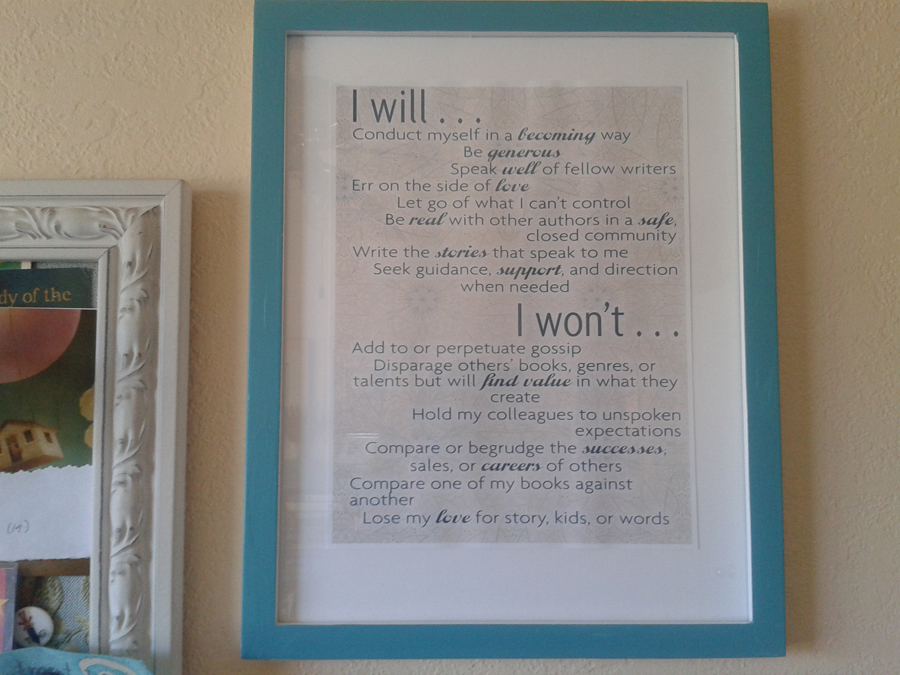
Avoid the comparison game
This is probably one of the hardest bits of advice to follow but one of the most beneficial to your writerly well-being. There are so many ways to get sucked into comparing, from measuring the number of blog followers you have against a friend’s to tracking the amount of time it took others to secure agents. It’s easy to think once you’ve “arrived” with a book deal, these worries fall away, but they don’t: there will be friends with bigger deals, with more push from their publishers, or better reviews and general buzz. Envy finds us at every level.

Choose to see your writing journey as yours alone. It’s not something anyone can do for you; there’s no way your experience will mirror another’s. Just like we all have something unique to contribute to the literary world, we all will go through different struggles and triumphs.

The only thing you will get out of the comparison game is disappointment.

And to negate everything I’ve said earlier...give yourself permission
In a world where instant information is available at all times and opinions are everywhere, you’re bound to come across conflicting advice on how to draft, edit, revise, submit -- do anything in relation to writing. For some of us, this becomes paralyzing; even if your approach works, you might worry that you’re not doing things right.

Give yourself permission to write in a way that works for you, whether that means writing daily or just on the weekends, editing as you go or waiting until your first draft is done. Though some advice seems to dictate otherwise, there’s no right way to write. Give yourself permission to alter the way you write if what you’re doing now isn’t working. Your patterns, needs, and abilities could change from manuscript to manuscript. Or they might not. And that’s okay.

Want to write to the market? Go for it. Want to try a story that can’t be categorized? Give it a try. You have permission to do as you wish with your writing. While there is no promise of success with this approach, there’s tremendous liberation in letting go of the “rules” we’ve absorbed consciously and subconsciously.

You’ve got a new year ahead of you. How will this affect your writing?

Tuesday, September 30, 2014

TRILOGY…ONE…TWO…THREE: Thoughts on writing the third book by Eden Unger Bowditch


DISCLAIMER: This post contains subject matter that seems to flip back and forth. It reflects the ambivalence I feel as I pen the third book in a trilogy. It flops from thought to thought and back. Is it great? Is it sad? Is it happy? Is it fun? Is it hard? Is it…so many different things? What I can promise, it is honest.

***

I am knee-deep in the third book of the Young Inventors Guild. 'Knee-deep' does not reveal the times when I am, in fact, in over my head, however. There are times when I am over my head. We all get attached to our characters and the worlds we create around them. By the third book, I sometimes feel overwhelmed by the final piece and all that it must contain.

(Wikimedia Commons)
While my publisher and I have discussed the idea of other Young Inventors Guild trilogies along different timelines, these specific characters during this particular time and place are contained in the three books. That means the mysteries are revealed and the story is given closure. It is exciting…and a bit sad. It’s like running to a finish line while loathing the end of the race. It is something you work so hard for, so relentlessly, so long. And, with one swift step or stroke of the pen or finger on the keyboard, it comes to a close.

So much goes into creating a world- heart, soul, love, madness. I find myself referring back to moments in the first two books to be sure I have it right and rediscovering things I’d almost forgotten about that story. The third book takes place in Cairo (good thing I came back!) and I find that I really do have to roam the streets, peruse the venues, explore the ancient markets to reestablish my own connection with a place that hasn’t changed much since my characters were there over a hundred years ago. I am lucky to have the opportunity to explore the very place that my characters will. But there is a sense of finality that goes along with the pleasure of exploring. It’s like a final walk-through, knowing you will close the door behind you and leave that house you built with your own hands, that home you love, forever.

(Gutenberg Image)
I know that, even if I continue and create new Young Inventors Guild books on their own timelines, it will be different. It will feel different, coming back to the first. Revisiting a place that was home is not going home again. That said, it is a wonderful thing to rediscover places where once we did dwell. With that in mind, those of us who have series that will come to a close, enjoy the time in that world, embrace it, and, as the adventure comes to a close, know that these books of ours become part of the world and people will get to enter the story and have a chance to be there. While we write, we are experiencing the adventure for the first time, too. The books then become their own destination. And we, too, can find our way back to visit them.

Tuesday, July 1, 2014

On Writing the Next Thing


When I was in college, I was fortunate enough to win an award for my first play, which resulted in a production of the play. It was a big deal—both my parents flew to Chicago from the west coast despite the fact that they were in the middle of a messy divorce. Sitting through the first act was strange, to say the least, and I dreaded intermission, when people would have to interact with me about my play to my face. Especially my divorcing parents.

So I was enormously relieved when my playwriting professor—who has gone on to win the Tony Award for Best New Play and has been nominated for screenwriting Oscars three times, by the by—whisked me off to his office the moment the lights went off for intermission.

I thought he was just saving me from the family tensions and weirdness of facing my audience, akin to sitting in a room with someone while they are reading your book. But as we sat down, the first thing he said to me was not about how well the production was going, or how I was feeling. It was this: “What’s next?”

My first thought: Uh, the second act?

But he went on. “What are you writing? What’s your next play?”

This mentality that my playwriting mentor taught me almost twenty years ago (yikes) has served me well as I’ve pursued a career in fiction. Just as I always began a new play by the time the previous one was sitting on desks in literary offices, I always began a new manuscript by the time I began querying the first one. And now that I have an agent…well, submission is like Fight Club and all that. But let’s just say the same rules apply.

I’ve heard some people say they cannot focus on something new when they are anxiously awaiting responses from agents or editors. But I think that’s one of the two main reasons to work on the next one. It’s not just that the act of writing something else will distract you—you’re not writing every minute of the day after all, and there will still be those times when you’re picking up library holds/toiling at your day job/wrangling children when you will continue to obsess over your submissions.

But for me, it’s more that when I am in the throes of something new, especially those exciting early days of drafting, my hope starts to shift toward that new project. When rejections roll in for the previous one, I think, That’s okay. Because this new project is going to be The One.

The second reason it’s so helpful to work on the next project is because it really might be The One. No matter how much you love your previous manuscript, there’s every chance it might not snag that agent’s interest. Or, frankly, the interest of 60 agents (not that I know that from personal experience or anything). If I had waited around to get an agent on my first manuscript, I wouldn’t have one now. And believe it or not, there are still a couple agents who requested the full for that first one four years ago and never responded. I could plausibly still be waiting.

But that manuscript wasn’t good enough. And my second, third, and fourth manuscripts—well, I still believe they were good enough and I got very close with a whole bunch of agents, but they still weren’t The Ones. But because it takes me about six months to write a middle grade novel from idea to submission-ready and because querying is a slow game, I was always ready to query my next manuscript right about the time I’d exhausted my list of agents to query and given the ones with fulls sufficient time to read.

So when my (super amazing, I love her forever) agent signed me on my fifth manuscript, I was actually just getting ready to query #6. So she read that, and was even more excited about that one. Now she’s got options, including a couple of my previous manuscripts that may still have hope.

I’ve just sent my next thing off to my agent and I’m pretty sure it’s The One. Are you writing the next thing?

Friday, December 20, 2013

End of 2013: reading & writing reflection, by Yahong Chi


This is Project Mayhem's last post of the year, and yes, there really are only 11 days left in 2013. Looking forward and anticipating the year ahead is always a tonne of fun, but it's important and useful to think back on the year that was, too.

Writing-wise, you can start with the big, general questions: how many complete drafts did you write? Did your revisions go the way you wanted? And if you made writing goals at the start of 2013, did you meet them? Writing is an art, and like all arts—like anything in life, really—you want to be constantly improving. Setting goals is a good foundation in building steps toward improving, and it's only one third of the equation; checking whether you met those goals is the last third. (The hardest third is actually writing enough to meet the goals!)

While you're all nostalgic for the year that has gone by and feeling fuzzy and warm with holiday spirit, this is also an opportunity to reflect on the personal growth in regards to your writing, the interior aspect of it as opposed to simply the words on the page. I find it fascinating to look over the stories I've written in the past year and remember my mindset at the time of writing. It's a bit of insight into my own character, the way I thought then and the way I think now. Writing is highly reflective of oneself, and sometimes it's good to reflect on the reflection and consider what it says about yourself.


Reading-wise, this is a good time to check that list you've been updatiing of all the books you read this year. And even if you don't keep track, a general look-back over the books you read can help you spot any trends in your reading, and decide whether you want to consciously make adjustments in your reading. For example, if you write fantasy, but find your past reading rather lacking in the fantasy department, then you can actively seek out fantasy titles to read in the new year. Embrace the To-Be-Read pile!

You can also identify trends in the books you've read. For example, it's pretty evident that sci-fi is dominated by male authors (check out this illuminating and thoughtful Tor.com discussion). So if you've been struck by a Shiny New Idea that has decided to categorize itself as sci-fi (like my latest MG SNI is!), then perhaps you decide to check the gender balance in your reading list, in the interest of ever-diversifying your reading and thus your writing.

One last word: remember to use your winter break to read as much as you can! As a student, I get how difficult it can be to find time to read. Writers are readers first.

Do you reflect on your reading & writing, and do you set new goals for the new year?

Wishing you happy holidays from us here at Project Mayhem!

-Yahong

Tuesday, March 26, 2013

The Writing Life: On Pushing Through

For those of you who have read my posts here or on my own blog, Caroline by line, you've probably noticed a certain theme -- I find writing hard. Sometimes I feel like a high diver who is afraid of heights. Don't get me wrong: I love what I do and am so fortunate to be an author (I mean, pinch me!). But almost daily there are challenges I face in this writing gig, and almost all of them come from within.

That's why I surround myself with things like this.
The lines about making good art are notes I took while listening to Neil Gaiman give the commencement address at The University of the Arts. 14 Ways to Make Mediocre Art comes from Emily Freeman at Chatting at the Sky (get your own cool copy here). The framed note I received in a packet of thank you letters after a school visit. "It's okay to be scared to write," it says. "I am too!"

To the right of my desk I've pinned this quote on the wall:
“Know that it is good to work. Work with love and think of liking it when you do it. It is easy and interesting. It is a privilege. There is nothing hard about it but your anxious vanity and fear of failure.
And when you work on your writing remember these things. Work with all your intellegence and love. Work freely and rollickingly as though talking to a friend who loves you. Mentally thumb your nose at the know-it-alls, jeerers, critics, doubters.”  -- IF YOU WANT TO WRITE, Barbara Ueland
Then there is this mini-poster I made, a response to all the thoughts rolling around in my head during my debut year. (Email me if you'd like your own copy!)
And other quotes I gather like sea shells, to pull out and examine when I need a boost:
"To make art is to sing with the human voice. To do this you must first learn that the only voice you need is the voice you already have. Art work is ordinary work, but it takes courage to embrace that work, and wisdom to mediate the interplay of art and fear." -- ART AND FEAR: OBSERVATIONS ON THE PERILS (AND REWARDS) OF ARTMAKING, by David Bayles and Ted Orland
"I am convinced that fear is at the root of most bad writing... . Good writing is often about letting go of fear and affectation. Affectation itself, beginning with the need to define some sorts of writing as 'good' and others sorts as 'bad,' is fearful behavior. Good writing is also about making good choices when it comes to picking the tools [words] you plan to work with." -- ON WRITING, Stephen King 
"Be an unstoppable force. Write with an imaginary machete strapped to your thigh. This is not wishy-washy, polite, drinking-tea-with-your-pinkie-sticking-out stuff. It’s who you want to be, your most powerful self. Write your books. Finish them, then make them better. Find the way. No one will make this dream come true for you but you." -- Laini Taylor
"Being an artist means: not numbering and counting, but ripening like a tree, which doesn't force its sap, and stands confidently in the storms of spring, not afraid that afterward summer may not come. It does come. But it comes only to those who are patient, who are there as if eternity lay before them, so unconcernedly silent and vast. I learn it every day of my life, learn it with pain I am grateful for: patience is everything." -- LETTERS TO A YOUNG POET, Rainer Maria Rilke 
How do you encourage yourself when writing is hard?

Friday, October 12, 2012

Learn all you can so you can write what you know


I fell off a horse the other day. It bruised my confidence; it hurt my backside; and, because it happened while my horse was going over a jump, I didn't exactly want to go over that jump again, not right after. But I did. I hauled myself up into the saddle, rerode the course -- and jumped it.

And now? If I ever have to write a scene where my protagonist falls off a horse, I'll know how to do it. (I'll probably need to at some point, actually. My current WIP involves horseback riding and mystery and superstition and family.) I'll know the emotions that go hand-in-hand with the experience. I'll know which muscles ache the most an hour afterward, and five hours afterward. And I'll know how hard it is to get back into the saddle again.

This, I believe, is at the core of the phrase "write what you know": use your own personal experiences to create scenes that ring emotionally true for whoever reads it.

It's not just about having the physical knowledge. After all, I don't have to have physically gone to Starbucks and ordered an iced cappucino to know how to write a scene involving one such trip. It's more to do with how your character will feel throughout the experience. Maybe a local Starbucks has a particular atmosphere -- shades hanging low, lamps lit, French vanilla scent especially strong -- that reminds your character of home. And these emotions can be worked in at the best of moments to connect the reader with the character.

This doesn't always apply, of course; sometimes, a scene isn't consequential enough to warrant a living, breathing description. Or how about fantasy and the supernatural: who can say they've ever experienced being a vampire? In these cases, making up the experience is necessary. What you won't want to make up are the emotions that go with the experience.

So jump a horse. Learn to climb trees (again). Set up a blind date. And remember that both failures and successes are experiences that everyone goes through, and good writers use all experiences to their advantage.

--Yahong

Monday, March 12, 2012

Reading to write

We all know that one of the foremost pieces of advice for writers in general is to read what you write. For us, obviously, it's middle-grade.

But we hardly have enough time to squeeze in a daily (or weekly) spurt of writing time. As well, the perennial fear of losing one's "touch" if we start a new novel in the middle of writing our own pops up. And then there's the issue of what to read, exactly. If I write contemporary, does that mean I can only learn from like contemporary novels? It's enough to turn a writer off books totally. ...Well, probably not. After all, we loved books enough to try our hand at this career.

The best way to tackle these problems, for me, is to set a reading goal.

Kind of like a word quota, this reading goal will be specific, achievable and balanced. (I'm feeling like a personal trainer of some sort now, hehe...) For a very basic guideline, all you have to do is set a specific number of books you want to have finished by the end of the year. Of course, being the type A personality that I am, I came up with two more guidelines you can apply to build your to-read list:

Age category & genre. If you'd like to focus on sci-fi middle-grade and dabble in fantasy on the side, go ahead and tweak your list. A while later you might want to get back into the groove of writing contemporary. In that case, switch a few titles up your list, easy-peasy.

Checkpoints. Saying you want to read fifty books by the end of August is perhaps just a little too broad. Checkpoints are dandy little things that can help keep you on track. (Okay, now I really feel like a personal trainer.) Try setting a goal to read a certain number a month -- and make adjustments for holidays, too. For example, spring break's just started. So, I decided to plow through at least ten books in my ginormous stack of library books this week. I might not make it, but then again, I might! (And if I don't, I'll probably be paying some fines pretty soon...)

Over the book blogosphere you'll find tonnes of reading challenges in all varieties aimed specifically at helping you, well, read books. Or you could keep it simple and just aim for a number. Whichever route you choose, you can't go wrong; after all, you're reading. What could be more right?

--Yahong

PS: As for me, I've read thirty-four books so far. Seeing how it's only March... I'm optimistic. ;) What's your goal this year?

Friday, December 9, 2011

Writing with a Soundtrack

Often when I visit another author's blog, I see a fancy-schmancy playlist. Usually it includes songs that inspired the story or music the author was listening to while writing. Not only does reading the list of unfamiliar names make me feel incredibly old - never do I see Roxette or Bon Jovi listed - ha!, but it makes me wonder if I'm missing out on potential creative inspiration.


When I write, I pop in my earbuds to block out background noise. If I have wifi, I'll click on over to Pandora and pick an instrumental station - piano is my favorite. Occasionally, I'll do string quarters or something. But I absolutely cannot listen to music with lyrics while I'm writing. Most of STORYBOUND was written to constantly repeating Christmas at the Keys, because I always worked in a coffeeshop that didn't have internet, and it was the only music I had saved on my laptop at the time. But, as fun as Christmas in July is, it doesn't make a very impressive author playlist.


I've tried to hip-it-up a bit. On my last writing day I braved a Tom Petty station on Pandora, but (though Tom Petty is as cool as ever), I just couldn't focus in on my writing.

What about you? Do you write to a soundtrack? I'll take any suggestions! What music inspires you? Do you have any imagined soundtracks to some of your favorite books?

Friday, September 30, 2011

Reading about Writing

So I finally went out and bought myself a copy of Stephen King's On Writing. I devoured it in about a day. (Confession: This is the first book by SK I've ever read. I know! I know! What have I been thinking? I will remedy this fact soon, believe me!)

At any rate, maybe because writing is such a solitary profession, or it could be that a writer's imagination is wired to find "kindred spirits" in books - whatever the reason - I now feel like Stevie (yes, he calls himself that in the book) is my new BFF, wise mentor, and witty grammatical go-to-guy all rolled into one. Observe:

"Put your desk in the corner, and every time you sit down there to write, remind yourself why it isn't in the middle of the room. Life isn't a support-sytem for art. It's the other way around." (pg. 101)

SK's sage words stand on their own, but he doesn't leave it there. Later on, this warning against letting your writing consume your life will seem to be at odds with a reminder to take what we're doing seriously:

"You can approach the act of writing with nervousness, excitement,
hopefulness, or even despair - the sense that you can never completely put on the page what's in your mind and heart. You can come to the act with your fists clenched and your eyes narrowed, ready to kick ass and take down names. You can come to it because you want a girl to marry you or because you want to change the world. Come to it any way but lightly. Let me say it again: you must not come lightly to the blank page." (pg. 106)

ON WRITING is full of this kind of brilliance that spot-on names the tension we feel as writers, articulates the challenges of creating stories, and passes out English-teacherish lessons on quality writing. Don't wait as long as I did to give this a read.

And, do share: what other writing books can't you live without?

P.S. Thanks, Stevie! Looking forward to meeting up again when I reread your book.