Showing posts with label stephen king. Show all posts

Monday, June 20, 2016

Reading and Writing Should Be Dangerous, and other things Stephen King said

Few things compare to the feeling of meeting a person we admire, and last Friday I had the chance to attend an event in Stephen King’s END OF WATCH national tour. I purchased tickets months in advance, and when I arrived to the venue hours before the event, the line already snaked around the building. That day temperatures hit the 90s for the first time of the summer, but I was undeterred. Melting under the scorching sun, I spoke with friends and strangers about when we’d discovered King’s books. His books hardly qualify as middle grade or young adult (with the exception of CARRIE, which in my opinion is fully YA), but the vast majority of us, his fans, confessed to finding his words in our tween and early teen years, 
Although I arrived early, I was still kind of far from the stage.  

 Growing up, I never chose books according to grade-reading level. I read whatever was available. The newspaper. Nutritional information behind the saltbox. I read even graffiti-ed poems on the front of the building where I lived.
 A novel was a special kind of treasure, but I knew even at a young age what I was ready to read then, and what could wait.
 Sometime in tenth grade, I read my first Stephen King: DIFFERENT SEASONS, a collection of novellas among which is Rita Hayworth and The Shawshank Redemption. I read it in Spanish, and although I know so many things are lost in translation, King’s trademark voice and mood stayed with me forever. When I read it again in college (this time in English), once again I fell into the reading trance I crave and that I look for in every book I read.
      Friday night in Salt Lake, King said that the Stephen in front of the audience wasn’t the one readers probably expected to find. Scary Stephen/Writer Stephen stays at home, waiting for Popular Stephen/Book-touring Stephen to return to the page for a new work-in-progress. He claims he hardly knows what goes on in Scary/Writer Stephen’s mind when creating a story, but that he knows that Writer Stephen has two things in mind when creating his worlds: verisimilitude and a character the reader will care about and follow to the end of the story.
 An author achieves verisimilitude when the story contains vivid, specific details that bring the world to life. A successful character needs to want something and yearn to achieve it, and the reader should identify with the wanting so much, she will not put the book down until she knows how the story ends. The reader should see a part of herself in the story.
 Maybe that’s why when I was younger I intuitively knew what things I was ready to read then, and what I should leave for later in life. That’s why even now sometimes I don’t connect with the character of a highly acclaimed book, but a few months from now, or even years, that book becomes one of my favorite ones ever (hello, Melina Marchetta’s JELLICOE ROAD). For every book, there's a time and a season, don't you think?
I’m currently in my final year of a MFA program at the Vermont College of FineArts, and I’ve been writing for a long time, so the advice to both write believable worlds and creating characters with a strong desire line was familiar to me. But the statement that struck me the most was when King said that reading should always be dangerous.
    I’ve been pondering on those words this weekend.
    Reading, everything and anything, changes me in some way, even if small, and that’s what makes it magical. It doesn’t mean that I, or any of us for that matter, should only read literary horror or edgy books. It means that we should be aware that everything we read leaves a mark upon us. Stephen King doesn’t throw those words—“reading should be dangerous”—in vain. Besides being a super-prolific writer, he’s a voracious reader, and has reviewed HARRY POTTER, TWILIGHT, and even FIFTY SHADES OF GRAY. As with writing, he knows what he’s talking about when he talks about reading.
     We read dangerously when we read outside of our comfort zone, about experiences vastly different from ours, in formats that we haven’t tried before.
For children, who are experiencing the world for the first time, reading is always a dangerous endeavor, so dangerous that sometimes well-meaning adults prevent them from reading books that are sorely needed, like Kate Messner’s THE SEVENTH WISH, Walter Dean Myer’s MONSTER, Sherman Alexie’s THE ABSOLUTELY TRUE DIARY OF A PART-TIME INDIAN, or Judy Blume’s ARE YOU THERE GOD? IT’S ME, MARGARET.
     King’s words inspire me to write dangerously too, to try formats and genres that I haven’t tried before, experiences and situations that make me curious, excited, or even afraid.
     This summer, I pledge to read and write dangerously:
I’m stretching myself to read more non-fiction and graphic novels. I’ll even dive into some “adult” books (gasp!).
With my son, 15, who's eager for his first Stephen King
 and a summer of reading dangerously
I’m double-dog daring myself to write the draft of that picture book I’ve been fantasizing with for months.
I’m challenging myself to write more poetry, even if it’s amateurish and still such a mystery to me.
I’m bribing myself with chocolate and a binge-watch-worthy show on Netflix if I finish revising the middle grade that’s been very hard emotionally for me and send it to my agent once and for all.

Tell me friend, how will you read and write more dangerously this summer?


Tuesday, October 15, 2013

What Makes a Scary Story Scary?

Sally Cooper thought the lake was picture postcard perfect, something a city girl like her had only imagined. She didn’t know the lake held secrets beneath that quiet water, secrets needing to come to the surface. The past doesn’t stay buried.

That’s the description of a short story I’ve put up on my website (for free) for anyone who likes old-fashioned ghost stories. My family and I spend a few weeks every summer at a lake, and almost every night we sit around a campfire enjoying the evening. And of course we need ghost stories in such a setting. I love lakes, but as a child, I could scare myself silly by thinking about what might be under the surface of the lake. Think about that. What could be a hundred feet down in the darkest, deepest part of the lake, where no one can see? *shiver*

This summer while we were there I got inspired to write a ghost story about that very fear. If you’d like to read it, or print it out for reading or telling aloud around a campfire, click on this link to go to a page on my website. Once there, there is another link to click to get up a printable pdf:  Beneath the Lake  I hope you enjoy!

Over the past few days I’ve done an informal survey of people to find what makes certain stories very scary for them. Here’s what I heard:

1. A storyline that involves something they were very afraid of as young children. I do think residual fear can affect us very rational adults. We can tell ourselves that of course we don’t believe in ghosts any more, but some of us (me) still can’t watch a scary movie like THE WOMAN IN BLACK or easily forget a particularly scary story like THE TURN OF THE SCREW. A confession - I am particularly freaked out by ghostly children. I don’t know where this fear came from, but it’s certainly there, even though I DON’T BELIEVE IN GHOSTS.

2. Knowing there is something bad that’s going to happen before the characters do. This builds an incredible amount of tension as the reader wants to scream at the main character, “Don’t open the closet door!” I’m reading ‘SALEM’S LOT by Stephen King, and he uses this technique. The story starts with the characters who have escaped the town, and we, the readers, know something very bad happened there, even if we don’t know what. When the story shifts back to the time the troubles started, readers are able to pick up on the clues before the townspeople do.

3. Having the characters trapped in a situation where they will have to face whatever it is, and it will be bad when they do. Stephen King used that to great effect in THE SHINING with his characters snowed in at an empty haunted hotel. The movie ALIEN also fits into this category. There’s certainly no easy way off that spaceship.

4. Horrific images that get stuck in your head. I don’t like this kind of scary story, because I have a hard time forgetting certain images once they are imagined. And for middle grade writers, relying on horrific images isn’t going to work well. Our goal is not to encourage reoccurring nightmares!


The best scary opening chapter in a middle grade novel I’ve read is Margaret Peterson Haddix’s first book in The Missing series, FOUND. She does a terrific job of building up the tension as the character begins to notice odd things, trying to rationalize them, and then realizes there is something very, very wrong.

So what scares you in a scary story? And can you recommend other truly frightening books?

~ Dee Garretson

Tuesday, March 26, 2013

The Writing Life: On Pushing Through

For those of you who have read my posts here or on my own blog, Caroline by line, you've probably noticed a certain theme -- I find writing hard. Sometimes I feel like a high diver who is afraid of heights. Don't get me wrong: I love what I do and am so fortunate to be an author (I mean, pinch me!). But almost daily there are challenges I face in this writing gig, and almost all of them come from within.

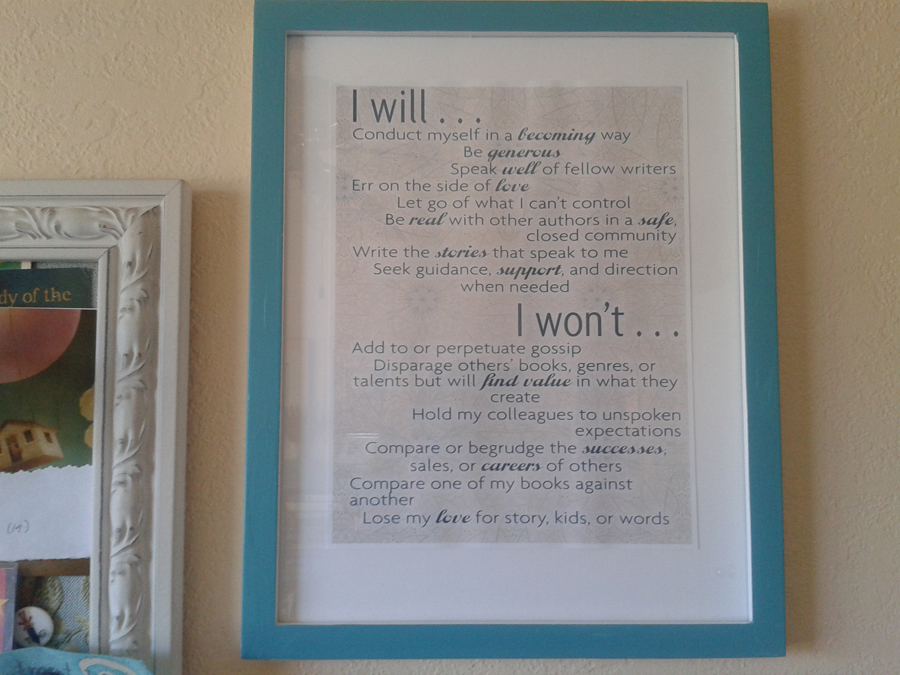
That's why I surround myself with things like this.
The lines about making good art are notes I took while listening to Neil Gaiman give the commencement address at The University of the Arts. 14 Ways to Make Mediocre Art comes from Emily Freeman at Chatting at the Sky (get your own cool copy here). The framed note I received in a packet of thank you letters after a school visit. "It's okay to be scared to write," it says. "I am too!"

To the right of my desk I've pinned this quote on the wall:
“Know that it is good to work. Work with love and think of liking it when you do it. It is easy and interesting. It is a privilege. There is nothing hard about it but your anxious vanity and fear of failure.
And when you work on your writing remember these things. Work with all your intellegence and love. Work freely and rollickingly as though talking to a friend who loves you. Mentally thumb your nose at the know-it-alls, jeerers, critics, doubters.”  -- IF YOU WANT TO WRITE, Barbara Ueland
Then there is this mini-poster I made, a response to all the thoughts rolling around in my head during my debut year. (Email me if you'd like your own copy!)
And other quotes I gather like sea shells, to pull out and examine when I need a boost:
"To make art is to sing with the human voice. To do this you must first learn that the only voice you need is the voice you already have. Art work is ordinary work, but it takes courage to embrace that work, and wisdom to mediate the interplay of art and fear." -- ART AND FEAR: OBSERVATIONS ON THE PERILS (AND REWARDS) OF ARTMAKING, by David Bayles and Ted Orland
"I am convinced that fear is at the root of most bad writing... . Good writing is often about letting go of fear and affectation. Affectation itself, beginning with the need to define some sorts of writing as 'good' and others sorts as 'bad,' is fearful behavior. Good writing is also about making good choices when it comes to picking the tools [words] you plan to work with." -- ON WRITING, Stephen King 
"Be an unstoppable force. Write with an imaginary machete strapped to your thigh. This is not wishy-washy, polite, drinking-tea-with-your-pinkie-sticking-out stuff. It’s who you want to be, your most powerful self. Write your books. Finish them, then make them better. Find the way. No one will make this dream come true for you but you." -- Laini Taylor
"Being an artist means: not numbering and counting, but ripening like a tree, which doesn't force its sap, and stands confidently in the storms of spring, not afraid that afterward summer may not come. It does come. But it comes only to those who are patient, who are there as if eternity lay before them, so unconcernedly silent and vast. I learn it every day of my life, learn it with pain I am grateful for: patience is everything." -- LETTERS TO A YOUNG POET, Rainer Maria Rilke 
How do you encourage yourself when writing is hard?

Friday, September 30, 2011

Reading about Writing

So I finally went out and bought myself a copy of Stephen King's On Writing. I devoured it in about a day. (Confession: This is the first book by SK I've ever read. I know! I know! What have I been thinking? I will remedy this fact soon, believe me!)

At any rate, maybe because writing is such a solitary profession, or it could be that a writer's imagination is wired to find "kindred spirits" in books - whatever the reason - I now feel like Stevie (yes, he calls himself that in the book) is my new BFF, wise mentor, and witty grammatical go-to-guy all rolled into one. Observe:

"Put your desk in the corner, and every time you sit down there to write, remind yourself why it isn't in the middle of the room. Life isn't a support-sytem for art. It's the other way around." (pg. 101)

SK's sage words stand on their own, but he doesn't leave it there. Later on, this warning against letting your writing consume your life will seem to be at odds with a reminder to take what we're doing seriously:

"You can approach the act of writing with nervousness, excitement,
hopefulness, or even despair - the sense that you can never completely put on the page what's in your mind and heart. You can come to the act with your fists clenched and your eyes narrowed, ready to kick ass and take down names. You can come to it because you want a girl to marry you or because you want to change the world. Come to it any way but lightly. Let me say it again: you must not come lightly to the blank page." (pg. 106)

ON WRITING is full of this kind of brilliance that spot-on names the tension we feel as writers, articulates the challenges of creating stories, and passes out English-teacherish lessons on quality writing. Don't wait as long as I did to give this a read.

And, do share: what other writing books can't you live without?

P.S. Thanks, Stevie! Looking forward to meeting up again when I reread your book.