Thursday, October 13, 2016

5 Lessons I Learned from NaNoWriMo by Caroline Starr Rose

It was with a bit of reluctance I decided to join National Novel Writing Month in 2013. For those of you unfamiliar with NaNoWriMo, it's a month-long challenge to produce 50,000 words on a new piece of writing. (Chris Eboch ran an excellent post on NaNo earlier this week.) I'd tried NaNo in 2009 and failed miserably. I never, ever was going to do it again. But that fall things came together in such a way that joining in made sense:
  • My verse novel, Blue Birds, was off with my editor
  • I was at the point with my research for a new novel that I was itching to get started
  • I read this blog post by Darcy Pattison
  • My critique partner, Valerie Geary, promised me peanut butter cookies if I made it through
I didn't sign up officially. Instead I created a contest of one I called Fake-o NaNo*, where I aimed to write 1500 words a day six days a week. I missed one day, had a good number of sessions I didn't hit 1500 (and a couple I wrote more), and felt finished with the draft a few days before Thanksgiving -- the exact day Blue Birds "flew" back to me in a big padded envelope.


Here are five things I learned from the experience:
  1. Slow and steady is my typical writing mantra. But sometimes fast and furious is just as important. Typically, I write verse novels and picture books. It's a sloooow process, especially when I'm initially drafting. But this novel was in prose, something I hadn't tried for seven or eight years. Throwing words on a page was a very liberating, non-committal way to reintroduce myself to this form. With my first NaNo attempt, I got stuck during the first week and decided to stop. This time around was no different. I faced the same impossible rut one week in. But I kept moving, mainly by sticking to the next lesson I learned.
  2. Sometimes you just have to write about the writing. While I'd kept a journal for this book since the previous spring, I still had a lot of exploring to do. Many days I found myself writing about what was working in the story and what wasn't. Things I'd have to look further into, characters I needed to add, relationships I needed to develop. Really, the draft became a running commentary, an in-the-moment chance to reflect on my ideas (or lack of them).
  3. Practice holds the fear at bay. The creative process is a scary thing for me, and beginning (and finishing) a first draft is my biggest challenge. By holding myself to a daily goal, I was able to break through some of that fear by simply showing up and doing the work.
  4. Embrace the mess. The "draft" I finished with was most definitely the messiest, worst thing I've ever written. But it was such a great experiment in getting words down, feeling out characters, and sometimes learning exactly what I didn't want to write about (by first doing just that). Knowing I could toss it all took me in some directions I might never have discovered if my approach had been more careful.
  5. Did I mention the cookies? Committing out loud to a friend kept me honest. And the cookies were a great pay off!

In February this NaNo novel hits the shelves as Jasper and the Riddle of Riley's Mine. As I think back to that draft I created three Novembers ago, the finished book holds little in common with it. But it was the starting place my story -- and my character -- desperately needed. Without that month of steady work, Jasper wouldn't be the boy he's become. I'm sure of that.

What are your plans for National Novel Writing month?


* I hadn't heard of the so much fancier "Faux NaNo" at the time, which I don't think is an official thing, just another name for a make-your-own version of NaNoWriMo.

Tuesday, October 11, 2016

On Knowing Enough To Know That We Don’t Know It All [PLUS EXCLUSIVE COVER REVEAL] by Stephen Bramucci


Five months ago, my publisher, Bloomsbury, told me they wanted to change the title of my first book. The idea was a shock to the system. The book had always been called Ronald Zupan and the Pirates of Borneo!, and I was deeply enamored with the Indiana Jones-ish, pulpy feel of that title.

As it turned out, the Bloomsbury team still wanted to keep the  “and the Pirates of Borneo!” bit—it was the narrator’s name they wanted to cut, in favor of something that would include the book’s other main protagonist, 11-year-old Julianne Sato. Something like The Adventure Crew and the Pirates of Borneo! or The Daring Duo and the Pirates of Borneo!

If there was a combination of adjective and noun, you can bet I tried it.

The Thrill Brigade.
The Peril Squad.
The Hazard Team.


Nothing felt quite right. My editor, Mary Kate Castellani, waited patiently.

In June, I flew to Thailand with my girlfriend. On the first day of the trip, riding in the back of a tuk tuk on the way to a train station, I was finally able to separate myself from the old name. To detach a little. I could see that for all of Julianne Sato’s hard work in the novel, leaving her out of the title would be a slight.

Almost instantly, a new title popped into my head, as if it’d been waiting there all along. I turned to my girlfriend. “The Danger Gang and the Pirates of Borneo!”

She was counting bills to pay our driver. “I like it.” She flashed me a smile. “Actually, I really like it.”

I repeated the title as we bought tickets. I muttered it again as we boarded a 1940s-era train. That night, I emailed the title to Bloomsbury.

Their reply came the next day: Everyone was all in on the Danger Gang.

***

A few weeks ago, I was chatting with my friend Jarret Myer, one of those rare folks whose expertise is having a sense of what’s cool. I told him that story because we were talking about how collaboration is essential to making art and sometimes you have to be willing to bend. Or at least I thought that was the point, until I started to leave and Jarret stopped me.

“Just so you know,” he said, “the new name is way better.”

“Yeah?” I asked.

“Put it this way: I’d pick ‘The Danger Gang’ up before I’d pick up the other one.”

When Jarret said it, I realized that I agree with him. The new name is more inclusive and fits perfectly with the book’s themes. It’s more big-hearted in its worldview. Ronald often idealizes himself as a solo hero, but in reality he’s not. Since he writes the book from the first person, past tense—after realizing that he couldn’t have succeeded on his mission without help—there’s no excuse for the old title.


I don’t put much stock in the notion of an author with a “singular vision.” I think we, as writers, can be overly rigid about our ideas and become myopic. The best luck we can strike is finding collaborators who will catch our blind spots. People who will urge us, as Mary Kate did when I was hesitant about the title change, to “Take some time and really think about this.”

We all like to talk about the writer’s toolbox. Perhaps one tool that too often gets neglected is the ability to recognize when someone else knows best.

***

With all that said, I’m thrilled to share the cover for The Danger Gang and the Pirates of Borneo. Like Ronald’s adventure, it hasn’t been a solo expedition. The illustrations (on the cover and inside the book) were done by the astoundingly talented Arree Chung—who has added constantly to the project by bringing awesome ideas and superb imagery to the table!


The Danger Gang and the Pirates of Borneo will be released in early August 2017.

Monday, October 10, 2016

Are You Ready to #NaNoWriMo? - Prep for National Novel Writing Month with Chris Eboch

During National Novel Writing Month (NaNoWriMo), thousands of people work on writing a rough draft of a novel in the month of November.

Why? How could you possibly write an entire novel (defined, for the purpose of this month, as 50,000 words or more) in a single month? More importantly, how could you possibly write a good novel in a month?

Writing a good novel is not the point. Maybe writing poorly sounds like a bad idea, but taking on this intensive challenge for a month has several advantages. The time pressure forces you to put aside your editor and critic hats and instead focus on getting words on paper. This helps some people avoid the insecurity that can come with starting a new project, or the temptation to endlessly edit the first few chapters instead of moving forward. Writing fast quickly gives you material to develop.

It also encourages you to schedule writing time – plenty of it, every week. It’s easier to give up TV, reading, and other hobbies for a single month. It’s also easier to get family members to adjust their schedule to yours if you are requesting a favor for a month, not forever. (You may even discover that your family, and the world, can function with less of your attention than you thought.)

So NaNoWriMo can get you jumpstarted on idea, give you a big, messy draft to work with, and help you establish new habits Even if you can’t devote the same amount of time to writing after November, maybe you can carve out some time every week.

Finally, the challenge provides a strong sense of community. You can network with other writers, encourage each other, and find inspiring blog posts or helpful tips to keep you moving for your project. (Just don't spend all your time reading about writing and talking about writing, rather than actually writing.)

Are You in?

The first step is establishing your own goal. Maybe you don't want to attempt the official goal of 50,000 words. For a middle grade novel, 30,000 words may be more realistic. That's *only* (?) 1000 words a day for the month! (Of course, you have to consider whether you can actually write seven days a week, and if you're in America, don’t forget Thanksgiving break.) Or maybe there's a cool that's better for you – writing for 15 minutes every single day, or making progress on a novel you've already started.

Making the Most of an Idea

If you want to be ready to write a novel in November, it’s best to start brainstorming and planning in advance. Even if you are a "pantser" who prefers to dive in and figure out your story as you go, you might avoid some time staring at a blank screen by brainstorming your basic idea and a few things that could happen. If you're a plotter, you might want a more developed plot outline before you begin.

Here's a condensed excerpt from my book Advanced Plotting to help you get started.

A story has four main parts: situation, complications, climax, and resolution. You need all of them to make your story work.

The situation should involve an interesting main character with a challenging problem or goal. Even this takes development. Maybe you have a great challenge, but aren’t sure why a character would have that goal. Or maybe your situation is interesting, but doesn’t actually involve a problem.

For example, I wanted to write about a brother and sister who travel with a ghost hunter TV show. The girl can see ghosts, but the boy can’t. That gave me the characters and situation, but no problem or goal. Goals come from need or desire. What did they want that could sustain a series?

Tania feels sorry for the ghosts and wants to help them, while keeping her gift a secret from everyone but her brother. Jon wants to help and protect his sister, but sometimes feels overwhelmed by the responsibility. Now we have characters with problems and goals. The story is off to a good start.

Tips:
·         Make sure your idea is specific and narrow. Focus on an individual person and situation, not a universal concept. For example, don’t try to write about “racism.” Instead, write about one character facing racism in a particular situation.

·         Ask why the goal is important to the character. The longer the story, the higher the stakes needed to sustain it.

·         Ask why this goal is difficult. The level of difficulty will vary depending on the length of the story and the age of the character, but the task should be believably hard.

·         Even if your main problem is external, give the character an internal flaw that contributes to the difficulty. This adds complications and also makes your character seem more real. For some internal flaws, see the seven deadly sins: lust, gluttony, greed, sloth, wrath, envy, and pride.

·         Test the idea. Change the character’s age, gender, or looks. Change the POV, setting, external conflict, internal conflict. Choose the combination that has the most dramatic potential.

Building the Middle

If a character solves his goal easily, the story is boring. To keep tension high, you need complications.

Try the “rule of three” and have the main character try to solve each problem three times. The first two times, he fails and the situation worsens. Remember: the situation should worsen. If things stay the same, he still has a problem, but the tension is flat. If his first attempts make things worse, tension rises.

This can play out in many ways in novels. In my first Haunted book, The Ghost on the Stairs, I made sure each ghost encounter felt more dangerous. As Tania tries to get closer to the ghost in order to help her, Jon worries that she will go too far and be injured or even killed. With enough variety, you can sustain this kind of tension indefinitely (witness the ongoing battle between Harry and Voldemort in the seven-book Harry Potter series).

You can worsen the situation in several ways. The main character’s actions could make the challenge more difficult. In my children’s mystery set in ancient Egypt, The Eyes of Pharaoh, a young temple dancer searches for her missing friend. But when she asks questions at the barracks where he was a soldier, she attracts dangerous attention from his enemies.

The villain may also raise the stakes. In my Mayan historical drama, The Well of Sacrifice, the main character escapes a power-hungry high priest. He threatens to kill her entire family, forcing her to return to captivity.

Secondary characters can cause complications, too, even if they are not “bad guys.” In The Ghost on the Stairs, the kids’ mother decides to spend the day with them, forcing them to come up with creative ways to investigate the ghost while under her watchful eyes.

Finally, the main character may simply run out of time. At her first attempt, she had a week. At her second attempt, she had a day. Those two attempts have failed, and now she has only an hour! That creates tension.

Tip: For each turning point in the story, brainstorm 10 things that could happen next. Then pick the one that is the worst or most unexpected, so long as it is still believable for the story.


For more help, see my blog posts on Developing Ideas and Plotting on my Write like a Pro! blog. You might also be interested in the Time Management tips. Or check out my book Advanced Plotting for the advice on getting started and various ways to outline your novel.

Don't worry if you wind up with a big messy draft. That's what National Novel Editing Month (NaNoEdMo) in March is for. You even get to rest for a couple of months before doing that.

Still, if you've developed some good writing habits… try to keep them going!


Chris Eboch’s novels for ages nine and up include The Eyes of Pharaoh, a mystery in ancient Egypt; The Well of Sacrifice, a Mayan adventure; The Genie’s Gift, a middle eastern fantasy; and the Haunted series, about kids who travel with a ghost hunter TV show, which starts with The Ghost on the Stairs. Her writing craft books include You Can Write for Children: How to Write Great Stories, Articles, and Books for Kids and Teenagers, and Advanced Plotting. Learn more at www.chriseboch.com or her Amazon page, or check out her writing tips at her Write Like a Pro! blog.

Thursday, October 6, 2016

TEN REASONS TO FINISH WRITING YOUR NOVEL


1. There’s a child out there whose life will be forever changed, enhanced, uplifted after reading your book.  

A parent as well.


2. Your husband (or wife) won’t have to deal with your moping.

3.  Your dog won’t have to deal with your moping.  (Or your cat, goldfish, orangutan or yak)


4. You won’t have to deal with your moping.

5.  All the revenue generated by your best seller will single-handedly prevent Barnes & Noble from closing down 23 stores. 


A statue of you will be erected outside the B & N nearest your house.  Pigeons will perch on it in the noonday sun and owls at night.


6.  The joy of completion, the intoxication of finally reaching the finish line, is an experience to which you are entitled.  You have paid your dues.


7.  You’ll pump new blood into children’s literature.

8.  ‘What if’ will be forever deleted from your vocabulary.

9.  Your agent will use her cut of the profits to put her daughter through med school and the daughter will go on to discover a cure for cancer, which never would’ve happened if you had tossed your manuscript in the trash and eaten three pints of Haagen-Dazs ice cream.


10.  You can finally move on to your next book.  Then your next book can stop seeing a therapist.  Are you aware that your next book has been in therapy for years because it’s afraid that it doesn’t exist?  Your next book is a basket case.  It has high blood pressure, low self-esteem.  It thinks you hate it.  It wonders what it did to offend you?  Show it some love.  Finish your current novel and wrap your arms around the next one.

Monday, October 3, 2016

Writing Funny on Purpose by Jim Hill


“Humor can be dissected, as a frog can, but the thing dies in the process, and the innards are discouraging to any but the pure scientific mind.” – E.B. White 

Writing funny takes a knack, but like any craft, there are techniques you can learn to let your silly out. The trick is, well there are a lot of tricks, but maybe the most important one is listening. Listening to what makes you laugh, and how that might be a bit different than the gut-buster your friends and family love.

What I'm saying is, humor is subjective with a side order of formulaic and a twist of the absurd. Like the infamous line about obscenity, "I know it when I see it."

[INSERT FUNNY CAT VIDEO HERE - Ed.]
[No. - Jim]

Maybe funny is a mindset. A way of looking at and responding to the world that is intentionally off-kilter. If writing reflects the real world–art imitates life–then writing funny on purpose breaks the rules of physics. The angle of incidence does not equal the angle of reflection. The degree to which you alter that formula defines the humor, taking it from the subtlest satire to the broadest slapstick. The world recorded by way of a funhouse mirror.

Back to listening. And by listening, I mean reading (but also I mean listening). Learning to be funny means exposing yourself to the funny. Fortunately, we live in a golden age of exposing yourself. [JIM! - Ed.] With content-on-demand finding comedy has never been easier. Better still, the spectrum of comedic voices is much broader than it was back in your grandparent's day when Uncle Milty was "the man" on that one TV channel. Which means you can find the things that make you laugh and learn from them, the same way you discover how to be a Newbery Award winner by reading your Kate DiCamillo collection into dog-eared, high-lighted, broken-spine relics of devotion. Or is that just me?

I'll get you started with a few of my favorites.

Finally, The Funny Links

The Comic Toolbox – Although it fulfills its promise to provide the rules and structure of comedy, this book also sneaks in quite a bit about writing in general. Vorhaus' light tone and banter walk the reader through a progression of comic tools to instruct on the techniques and provide the vocabulary of critique and analysis.

What Are You Laughing At? – If you've ever wondered if comedy can be scientifically analyzed, this is the book for you. Dan O'Shannon breaks down the ha-has of humor the same way Nate Silver attacks polling data. It's a deep study, but well worth the time. Perfect for the Ravenclaw that wants a little more Hufflepuff in their writing.

(Not So) Rando Resources That I Found

Now that you're a comedy expert, in the same way that you're an architect because you built that LEGO Fallingwater with your nephew, it's time to hear from the professionals.

Poking a Dead Frog – In this book, Mike Sacks interviews a wide array of comedy writers. There's a lot of background on breaking into TV or film, but there's also kernels of humor truisms and nuggets of hilarity. Most of the interviews are short, perfect for my attention span, so this book makes an excellent bathroom reader. [Jim, I'm scheduling a meeting for you with HR. - Ed.]

Funny Business – Subtitled "conversations with writers of comedy," Leonard Marcus pitches this collection at younger readers and includes many favorites of the middle-grade set. Beverly Cleary, Norton Juster, Daniel Pinkwater, and Jon Scieszka, to list a few.

By Ken Levine – Ken Levine wrote episodes of MASH and Cheers. That ought to be enough of a comedy pedigree to get your attention. His blog features a lot of behind-the-scenes craft-based stories about what goes into writing sitcoms, and that stuff translates into middle-grade humor very easily. Worth checking for his Friday Questions, if nothing else.

The Writers Panel – This podcast isn't always focused on comedy, but there are almost always great insights into serving an audience well-crafted stories. And even when something isn't a straight-up comedy there's often humor in the mix. Ben Blacker and the panelists dig deep. Have a notebook handy.

WTF with Marc Maron – NSFW, but if you can get beyond that issue, Maron's interviews with comedians both contemporary and legendary are fantastic. Almost never craft focused, but if you're wondering about how to be funny, getting a look into the mind of funny people might help.

Congratulations, You Are Now Hilarious


So that's it. Go forth and be funny.

[Really? That's it? - Ed.]
[Fine. - Jim]

What's Made You Laugh Lately?


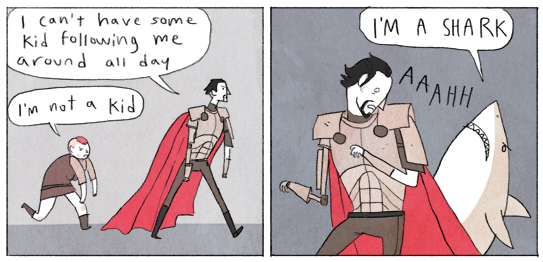
Wait! Before you go, tell me the last book you read that made you laugh out loud. For me, it was Nimona by Noelle Stevenson. Okay, your turn.


It's Cat Video Time!

Play me off, Keyboard Cat!


[Thank you! - Ed.]
[You're welcome. - Jim]