Wednesday, June 29, 2011

Rules Are For Suckers!


Okay, the above statement is not exactly "true", but hopefully I can explain what I mean. I've been thinking about all the rules were told to follow as writers. Team Member Michael Winchell did a post on this earlier in the month, about all the things were told are bad  to do as writers and I have to say, while writing my first novel I threw all the rules out the window and not because I wanted to--I had to.

When we write a novel, the goal is to create an extraordinary world (realistic or fantasy), remarkable characters, and an unforgettable voice that draws readers in and keeps them wanting to know more, consequently turning every page of our novel until they get to the end and become very, very sad that our book is over and they have no more left to read. 

For the above reason, I threw caution to the wind, killed my first (and second) draft of Nightshade City, and started fresh, this time with my voice and mine alone--and of course my rules. I threw out the notion that prologues should be avoided (yes, my book has one), that all adverbs are evil, to never use the word suddenly (still use that when I feel the need), and that "said" should be the only word used to carry dialogue (there are a few more that work quite nicely), among other steadfast rules.

Once I did that, I freed myself of doubt...all the doubt first time novelists have about writing and what they should and should not do, and the thought of being laughed at by agents and editors, as they all stand around the proverbial water cooler, snickering about the greenhorn writer who was ridiculous enough to send them a novel with a prologue--oh how gauche!

But guess what? That never happened. Not one agent said you've broken so many rules you are permanently banned from writing. And no one said, "Listen you silly, tacky girl--don't quit the day job." Shortly after I chucked those rules and wrote Nightshade City, my way, I started getting several requests from agents for more, which resulted in representation and lucky for me publication.

I guess in a nutshell, what I'm trying to say is writing without rules is a sure way to bring your true voice to the paper. And I'm NOT saying the rules don't matter. For obvious reasons, they do. You just need to write your book on your terms, with no set rules hanging over your head, impeding your thought process. Once you've done that, you can tighten up your manuscript and at that point you can give much thought to the rules you do want to follow or that do make sense for your story, but at the same time keeping your unique and original voice.

Of note, opening a book with the weather is a rule I do follow (at least for now), but this rule was broken by English author Edward Bulwer-Lytton who wrote Paul Clifford. "It was a dark and stormy night..." Clearly even breaking this rule worked for him. :)

xoxo -- Hilary

Monday, June 27, 2011

Recycling Old Manuscripts, Rose-Family Style

Cut in half.

Rustle up some silly kids.

Spread out on the kitchen table.

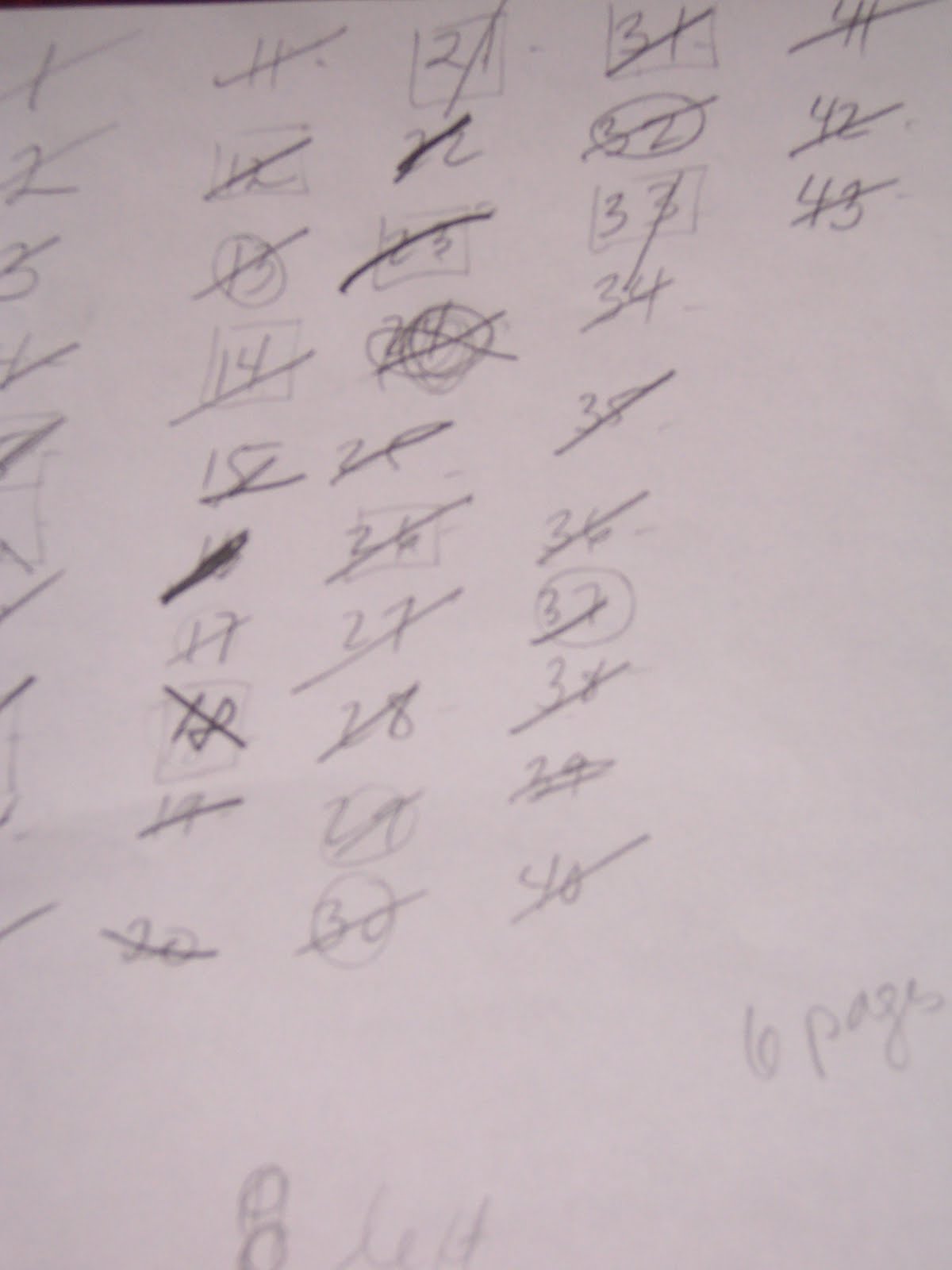
Set up a chart.

Number your pages.

Create a Choose Your Own Adventure Story.


(Ours is called THE BLACK DOOM and includes a haunted castle with a parking lot, an eyeless lifeguard [who later gets olives as eyes], lots of gorillas, a pool full of raspberry Jello, and an annual haunted castle pizza party).


Staple.


Enjoy!

Friday, June 24, 2011

Writing with Taste

In L. M. Montgomery's Anne of the Island (pausing so all of us dedicated LMM fanscan collectively applaud), Phil says the following:

"The [Pickwick Papers] always make me hungry...There's so much good eating in it. The characters seem always to be reveling on ham and eggs and milk punch. I generally go on a cupboard rummage after reading Pickwick. The mere thought reminds me that I'm starving. Is there any tidbit in the pantry, Queen Anne?"

Y'all know exactly what she's talking about, don't you? Rowling's description of Honeydukes comes to mind. P.D. James mysteries inevitably make me want to go get a coffee (even though the caffeine puts me over the edge) and something with curry in it. Most epic fantasies end in me cooking beef stew with a loaf of crusty bread and a wedge of cheese. What scenes make you want to rummage through your cupboards and hunt up a tasty snack?

Including good eats in our writing is an easy (and enjoyable!) way to heighten the detail of a scene. Why not add a quick note about what your characters are eating when they sit down to discuss the latest gossip? Give her a bag of Doritos to munch while she's contemplating Big Problem in her life. Have her peel potatoes in the kitchen or sneak a taste of a just-made cake's frosting while she chats with her mom.

Just make sure you've gone grocery shopping before you work on these scenes. You don't want to go on a vigorous cupboard rummage and come up empty-handed. ;)

Wednesday, June 22, 2011

Highlighters, coloured index cards & gel pens, oh my!

(Side note: who says "oh my" anymore? Not any young'uns, that's for sure. Oh and plus, this post is looong. So maybe... don't read it on your lunch break?)

I have a stationery fetish.

 In fact, I'm writing these very words on gorgeous paper that can only be defined as orchid (aka purple). I take any opportunity to use my rawksome old-fashioned writing utensils. Yeah, that's right, I actually write on paper. And this is the Millenium baby you're talking to! In my opinion, there's no better way to put your hand muscles to work than when outlining. Here's a colourful method to try. (And, since this post turned out to be way longer than I thought, I gave you subtitles! Yay!)

index cards + setting = highlighters + characters

Assign each setting in your novel an index card colour, say orange for school, blue for home, red for the water park, etc. Write down a summary sentence for each scene on its respective colour and lay them out in front of you. What do you see?

If there's a lot of orange, then you know you can take the time to develop your protag's school life more in-depth. Add some teacher names, describe a favourite (or hated) class, maybe even a little description about the barf-coloured bathrooms? My point is: if one setting is particularly important, make it interesting, make it reactive. Make it alive. Setting is a powerful element you can manipulate, and coloured index cards will help you do just that.

Now assign each of your secondary characters (basically, everyone except your main character) a highlighter colour. Mark every scene with the colours of the characters present and then take a gander. Just like with your settings, identify which secondary characters are most essential to the story and make them distinctive. Consider giving them some backstory, or conflict amongst themselves. An active setting is a treat, but active characters are a must.

gel pens + small stuffz = OMG I WANT THAT GLITTER PEN.

Now that you've got some of the big-picture stuff down, arm yourself with those gel pens -- oooh, is that a sparkly teal blue? Here, I'll trade you my hot pink for it. Pretty please? What? Keep going? Oh right, sorry. Got sidetracked. Ahem. *clears throat*

We're going hunting for adverbs, telling vs. showing and dialogue tags. Underline any adverbs you find in, say, purple, any passages full of telling where you could be showing in yellow, and dialogue tags in green.

Look over each purple mark and ask yourself if those adverbs really are necessary. Same with the dialogue tags -- can the conversation carry itself after a while? And for yellow passages, decide whether showing or telling would be more effective. Sometimes it is the latter, but those occasions must be judiciously identified.

conclusion. Because my high school English teacher always tells me I need one.

By now your hands are probably smeared with glitter and your floor might be littered with index cards. But hey, who ever said a creative mind is an organized one? ;)

Tuesday, June 21, 2011

Writers Matthew MacNish and Paul Greci join PROJECT MAYHEM!

TEAM MAYHEM is excited to announce the addition of two more writers! Starting next month, Matthew MacNish and Paul Greci will be adding to the fun, evening out our boy vs girl numbers a bit, as the Team Mayhem boys were sick of getting beat-up by us girls!
Ha, ha!

About Matt:
Matthew MacNish is the father of two beautiful young ladies, three lazy cats and one adorable German Shepard. Together they live in the mountains of north Georgia amidst his endless collection of vinyl records, Lord of the Rings memorabilia, Star Wars figures, and books about swords. You can find him on his blog, Facebook, and Twitter.


About Paul:
Paul grew up in northern Indiana where he spent as much time as he could on the Lake Michigan shoreline. After high school Paul discovered mountains. He worked his way west and north, and after a five year lay-over in California, settled in Alaska, where he’s lived for the past twenty years. When he isn’t teaching English or writing YA and MG fiction or figuring out how to keep the moose out of his vegetable garden, Paul roams the mountains and paddles his kayak on the coastlines, watching bears catch salmon and sea otters cracking mussel shells. His middle grade novel, Stranded, a survival story set in the Alaska wilderness, is a finalist in the 2011 Pacific Northwest Writers Association’s annual contest. blog  twitter facebook

Please everyone, give our new guys a warm welcome! Follow their blogs and stalk them on twitter and facebook! I know they are both going to have great insights on  middle-grade writing and will hopefully be able to get us girls in-line! Okay, yeah...not likely on the getting us girls in-line part, but it sure sounded good!

xoxo -- Hilary