Showing posts with label getting published. Show all posts

Thursday, November 16, 2017

A Continuation on Rejection Letters, by Hilary Wagner


These are my REAL rejection letters from 2009-2010.


Just last week, Kell Andrews did a great post on rejection letters. Below are some of the general responses she received. 

Thank you for your submission
Thank you for your patience
No reflection on your work
No reflection on you
I don't feel passionate
I don't feel connected
Not a fit at this time
Not a fit for my list
Sorry for the delay
Sorry for the news
Sorry

As some of you have read in previous posts, I too was rejected so many times I'd be rich if they were counted in dollars. Here are a few of my rejections to add on to Kell's list. 

I don't believe in anthropomorphic animals.
Too many characters.
Too gritty.
I hate rats.

I think the funniest rejection letter was the one I received from an agency about 6 months after my first book was published and in stores. That one made me laugh out loud.... BEST. REJECTION. EVER! 

That said, along the way, I did get one very special rejection from an agent at a well-known children's agency. She rejected the manuscript after reading the whole thing, but gave me the most amazing insight and really pointed out some issues I couldn't see from where I sat in the author's chair. 

Every once in a while you get lucky with an agent who rejects you, but gives you valuable feedback. Her advice made me change some major items in the manuscript. Did this lead to it getting picked up by another agency? I think so. The thing that got me the most, was this agent, who owed me absolutely nothing and could have easily have given me one of those generic rejections, took the time to really help me. That's rare and it's special and even though you might receive 100 generic rejections, you're bound to receive one or two that are really helping hands, so take advantage. 

After I signed my contract, I emailed this agent to let her know and to thank her. She was very happy to hear about it and her exact words were, "I knew there was something there!" 

And yes, I did mail her a copy of the book! 

KEEP MOVING FORWARD! 

Hilary

Monday, August 7, 2017

A Conversation with Rejection by Linda Williams Jackson


Me: Hi, Rejection! Welcome to Project Middle Grade Mayhem! (I think….)

Rejection: Thanks, Linda! I’m VERY happy to be here. I’ve known many of you Mayhemmers for a long time. (Howdy, Caroline Starr Rose!) As a matter of fact, Linda, you and I go waaaay back.

Me: Hold up…. Let’s get something straight. Yes, we’ve known each other for a long time, since the early 1990’s, tbh. But that doesn’t mean we go way back. Going waaaay back, in my opinion, denotes a certain level of friendliness. And you, Mr. Rejection, are no friend of mine.

Rejection: Oh, touchy, aren’t you?

Me: You should know. You’ve made me cry a few times, haven’t you?

Rejection: A few times? Girl, please. I made you cry a whole lotta times.

Me: And now you’re bragging about it?!?!

Rejection: Not bragging. Just stating the facts. Here’s the deal, sweetheart. My job is to make people better, more specifically for the purpose of this conversation, to make you guys better writers.

Me (under my breath): Do you have to be so ruthless about it?

Rejection: I heard that. And the answer is yes. I can’t let you guys off easily. No pain, no gain, baby. I mean, would you have ever written Midnight Without a Moon if I had let you get that little funeral home story published?

Me: Hey, don’t make fun of my funeral home story. I love that story!

Rejection (under his breath): Obviously, you queried it for five and a half years.

Me: I heard that.

Rejection: Good! I’m glad you heard it. I hope you learned something from all that pain I put you through. Otherwise, my time has been wasted.

Me: Oh, I learned plenty. Thank you very much.

Rejection: Such as?

Me: Don’t get stuck on one project, no matter how much you love it. And regardless of how many agents have requested the full and provided positive feedback, or how many pitch contests the project has won, I should have been seriously writing more projects and querying them.

Rejection: But you did write more manuscripts. I remember doing my magic to make sure those were under my spell too. You didn’t get anywhere with them.

Me: I know. But I realized I had gotten to the point where I wanted an agent more than anything else in the world. My focus was all wrong. I was writing to get a “yes” instead of writing to tell a story that I felt like people needed to hear, or read, rather.

Rejection (smiling broadly): Awww. I feel like a proud papa. That’s exactly what I was hoping to accomplish by putting you through the wringer the way I did.

Me (rolling eyes)

Rejection: What else did you learn?

Me: Humility.

Rejection (clapping): Bravo! Another score for Rejection! I really know how to knock the pride out of you guys!

Me (under my breath): And the wind too.

Rejection (laughing): Sorry about that.

Me: Sure you are.

Rejection: Remember that time I made you break down and cry right in front of your computer? I mean, that rejection stung so hard that you hadn’t even finished reading the email before you started bawling.

Me: But, I survived.

Rejection: Yes, you did. You were a real trooper…simply unstoppable.

Me: Well, I don’t know about unstoppable. I think I was ready to quit. If you hadn’t stopped coming at me in 2015, I might have given up.

Rejection: Wait! What?!?! You mean I was THAT close to breaking you?

Me: Yep. You sure were.

Rejection (slaps forehead): Aw, man! One more year, huh?

Me: Yep. That’s what I was giving myself.

Rejection: You’re saying that now, Linda. But as I recall, you said that every year. “Just one more year. If I don’t make it this time, I’m quitting.”

Me (chuckling): I did say that, didn’t I?

Rejection: Yep. Every year. Actually, you said it after every full request, too. You said, “If this one isn’t ‘the one,’ then I’m done.” Then I’d show up. Then you’d cry. Then you’d go listen to some inspirational song or read some inspirational post. Then you’d be right back at it the next day.

Me: I was pretty stubborn, huh?

Rejection: No, honey. You were resilient. (Gestures around the Mayhem blog) You all were. I tried to break you guys, but you just kept going. You were all so determined.

Me: Why, Rejection? Why do you put people through all this? I know you said to make us better writers and to make us humble, but why make it so hard? Don’t you trust that we’ll improve our skills and appreciate our success without so much pain?

Rejection: You read The Last Lecture by Randy Pausch, right?

Me: I did.

Rejection: Remember what he said about brick walls?

Me (Googling): He said, “The brick walls are there for a reason. The brick walls are not there to keep us out. The brick walls are there to give us a chance to show how badly we want something. Because the brick walls are there to stop the people who don’t want it badly enough.”

Rejection (wiping tears from his eyes): I’m sorry I hurt you so badly, Linda. I’m sorry I hurt all you guys, Mayhemmers. But do you now understand why I did it? You guys wanted this badly enough to take everything that I threw at you. You were unstoppable. And I am very proud of you. But please know that my job is never completely done. You will still face rejection. But I know you will persevere. All of you, because you are winners.

Me: Thank you, Rejection, not just for being here with us at Project Middle Grade Mayhem today, but for being present with us during our writing journey. Thank you for showing up when we needed you even though we didn’t want you there. You were like a helicopter parent who knows what’s best for her kid even when the kid doesn’t realize it at the time. You made us better writers. And because you humbled us, we don’t mind helping others along the way. No offense, but you are both hated and loved at the same time.

Rejection: No offense taken, my dear. I’m just happy to do my job. Now I must leave you guys. I have some dreams to try to crush. Good bye.
Me: So long, Rejection. I’m not looking forward to seeing you again any time soon.

Monday, March 6, 2017

I SENT WHAT?! by Hilary Wagner


We've all done it. I don't care how well published you are or how new to the industry you are, but we've all sent something out with a big fat humbling and in most cases highly visible typo--and many times more than one. It's unavoidable. No matter how many times you read through a manuscript, you are bound to miss things. It's simply part of being human and how the brain works.

Now then, If you've recently sent a manuscript out to an agent or editor and realized you've left in some conspicuous typos, don't freak out. Take a step back and know that it happens to everyone. Besides, if someone was going to bounce you out of consideration for a typo or two (or even a couple more) in your 250 page manuscript, possibly it's someone you wouldn't want to work with anyhow. Clearly, there are flagrant typos, wherein the reader is tripping over typos in every paragraph, that's not going to fly, but everyone, from writers, to agents, to editors, miss things now and again. After all, we are only human and if humans were perfect, there would never be typos in published books--bestselling books--books that have been combed through by the author, the editor, readers, and copy editors, BEFORE they hit the shelves. In other words, it happens. It does. Period.

Tips for catching typos:
Print it out: Print out the full manuscript. Somehow a lot more typos slip by the naked eye staring at a monitor than when you hold the physical manuscript, knocking out typos like Mike Tyson with your almighty red pen.

Read your work out loud: This requires you to read every word from start to finish. Time consuming and dry throat inducing? Yes, but a lot more effective than skimming through it silently.

Let your work sit a while: This is a hard one for me, as I'm about as patient as a starving bear, but do it. Even if it's just for a few days, let your work sit. This will cause you to read your words more thoroughly and thoughtfully, rather than flying through something you were just working on.

A second set of eyes: When time permits, I always have my husband read through my work before I send it off. Since he's reading it for the first time, it's far easier for him to catch "to" versus "too" than it would be for my eyes, which at this point in the process, have gone blind to the little things.

Okay, truth time. In my first manuscript I had typos. After I caught them (which was after I hit "send") I sat at my laptop and cringed, wondering how on earth I could have missed something so glaringly obvious. I probably read through the manuscript at least 50 times, but there they were in all their glory, "shutters" instead of "shudders", "there" instead of "their". You get the picture. I wondered if I'd be automatically rejected based on this, but I learned editors get it. They understand how things get missed. It's about your impelling story not your misspelling of "accommodate".

In the end, I got published! Luckily, the typos did not. ;)

Long story short, there will generally be normal inconsequential typos somewhere in something you send out. Don't sweat it. It doesn't change your story or your hard work. It only makes you human.

PS: If there are typos in this post, please blame someone else. :)

Hilary

Monday, May 20, 2013

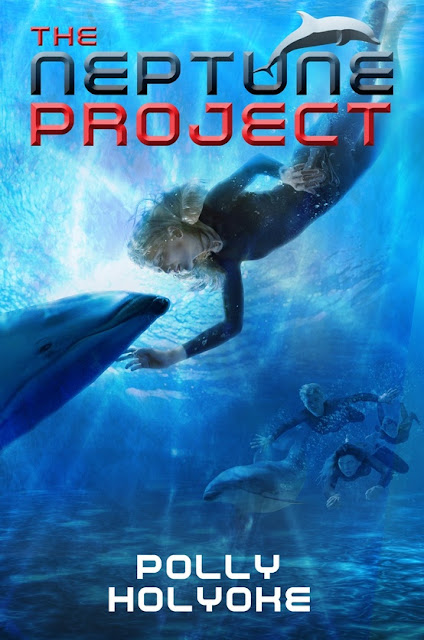
An Interview with Polly Holyoke, Author of THE NEPTUNE PROJECT

Polly Holyoke - THE NEPTUNE PROJECT
Disney Hyperion and Puffin Books UK
May 21, 2013

What inspired you to write this story?
I’ve often wondered where our species would go if we so totally foul up the land of our planet that we render it unlivable. It’s always seemed logical to me that eventually we would try to live in our oceans. After all, five-sixths of our planet is covered by seas. But first we would need to figure out a few small technical problems… such as how to breathe water! Genetic engineering takes care of that challenge very conveniently for the characters in THE NEPTUNE PROJECT.

What was your publication process like from initial idea to sale?
I was fortunate to have a relatively quick trip for this particular project. I wrote ten chapters and started marketing a proposal for THE NEPTUNE PROJECT, and my agent’s assistant wrote back shortly after Sterling Lord Literistic received it. He said they wanted to see the rest of the novel RIGHT AWAY. The funny thing was, I had completed six children’s novels before this one, and they asked to see the one novel in my closet that I hadn’t completed! I wrote and wrote and had the whole of the story finished four months later. Then I had a nail-biter of a fall waiting to hear if the main agent liked it, and HE DID! He sat down and read it in a day, and he staged an auction for it a week later. Then he pulled off another wonderful coup and sold the book to Puffin Books UK, so I started off with a foreign sale. I still can’t quite believe I’m getting paid twice for the same work, and that kids in the Commonwealth countries around the world are going to be reading my books!

What books shaped you as a reader and writer, from childhood to present?
I have always loved fantasy and science fiction. I read lots of C.S. Lewis and J. R.R. Tolkien, and later I loved Ann McCaffrey’s dragon books. I think reading so many books with excellent world-building in them helped me to understand how important that aspect of science fiction is.

What is one thing people misunderstand/tend to misunderstand about science fiction?
Sometimes sci/fi authors have incredible premises, cool technology and non-stop action, but the very best sci/fi, in my opinion, includes unforgettable characters. THE HUNGER GAMES works so well because Katniss is such a strong and well-developed character with plenty of issues and flaws.

Are you working on anything new?
I recently completed Book 2 in the Neptune series for Puffin UK, and I’m hoping they’ll want a third book which I already have plotted. But in the meantime, I’m always jotting down ideas for new stories. I sometimes wonder if the creative well might run dry for me, but somehow my subconscious is most obliging and new concepts and premises keep bubbling up!


Thank you, Polly, for joining us today! Best of luck with your debut.

Wednesday, January 11, 2012

Rushing towards that dream? Wait.

So for some writers, the ultimate dream is to get published. The path there may differ, of course: get an agent, get picked up by one of the Big Six; self-publish; go with a small press. Whatever it is, the years of long hard work and patience all seem to culminate in the golden prize of being a published author.

That's how it is for me, too. But it shouldn't be all about your name on the hardcover. So I asked a few middle-grade authors:

What do you miss most from when you were an unpublished, unagented writer?

From Kate Messner, author of Sugar and Ice and The Brilliant Fall of Gianna Z.:
The thing I miss about being an unpublished, unagented writer is that feeling of anticipation, I think...the knowing that that first phone call would come if I worked hard enough and persevered. It’s funny because I think that waiting can be the most frustrating thing about that stage in one’s writing life, too — but I also know that you only get one first book, and hearing the news of that first sale on the phone is something I’d love to go back and experience again. It’s the moment when a dream comes true.


From Jonathan Auxier (remember him, guys? we reviewed his book a while back), author of Peter Nimble and His Fantastic Eyes:
That is a wonderful (and complex!) question. I don't miss anything about being un-agented, save the complete ignorance of just how hard it is to get something you've written out into the world. However, there is one thing I miss about being unpublished: before I had a book in the world, I had no real sense of my audience. Audience was an abstract idea that couldn't be pinned down and had little say in my storytelling. With the publication of Peter Nimble, however, I've suddenly found myself writing stories with specific readers in mind. It's hard to type a sentence without thinking: I wonder what Librarian X or Critic Y will think of this? While such thoughts may be helpful during revisions, they can be crippling to the early stages of the creative process.


From Stephen Messer (remember him, too? we interviewed him), author of The Death of Yorik Mortwell and Windblowne:
This is a tough one. You work so hard to get to the point where you're a published author that your first instinct is to say you don't miss anything about the period where you were working on the seemingly hopeless task of writing this novel that may not be any good and that no one would ever want to read (you imagine). But that wouldn't be true. I do miss writing purely for the act of creation, without any thought to sales or business or placement in chain bookstores or any of the other things you can't control but still find yourself thinking about once you've got a contract. There's a freedom in knowing you can write whatever you like, taking all the time you like, and simply run wild without consideration of the bottom line. But as far as problems go, this is still one I'll gladly accept!


Anticipation, lack of an audience, and no creative boundaries... those all sound like excellent reasons to me for appreciating your time as an unpublished writer. What do you think?

Friday, December 23, 2011

Holiday Hope & My REAL Rejection Letters


On Wednesday, I posted on my own blog about the mountain of rejection letters I received while trying to find an agent for Nightshade City. I've reposted it here today and I think after you read it, my reasons will be clear. Around this time of year, I'm hopeful we can shed a bit of inspiration for those currently in that uphill battle to get published. With any luck, my story will help.... :)

This is not some random picture I pulled off Google, these are the actual rejection letters I received from literary agencies from 2008-2009. There are about 75 letters in all, not to mention 100+ email rejections. I'm sure you can do the math. I wanted to toss these into the trash as even now they're a bit hard to look at, but my husband forced me to keep them. He said I'd be happy I did later on, and he was right. Since my first book, Nightshade City, was published, it's won the Westchester Fiction Award for 2011, it's been named a CBC Best Book of 2011, and is a Goodreads Choice Award and SCBWI Crystal Kite Finalist for 2010. I'm invited to speak to kids and other writers on a regular basis and they actually are interested in what I have to say, which is pretty darn cool for a girl who four years ago decided to write a random book about rats--of all things. Nightshade City also resulted in my job with National Geographic, as a Nat Geo editor read it and then contacted me to see if I'd be interested in writing for them. I guess what I'm trying to tell you guys is it's darn hard to get published, but my story is one of the many examples that it is entirely possible and there are many good things to come if you can weather the storm.

Around this time of year we all wonder about our goals in life and if we'll ever reach them. I cannot say I didn't get defeated back then, with my ever growing pile of rejection letters, but I can say, I didn't give up...so don't you do it either.

I mean it. Don't give up or I will hunt you down and slap you around a bit! 
 
Me holding my first copy of Book II
of the Nightshade Chronicles,
The White Assassin
 

Friday, April 29, 2011

Two roads diverged in a yellow wood...

There was a time when publishing a book pretty much meant one thing for an author: find an agent (optional, but helpful), get a publisher to say “yes” (never easy), and then wait for your “baby” to grace the shelves (usually at least a year in the waiting for this step). For many authors, this is still the preferred road to take, but let’s face it, the times they are a-changin’ (thanks, Bob Dylan). Nowadays, thanks in large part to the convenience and user-friendliness of modern technology, many authors are choosing a different road, “the one less traveled by” (thanks, Robert Frost), and that road is self-publishing.

While there are many authors who have found success via the traditional road, the field of authors who are finding success using the self-publishing road is growing every day (traffic is picking up). With this in mind, I wanted to invite an author who recently made the decision to jump from one road to the other and self-publish. To that end, take it away Anita Laydon Miller. Tell us about your journey on the road “less traveled by.” 

Anita Laydon Miller
Thanks, Michael. First of all, I want everyone to know I respect people who dream of traditional publication. It’s a beautiful dream and I wish everyone the best in making that dream reality. And I do not dislike or mistrust agents, editors or publishers…these people have given me treasures in the form of books I’ve read.

Here’s my story:
You know how sometimes when you view a situation through someone else’s eyes, the situation becomes clear? That’s what happened to me.

A couple years ago, I decided I wanted to be a published author, and so I began researching. I learned I needed to write a great book with a unique premise and likeable characters. Then I needed to find a kick-ass agent who would provide me with suggestions to make the manuscript more marketable. Once the suggestions were incorporated, the kick-ass agent would find a publisher for my book. I’d work for several months with an editor at the publishing house, and about a year after the book was edited, it would appear on the shelves of the major bookstores. Then I’d work my tail off marketing the book, but I probably wouldn’t make much money.

I explained the above to my husband, a pragmatic FedEx pilot (with an honest-to-God degree in rocket science) and he was like, “What? You’ve got be kidding me.” I assured him I must follow the publishing rules, and he shrugged and watched the kids, and I wrote.

Lucky me (and I know that sounds sarcastic, but it’s not), I hooked a great agent…she was professional, savvy and fun. We made some changes on my middle grade mystery and she submitted it to about 15 editors. They all said, “No,” but with some positive feedback like, “I want to read everything else she writes.”

Still, I started getting a little suspicious of the process at this point, because in the comments that accompanied the rejections, the editors were often in complete disagreement with each other. I knew it was a subjective industry, but when one editor says something like, “It’s too scary,” and another editor says, “It’s not scary enough,” it gives a person pause.

My husband was especially thrown off by this, but I assured him that’s the way things are done and that I must move on.

So, not to be dissuaded, I started work (also as part of my MFA requirements) on another book—a middle grade science fiction. When it was time to submit, my agent and I decided to send it to only a few editors. The manuscript got rejected, but with some great comments. One editor (at a big house) even had several other editors look at the book. Ultimately she decided not to send it to committee, because (among a couple other reasons), aliens weren’t selling in house—meaning it was difficult to get an alien book sold within the company.

My husband was like, “What? But kids love aliens.” And I started looking at my husband like maybe he was right.

My agent and I reviewed the manuscript again (we both thought this book was a winner) and she suggested some changes. Now, I’ve been a freelance writer for over a decade, and when the person in charge says to make a change, I make it and I make it fast. But not this time. I totally disagreed with the change. My agent and I discussed it and she said that if I didn’t want to make the change, we could shelve the book and move forward on a YA that I’m writing.

My husband was like, “What? You love that sci fi. There must be another way to get it to kids.” And everything became clear to me, because there was another way: epublishing.

My agent and I had a few polite discussions via telephone and email, and we decided (I like to believe amicably) to part ways. I still think she’s a great agent, incidentally, and highly recommend her to anyone seeking an agent.

11 days later, EARTHLING HERO was for sale. Sales have been steady and the marketing experience has been fun. I feel like I own a small business. And I like it.

Here’s what I think: Every writer should investigate independent epublishing before signing with a literary agency or publisher. Buy an ebook in your genre, so you can get over the notion that indie writers’ books suck. They don’t. Read JA Konrath’s blog and Google “Jane Friedman.” Find out the number of sales of Nooks and Kindles. Then you’ll be in a position to make an informed decision.

Below is information about my inexpensive kids’ ebook, a $.99 middle grade science fiction titled EARTHLING HERO. It’s a great family read-aloud. I’m the book columnist for the COLORADO SPRINGS GAZETTE, and I’m always pleased to find family read-alouds to recommend. I had that in mind when I wrote the book.


Imagine waking one summer night to see someone standing beside your bed. The “someone” is a complete stranger, but looks exactly like you. That’s what happens to eleven-year-old Mikey Murphy. The next few days are filled with adventures—breaking into a high-security military installation, engaging expert assassins in hand-to-hand combat, searching for an evil alien’s hideout in the middle of a national landmark—all with two new alien friends at his side. Can Mikey and his friends survive their adventures and save the world?

Wednesday, April 20, 2011

Wherein Writer Cat Gets Published!

Only Writer Cat could make rejection adorable!
Stats:
Number of agent rejections: 175
Number of requests for partials and fulls: 17 and 10
Number of times I rewrote the book while querying: Twice
Number of agents who offered representation: 2
Months looking for an agent: 13 months

Months it took my agent to sell NIGHTSHADE CITY: 7 weeks

I think everyone has a different story about their road to publishing, but I think almost every author could agree the process was far from easy, sometimes even painful. Sure, there are those anomalies, but still, even those required lots of hard work.


Looking back, I started querying way to early. First, I didn't have my query perfect--big mistake! I was so impatient after finally finishing the book, that my query just didn't make the mark on my first round of subs, so I racked up some serious rejections. Then I perfected my query, getting several requests for partials and fulls, but shortly after that, I realized I needed to rewrite the book, which I did--twice! The first time around it was way too long and just had to many side stories and nice little vignettes that really didn't need to be in the book--massively slowing down the pace. On the second rewrite, I realized my timeline needed an overhaul. My rats had to get from one underground city to another by way of a humans house, which (if you’re a rat) is a long chunk of travel time. The timing didn't make sense in the book and it got confusing. If you're confusing an agent as they read, just imagine how a kid will feel! So, after I completed the second rewrite, things really heated up for NIGHTSHADE CITY.

Craig Virden (Nancy Gallt's husband and former president of Random House Children's Division) was the agent I'd been wanting. I knew he was the one I wanted to represent me. We'd exchanged some funny letters. He'd requested the full and made me laugh out loud, telling me my book had more characters than a Russian novel (far less now) and even though Nancy (who'd I originally queried) is not a rat fan, he wanted to read the rest--how does this book end, he asked? This progression took about 6 months. Finally, I got a letter back from him. As much as I'd wanted good news, I knew before I even opened it; it was a rejection. It was the kindest, most inspiring rejection anyone could ever get, but a rejection even so. He said due to the current market woes (2008 economic meltdown) and competition he just couldn't take it on. You'd think I'd be broken, but I wasn't--not at all. He offered to read anything else I had "moldering" in my desk--that was the word he used. So, instead of self-pitying (which I'd become an expert at), I got to work that day on another MS I'd been waiting to finish. Then, about a month later my phone rang. I didn't recognize the area code, so normally I wouldn't have answered it, but I just had this extraordinary feeling. Yes, it was Craig Virden. He said he just couldn't stop thinking about the book and no matter the market, etc, he wanted to take it on if I was still interested...YES! So, long story short, that's how I landed my agent.

Sadly, a month later, Craig passed on. It was a horrible blow to his family and the children's publishing community at large. He was one of those remarkable men that everyone in the industry knew and loved--a truly singular person. Marietta Zacker called me immediately. She was good friends with Craig and Nancy and had just started working at Nancy Gallt as an agent. She called me right away and let me know everything was all right and most of all do not worry. Shortly thereafter, I officially signed with her. She is one of those inspiring agents that everyone in the industry should be thankful for. She answers all my emails (and I bug her a lot!) and is wonderful at touching base, even if not much is going on at a given time. Oh, and she sold NIGHTSHADE CITY in less than two months and then Book II, THE WHITE ASSASSIN (releasing this October) about 6 months later--pretty darn cool!

My Thoughts on Querying:
No one takes rejection well, so don't let anyone ever say you shouldn't be in the industry if you take rejection too personally. Who doesn't take rejection personally? We all might say we don't, but we do! At least the people I know! ;)

Don't query too soon. If your query and/or manuscript is not ready, it will show. Agents can pick out problems right away.

Before you sign with an agent do your research. Read everything you can find on them, shoot emails to a couple of their clients and get their take. You'll be surprised how honest clients are and it's not always with hugs and kisses for their agents! Also, make sure the agent is in it for the long haul, not just one book. You never want to think that your representation is only based on one manuscript, but from time to time it does happen--so ask before you sign!

Last but not least, don't take yourself too seriously OR the agents you're querying. In other words, don't be someone you're not. If you get on the phone with an agent, just be yourself, no need to try and act clever, etc. Be professional of course, but agents are just people and from what I can tell, pretty good ones, so never be afraid to be you. When you do sign with an agent, never feel like you're bothering them if there are things you need, as in questions answered, updates, sub lists, etc. They signed you after all. You're the talent! Too many writers are scared of their agent, especially if they haven't sold anything yet. If you feel intimidated or neglected by your agent, then you need to clear the air and really figure out where you stand.

Other than that, take a nice deep breath, smile and have fun! You've earned it!  

xoxo -- Hilary 

Originally posted on the childrenspublishing blog, Jan 2011