Showing posts with label pantsing. Show all posts

Thursday, June 15, 2017

Chris Eboch Asks: Does Plotting Take Away the Fun?

We talk a lot about writing process on this blog. (You’re welcome.) It’s always interesting to see how other authors work. In general terms, we are often broken into two groups – plotters who plan things out in advance, and pantsers who make things up as they go (writing “by the seat of the pants”).

One statement I’ve regularly heard from pantsers is that plotting would “take the fun out of writing.” Today I got wondering… Is this something people know from experience, or is it an assumption? Possibly a false one?

Let me give you an example from my current work in progress. This is a mystery novel for adults, but the process would apply to middle grade as well.

I started by developing a main character, some family members, and a mystery premise. I knew “whodunit” but not much else. At a recent small writing retreat, we sat around talking about our WIPs (works in progress) and people tossed out reactions and feedback. This gave me some great new ideas. I brainstormed additional ideas and wrote down everything on scraps of paper. (I hadn’t brought index cards, which I would normally use for this kind of thing.)

Then I shuffled the ideas around until I had a plot I thought worked well, alternating quieter investigation moments, such as interviewing people, with more dramatic action scenes, and weaving in subplots. Finally, I wrote this up as an outline.

Now that I know “everything” that happens, did I remove all chance for spontaneity and surprises in the writing?

No way!

Let’s look at my upcoming scene. First, some background: Kate is a conflict journalist who has returned to her childhood home to recover after a serious injury. Her mother is in an Alzheimer’s care unit, and the director there – an old acquaintance of Kate’s – asks Kate to quietly look into some suspicious deaths at the Home. Besides the two deaths, one woman had a mysterious illness but recovered. Here is the description of the scene I’m about to write, from my outline:

Visit woman who got sick while [the woman’s] family is there. Discuss the symptoms of her illness. A family member makes the comment that it would be better if she had died.

Does this look like there are no opportunities for creativity or surprises in the scene? Here are some of the things I don’t yet know:
  •         Where should the scene take place? In the patient’s room, or a common room? What is the room like? How can I describe it vividly with a few specific details?
  •         What is the elderly patient like? What’s her appearance? How does she behave? She’s in an Alzheimer’s care unit, so I may want to watch some videos of Alzheimer’s patients.
  •         What are the family members like? How many are there? What is their relationship to the patient? How do they behave?
  •         How does the scene play out? How does Kate asked questions without revealing that she’s investigating?
  •         Kate has a strained relationship with her sister, who is also present but doesn’t know about Kate’s investigation. How does the sister react to what’s happening? Can I create more conflict between the two of them?
  •         Kate’s father has recently learned what she’s doing and wants to help her. What can he do in this scene? What about Kate’s mother and other secondary characters?

As you can see, having an outline doesn’t mean you don’t have flexibility, creativity, or surprises. Besides the questions above, I may come up with a new twist or a way to drop in a clue that I hadn’t anticipated.

What Works for You?

I fully believe that when it comes to writing technique, there’s no one right answer for everyone. If you have a process that’s working for you, congratulations! Keep at it! If you feel there’s room for improvement, you might want to try some different things.

And if you’ve always assumed that brainstorming and outlining would ruin the creativity and fun, please don’t knock it until you’ve tried it.

Here are some posts on plotting and process from other Project Mayhem authors:


Plus a few more plotting resources:


Also, my book Advanced Plotting offers a tool for outlining and analyzing your plot, along with articles on fast starts, developing middles, plot points, cliffhangers, and more advice on making your work stronger. Get the paperback or e-book on Amazon.

Get The Plot Arc Exercise as a free Word download you can edit at my website.

Chris Eboch is the author of over 40 books for young people, including The Eyes of Pharaoh, a mystery in ancient Egypt; The Well of Sacrifice, a Mayan adventure; and the Haunted series, which starts with The Ghost on the Stairs. Her writing craft books include You Can Write for Children: How to Write Great Stories, Articles, and Books for Kids and Teenagers, and Advanced Plotting.

Learn more at www.chriseboch.com or her Amazon page, or check out her writing tips at her Write Like a Pro! blog.

As Kris Bock, Chris writes novels of suspense and romance involving outdoor adventures and Southwestern landscapes. The Mad Monk’s Treasure (FREE at all ebook retailers!) follows the hunt for a long-lost treasure in the New Mexico desert. Whispers in the Dark features archaeology and intrigue among ancient Southwest ruins. What We Found is a mystery with strong romantic elements about a young woman who finds a murder victim in the woods. In Counterfeits, stolen Rembrandt paintings bring danger to a small New Mexico town.

Read excerpts at www.krisbock.com or visit her Amazon page. Sign up for the Kris Bock newsletter for announcements of new books, sales, and more.

Monday, December 1, 2014

Anatomy of a First Draft by Dianne K. Salerni

I. Genesis:
Every new novel begins with an inspiration comparable to The Big Bang – an explosion of light and matter and creative force capable of producing an entire universe, not to mention critical acclaim, several awards, and New York Times best seller status.  

Of course, in the light of the next day, what appeared to be the genesis of life usually turns out to be one of those sparklers you stick in your lawn on the Fourth of July.  But, hey, any light in the darkness is better than none!

II. Pre-Writing:
Here’s where first drafts begin to diverge.  Plotters will tackle the characterization, plot, and theme with the precision of architects and engineers.

Pantsters, on the other hand, will scribble a couple notes on a napkin before strapping on a harness and a bungee cord and leaping off a cliff.

III. One Quarter of the Way In:
About 15-20k words into the story, pantsters find themselves wrestling an alligator.  It’s suddenly a squirming fury of snapping jaws and wicked teeth, with a thrashing tail and a hide too tough to penetrate.  They realize, while fighting for limb and life, that this is not what they envisioned back in that Big Bang stage!

Meanwhile, plotters look at that carefully designed and meticulously implemented story structure they created and discover it looks more like:


IV. Playing Possum:
No matter where the writer is on the continuum between pantster and plotter, at some point the first draft will look like this:

It’s not dead. It’s just playing dead.  Poke it with a stick.  Poke it again.  Google possums on the internet and verify: It can’t really be dead. It’s faking. Isn’t it?

V. The Home Stretch:
Assuming the possum isn’t really dead, the story begins to move again.  The writer breathes life into it, then can’t stop to catch a breath.  Plotters find themselves back on their outline; pantsters discover their subconscious was right all along.  The story moves so fast, the writer can barely keep up.  Forget sleep. Forget meals.  Forget the children and the husband – they know how to use the microwave, gosh darn-it!

VI. The Masterpiece:
Finally, after a few weeks (or months, or years) of toil, the writer produces the first draft of that brilliant masterpiece, first conceived in a moment of ultimate creativity.


And it looks like this:


Oh well, it’s yours anyway, and you love it.  Besides, you’ve had some Big Bang-ish ideas for Draft #2, and there’s still plenty of time to get your Michelangelo on!

Tuesday, February 11, 2014

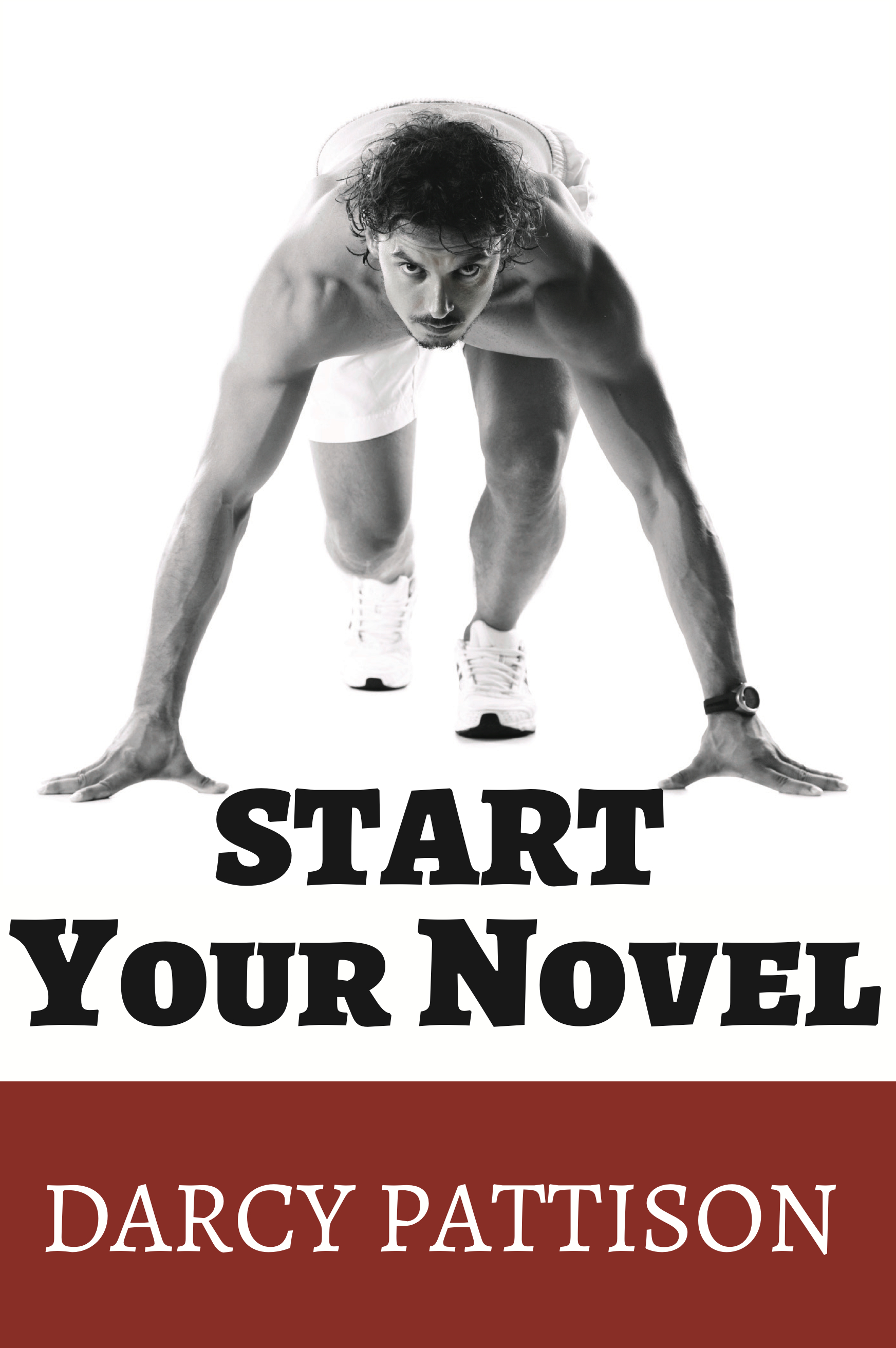
START YOUR NOVEL: SIX WINNING STEPS TOWARD A COMPELLING OPENING LINE, SCENE, AND CHAPTER by Darcy Pattison

The one thing I can count on when starting a new manuscript is the feeling I’ve never written a book before. Because each of my stories has to find its own way, and I can always use a refresher course on this thing called writing, I decided to use writing guru Darcy Pattison’s latest book, START YOUR NOVEL, as my guide when drafting a new book during National Novel Writing Month last November.

Darcy opens her book by stating everything a first chapter must accomplish:

  • grab your reader’s attention
  • ground your reader in the setting
  • intrigue the reader with a character
  • give the reader a puzzle to solve
  • set the pace

The first chapter sets the stage for the rest of the book. The first sentence builds on the first page builds on the first chapter. And to grab an editor’s attention, all three must shine.

I consider myself a “plotser” (or “planster”, as Darcy would say) -- someone who doesn’t fully plot a story but also doesn’t fly by the seat of her pants. Darcy says her approach might feel overly rigid to pantsters or too loosey-goosey to plotters. For me, her system feels like the perfect fit.

So you have an idea for a story? Now’s the time to brainstorm possible scenes. Next Darcy suggests studying the “29 Plot Templates” to decide which structure might best tell your story. Will your book be a quest? A story of escape? One about an underdog or forbidden love? “Each plot pattern would require a different set of scenes, emotions, motivations.” The approach you take will affect how you let your possible scenes play out.

Darcy then briefly discusses exploring your protagonist with one key element in mind: your character’s pain. “What is the character most afraid of; what could make the character hurt the most? Of course, you must make your character face this very thing.”

Now you’ve got some possible scenes and a structure for these scenes to unfold. With your character’s pain pinpointed (and the things you know she must face to bring about change), you have the beginnings of your character’s arc.

scene ideas + plot pattern + character arc = the beginnings of your book

Because you’ve not yet committed hours and hours to writing at this point, there is plenty of freedom to play with your ideas: adding scenes, deleting them, changing a character’s motivation or the type of story you’d like to tell. As someone who’s written a few books and many more “trunk manuscripts,” I appreciated this experimental phase. It’s something I need to do more of before my drafting begins.

“The function of a first draft is to find your story. The function of the next few drafts is to find the best way to tell that story.”

To that end, Darcy spends much of her book showing authors how to experiment with different approaches. For example, what type of sentence structure might you use to start your book? Darcy identifies twelve types of opening sentences*, gives examples of each, and then tries each type for her own novel-in-progress. In pushing herself to study her opening from different angles, she’s able to find the best way to tell the story.

As I planned and then drafted my NaNo novel, this book was an invaluable guide. And once I've given it a few months to breathe, I’ll pull Darcy’s revision book, NOVEL METAMORPHOSIS, off my shelf.

What books do you recommend for starting a new piece of writing?

*Here are a few to consider:
  • It was... It is... This is...
  • viewpoint on life
  • mid-action
  • dialogue
  • landscape
  • misleading lines

Friday, November 9, 2012

Outlining: write with the end in mind


Write with the end in mind. That advice has been around for a pretty long time, I think, but it seems to me that in the writers' blogosphere, pantsers (a.k.a. people who don't outline) run amok, for various reasons: it's liberating to write without an outline; if you don't know where your plot's going, then neither will your readers be able to predict the plot. (Honestly, I'm not quire sure of the reasons. As you might've guessed, I'm not a pantser.)

But there's a reason, I believe, why "write with the end in mind" is valid advice. Every story needs a plot arc. If you know where your plot arc ends, you'll always have an end goal towards which you can work. It also saves you from wandering through your middle in one direction, only to realize that your story actually ends up over there -- and thereby rendering your first 10,000 words useless.

As an outliner, I like to go beyond figuring out the ending; I usually summarize the general events of my middle, too, so I always have a general idea of the scene I should be writing. But as long as you know where and how to bring your story to a close, I think you can go ahead and pants your way through the middle.

Do you follow this advice? Why or why not?

-Yahong