Showing posts with label anne nesbet. Show all posts

Thursday, June 7, 2018

Let's Talk More About . . . Fear, by Anne Nesbet

I've been putting together a set of teaching materials (under the rubric of "History through Primary Sources") to accompany The Orphan Band of Springdale, which tells the story of 11-year-old Gusta Neubronner's arrival in the rural town of Springdale, Maine, in 1941, and so I find I've been thinking a lot about a topic that doesn't get an enormous amount of treatment in middle-grade books: fear. 

"Wait!" you say. "There are lots of scary books out there! And--ahem--look at your cover, Nesbet--that does NOT look like a book about fear--"


 Well, right. I don't mean the kind of fear that makes a zombie story so delicious. I am interested in exploring the way "fear" wriggles into our brains and gets us to do sometimes hurtful things, as if fear itself were a rational reason.This sneaky, powerful kind of fear is very much at work today--and it was very much at work in 1941.

Here's the basic blurby version of what The Orphan Band of Springdale is about:

It’s 1941, and tensions are rising in the United States as the Second World War rages in Europe. Eleven-year-old Gusta’s life, like the world around her, is about to change. Her father, a foreign-born labor organizer, has had to flee the country, and Gusta has been sent to live in an orphanage run by her grandmother. Nearsighted, snaggletoothed Gusta arrives in Springdale, Maine, lugging her one precious possession: a beloved old French horn, her sole memento of her father. Gusta finds herself facing patriotism turned to prejudice, alien registration drives, and a family secret likely to turn the small town upside down.

In Springdale, Maine, in 1941, people are afraid of a great number of different things:

--having family secrets exposed;
--labor organizers and Communists;
--vision charts (and other tests they cannot pass);
--Germans and in general anyone with "foreign" names;
--aliens;
--cows.

The fear of cows doesn't necessarily cause a lot of harm (though it's embarrassing if your family runs a dairy), but some of these other fears can reshape our view of the world and affect the way we treat the people around us. 

In 1940 the United States passed a law known as the "Smith Act" or the "Alien Registration Act." One of its provisions was that all non-citizens ("aliens"), no matter how long they had been living in the United States, had to go in to an official place (often the post office), fill in forms and be fingerprinted. 

The local effects of this new law can be seen in the Sanford Tribune (the real-life newspaper covering the area of my fictional "Springdale"):


In my teaching materials about the Smith Act, I ask some questions about this article, and the way it must have affected the residents of Sanford-Springvale when they read it:

What word is used here to describe people who are not United States citizens? What effect does that word have, do you think?

If you came from a French-Canadian family and had been living in the Sanford area for a long time (generations, perhaps), but had not switched your official citizenship to "United States," what did the new law make you do?
                               
What words in this article might worry you, if you were a non-citizen in 1941?

What would the effect of this article be on someone who WAS a citizen in 1941? What new thoughts about their non-citizen neighbors might the article make them have?

Notice how the words "person" or "people" do not appear once in this article. The people without U. S. citizenship--the same people who used to just be your neighbors on the next street--have been entirely transformed into "aliens."

In The Orphan Band of Springdale, the characters are afraid of all sorts of different kinds of things. At one point Molly Gowen, one of Gusta's classmates, argues that registering "aliens" is "just trying to be careful": 

As the narrator comments, "Some conversations are like two people picking their way toward each other across a swamp." And fear is very hard to talk about. Some of Molly's fears seem pretty reasonable, right? But some of them have serious side-effects, like getting the Sheriff wondering whether Gusta or the German refugee oculist Mr. Bertmann belong in town at all.

Here's how Gusta responds to Molly: 

"Even if my papa came here from Germany, haven't you ever thought for one minute that some people might leave Germany becausethey don't agree with what the Nazis are doing? Haven't you thought for a moment how dangerous it would be, to be someone who disagrees with what the Nazis think? If someone like my father put his foot into Germany, you know what they would do? They would lock him up! And then they would probably kill him."

Fear is a complicated feeling with complicated effects--which I guess means it is exactly the sort of thing middle-grade fiction should bravely explore. Fear can make us do hurtful things--but it can also make us cautious (which isn't always bad)--and it can even inspire us to be brave, despite our fear.  I realize now, thinking it over, that there are examples of all sorts of different reactions to fear (hurtful actions, cautious actions, brave actions) in The Orphan Band of Springdale. I didn't know this book about love and family and courage and music would turn out also to be a book about fear, but I'm glad it did.

Let's dig thoughtfully into ALL the tangled feelings and emotions and motivations in our books--in our reading and our writing!

Tuesday, April 10, 2018

Happy Birthday to THE ORPHAN BAND OF SPRINGDALE! by Anne Nesbet


I thought  that to celebrate the birth of my new book, The Orphan Band of Springdale, I would share a special, ILLUSTRATED edition of the Author's Note! 

But first I must thank two people in particular: Josie Portillo, for creating the beautiful, heartfelt cover, and Kaylan Adair, my wonderful editor, for her faith in the story--and in the power of revision.


"Oh, this reminds me of Maine!"
--my mother, in front of any beautiful landscape anywhere

            There are stories that come from the heart, and others that come also from the very bones that give us shape. THE ORPHAN BAND OF SPRINGDALE is one of those bone marrow tales. It is my echo of a story that I wish my mother had been able to finish telling me--the story of her childhood, which was so hardscrabble and tough that she could only bear to give us scraps and pieces of it when we were little.
            We knew that she had to go to a new school in a new town every single year, because they could never afford to pay the rent.
            We knew that her father was mostly not around.
            We knew that during particularly hard times she would be sent to live in the orphan home run by her grandmother up in Maine--an orphan home that had been started in order to keep a family secret.
            

            And we knew that somehow out of all this trouble, our mother emerged with some enduring and fine things: how to tell a good story, how to bring extended family together around a table, and how to play the French horn.
When summer came, she would take us back to the farming country of southern Maine, and we camped on a hill that had been allowed to go back to woods, and from the top of which all the grown-ups insisted that with a good telescope you might be able to see sails off the Portland coast, maybe.
            

            This was not the Maine of fishermen and saltwater. Instead of the ocean, we had occasional treks to Square Pond.  The mosquitoes kept us on our toes.
            The cousins would gather at the end of the day, and over long afternoons my mother and grandmother and aunts and uncles and cousins would share epic stories in few words, while we kids ran around creating small kingdoms in the woods.
            
(I'm the awkward one on the right.)
            I would have eavesdropped better if I had known I would lose my mother early. But of course I didn't know.
            But it happened: my mother died too young, and years passed, and all the stories about Maine kept wriggling and whispering inside me, and eventually I realized I was going to have to give some voice to them. I couldn't ever know the whole truth about my mother's childhood, true--but that just meant I would have to write it anyway, as fiction.
            To make that fiction as true as possible, I went back to Maine and spent some time at the Sanford-Springvale Historical Society, reading through old issues of the excellent local paper, the Sanford Tribune.


The flavor of 1941 comes through those newspaper pages: anxieties about drought and the war in Europe, "alien registration" drives,


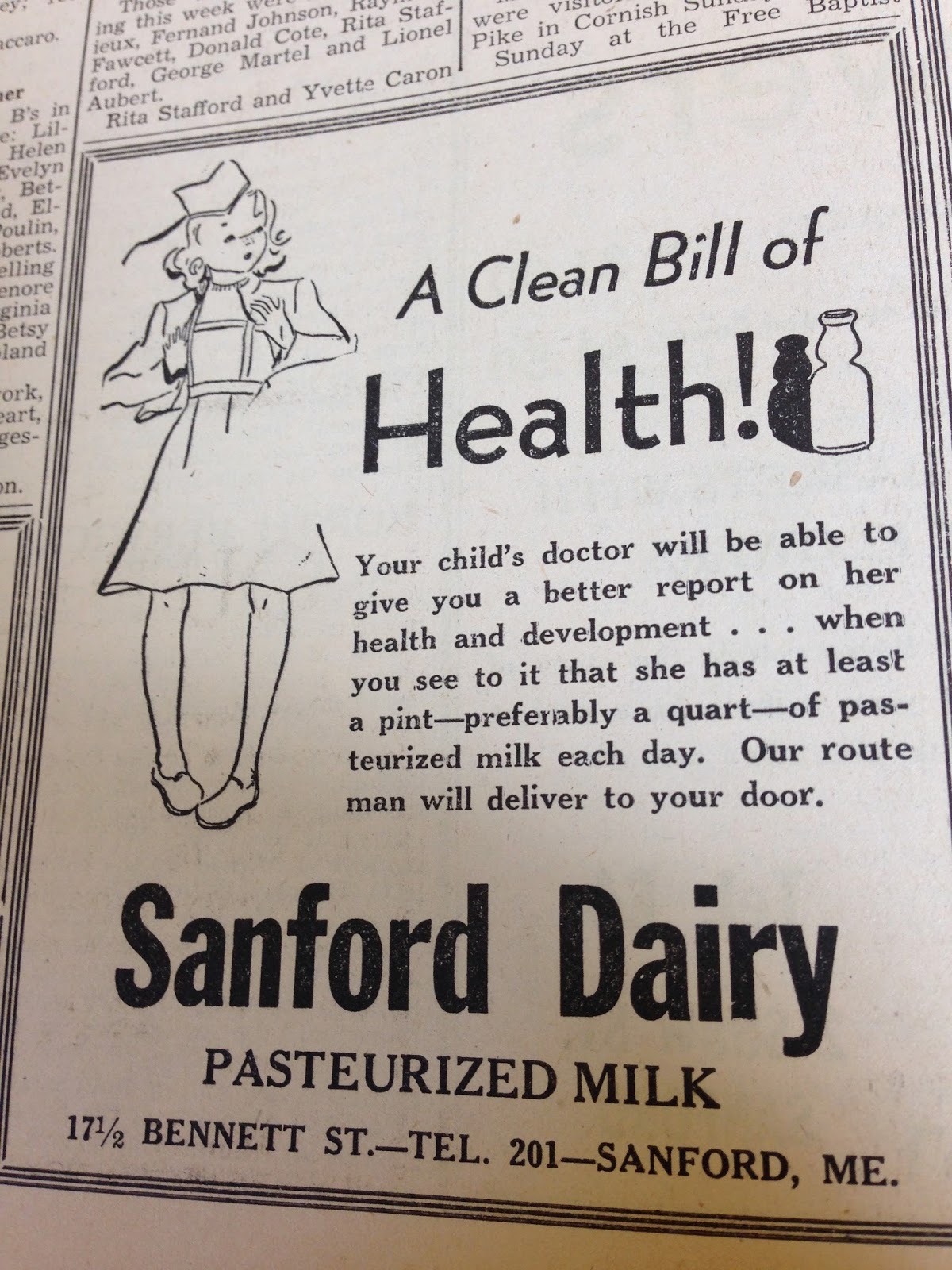
Union elections in the local mills, a "7-Point Health Certificate" school campaign waged with vigor against bad eyes, crooked teeth, and malnutrition, all garnished with competing hyperbolic ads from the local dairies . . . .

So the seeds of this story are true, but the resulting crop is fiction. I changed the identities and biographies of my characters and even tweaked the names of the local towns, out of respect for the difference between Gusta's fictional world and the real childhood places of my real mother.
           My mother did love a good story, and I hope she would have been tickled by this one. In the heart-and-marrow of my dreams, sometimes she even looks up from the pages and smiles her wonderful, crooked grin and says, "Oh, Anne, this reminds me of Maine!"


Monday, February 5, 2018

Awards? A Letter About Being Kind To Yourselves, Oh You Lovely Longlisters, by Anne Nesbet

Dear friends who have ever hoped-against-hope for something wonderful to happen,

Yes, it's true: another awards season is upon us! Not just for children's book writers, but oh definitely for us, too: The "Youth Media Awards" (which include the Newbery Medal and the Caldecott Medal and a number of other lovely honors) will be presented at 8 a.m. Mountain Time next Monday, February 12th. 
Many of us set our alarm clocks early every year so we can follow the livestreaming event--it's so exciting! A morning when children's books get to be cheered and adored! A morning when a few talented and hard-working and creative and fortunate writers get phone calls that mean their lives will change. Their books will live (approximately) forever. They will be allowed to write more stories for more children. It's that moment when hungry Charlie Bucket peels the wrapper back on his chocolate and there, unbelievably, is the golden ticket, after all: his life is going to be magical now. He will not be hungry, ever again.


[NOTE: In the real world, we know, even a golden ticket does not actually guarantee happiness forever; Newbery medalists--being lovely, vulnerable human beings like the rest of us--still have all the ups and downs of life to wade through; we send them love and fortitude.]

But right now I want to hold a hand out to a pretty large crowd: the future also-rans. You do not have to 'fess up to being in this demographic, but I know you are out there in surprisingly large numbers, and perhaps feeling surprisingly Alone.

Let's start with the people who have had the uncomfortable spotlight on them for a while. These are the writers whose books have benefited from all sorts of buzz, who have the curse of being called "frontrunners" by people with clout--I'm sending courage and compassion to you, dear frontrunners. It's wonderful to have created books so powerful and eloquent and beautiful that many readers are willing to say out loud: THIS ONE SHOULD WIN! But expectations are a jacket with a very scratchy lining, because here's the thing: even most "frontrunners" don't actually win. Those beloved books will still be as absolutely marvelous on February 13th as they were on February 11th, but it's hard to come that close to awards glory and miss. Yikes! Of course it is.

And guess what? I will share a secret truth: It's not only frontrunners who find themselves putting on that Scratchy Jacket of Hope. Human beings being what human beings are, there are many other people suffering right now from unreasonable hopes that (believe me) they are trying very hard to ignore or to repress.

My heart really truly goes out to you, too, whoever you secretly are:

Maybe your book made it onto some long "awards prediction" lists--or a couple of schools put your book on their Mock Newbery bookshelves--or someone mentioned your novel in the comments somewhere as "a book I wish had a chance, even though I know it probably doesn't." My friends, it doesn't take much to infect us with hope.

And if you have ever been infected with hope for something unlikely but life-transformingly amazing--you know how much pain is involved.

Let's say you are an utterly rational person (or mostly so). Let's say that you figure, in your utterly rational way, that you have a 1% to 5% chance of being called with good news in the wee Monday hours. Let's say that you are rather proud of how rationally you calculated those odds, and how well your rational brain did the follow-up subtraction sum that tells you that in 95% or 99% of possible timelines in the multiverse, your book does not win a thing.

Odds are, my dear, rational friends, that more than half of you will still find yourselves awake at four in the morning, listening to the silence--

and perhaps you will even be *despising yourself* for being awake--

because perhaps then you will find yourself not merely feeling the ordinary, understandable disappointment of not winning something that really would have changed your life, but also feeling the extra pain that we can inflict on ourselves, as punishment for hoping. It was so STUPID and UNCOOL to have hoped for a moment (we think)! And then we beat ourselves up! And then we suffer more!

And to whom are you going to confess that you're in pain? The people who love you but aren't in the writing world won't entirely understand what this thing that didn't happen would have meant--and it's downright embarrassing to confess to people in the writing world that you hoped for.....--no, aaaaaaaaargh, you're ashamed even to say it! THE OTHER BOOKS WERE ALL SO WONDERFUL! You know that! You read them all! You don't want a single one of them dethroned! You just wish the list could have magically expanded an extra inch to include--oh, ugh, you can't say it----------and so you writhe on your own.

Dear involuntarily hopeful friends! This is what I promised myself exactly a year ago that I would come here today to say: It is not your fault. Also: you are not alone.

It is not your fault. You are a good person, despite accidentally hoping for something unreasonably wonderful to happen.

And you are not alone. The reason this unreasonable hope took hold of you so hard (despite your trying SO valiantly not to let that happen--I know you really tried) is because this whole business of writing books is deeply unreasonable, in certain respects. You dream of a sticker on your book, because then your book will live! And you will be able to treat this writing career as an actual career, which is probably something you long for.

Why, after all, should it take having your book officially termed the Best (or one of the three or four or five Best), for you to have a career as a writer? I actually had an argument with someone in a dream the other night about this problem. I said, in my dream, "The children's books business is so weird! Let's think of it in terms of Mechanical Engineering! Wouldn't it be absurd if only FIVE or TEN Mechanical Engineers in this country could actually make a living doing Mechanical Engineering, and all the rest of the Mechanical Engineers had to have other careers (or sources of support) to pay the bills, while they do full-time Engineering on the side for almost no money???"

(When I woke up, I thought that was actually surprisingly logical, for a dream argument.)

I'm saying, dear longlisters: your unreasonable longing for something wonderful to happen for your book and your writing life is actually completely reasonable and understandable.

Don't beat yourself up for hoping.

We're people, and hope is one of those things people do.

Your hope is a symptom of loving the work you do and loving the children who need books to read, books that can reach out to them and comfort them and challenge them and show them new worlds or reflect their own wonderful, sometimes difficult world back at them in a new and loving light.

You are not alone, and your stories help others feel less alone.

Thank you for what you do, brave writers.  You weather so much, and you work so hard. Even when despair or hope get their claws into you, you keep plowing on and keep writing.

What can I say? You're all winners in my book--whether or not your books are officially "winners."

your fan,

Anne

Monday, October 2, 2017

Going Bald in Public: A Story about our Stories and their Audiences, by Anne Nesbet

A few years ago a friend invited me to Lake Tahoe, and while I was swimming in that cold water, I learned a lesson about kindness and audiences that I've never forgotten. Here's the story:

I went up to Tahoe to lose my hair. Really! I had just started chemo, and it was the end of the summer, and the experienced oncology nurses had pointed at a date on the calendar and said, "Hair should start coming out about then." My attitude was a mixture of horror and curiosity. I had never had all my hair fall out before! My friend Linda (who had been through this sort of thing herself) said, "Anne, come stay with us up at Tahoe. It'll be a great place to lose your hair!"


And she was right. It was healing, after all the first-round-of-chemo nausea, to be up in a place where the air felt practically newborn, it was so crisp and clear. And to be able to go walking in mountains and under lovely trees! And to have someone around whose attitude was as crisp and refreshing as the air: "Okay, Anne!" she said every morning. "Making progress? How's that hair coming along?"

And every day I took my battle-scarred, strange-looking, hair-shedding self down to the dock to swim (euphemism for "jump in, paddle about for a second, and climb back out") in the cold, bracing, wonderful water of Lake Tahoe.  It was wonderful!

And then one afternoon, I went down to the dock, and there were other people on it. Not just "other people": a group of teenagers, all boys. For a moment I froze. Perhaps you can understand: I had had a lot of surgery, not that long before. My swimsuit fit very strangely, and there were scars showing, and there was that weird lump that was the chemo port, and--and of course I was losing my hair. My head looked like it had just lost several big fights with an angry cat.

Well, I saw all those boys on the dock, and part of me was suddenly in 7th grade all over again--just wanting to take this battered body and obviously balding head of mine and hide. But I also didn't want to miss my dip into the magic water! So I forced myself to be brave--to march down that dock like I belonged there--to whip off my fleece and step onto the ladder, ignoring what I assumed were the staring, possibly mocking eyes of my audience--

and then one of those very scary people spoke out, just as I reached for the ladder (he was older than the others--it turned out I hadn't looked at them very closely). And what he said was,

"You know what, my wife did this, what you're doing now. Their mother did this. Seven years ago now." He made a funny little sound in his throat and added, "I just wanted you to know--she's doing really well now. Their mother."

And I looked up at them, finally, and saw what I had missed by not really looking before: not judgment, but kindness. Not some scary imagined other ("teenage boys"!), but human beings. (Then of course I couldn't see much at all, because of tears followed promptly by lake water!)

I learned something on that dock, and it occurs to me now that what I learned can be phrased in terms of writers and readers, books and audiences.

Let me count the ways:

1. When a book goes out into the world, it is exciting and frightening, both at once. It can feel like all your secret scars are going out on parade. It is as scary as walking out onto a crowded dock when your hair is coming out in clumps.

2. Fear makes us bad readers--in particular, bad readers of our audience. Here's a bit of irony: I misjudged these people because I was so clamped up in my own anxiety that they might be judging me. When we write, it is our solemn duty to be less afraid. We have to open up for our audiences, whoever they may turn out to be. Almost certainly they are more complicated and more human than we may think at first.

3. Our readers carry many stories in them. That is amazing and something a writer can't forget. Our stories reach out to theirs. All of these things are wonderfully plural, too: the stories people carry inside them; the stories they are ready or need or long to hear.

4. And finally, that father did what a good writer does: he told me a story that touched my heart and opened the world to me so that I saw it in a different way. A good story tells us that life may be hard, but we are not alone. It must have taken courage to speak up, in the face of all my determined shyness. But what a gift his story was! Let's all be as brave in our story-telling as that father was that day.

I think of this man and his sons (and their mother!) often. I am so grateful to them. I hope they are doing well. Some part of everything I write will always have a bit of lake-water in it, to remind me to be more open, to be ready to meet people and their stories, wherever they may be.
Under this hat, progress toward baldness was being made!