Showing posts with label craft. Show all posts

Monday, October 3, 2016

Writing Funny on Purpose by Jim Hill


“Humor can be dissected, as a frog can, but the thing dies in the process, and the innards are discouraging to any but the pure scientific mind.” – E.B. White 

Writing funny takes a knack, but like any craft, there are techniques you can learn to let your silly out. The trick is, well there are a lot of tricks, but maybe the most important one is listening. Listening to what makes you laugh, and how that might be a bit different than the gut-buster your friends and family love.

What I'm saying is, humor is subjective with a side order of formulaic and a twist of the absurd. Like the infamous line about obscenity, "I know it when I see it."

[INSERT FUNNY CAT VIDEO HERE - Ed.]
[No. - Jim]

Maybe funny is a mindset. A way of looking at and responding to the world that is intentionally off-kilter. If writing reflects the real world–art imitates life–then writing funny on purpose breaks the rules of physics. The angle of incidence does not equal the angle of reflection. The degree to which you alter that formula defines the humor, taking it from the subtlest satire to the broadest slapstick. The world recorded by way of a funhouse mirror.

Back to listening. And by listening, I mean reading (but also I mean listening). Learning to be funny means exposing yourself to the funny. Fortunately, we live in a golden age of exposing yourself. [JIM! - Ed.] With content-on-demand finding comedy has never been easier. Better still, the spectrum of comedic voices is much broader than it was back in your grandparent's day when Uncle Milty was "the man" on that one TV channel. Which means you can find the things that make you laugh and learn from them, the same way you discover how to be a Newbery Award winner by reading your Kate DiCamillo collection into dog-eared, high-lighted, broken-spine relics of devotion. Or is that just me?

I'll get you started with a few of my favorites.

Finally, The Funny Links

The Comic Toolbox – Although it fulfills its promise to provide the rules and structure of comedy, this book also sneaks in quite a bit about writing in general. Vorhaus' light tone and banter walk the reader through a progression of comic tools to instruct on the techniques and provide the vocabulary of critique and analysis.

What Are You Laughing At? – If you've ever wondered if comedy can be scientifically analyzed, this is the book for you. Dan O'Shannon breaks down the ha-has of humor the same way Nate Silver attacks polling data. It's a deep study, but well worth the time. Perfect for the Ravenclaw that wants a little more Hufflepuff in their writing.

(Not So) Rando Resources That I Found

Now that you're a comedy expert, in the same way that you're an architect because you built that LEGO Fallingwater with your nephew, it's time to hear from the professionals.

Poking a Dead Frog – In this book, Mike Sacks interviews a wide array of comedy writers. There's a lot of background on breaking into TV or film, but there's also kernels of humor truisms and nuggets of hilarity. Most of the interviews are short, perfect for my attention span, so this book makes an excellent bathroom reader. [Jim, I'm scheduling a meeting for you with HR. - Ed.]

Funny Business – Subtitled "conversations with writers of comedy," Leonard Marcus pitches this collection at younger readers and includes many favorites of the middle-grade set. Beverly Cleary, Norton Juster, Daniel Pinkwater, and Jon Scieszka, to list a few.

By Ken Levine – Ken Levine wrote episodes of MASH and Cheers. That ought to be enough of a comedy pedigree to get your attention. His blog features a lot of behind-the-scenes craft-based stories about what goes into writing sitcoms, and that stuff translates into middle-grade humor very easily. Worth checking for his Friday Questions, if nothing else.

The Writers Panel – This podcast isn't always focused on comedy, but there are almost always great insights into serving an audience well-crafted stories. And even when something isn't a straight-up comedy there's often humor in the mix. Ben Blacker and the panelists dig deep. Have a notebook handy.

WTF with Marc Maron – NSFW, but if you can get beyond that issue, Maron's interviews with comedians both contemporary and legendary are fantastic. Almost never craft focused, but if you're wondering about how to be funny, getting a look into the mind of funny people might help.

Congratulations, You Are Now Hilarious


So that's it. Go forth and be funny.

[Really? That's it? - Ed.]
[Fine. - Jim]

What's Made You Laugh Lately?


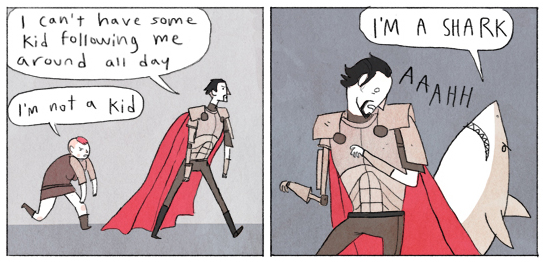
Wait! Before you go, tell me the last book you read that made you laugh out loud. For me, it was Nimona by Noelle Stevenson. Okay, your turn.


It's Cat Video Time!

Play me off, Keyboard Cat!


[Thank you! - Ed.]
[You're welcome. - Jim]

Thursday, June 16, 2016

Takeaways from Elizabeth Gilbert's BIG MAGIC and my favorite books on craft by Joanna Roddy

I'm forever reading books from other writers about the craft of writing. Writing is solitary in many ways. I'm always looking for coyotes of the borderlands to show my wandering writer's soul the way into the land of plenty. 


This spring I read Elizabeth Gilbert's BIG MAGIC. I never read EAT, PRAY, LOVE, but I fell utterly in love with Gilbert's TED talk on creative genius, in which she argues for the classical idea of the muse. She says that the modern concept of artistic genius is too much pressure and is silently killing off our artists through addiction, self-destruction, and despair. She offers instead the ancient idea of having a genius: a creative entity that brings inspiration to collaborate with the artist. Today we typically think of this as a muse. The artist is the servant of the muse, offering the grunt labor to bring the idea into being. As a co-collaborator, the artist is only partially responsible for the success or failure of the work.  

The video is 20 minutes long, but if you can give yourself a learning/ inspiration break today, it's worth the watch.


BIG MAGIC expands on the TED talk, and it is a rich, nurturing baptism into the good news of creative living free from fear. It may be the psychologically healthiest thing I've ever read about being an artist. A lot of writers on craft focus on all the barriers to creativity--resistance, apathy, difficulty, fear. I think this can sometimes lead to the paradigm of the tortured artist who believes that their creative work requires brutal sacrifice and torture. Gilbert reminds us that ideas want to be brought to life by artists and that our creativity chose us and is dependent on us to produce anything in the world. So why would we think it hates us and is trying to punish us? One line from BIG MAGIC I quite like on this theme is this:
“I’ve always had the sense that the muse of the tormented artist—while the artist himself is throwing temper tantrums—is sitting quietly in a corner of the studio, buffing its fingernails, patiently waiting for the guy to calm down and sober up so everyone can get back to work.”

Here are my main takeaways from the book:

  • Ideas are seekers of human collaboration and we have the freedom to say yes or no to them. If you say no, someone else will get that idea and run with it. If you say yes, but don't show up to do the work, eventually the power of that idea will leave you, looking for another collaborator.
  • You're never too old to begin.
  • Take the long view of failure and rejection: I plan to do this for the rest of my life. Many years of rejection is only short-term. 
  • Do not pressure your creative work to succeed or provide for you financially. That's the quickest way to kill it off. You provide for both yourself and your creative work. (Don't quit your day job.)
  • Stop complaining. Complaining about your creative life is bad juju and ideas will not want to collaborate with you. Treat your work with respect, approach it with love, and see how that alters your experience of doing the work.
  • Create because you love to do it. There may be no other reward.
  • Your work is not your baby. Cut, change, adapt if you must. Your creative power is precious, but your projects will never find their way in the world if you feel that you must forever hover over them protectively. 
  •  You are unlikely to get the outcome in the world that you desire from your work. Not that you will never succeed. But even success takes longer and comes in unexpected ways. You cannot control the outcome. Create anyway.
  • Put fierce trust in the love you bear for your creativity, trust for which the qualifiers of success or failure effectively lose their meaning.

This mantra toward the end of the book brought me to tears:
"Fierce trust asks you to stand strong within this truth: You are worthy, dear one, regardless of the outcome. You will keep making your work, regardless of the outcome. You will keep sharing your work, regardless of the outcome. You were born to create, regardless of the outcome. And you will never lose trust in the creative process, even when you don't understand the outcome."

I can't recommend this book more. It's a gem, unlike anything in its class.

Here are a list of other books I've enjoyed as creative inspiration and writing craft:

On Writing, Stephen King: The most practical and helpful book on writing and craft I've read. The memoir portion feels erroneous to the reader looking for writing advice, until you realize it's integral. Try not to feel as though you too must produce 2000 words a day after reading it. 

Bird by Bird, Anne Lamott: This was the first book of writing advice I ever read. It's hilarious and honest and focuses on getting past our own hang-ups in order to do the work. 

Walking on Water, Madeleine L’Engle: A Christian spiritual reflection on writing by the author of A WRINKLE IN TIME. Deep and moving, abstract but inspiring. 

The Artist’s Way, Julia Cameron: A twelve week creative recovery workbook, not unlike a twelve step program. Great for digging deep into oneself and mining out the reasons for blockage and reconnecting with your creative dreams.

Reflections on the Magic of Writing, Diana Wynne Jones: A hodge-podge of lectures and essays by the great children's fantasy writer who studied under Lewis and Tolkein at Oxford and authored many books, including HOWL'S MOVING CASTLE. The latest edition has an introduction by Neil Gaiman. 

The Writing Life, Annie Dillard: A soulful memoir by the Pulitzer Prize winning Dillard, reflecting on the experience of her own writing life. 

Writing Down the Bones, Natalie Goldberg: This is a book filled with practical exercises and the exhortation to keep the pen moving! A huge proponent of free writing, Goldberg, a Zen Buddhist, approaches writing as a practice, much like yoga or meditation.

Question for you: What are your favorite books of writing advice? (I'm always adding to my reading list.) If you've read BIG MAGIC, what was your number one takeaway?

Thursday, May 19, 2016

Grab Readers with Page-Turning Pacing, by Chris Eboch

Fast-paced. Gripping. A page turner. “I couldn’t put it down.” Why do some books get these comments, while others are called slow or flat?

Characters, plot, setting, and theme are all part of pace. But once you have a fast-paced draft, you can pump up the pace even more by focusing on the line-by-line level. In fact, relatively minor changes in sentence structure and paragraphing can make a scene much more dramatic. A page that is one solid block of text looks dull and intimidating. On the other hand, with short paragraphs the reader’s eyes move more quickly down the page, giving a sense of breathless speed. The book literally becomes a page turner because the reader finishes each page so quickly. This means you can make action scenes more dramatic by using short paragraphs.

Here’s an example from my middle grade mystery, The Eyes of Pharaoh. Seshta is on the roof, spying down a stairwell. When someone comes up the stairs, she must escape.

     She glanced back at the stairwell. She didn’t have much time.
     Seshta turned and lowered herself over the edge of the roof until she hung from her elbows, her legs scraping against the wall.
     From the stairwell, a head rose into view.
     Seshta let go and fell.

Imagine all that in one paragraph. It wouldn’t have the same pace.

Sentence length affects pace as well. Short sentences have a different rhythm from long ones. Long sentences can feel leisurely, while short ones have blunt impact – the difference between a hug and a slap. You want a variety of sentence and paragraph lengths, because if everything is the same the story will feel clunky or sluggish. But save the longer sentences and paragraphs for description and introspection, and use short sentences and short paragraphs for maximum impact in action scenes.

Here’s another example from The Eyes of Pharaoh. This is the end of a chapter where Seshta is waiting for a friend who is supposed to bring important news.

     Ra, the sun god, carried his fiery burden toward the western horizon. Horus caught three catfish. A flock of ducks flew away quacking. Dusk settled over the river, dimming shapes and colors until they blurred to gray. The last fishing boats pulled in to the docks, and the fishermen headed home.
     But Reya never came.

The long paragraph of description conveys time passing slowly. Putting the last short sentence into its own paragraph gives it added emphasis, causing it to seem more important and ominous.

Print your story or a chapter of your novel and look at your paragraphing. Don’t read it, just see how it looks on the page. Do you have variety, or is everything about the same length? Do you favor short paragraphs or long ones?

Now look closer. Do you have long paragraphs of action, where several things are happening within one paragraph? Consider breaking that into shorter paragraphs, starting a new one for each small piece of action, as in the first example above.

Look at your chapter endings, especially when you have cliffhangers. Can you break your paragraphs into smaller pieces for more drama? Can you shorten your sentences? How does the feel of the section change as you play with sentence and paragraph length? Note the difference between even small changes in wording and punctuation. For example, compare these unpublished examples:

     I heard a noise and looked up with a gasp in time to see a huge rock tumbling toward me.

     I heard a noise above my head. I looked up and gasped.
     A boulder tumbled toward me.

It’s almost hard to follow the action in the first example, because too much happens in one sentence. Shorter sentences clarify the action and give each piece more impact.

You can do this exercise with published books as well. Note sections that are poorly paced and try rewriting them to see how things change as you vary the structure.

Master pacing, and keep those pages turning.

Chris Eboch’s novels for ages nine and up include The Eyes of Pharaoh, a mystery in ancient Egypt; The Well of Sacrifice, a Mayan adventure; The Genie’s Gift, a middle eastern fantasy; and the Haunted series, about kids who travel with a ghost hunter TV show, which starts with The Ghost on the Stairs. Learn more at www.chriseboch.com or her Amazon page

Her writing craft books include You Can Write for Children: How to Write Great Stories, Articles, and Books for Kids and Teenagers, and Advanced Plotting. Check out her writing tips at her Write Like a Pro! blog.

Photo: The Horse in Motion by Eadweard Muybridge.
This media file is in the public domain in the United States.

Thursday, April 14, 2016

The Enneagram for character development by Joanna Roddy


I have to confess, I put little stock in personality tests. They seem too generic, like magazine horoscopes that, with a little finagling, could apply to anyone. The tests are fun to take, but they're more like acceptable vanity exercises. Only the saints and psychologists among us really dig into understanding types other than their own. At best we say: "Oh you're an INFJ? I'm an ENFJ!" and remark on our shared traits and the differences between introverts and extroverts. 

But recently a psychologist friend introduced me to a personality system she uses in her practice, and I have found it incredibly helpful, both personally and in my relationships. Recently I decided to use it in my writing as well. I was having a hard time making certain characters distinct and clear. Using this system, two-dimensional characters suddenly popped up off the page. I began to understand what motivated them, how they would react in situations, what they might say (or not say), what vice they might gravitate toward, and what core virtue would emerge under the right circumstances. In short, it was character development magic. 

The Enneagram:

The personality typing system is called the Enneagram, and it articulates nine personality types that are interrelated. In an extremely condensed form, here are the nine types and their core motivations:

Type 1: The Reformer/ Perfectionist. "I must be/ do right."
Type 2: The Helper/ Giver. "I must help others."
Type 3: The Achiever/ Motivator/ Performer. "I must succeed."
Type 4: The Individualist/ Artist/ Romantic. "I must be unique."
Type 5: The Observer/ Investigator/ Thinker. "I must understand the world around me."
Type 6: The Loyalist/ Skeptic. "I must be secure."
Type 7: The Enthusiast/ Adventurer. "I must seek new experiences."
Type 8: The Challenger/ Leader. "I must be in control."
Type 9: The Peacemaker/ Mediator. "I must have/make peace."

Each personality type perceives these motivations as the means for them to be safe, to have meaning in their lives, or to be loved.

There are a lot more details to each type, like key fears and desires, and basic virtues and vices. Check out this cheat sheet from Wikipedia (click to enlarge):


Integration/ Disintegration:

What I like about the Enneagram is its nuance and complexity. We all know that a healthy or growing person and an unhealthy or stressed person behave in totally different ways, even if they share personality traits. The Enneagram predicts what traits emerge under stress and during personal growth.  Every Enneagram type uniquely integrates to the healthiest characteristics of another type and disintegrates to the least healthy behaviors of a different type.


For example, threes integrate to a six and disintegrate to a nine. Achieving threes can be self-focused, but with maturity, they look more like other-focused healthy sixes. Threes can be driven, but under stress they begin to look like unhealthy nines: disengaged and apathetic.

Wings:

Enneagram types can have an even greater degree of complexity by demonstrating traits from one of the numbers adjacent to them, which are called wings. The wing augments the primary personality. So you can have an observant five with an artistic four wing, which might produce a professorial art school type, or an achieving three with a helpful two wing might be an front-person for a non-profit organization. These are gross generalizations, but I find the flexibility of wings accounts for a wide array of personality manifestations, even among people who share a primary type. It keeps it all from becoming too canned and stereotyped, but not so general as to become meaningless. 

In Writing:

The Enneagram goes much farther and deeper than this crash course, and those who are interested could spend a lot of time learning about it. I think most of us instinctively pick up on others' personalities, especially writerly types who want to write believable characters. If people were clocks, we immediately perceive the difference between a cuckoo clock, a grandfather clock, a digital clock and an alarm clock. We get, on a basic level, what makes them tick. The Enneagram, then, is effectively like a screwdriver that removes the backing so we can see the actual mechanics at work. 

The most helpful aspect of the Enneagram for me is the basic fears and desires. It helps me to know how a character is going to react to the sticky situations I put them in. For example, one of my characters is an adventurous seven. When his parents want him to go into the military for a war he doesn't agree with, his response is to hop a plane out of the country. A seven's core fear is being trapped or in pain and their spontaneity can make them impulsive, so this response makes sense for him, drastic though it may seem. Another of my characters is a loyal six. A six's basic fear is making the wrong decision. They need guidance to orient themselves. In this situation, my six character would have struggled with living up to his parents' expectations. In fear of making the wrong decision for himself, he probably would have enlisted despite his own reservations. And that would have made for an entirely different plot.

A Warning: 

Fully fledged characters will still surprise us. They should never act against their own character, but they might step out of the box that a personality type wants to put them in. A challenger-leader eight who tends toward domineering might unexpectedly resist the urge to step into an argument, which would mean something substantial for that character. Perhaps they are moving in their direction of integration to look like a helping two, or they've newly realized that winning a fight is less effective than leading by example. This flexibility is how we avoid stereotypes and wooden characters. I like that the Enneagram allows for the changes brought on by maturing or devolving or blending a couple of personality types together. But once these type of tools have helped you build your writing, like scaffolding, they should fall away and let the real, living world on the page play itself out as it must. Using the Enneagram as a tool, not as a law, is the best way. 


Resources:

Start with the Enneagram Institute site and the Enneagram of Personality Wikipedia page. From there, there are lots of books, sites, and articles available to learn more about the Enneagram. And here's a link the the long version of the test if you want to find out what Enneagram type you are and to a shorter version and another type of short test. The last one is my favorite. I apologize in advance for the productive time you will inevitably lose on those tests, but if it gets you to an understanding of good character building, then I think you don't have to feel too guilty about it. 

Please leave a comment if you've used the Enneagram or other personality typing for character building! I'd love to hear your insights. And here's something I'm deeply curious to know: do the main characters you write have the same personality type as you do? Happy writing!

Thursday, December 3, 2015

Resistance by Joanna Roddy

"Sea captain in storm," illustration by N.C. Wyeth from The Rakish Brigantine
We all know that feeling.

The early morning alarm has gone off...
...or we've just got the kids out the door for school...
...or we've finally made it to our favorite coffee shop and sat down with our favorite cup of warm...
...or we've rented an actual cabin and have finally arrived and settled in...

...and now we're supposed to sit down and write. 

Because we carved out the time and the space and we planned to do it and here we are. We fought tooth and nail for this time. 

But what rises to the surface is the simple mantra that destroys everything we've worked so hard for:

I don't want to. 

Which materializes in the form of checking Facebook, or email, or twitter, just one last time before really getting down to it... 
...or getting a snack...
...or turning off the alarm and promising ourselves we'll put in some time later in the day...
...or wondering what ever made us think renting a cabin would be a good idea and reaching for the nearest book about writing...
...or starting a sewing/cooking/building/organizing/art/charity/garden project that's been lying dormant for months...

...or any number of seemingly worthy distractions that all sound reasonable, but come from the same source: 

Resistance. 

Resistance is almost always there. It's the part of you that wants entertainment, or distraction, or rest instead of doing the hard work required to sit there and put words on the page. Resistance keeps kids from doing their chores, adults from keeping their New Year's resolutions, and dieters from keeping off the weight. And Resistance keeps writers from writing, and creatives from creating.


I've been thinking about Resistance lately because Steven Pressfield in his books DO THE WORK and THE WAR OF ART talks a lot about it. His books read like missives from the front lines, like letters back East from Clint Eastwood on the frontier of the wild west. It's gritty, and real, and wise in the way that old sea captains are wise about the sea, or a hunter is wise about the wolf. Pressfield can describe Resistance with the intimacy of an opponent and the accuracy of a scholar.

Ok, so it's there. But what do you DO about it?

Pressfield puts a lot of stock in outwitting, outmaneuvering, and outlasting Resistance and he has some very salient things to say about how to deal with it. He gets it.

But I've been thinking about how I deal with resistance and I've decided that the most powerful tool I have is the truth. Not my wits or my stubbornness or my blind faith. 

Because once you realize that Resistance exists, and it borrows your voice, and your doubts, and your insecurities, and your vices, and it puts them on like a costume to pretend to be you and manipulate you away from doing the work, the thing that can stop it mid-stride is just this:

That isn't me. 

Because, actually, I do want to do this. I do want to write the book. I just do. And all that other stuff that's telling me how hard it is: that's not me. 

The dance with Resistance is different every day, but when I remember that it's outside of me, and stand on the truth of who I am and what I want, I stop confusing Resistance's voice with my own. And I'm free. 

And I don't have to be a warrior most of the time. I can just be me. 

Write on, writers. You actually do want to do the work. Really, you do.

Friday, June 5, 2015

The Opening Hook by Jim Hill

I’m teaching a picture book writing class at the Cotuit Center for the Arts, and it’s been fascinating exploring the connections between middle grade novels and picture books. How do you compare a five-hundred-word story to a thirty-thousand-word-plus novel? One way is to look at the opening.

Among the many books I’m drawing from for lessons is Ann Whitford Paul’s Writing Picture Books. She talks about the “story question” of a book, an idea I think of as the character’s need and theme bundled up together. Getting the reader involved with the character’s need is imperative from the get go, otherwise why will she turn the page? So, how do you do that? What’s the hook?

At the 2014 NESCBWI conference, Jo Knowles presented a fantastic workshop on baiting the hook, “Let’s Go On a Journey.” She proposed a series of questions that every book opening should answer:
  • Who is the main character?
  • What do you know about him/her? How?
  • What is happening?
  • Is there a conflict? What is it?
  • What is the overall emotion conveyed?
  • Would you keep reading? Why/why not?
With these questions in mind, I’ve been looking at my work-in-progress and published books to see how well Jo’s questions are addressed. The opening of Up & Down (Philomel, 2010) by Oliver Jeffers makes for an excellent example.

Up & Down features two characters (the Boy and the Penguin) established in Lost & Found (Philomel, 2005). Lost & Found can be described as “a wonderful story about the meaning of loneliness and the importance of friendship.” Up & Down continues that theme by looking at the importance of individual growth within a relationship.

It opens with a spread that establishes the relationship between the Boy and the Penguin with the text:
“Once there were two friends…”

The second spread continues:
“who always did everything together. Until the day the penguin decided there was something important he wanted to do by himself…”

The third spread takes the reader inside the head of the Penguin so that she can see his dream:
“…fly!”


Run that opening through the magic of Jo’s Questions and you’ll see they’re all answered. And unless you’re the Grinch, pre heart-expansion, you want to read on. Now, in a middle-grade novel you’re more likely to hit these points within the first two pages. The brevity of text and the interplay with the pictures allows Jeffers to breathe space into the opening. And yet, there’s a ton of story in there that reveals the tone, the protagonist, the need, and addresses Anne Whitford Paul’s “story question.”

Now it’s your turn. Pull a book off the shelf, and give it a close read. How does it compare? Make notes. Next, take a look at your draft and do the same. You might find the opening needs a little revision love–I know mine did.

Monday, February 16, 2015

Mouth-to-Mouth Resuscitation (aka Revision) by Joanna Roddy

Photo courtesy: Moving Picture World
Wikimedia Commons

It was just before Christmas two years ago and I was on the phone with my agent...having the conversation everyone dreads.

Back when I first signed with my agency, I knew they wanted a big revision and I was more than willing to do it. I *wanted* someone to tell me what to do next. I was good at being a student--doing my assignments, acing tests, and regurgitating my teacher's ideas--but all this author-ity was kind of unnerving to me. The creative process was so lonely and hard and I had no one to tell me if I was doing it right. So I took my agent's revision notes and treated them like my study guide. When I was done checking off all the boxes, I sent off my manuscript, sick of the thing and glad to be done working on it.

But then my agent let me know that although I had made some good changes, I still wasn't done. The manuscript needed more work. I was honestly a bit lost about what to do. The new revision notes reiterated problems I had tried to fix the first time. I wrote up a sample chapter and asked my agent for some feedback, desperately hoping I was now moving in the right direction. 

And here we were on the phone just a few weeks before Christmas when my to-do list was miles long (and the last thing I wanted to do was take on a major writing project) and she was telling me what I absolutely did NOT want to hear:

This revision wasn't working. Maybe I should take some time off and reassess. Maybe I needed to get a book doctor to work with me. Maybe I should go back and revisit craft. 

Ouch. 

So I took some time off, tried not to think about it, and enjoyed the holidays with my family.  

Then I thought hard about what to do next. I was embarrassed and confused and a big part of me wanted to give up--the part of me that didn't know if I had whatever skill it would take to revive my book. 

But after a few months, I swallowed my bruised pride and I started to reach out. I contacted two published authors I know and asked if they'd meet with me to talk about my situation. I shared with them the painful truth and each in their own way offered perspective, advice, and got me thinking about craft in new ways. ON WRITING by Stephen King and Pixar's 22 Rules of Storytelling were game-changers for me.


After these conversations, something shifted inside me. I realized that I had to stop waiting for someone else to tell me how to write my book. I *already knew* what I needed to do to make it what I wanted it to be. I just needed to do it and stop waiting for someone to give me permission. I also needed to roll up my sleeves for some more(!) hard work and stop clinging to my earlier efforts.

I dropped the first five chapters and rewrote the beginning from scratch. I cut characters and scenes. I combined repetitive elements, reordered the plot, and even mashed two major characters together into one. I tied up loose plot ends. I took two-dimensional aspects of the book and examined them from new perspectives until I understood them more deeply. I clarified my point of view. I thought of new plot twists. I simplified unnecessary complications. 

By the time I was done, not a single scene was left untouched, much of the previous draft was discarded, and I'd estimate at least 60% of the manuscript was entirely new. It wasn't so much a revision as a rewrite.

And for the first time, I truly loved my book. It felt right in a way it never had before. 

I sent it off. When my agent and I had that next call, she said words that I almost never thought I'd hear: "Joanna, this is such a huge leap forward! How did you do it?"

Are you stuck? It's pretty likely you already know what you need to do. Keep learning your craft, trust yourself, trust your work, and don't give up.

Monday, January 19, 2015

A Writing Exercise from HARRIET THE SPY by Joanna Roddy


I was reading HARRIET THE SPY the other day and was absolutely smitten with Harriet's writer's game from the beginning of the book. Check it out:

Harriet was trying to explain to Sport how to play Town. "See, first you make up the name of the town. Then you write down the names of all the people who live in it. You can't have too many or it gets too hard. I usually have twenty-five....Then when you know who lives there, you make up what they do. For instance, Mr Charles Hanley runs the filling station on the corner."

She goes on to explain that once you know the names of all the families and how many kids they have and what they do for a living, that's when the fun begins. She starts imagining situations that happen in the town and how the people's lives intersect. While one farmhouse is getting robbed in the dead of night, a baby is being born in the hospital and the police chief is strolling down Main Street and senses that something is amiss. And so on.

I thought to myself, now there's an idea. 

So many children's books happen in the center of a community: TO KILL A MOCKINGBIRD, ANNE OF GREEN GABLES, and HARRY POTTER, to name a few. The setting could be a town, a school, a secret government training facility, or a summer camp, but when there's a cast of characters around your heroes, it's good to know who they are and where they come from right off the bat. Then you can start imagining situations that would arise between these characters in this setting, instead of (as I so often do) waiting for scenes and characters to present themselves as you write or outline. I would imagine that this is where great subplots, interesting characters, and plot complexities can emerge. Kind of like real life. 

Anyone want to play town?


Let us know if you have any great exercises for constructing characters, world-building, or beginning a new story idea. We'd love to hear from you!

Wednesday, December 10, 2014

The Importance of Beginnings by: Joanna Roddy


Story beginnings have been tricky for me. When I started editing with my agent, that was one of the first and hardest things I had to work on. At one point she said, "Your main character wakes up thinking about chess. So we think he's a chess geek. Is that what you were going for?" My adventurous hero with a burning desire to travel the world with his archeologist grandpa? No. Chess geek was not what I was going for. I was just trying to get him to an important scene as quickly as possible. Back to the blank page for me.  

Something I've learned since then is that the beginning of a story has more weight than the rest of it. Your reader is trying to orient themselves to the world, to the characters, and to your voice. The first few things your character does and says DEFINE that character for your reader. 

The beginning of your story is like a resume, trying to get your reader to hire you for the job of temporary entertainer--and if that reader is an agent or editor you want to work with, then you want those pages to shine. 

As I entered a season of ruthless and wholescale editing, I noticed how the Pixar movies that my kids watch are so tightly written. Everything has a purpose: humor, plot, character, or setting, and usually several at once. In a 100 page screenplay for an audience with a notoriously short attention-span, there is no dross. And within the first few minutes, you clearly understand the main character, the world they live in, and what they want.  

Pixar screenplay writer, Michael Arndt, made a YouTube video about Pixar's approach to story beginnings. This is just packed with great ideas. Have a look if you have a few minutes.


His basic formula for the very beginning of a story:
1. Right away, introduce your character, the world they live in, and show them doing the thing they love most.
2. Show that they have a flaw, which flows out of their grand passion--some way in which they take it too far.
3. Show clouds on the horizon--some hint of the conflict or emotional challenge the character will face for the rest of the story.

He goes on to explain the rest of Act 1, by the end of which your character has a goal and has set off on the journey of the rest of the story. He summarizes: "So your story is coming out of your character's deepest desires and their darkest fears. The thing they love gets taken away from them and the world is revealed to be unfair. To put things right, they have to make the journey that is the rest of the film. And by the end of the journey, hopefully they'll not only get back what they lost but they'll be forced to fix that little flaw they had when we first met them."

Formulas can be prisons or wings, depending on how you work, but as a jumping off place, I found this advice super helpful. 

How do you start a new story? Do you use a formula or have any advice to offer? I'd love to hear!

Wednesday, November 5, 2014

First Person POV: Building Kinship with the Reader by Jim Hill

First person point of view has found a home in middle-grade novels, and it’s easy to understand why. Though there are narrative limitations and challenges to writing in first person, the strengths can outweigh the weaknesses.

In her book, The Writer’s Guide to Crafting Stories for Children, Nancy Lamb states that one of the strengths is that an author can “create a sense of connection. The intimacy of first person sets up a direct communication between reader and writer.”

I refer to Lamb’s point as immediacy – the quality of bringing one into direct and instant involvement – and this connection may be one reason that first person is so engrossing to young readers. Using this technique the author draws the reader into the narrator’s private world, creating a confidante. That relationship empowers the reader with an insider’s sense of belonging. In a very real way, the narrator makes friends with the reader. They share secrets and concerns that others in the fictional world may not be privy to. BFFs in the making.

In The Lightning Thief, protagonist Percy Jackson opens the book by directly addressing the reader with a warning, and a confession about his true nature, that bridges the gap between narrator and reader.

“Look, I didn’t want to be a half-blood. If you’re reading this because you think you might be one, my advice is: close this book right now. Believe whatever lie your mom or dad told you about your birth, and try to lead a normal lifeBeing a half-blood is dangerous. It’s scary. Most of the time, it gets you killed in painful, nasty ways.”

By starting this way, Percy presumes a level of intimacy and knowledge that we want to play along with. Even if we have no idea what a half-blood is we nod our heads and smile hoping we’ll get it soon enough. As if realizing that perhaps he’s opened up too much, Percy tosses out a disclaimer to keep the reader at arm’s length, in case we’re not like him.

"If you’re a normal kid, reading this because you think it’s fiction, great. Read on. I envy you for being able to believe that none of this ever happened."

After that quick rebuff, Percy then dives back into the warning, showing his concern while bringing the reader back into his circle of intimacy.

"But if you recognize yourself in these pages––if you feel something stirring inside––stop reading immediately. You might be one of us. And once you know that, it’s only a matter of time before they sense you too, and then they’ll come for you. 
Don’t say I didn’t warn you."

First person narratives work by bringing the reader inside a private club for two. Reader and protagonist become confidantes in a shared adventure. 

Speaking directly to the reader also allows the writer the ability to establish a distinct voice quickly. Conversational quirks and flourishes are aimed straight at the reader. First person helps shrink the psychic distance, tearing down the wall between reader and protagonist.

By having the protagonist open up to the reader and share self-perceived vulnerabilities there is the opportunity to build kinship and reveal hidden truths. As the reader gains a deeper understanding of how the protagonist sees the world and reacts to it with asides and direct address, the reader can also discern how the protagonist may be misreading the situation. Just as in real life, confidantes can question the motives and authenticity of each other.

The affect of immediacy, and the opportunity to craft a unique voice through the protagonist's asides, make first person a compelling choice. With first person, the writer has the means to get the reader invested in the protagonist’s story from the very first words, a virtual arm around the reader. 

A whisper that says, “Hey, we’re in this together. Let’s go!”