Showing posts with label Matthew MacNish. Show all posts
Monday, February 26, 2018
What BLACK PANTHER can teach us about Storytelling: Conversation with Matthew MacNish
One of the things I've learned about myself recently is that I'm not much for movies. This became apparent with the advent of the Movie Pass, and the fact that both my wife and eldest son snapped them up. The two of them were giddy from going to movie after movie. What was I doing? Staying home and reading a book.
This is not meant to disparage movie going. Part of my reluctance to venture forth to the silver screen is probably because of my extreme introversion. I mean, getting in a car and driving to a movie theater and then being cheek and jowl with all those strangers: taxing! But my wife lost her job and we decided we were going to call this time of transition a 'sabbatical,' and we headed off to stay at the Sylvia Beach Hotel in Newport, Oregon, where we could sit in the library and read all day to our two hearts' content.
The siren call of the movies gripped my wife even here. And so, in a small local theater on the Oregon coast, we watched the stunning Black Panther, which has taken the world by storm.
I loved the movie and found it fruitful for discussion. But, movie-amateur that I am, I realized I needed help in formulating my thoughts. I reached out to former Mayhemmer, Matthew MacNish, who is one of the cleverest guys I know. He can write entertainingly on everything from politics to music to sports to the literary life to movies. He gladly agreed to help out. Here is our conversation. Hopefully it will elucidate what Black Panther can teach us about storytelling:
I'm interested in the structure of the movie. It begins with a kind of prologue, where we don't exactly know what's going on, and the aftermath is kept from the viewer till later in the movie. SPOILER ALERT: SHADE YOUR EYES!!! (i.e. the king killed his brother.)
SPOILER ALERT MIKE! LOL. But in all seriousness, I really enjoyed the structure of the film, and the way Ryan Coogler (the director and one of two screen writers) revealed the plot. I especially enjoyed the pre-prologue, which describes the history of Wakanda, and the separation of the tribes, and also mimicked Shuri’s sand table. There’s a theme here, in which all the past kings of Wakanda have done what they believed to be right, to take care of their people, but they’ve behaved in a kind of nationalist xenophobic way, and T’Challa is awoken to the wrongness of this, interestingly enough, by his own cousin.
I'm also interested in the portrayal of the "villain." He has an agenda we can understand (revenge), plus he wants to use Wakanda's technology to help break black people out of the discrimination in which they're held. On some level, we can understand his motives and he is the hero of his own story. Was it necessary for him to die?
If you know Ryan Coogler, and follow his films, such as the masterpiece FRUITVALE STATION, and the surprisingly good CREED, you’ll know that he has a bit of a love affair with Michael B. Jordan--for good reason. Jordan is a fabulous actor, and he nails one of the most sympathetic “villains” I have ever seen in a superhero film. His methods might be misguided, but you can absolutely understand his goals, and in fact, he sways the Black Panther to his point of view, in the end.
There’s a line at the end, when Killmonger says something like “Imagine that, a little boy growing up in Oakland believing in fairy tales." Understand that this is Ryan Coogler talking to the audience about his own life, and the dreams of storytellers. It’s a beautiful, tragic moment. I did kind of wish that Erik could have accepted T’Challa’s offer to heal him, but I understand the decision to let him go, as sad as it was.
The other thing that gnawed at my consciousness was that Wakanda, for all its technology, was very African (or something I accepted as African). The street scenes didn't show gleaming roads or superhighways, but sort of dirt roads and a bazaar-like feel. On the other hand, they had amazing aircraft, kind of like spaceships. And the superstrong metal, vibranium. What did you feel about Wakanda making this decision to keep its technology hidden from the outside world?
This is two subjects, kind of. I really appreciated the production design in that it did show a Wakanda, especially on the street level, in which economic inequality was starkly apparent. Even between the rancher/farmer tribe of W'Kabi, and T’Challa’s tribe’s ivory towers it was clear that some people in Wakanda did not live the same kind of life as others. It was subtle, but Nakia very clearly touches on the fact that it is her calling to take care of the underprivileged.
As for Wakanda keeping its tech hidden from the outside world, you can certainly sympathize with T’Challa’s father and the kings who came before him, but the world is indeed getting smaller, as the film points out, and this kind of tribalism is going to become a thing of the past one way or the other. I thought this was an incredibly contemporary theme, and was brilliantly portrayed in the film.
I really liked the role of strong women in this movie. And it was incredible to see so many black actors and few white. Was the CIA pilot absolutely necessary to the success of the story? What if he'd been black?
I’ve seen some articles claiming that this film is too male gazey to be properly appreciated as a social justice vehicle. I have to completely disagree. Yes, technically it was written by two men, and certainly it was directed by a man, but the real strength of this film, at least in my opinion, is all the strong women of color who quietly and with dignity learn to endure the hegemony of colonial imperialism. Yes, in the long run, T’Challa is the king, and he must see the light, but he would never be the man he became without his mother, his general, his love, and even his little sister, who was my absolute favorite.
Having Martin Freeman as the one white ally did not bother me. Films have inserted token black sidekicks for decades. Sure, he could have been black, and that would have been great too, but I didn’t have a problem with his casting. There’s a great moment when M’Baku silences him in the throne room, showing that they will make their own decisions, regardless of what the colonizers want them to think or know.
I'm sure we could have gone on and on, but this blog post is long enough already! Thanks, Matt, for being my go-to film guy. Q to everyone else: if you've seen Black Panther, what are your thoughts about any of the topics touched on above--or any others? Thanks for reading Project Mayhem!
Friday, March 3, 2017
So Long, Farewell... and Welcome: Changes at Project Mayhem by Michael G-G
| Dawn Lairamore |
![]() |
| Matthew MacNish |
One of the magical things about belonging to a group blog is the fellowship you find with other writers. Project Mayhem, since its beginnings in 2010, has been a tight-knit and supportive community. In the nearly 7 years we've been around, our writers have created over 1000 posts!
We have a list of sterling alumni, and it is now my bittersweet moment to add a further two to that illustrious roll. Dawn Lairamore and Matthew MacNish have been Mayhemmers before even I came on the scene (in fact, it was Matt who put my name forward as a Mayhem initiate all those years ago.) As with most of those who leave our tribe, they do so because of the busyness of life. But before they go, I asked them to pen a farewell letter. Goodbye, Dawn and Matt: we will all miss you!
From Matthew: It is with much regret that I leave Project Middle Grade Mayhem behind. I was always made to feel welcome here, and truly enjoyed working with my co-authors. I would like to both thank Rose Cooper for inviting me in the first place some six odd years ago, and to proudly take responsibility for in turn inviting Michael Gettel-Gilmartin. I really enjoyed being part of the blog, and wish that circumstances weren’t forcing me to leave.
If you’re looking for something to reminisce with, you could read:
My first post: The Character Should Make the Name
When I argued about YA/MG: Debate: The Book Thief is a
MG Novel
Or something actually useful: Document Map, a Tutorial
From Dawn: It has been both a pleasure and an honor to have been part of Project Mayhem these past many years, and I remained amazed at what a talented, generous, and insightful group of writers we have here, bloggers and visitors alike. I'm so grateful for online writing communities such as this. Rest assured this is not so much a goodbye as it is a "see you around"--this is definitely a community worth holding on to. Happy writing, everyone!
Goodbyes often lead to "hellos," and I am very pleased to welcome two new members to the blog. I am so excited to see what Hilda Burgos and Linda Williams Jackson bring to the blog, starting in March. Here's the introduction to both of them.
![]() |
| Hilda Eunice Burgos |
Hilda Eunice Burgos - Hilda’s first middle grade novel, The Castle of Kings, was a 2015 Lee & Low Books New Visions Award finalist, and is due out in 2019. The story takes place in New York City (where Hilda was born and raised) and in the Dominican Republic (her parents’ native country). Hilda received her undergraduate degree from the University of Pennsylvania, where she majored in French and Spanish literatures, and her J.D. from Harvard Law School. She now lives and practices law in the Philadelphia area. She and her husband have two grown human children and a canine forever baby. Hilda looks forward to spending more time writing now that her kids aren’t around as much to smother – um, mother.
![]() |
| Linda Williams Jackson |
So long, farewell... welcome! Hooray for Project Mayhem!
Monday, August 24, 2015
The Hugos and Kidlit, by Matthew MacNish
Disclaimer: this is a deeply personal post for me, and it may be my last at Project Mayhem for some time, as I take a hiatus to reevaluate what my goals for and role in publishing will be for the foreseeable future. Heavy news, for my five fans, I know, but I am nothing if not honest.
From the jump, let's make a few things clear: I LOVE books. I love STORY, and I enjoy it in many formats, be they books, video games, roleplaying games, film, television, or whatever, but I ESPECIALLY LOVE BOOKS. I have ever since my father, may he rest in peace, read The Lord of Rings by J.R.R. Tolkien aloud to me and my sisters when we were but knee high to a hobbit.
Books convey story to reader in a way that no other medium for storytelling can. A novel, at its best, is essentially, at least to my mind, the absolute cosmic joining of two disparate consciousnesses into a singular experience. Not every writer can write every book, and every reader experiences each book in a way that is absolutely unique to their lives and scope of memory.
This is the beauty of the printed word, especially when applied to fiction in the form commonly known as a novel, but certainly eqaully importantly when it comes to short stories, novellas, vignettes, flash fiction, and ... what's that other category? There's something between a novella and a novel, right? Or between a short shorty and a novella?
I ask because I don't remember, but also because form and function and how they are awarded is rather heavily covered in the news at the moment.
In case you live under a rock, the Hugo Awards, SF/F's most historic and prestigious award (compare to the Printz, the Newberry, and the Caldecott when it comes to Kidlit) have recently been under siege. What happens next is critically important, not only to publishing, but especially to the fandom that awaits its whims.
Why am I writing about this on a MG blog?
That's a great question. Kidlit has historically been ... excluded from the Hugo awards, which I don't necessarily take huge exception to, personally, because those awards and WorldCon have a particular history which in general is not exclusionary, but I still do wonder what all of this means ... for all of us ... fans and authors, and aspiring writers ... and I have to say I have personally experienced the awkward and embarrassing feeling of being treated like an outsider at WorldCon, and I don't know if it was intentional, and I tend to think it wasn't, but at the same time, who knows?
At the risk of getting too deep into the vernacular, I don't personally care for the puppy's tactics, be they Sad or Rabid, but I do at times find myself wondering whether fandom, or the Hugos, or WorldCon, are as accepting as I would like them to be.
We have certainly seen SF/F become more accepting of women and people of color and LGBTQIA stories of late, and that is a good thing if you ask me, but I do wonder whether it will ever be a little more inclusive when it comes to Children's Literature. Paolo Bacigalupi, for example, won a Hugo for his adult novel The Windup Girl in 2010, but he also writes award winning fiction for Young Adult and Middle Grade readers, none of which has a category to even be considered on the Hugo ballots.
Do we need to change that? I don't know. I'm new enough to serious SF/F fandom and WorldCon that I don't know that it's my place to say, but I will say this: after the puppy slates this year, both Sad and Rabid, more fans voted on the Hugo awards than ever have before, and that, I think, is good for all of us.
. . .
If you'd like to learn more about what happened at the Hugos, here are some articles, but note that this whole situation is highly political, and I am providing these links to allow access to both sides of the argument, not necessarily because I agree with everything they say.
The 2015 Awards
The Mary Sue reacts
Breitbart has a differing perspective
NPR is generally neutral, as usual
And io9.com makes an interesting point
Labels:
Fantasy,
Hugo Award,
Matthew MacNish,
Science Fiction,
SF/F,
The Hugo Awards,
WorldCon
Wednesday, July 30, 2014
Enough Head Space, by Matthew MacNish
I wrote this post a while back on my personal blog. I called it Storytelling, but really it should have been called How do You Know When You're Ready to Start Telling Your Story? I'm not sure why it was so popular, but it probably had something to do with Nathan Bransford sharing it on his blog.
It wasn't really a very good post. It was short, and no research went into it or anything, but I think it asked a question that really resonated with writers.
I've been thinking about that question again lately, because I'm kind of in-between projects. I'm not the kind of writer who writes every day.
Well, let me rephrase that. I'm not the kind of writer who puts words into a draft of a new manuscript every day. But I am the kind of writer who thinks about stories every day.
Lately, I've been wondering how I find the head space. Recently, I've been working on two deep critiques for some critique partners I have (they are both award winning published authors, so I'm not really sure why they trust or even need my feedback, but that's neither here nor there). I have also been putting words down on a project of my own I'm working on, but it's not a draft. It's brainstorming.
I can't say much about the project, but it's a secondary world fantasy, and I've never written one of those before, so I want to make sure to do the necessary work up front, to build the world, so that I have a sturdy foundation going in once I really am ready to draft.
So what's my point?
I'm not really sure, but I guess what I'm trying to say is that I'm okay with "not writing every day." I don't have the head space to juggle four stories at once. I mean as long as I'm working on storytelling--which, let's face it, if you're a storyteller by your nature, there's really no getting away from it--I'm okay with that.
I learn more from reading and analyzing other people's work than I do from pounding out my own first drafts anyway.
What about you all? How many projects can you work on at once?
Tuesday, June 24, 2014
Critique Methods Part II, by Matthew MacNish
Okay, this should hopefully be the last post in my series about critique and advanced use of MS Word. You can find the previous posts here:
Last time, in Critique Methods, I talked about the difference between copy-editing, line-editing, and developmental editing. This time, I'm going to cover ways to convey those methods, and some other types of feedback, to the author of the manuscript you're critiquing.
First, and probably most important, is the function built into MS Word "leave a comment." It's been there since at least Office 2003, and I'm sure much longer, and it is probably the most useful tool when providing another writer feedback on her work.
To leave a comment, highlight a bit of text, or even a space, a punctuation mark, or formatting character (if formatting is revealed), and press CTRL+ALT+M. You can also use your mouse to click REVIEW-NEW COMMENT, but who has time for that, amiright? You can also leave a comment on another comment. This is done by highlighting the comment instead of a piece of text, and again, pressing CTRL+ALT+M. This can become extremely useful when passing a critique back and forth for a few passes, or when doing a tandem critique, or when co- or multi-authoring a text. Comments left by different user will be color-coded and start with that user's initials [in brackets].
NOTE: In the below screenshot, the comment color by user/author wasn't working, and I didn't have time to figure out why (Review - Track Changes - Dropdown Menu - Track Changes Options - Comments By Author - Didn't Help).
Anyway, comments can be used for all sorts of things. I think one of the most important things you can do during critique is to leave a comment on a particular turn of phrase or line of dialog that as a reader, you really loved. Encouragement is its own form of critique, and it can be just as crucial to the development of a manuscript as constructive criticism.
Another thing I try to do when critiquing a manuscript is to point out overused words. In my own manuscripts, these would be all the JUSTS and ANYWAYS and ONLYS. Everybody has different crutch words, and of course sometimes an author uses and repeats particular words for particular reasons, whether they might be narrative voice or even a verbal tic of a certain character that they use in dialog.
So I find that the best thing to do is to highlight these words, and therefore point out to the author how often those words are appearing, and let them decide for themselves whether it was on purpose, are whether perhaps the volume grew so high by their falling into autopilot while drafting. It's their manuscript, so it's up to them to decide what, if anything, to change.
Something you may eventually notice (this is rare when doing a solo critique unless it gets passed back and forth several times, but can be quite common when co-authoring) is that when so many comments are added (or a few comments that are very long) you will eventually run out of space on the right sidebar. When this happens, some of the comments will be truncated, and a small ellipsis will appear at the bottom right corner of those comments.
You can click on the ellipsis (it's barely visible in the bottom right of that screenshot above) to have the entire comment appear (scroll-able if necessary) in the left sidebar that usually makes up the document map when you have that option displayed. This setting is extremely useful in comment heavy documents like co-authored works.
NOTE: As I mentioned above, I created this example (I would never edit Melville, but it was the first free text that came to mind) on two different computers, with two different users. Normally, Word will color code the comments by user. I'm not sure why it didn't do that here, but if you click the image to zoom in, you should be able to see that the [BRACKETED] initials are different for the two users. You can also tell when a comment is commenting on another comment, rather than the text, because the bracketed text references the number of the original comment. It sounds much more complicated than it is.
And with that, this post has probably gone on far too long already, especially considering most of this is pretty basic stuff that the vast majority of you know already. Personally, I consider myself somewhat knowledgeable in Microsoft Word, but I am by no means an expert, and there is always more to learn.
Do you have any questions? See anything I missed or got wrong? Please share your thoughts in the comments!
Last time, in Critique Methods, I talked about the difference between copy-editing, line-editing, and developmental editing. This time, I'm going to cover ways to convey those methods, and some other types of feedback, to the author of the manuscript you're critiquing.
Comments
First, and probably most important, is the function built into MS Word "leave a comment." It's been there since at least Office 2003, and I'm sure much longer, and it is probably the most useful tool when providing another writer feedback on her work.
To leave a comment, highlight a bit of text, or even a space, a punctuation mark, or formatting character (if formatting is revealed), and press CTRL+ALT+M. You can also use your mouse to click REVIEW-NEW COMMENT, but who has time for that, amiright? You can also leave a comment on another comment. This is done by highlighting the comment instead of a piece of text, and again, pressing CTRL+ALT+M. This can become extremely useful when passing a critique back and forth for a few passes, or when doing a tandem critique, or when co- or multi-authoring a text. Comments left by different user will be color-coded and start with that user's initials [in brackets].
NOTE: In the below screenshot, the comment color by user/author wasn't working, and I didn't have time to figure out why (Review - Track Changes - Dropdown Menu - Track Changes Options - Comments By Author - Didn't Help).
Anyway, comments can be used for all sorts of things. I think one of the most important things you can do during critique is to leave a comment on a particular turn of phrase or line of dialog that as a reader, you really loved. Encouragement is its own form of critique, and it can be just as crucial to the development of a manuscript as constructive criticism.
Highlighted Text
Another thing I try to do when critiquing a manuscript is to point out overused words. In my own manuscripts, these would be all the JUSTS and ANYWAYS and ONLYS. Everybody has different crutch words, and of course sometimes an author uses and repeats particular words for particular reasons, whether they might be narrative voice or even a verbal tic of a certain character that they use in dialog.
So I find that the best thing to do is to highlight these words, and therefore point out to the author how often those words are appearing, and let them decide for themselves whether it was on purpose, are whether perhaps the volume grew so high by their falling into autopilot while drafting. It's their manuscript, so it's up to them to decide what, if anything, to change.
Tracked Changes
Then again, sometimes you want to illustrate a change or point out a clear mistake. As discussed in my previous post, you want to be careful about copy- or line-editing someone's work who didn't ask for it, but if the need or lack thereof is not specific, and if we haven't worked together before, I will generally do some light copy-editing when critiquing a manuscript.
Some of the changes I will track are simple and obvious mistakes like typos, mispellings, comma splices, and other general grammar snafus, but sometimes, I will also track changes in stylistic choices. This is not done to tell another writer how they should tell their story, but rather to suggest options that cannot be conveyed by a simple highlight. Oftentimes, this is to discuss a specific question the author had when they requested the critique, such as "Does my male teen protagonist sound like an actual teenage boy here?"
This is the kind of thing critique partners should definitely discuss up front, so that a clear understanding of what's needed and what's expected will be in place before the work begins (critiquing an 80,000 word manuscript is a lot of work). Once you have worked together several times, there should be a clear understanding and solid foundation of trust established.
Inserted Text
Sometimes, comments just are not enough. Different people work in different ways, but I find that it's most often when discussing big-picture topics like pacing, plot arc, or character development that it becomes necessary to insert a large chunk of text as pictured here (actually, usually much larger, but this is just an example).
Of course, as I will describe below, you can technically fit as much text in a comment as you need to. I'll get to how that works in a moment, but the problem is that there is only so much real estate in the comment sidebar, and eventually you will run out of space.
So when I have something very complicated to say, I simply insert a large chunk of text directly into the existing text. As long as TRACK CHANGES is enabled, it will automatically appear colored (again, this should by default appear in different colors for different users, but something was off with my settings).
Comment Sidebar
Something you may eventually notice (this is rare when doing a solo critique unless it gets passed back and forth several times, but can be quite common when co-authoring) is that when so many comments are added (or a few comments that are very long) you will eventually run out of space on the right sidebar. When this happens, some of the comments will be truncated, and a small ellipsis will appear at the bottom right corner of those comments.
You can click on the ellipsis (it's barely visible in the bottom right of that screenshot above) to have the entire comment appear (scroll-able if necessary) in the left sidebar that usually makes up the document map when you have that option displayed. This setting is extremely useful in comment heavy documents like co-authored works.
NOTE: As I mentioned above, I created this example (I would never edit Melville, but it was the first free text that came to mind) on two different computers, with two different users. Normally, Word will color code the comments by user. I'm not sure why it didn't do that here, but if you click the image to zoom in, you should be able to see that the [BRACKETED] initials are different for the two users. You can also tell when a comment is commenting on another comment, rather than the text, because the bracketed text references the number of the original comment. It sounds much more complicated than it is.
* * *
And with that, this post has probably gone on far too long already, especially considering most of this is pretty basic stuff that the vast majority of you know already. Personally, I consider myself somewhat knowledgeable in Microsoft Word, but I am by no means an expert, and there is always more to learn.
Do you have any questions? See anything I missed or got wrong? Please share your thoughts in the comments!
Saturday, May 24, 2014
Critique Methods, by Matthew MacNish
There are lots of ways to critique a novel, most of them pretty useful. But ... they do not always have clearly defined definitions among the writing community. I'll be covering what I understand them to mean, in this post and probably one other, but I don't mean to imply that I know everything, or can't be wrong, because I definitely don't, and certainly can.
Before I get started, you should definitely read:
These topics are all related, trust me.
Now, you back? Good. I've exchanged a lot of pages with a lot of writers. Some of them are famous authors, some of them are regular authors, some of them are aspiring authors, and some of them are just starting out. There is great value in all of those examples, for both writers involved.
In exchanging all those pages, I've learned a lot of things. For one, no two writers work exactly the same. Probably when drafting and revising too, but I'm talking about critiquing here. A lot of times, when exchanging work with another writer, there isn't time for what I like to call "a deep critique," and so we go through a quick "beta read," and end up exchanging an editorial letter, that usually averages around 2-5 pages, and really only covers big picture topics. Character Arc, Theme, Plot, Pacing, and so on.
These are great, and they certainly help, but personally? Nothing helps me polish my manuscripts more than a good deep critique. One that is so full of highlights, and tracked changes, and comments, and inserted colored text that it looks like a burst pinata at a third grade birthday party.
Nothing inspires me more than really digging in. And I mean both with feedback someone has given me on my work, and in doing the same for someone else.
So, a deep critique. What goes into it? Like I said, it can be different for every writer, but this is what I do:
Copy-Editing
I'm no professional, and it isn't quite this simple, but basically copy-editing is looking at the text (copy is text of any kind before it gets typeset in preparation for printing, binding, and publishing) on the most microscopic level. Is everything spelled right? Is the grammar correct? Are words properly capitalized? Is the punctuation correctly used and properly placed?
Basically, copy-editing is pointing out mistakes. Again, it's not that simple, but that is the basic concept.
I usually try to do a little copy-editing when I critique. A lot of times, the things I point out will be stylistic choices, and the writer knows what I'm pointing out is just a suggestion, so much of the changes are eventually ignored, but the important thing is to point them out, and let the author decide for themselves whether they made that choice on purpose.
Some writers vehemently do not want you to copy-edit their text during critique. They will usually clue you into this in one way or another. For example, "I'm sending you this in .PDF format, so you can turn your inner editor off."
That's generally a hint that means don't send me back a document that has more red on it than black and white.
When working on critique exchanges with a fellow writer, it's important to know what they're looking for, and not to waste your time giving them feedback they aren't interested in, and honestly might offend them.
Line-Editing
For a long time I did not understand the difference between line-editing and copy-editing, and to be honest, as far as I know, there is still some overlap, and a few gray areas. That said, if we're sticking with the microscope metaphor, line-editing is generally considered a level above copy-editing on the big picture scale, but the two are tied together closely enough that sometimes the same person can do them both.
In informal critique exchanges, I certainly try to. Line-editing, like copy-editing, still deals with sentence structure, and does not concern itself with macro-level concepts like pacing and plot. The main thing line-editing seeks to achieve is consistency. If you called the love interest's dad Jon with no H in chapter 3, did he suddenly gain a letter in the spelling in chapter 10? If the antagonist has a verbal tic in which he refuses to speak in contractions, does he suddenly say "ain't" in chapter 12?
Passive voice, syntax, repeated words, subject/verb agreement. There are many things to look for, but the job of a good line edit still considers a manuscript one sentence at a time.
Developmental Editing
Why is there no hyphen in this one? I'm not sure either.
Anyway, developmental editing is the highest level gaze a manuscript gets. Oftentimes, major changes of this kind are best left to a developmental editor who works for a publisher who is actually paying you to publish your manuscript, but when exchanging pages with other writers, there is nothing wrong with making suggestions, knowing that your critique partner will only implement those that resonate with her vision for her story.
Developmental editing concerns itself with the biggest of the big picture topics. Plot, pacing, character arc and development, theme, and so on. It considers a manuscript by the paragraph, page, scene, and even chapter. Oftentimes, scenes can be moved around to improve tension or build suspense. Other times, scenes can be cut or lengthened or even inserted (as in a new scene), depending on just what the story needs at that position in the tale.
Of course, this is all highly subjective, and I would definitely recommend second and third and fourth opinions if you're considering making these kinds of sweeping changes to a manuscript, but I have personally re-written an entire book from scratch before, and it was a great learning experience.
Well, that's it for today. Come back next time and I will cover exactly how I implement these methods when I'm critiquing pages for another writer.
In the meantime, when it comes to general manuscript cleanup, you should absolutely check out this post by my favorite editor, Andrew Karre from Carolrhoda Lab.
Before I get started, you should definitely read:
These topics are all related, trust me.
Now, you back? Good. I've exchanged a lot of pages with a lot of writers. Some of them are famous authors, some of them are regular authors, some of them are aspiring authors, and some of them are just starting out. There is great value in all of those examples, for both writers involved.
In exchanging all those pages, I've learned a lot of things. For one, no two writers work exactly the same. Probably when drafting and revising too, but I'm talking about critiquing here. A lot of times, when exchanging work with another writer, there isn't time for what I like to call "a deep critique," and so we go through a quick "beta read," and end up exchanging an editorial letter, that usually averages around 2-5 pages, and really only covers big picture topics. Character Arc, Theme, Plot, Pacing, and so on.
These are great, and they certainly help, but personally? Nothing helps me polish my manuscripts more than a good deep critique. One that is so full of highlights, and tracked changes, and comments, and inserted colored text that it looks like a burst pinata at a third grade birthday party.
Nothing inspires me more than really digging in. And I mean both with feedback someone has given me on my work, and in doing the same for someone else.
So, a deep critique. What goes into it? Like I said, it can be different for every writer, but this is what I do:
Copy-Editing
I'm no professional, and it isn't quite this simple, but basically copy-editing is looking at the text (copy is text of any kind before it gets typeset in preparation for printing, binding, and publishing) on the most microscopic level. Is everything spelled right? Is the grammar correct? Are words properly capitalized? Is the punctuation correctly used and properly placed?
Basically, copy-editing is pointing out mistakes. Again, it's not that simple, but that is the basic concept.
I usually try to do a little copy-editing when I critique. A lot of times, the things I point out will be stylistic choices, and the writer knows what I'm pointing out is just a suggestion, so much of the changes are eventually ignored, but the important thing is to point them out, and let the author decide for themselves whether they made that choice on purpose.
Some writers vehemently do not want you to copy-edit their text during critique. They will usually clue you into this in one way or another. For example, "I'm sending you this in .PDF format, so you can turn your inner editor off."
That's generally a hint that means don't send me back a document that has more red on it than black and white.
When working on critique exchanges with a fellow writer, it's important to know what they're looking for, and not to waste your time giving them feedback they aren't interested in, and honestly might offend them.
Line-Editing
For a long time I did not understand the difference between line-editing and copy-editing, and to be honest, as far as I know, there is still some overlap, and a few gray areas. That said, if we're sticking with the microscope metaphor, line-editing is generally considered a level above copy-editing on the big picture scale, but the two are tied together closely enough that sometimes the same person can do them both.
In informal critique exchanges, I certainly try to. Line-editing, like copy-editing, still deals with sentence structure, and does not concern itself with macro-level concepts like pacing and plot. The main thing line-editing seeks to achieve is consistency. If you called the love interest's dad Jon with no H in chapter 3, did he suddenly gain a letter in the spelling in chapter 10? If the antagonist has a verbal tic in which he refuses to speak in contractions, does he suddenly say "ain't" in chapter 12?
Passive voice, syntax, repeated words, subject/verb agreement. There are many things to look for, but the job of a good line edit still considers a manuscript one sentence at a time.
Developmental Editing
Why is there no hyphen in this one? I'm not sure either.
Anyway, developmental editing is the highest level gaze a manuscript gets. Oftentimes, major changes of this kind are best left to a developmental editor who works for a publisher who is actually paying you to publish your manuscript, but when exchanging pages with other writers, there is nothing wrong with making suggestions, knowing that your critique partner will only implement those that resonate with her vision for her story.
Developmental editing concerns itself with the biggest of the big picture topics. Plot, pacing, character arc and development, theme, and so on. It considers a manuscript by the paragraph, page, scene, and even chapter. Oftentimes, scenes can be moved around to improve tension or build suspense. Other times, scenes can be cut or lengthened or even inserted (as in a new scene), depending on just what the story needs at that position in the tale.
Of course, this is all highly subjective, and I would definitely recommend second and third and fourth opinions if you're considering making these kinds of sweeping changes to a manuscript, but I have personally re-written an entire book from scratch before, and it was a great learning experience.
* * *
In the meantime, when it comes to general manuscript cleanup, you should absolutely check out this post by my favorite editor, Andrew Karre from Carolrhoda Lab.
Tuesday, January 28, 2014
The Mostly True Story of Jack by Kelly Barnhill, Review by Matthew MacNish
This was the first book I finished this year, and the first of Kelly Barnhill's novels I've read. Before I get to my thoughts, here is the jacket copy from Goodreads:
Enter a world where magic bubbles just below the surface. . . .
When Jack is sent to Hazelwood, Iowa, to live with his strange aunt and uncle, he expects a summer of boredom. Little does he know that the people of Hazelwood have been waiting for him for quite a long time.
When he arrives, three astonishing things happen: First, he makes friends -- not imaginary friends but actual friends. Second, he is beaten up by the town bully; the bullies at home always ignored him. Third, the richest man in town begins to plot Jack's imminent, and hopefully painful, demise. It's up to Jack to figure out why suddenly everyone cares so much about him. Back home he was practically, well, invisible.
The Mostly True Story of Jack is an eerie tale of magic, friendship, and sacrifice. It's about things broken and things put back together. Above all, it's about finding a place to belong.
I really loved the way this story handled magic. Like it was kind of just there, always running barely beneath the surface, and that it was perfectly normal for some people to be aware of it, and for others to ignore it completely. Although few of them did.
This is Jack's tale, of course, but it's also the story of Hazelwood, and the people who live there. Jack's aunt and uncle and their crazy house with its pair of odd cats and preternaturally intelligent parrot. Jack's first friends ever, Anders, and Wendy and her brother Frankie. And of course the corrupt town patriarch and his son.
Jack leaves his mom and dad and brother behind in San Francisco, but there's something just a bit strange about that too. He can't reach them by phone, and when he tries to send them letters it just doesn't seem to work. It's almost as if they've forgotten him, or that he never existed.
Jack spends a good portion of the book trying to deny everything that seems to be going on in Hazelwood, but eventually it becomes too much to ignore, and with the help of his friends and a trusty but unusual skateboard, he goes investigating.
Barnhill does something very interesting with the voice in this novel. It's told from a 3rd Person POV, and it mostly focuses on Jack, but it does so in an odd kind of passive way that makes you feel like maybe it isn't his story. It's subtle, and very clever, because we eventually discover this is only mostly Jack's story.
Recommended for fans of magic and mystery and readers who enjoy fantasies set in otherwise mundane settings.
Tuesday, December 17, 2013
Holiday Gift Guide: Adventuresome Boy Books with Matthew MacNish
A couple of weeks ago, we here at Project Mayhem started discussing the possibility of having a holiday gift giving guide, with different categories of books or writing goodies. Since we are independent types who are about as herdable as cats, we decided to let everyone do their own thing. But keep an eye out this month for occasional gift guides!
With very little deliberation, I decided to write about Adventurous books for boys! Most of these books will feature boy protagonists, but some of them will have girls in the lead, and strong, brave, hilarious boy sidekicks. Regardless, they will all be full of adventure, whether in space, a magical fantasy realm, or even a mostly contemporary small town Iowa.
All of them are recommended for boys, primarily those age 8-12, who love a great adventure story.
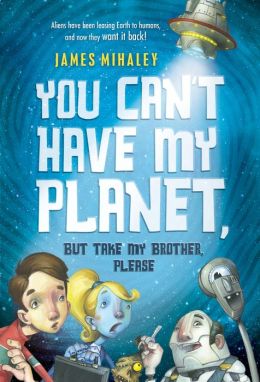
You Can't Have My Planet, but Take My Brother, Please, by James Mihaley
Thirteen-year-old Giles is the last person anyone would expect to save the planet. he's not as charming as his little sister, and not as brainy as his goody-goody older brother. But when Giles witnesses an alien realtor showing Earth to possible new tenants, he knows he'd better do something. With the help of an alien "attorney" and the maddest scientist in middle-grade fiction, Giles just might save humans from eviction from Earth. Let's hope so. The alternatives are...not so hospitable.
Jacob Wonderbar and the Cosmic Space Kapow, by Nathan Bransford
Jacob Wonderbar is used to detentions, but when a spaceship crashes near his house, he finds himself in a whole new level of trouble. After swapping a corn dog for the ship, he and his two best friends, Sarah Daisy and Dexter, take off on a madcap adventure. They accidentally cause an epic explosion, get kidnapped by a space pirate, and are marooned on planets like Numonia and Paisley, where the air smells like burp breath and revenge-hungry substitute teachers rule. And that's only the beginning . . . It turns out that there's an entire colony of space humans, and Jacob's long-lost father just might be one of them.
The first book in debut author Nathan Bransford's hilarious space adventure series has dynamite friendships, peculiar planets, and nonstop action. You'll never look at the stars the same way!
The Mostly True Story of Jack, by Kelly Barnhill
When Jack is sent to Hazelwood, Iowa, to live with his strange aunt and uncle, he expects a summer of boredom. Little does he know that the people of Hazelwood have been waiting for him for quite a long time.
When he arrives, three astonishing things happen: First, he makes friends -- not imaginary friends but actual friends. Second, he is beaten up by the town bully; the bullies at home always ignored him. Third, the richest man in town begins to plot Jack's imminent, and hopefully painful, demise. It's up to Jack to figure out why suddenly everyone cares so much about him. Back home he was practically, well, invisible.
The Mostly True Story of Jack is an eerie tale of magic, friendship, and sacrifice. It's about things broken and things put back together. Above all, it's about finding a place to belong.
Nightshade City (Nightshade Chronicles Book One), by Hilary Wagner
Deep beneath Trillium City, a modern metropolis, lies the Catacombs, a kingdom of rats of extraordinary intelligence and ability. The once peaceful and democratic colony has become a harsh dictatorship ruled by the High Minister Kildeer and his henchman, Billycan, who runs the Kill Army and collects weekly Stipend from the terrified subjects. The two of them rule with iron fists. With most of the adult rats wiped out in Killdeer's Bloody Coup and the subsequent great flood, orphaned young male rats are forced into the army and the females into servitude or worse. But change is coming. . . .
Two orphan brothers, Vincent and Victor Nightshade, sons of a hero killed in the Bloody Coup, manage to escape from the Kill Army and meet up with Juniper Belancourt, leader of a rebel group seeking to overthrow their oppressors and restore peace and democracy in a new city. The brothers are quickly caught up in Juniper's cause: "We survive by cover of night. We live in the shadows, waiting for our redemption! Our name must symbolize our burning spirit. . . . Tonight and forever, we are Nightshade City!"
Juniper's plans are complicated by many factors. His lovely young niece Clover has been picked by Killdeer to be his next Chosen One, so the rebels and their allies the Earthworms must work fast to save her. Can the rebels locate their enemies' War Room? Can Juniper's former love, now holding a position in Killdeer's Ministry, be trusted? Will the rebels be able to execute their plans without the aid of a young Topsider (human)? And how will Vincent and Victor fare in battle will they honor their father's legacy of courage?
The Kindling (Middle School Magic Book One), by Braden Bell
All thirteen-year-old Connor Dell wants to do is pass pre-algebra, play lacrosse, and possibly kiss Melanie Stephens, but when a run-in with the school bully ignites strange powers inside him, Connor's normal teenage life goes up in flames. Now he'll need his new powers to defeat the Darkness that's coming for him. Fast-paced and original, this book's guaranteed to keep you guessing!
Storybound (Storybound Series Book One), by Marissa Burt
In the land of Story, children go to school to learn to be characters: a perfect Hero, a trusty Sidekick, even the most dastardly Villain. They take classes on Outdoor Experiential Questing and Backstory, while adults search for full-time character work in stories written just for them.
In our world, twelve-year-old Una Fairchild has always felt invisible. But all that changes when she stumbles upon a mysterious book buried deep in the basement of her school library, opens the cover, and suddenly finds herself transported to the magical land of Story.
But Story is not a perfect fairy tale. Una’s new friend Peter warns her about the grave danger she could face if anyone discovers her true identity. The devious Tale Keeper watches her every move. And there are whispers of a deadly secret that seems to revolve around Una herself....
With the timeless appeal of books like A Wrinkle in Time and the breathtaking action of Inkheart, Storybound has all the makings of a new classic. Brimming with fantastical creatures, magical adventure, and heart-stopping twists, Storybound will leave readers wishing they too could jump through the pages into this enchanting fairy-tale world.
The Atomic Weight of Secrets or the Arrival of the Mysterious Men in Black (The Young Inventors Guild Book One), by Eden Unger Bowditch
In 1903, five truly brilliant young inventors, the children of the world’s most important scientists, went about their lives and their work as they always had.
But all that changed the day the men in black arrived.
They arrived to take twelve-year-old Jasper Modest and his six-year-old sister, Lucy—he with his remarkable creations and she with her perfect memory—from their London, England home to a place across the ocean they’d never seen before.
They arrived to take nine-year-old Wallace Banneker, last in a long line of Africa-descended scientists, from his chemistry, his father, and his New York home to a life he’d never imagined.
Twelve-year-old Noah Canto-Sagas, already missing his world-famous and beloved mother, was taken from Toronto, Canada, carrying only his clothes, his violin, and his remarkable mind.
And thirteen-year-old Faye Vigyanveta, the genius daughter of India’s wealthiest and most accomplished scientists, was removed by force from her life of luxury.
From all across the world, they’ve been taken to mysterious Sole Manner Farm, and a beautiful but isolated schoolhouse in Dayton, Ohio, without a word from their parents as to why. Not even the wonderful schoolteacher they find there, Miss Brett, can explain it. She can give them love and care, but she can’t give them answers.
Things only get stranger from there. What is the book with no pages Jasper and Lucy find in their mother’s underwear drawer, and why do the men in black want it so badly?
How is it all the children have been taught the same bizarre poem—and yet no other rhymes or stories their entire lives?
And why haven’t their parents tried to contact them?
Whatever the reasons, to brash, impetuous Faye, the situation is clear: They and their parents have been kidnapped by these terrible men in black, and the only way they’re going to escape and rescue their parents is by completing the invention they didn’t even know they were all working on—an invention that will change the world forever.
But what if the men in black aren’t trying to harm the children? What if they’re trying to protect them?
And if they’re trying to protect them—from what?
An amazing story about the wonders of science and the still greater wonders of friendship, The Atomic Weight of Secrets or the Arrival of the Mysterious Men in Black, the first book of the Young Inventors Guild trilogy, is a truly original novel. Young readers will forever treasure Eden Unger Bowditch’s funny, inventive, poignant, and wonderfully fun fiction debut.
-----------------------------------------------------------------------------------
That's it for today! Please feel free to share your own recommendations in the comments.
Monday, November 18, 2013
First Page and Cover Analysis of The Girl Who Circumnavigated Fairyland, by Matthew MacNish
Technically, the title of this book is actually The Girl Who Circumnavigated Fairyland in a Ship of Her Own Making, which is a great, if somewhat long title, but just wouldn't fit as a post title.
Anyway, today I would like to take a look at the fascinating cover and first page of a very interesting middle grade novel. The cover, with the original illustration by Ana Juan, is gorgeous enough in its own right, but as a writer, it's the blurbs that really struck me when I first picked up this book.
The front cover is blurbed by Neil Gaiman, and that, of course, is impressive enough, but turn the book over, and you'll see none other than Tamora Pierce and Holly Black recommending the tale inside. But it doesn't stop there. Crack the book open, and take a peek at the inside jacket flap, and you'll see yet another blurb touting the originality of this story, this one from none other than Peter S. Beagle, who in case you don't recall, wrote this little book called The Last Unicorn.
So anyway, I guess needless to say, my point is that as covers go, I was definitely impressed the moment this book showed up at my house (I won it and its sequel on Facebook, from Liz Szabla, who is the editor at Feiwel and Friends who published the book). With a title as inventive as this book has, I'm not sure it needed so many great blurbs to sell me on its story, but it couldn't have hurt, right?
Now, let's talk about the first page:
Beginning with another lovely drawing, the first chapter is titled Exeunt on a Leopard. What a great title, right? Sure, I had to look the word Exeunt up, but once I knew it was a stage direction, I was in love. From there, we have the chapter sub-title/heading: In Which a Girl Named September Is Spirited Off by Means of a Leopard, Learns the Rules of Fairyland, and Solves a Puzzle.
Well, as you can imagine, from there on out, I was in. I'm actually still reading this novel, and while I'll admit it can be occasionally a bit heavy handed in its verbosity, it's a fantastic tale, filled with some of the most inventive characters and imaginative circumstances I've ever encountered in a book. Certainly highly recommended, in case the cover, blurbs, and first page weren't enough to pique your interest.
Have you heard of this book? If not, how much of a role do covers and blurbs and such play in your decision to read a particular book?
Monday, August 26, 2013
Do At Least Two Things At Once, by Matthew MacNish
I'm not sure the many-armed statue of Shiva is the best image to represent this post, but it's important to use open licensed images, so it's what we've got.
Anyway, today I want to discuss one of many revision techniques I use. That is, for lack of a better term: do at least two things at once. And I don't mean multi-tasking, though the photo may imply otherwise. What I mean is, while reading back through a manuscript, and revising it, one thing I try to focus on is making sure that every scene accomplishes at least two things. Here are some examples of goals that scenes can strive for:
- Furthering the reader's understanding of a character
- Furthering the reader's understanding of the world
- Describing the setting
- Foreshadowing a coming plot element
- Echoing a past plot element
- Speaking to theme
- Ramping up tension
- Purposefully slowing down (or speeding up) pace
There are dozens, if not hundreds more, and I would love to see more examples in the comments, but I'm sure this list is enough to make my point.
Of course we all know about the four rhetorical modes of discourse: exposition, argumentation, description, and narration. While argumentation isn't much used in fiction, sometimes, depending on point of view and narrative distance, two of the others can be done at once. But that's not really what I mean either.
Whatever the method may be, and certain methods work better for certain types of scenes (dialog vs. action, for example, or inner thoughts vs. description) the point is to try to make sure that every scene exists for more than one reason, and that it accomplishes at least both of those goals (hopefully more than two, but by having a rule of at least two, I find that helps me decide what to trim).
I wish I could share an example from my own work, but I've got nothing published except for some very short flash fiction/vignettes, and they don't really follow the same rules as longer stories. Hopefully this technique makes enough sense to be understood without an example, but feel free to share one if you have one (or more goals that scenes can strive for)!
Labels:
Fiction,
Matthew MacNish,
Revision Techniques,
Rhetoric,
Storytelling
Friday, August 2, 2013
Duality of Tone in MG, by Matthew MacNish
One of the things I love most about reading Middle Grade literature is how nuanced I find it often is, especially when it comes to tone. Take Harry Potter, for example: (which could certainly be argued escalates into YA territory by the end, but there's no question the cupboard under the stairs begins firmly in MG) the tone, for the most part, is light and humorous. The world is full of Weasley Wizard Wheezes, Every Flavored Beans, Bogeys, Hinky-punks, and all other sorts of wonderful nonsense. Just the kind of stuff that gets kids really into a story - truly invested, emotionally.
But ... even from the very beginning, the Wizarding World also contains a darker underbelly. Harry's parents were murdered by a dark wizard. His aunt and uncle and cousin, while somewhat humorous, are also unbelievable cruel and uncaring. Much of the darkest elements such as dementors and killing curses don't come up until later, but my point is that Harry Potter, much like a lot of MG Lit, I find, walks this amazing balance of light and dark, a sort of duality of tone that truly makes for a deeply compelling read.
There are countless examples of this duality. The Graveyard Book, by Neil Gaiman, is a MG novel in which cold blooded murder is committed in the first few pages, and the dark tone of the story stays with the reader throughout, but there is also plenty of humor and love and family, not to mention the somewhat ridiculous but terrific notion of a boy named Nobody who grows up living in a graveyard.
Lemony Snicket and the Series of Unfortunate events is another example. Heck, every Roald Dahl novel ever written pretty much invented this trope, if you could even call it one.
I think this is important, because books and literature are the very best way for young people to become exposed to the world, especially when it comes to some of the darker aspects of it. A picture book that exposes a child to the death of a pet is much better than having to experience such tragedy for real. A chapter book that covers a friend moving away, or divorce, or any other number of topics is a much safer way to explore the emotions that might come up.
Anyway, I'm sure you see my point. Does anyone have any other examples of great MG novels with obvious duality of tone?
Either way: happy Friday! Have a great weekend.
Labels:
Matthew MacNish,
MG,
Tone,
voice
Friday, July 26, 2013
How to Answer FEAR, by Matthew MacNish
Watch the video. If you're a young kid, or the parent of a young kid, be aware there's some implied violence, and one semi-foul word, but if not, I hope you'll see how The First Sword of Bravos, Syrio Forel's admonition to Arya Stark is a perfect analogy for how to answer Fear. Just replace "death" with "fear."
In other words, when fear tries to take over your day, your life, your ambition, your dreams, and you feel like its crippling grip is latching on to whatever motivation you might have left to do what you do?
There's is only one thing you need say to Fear.
"Not today."
I bring this up, even though it's Friday and I don't want to keep you long, because I was recently offered a writing related opportunity. I can't share the details, but they really don't matter. What matters is that it was the kind of opportunity that for an unpublished writer like me, scared me half to death. I felt like I didn't belong. I felt like I had done nothing to have earned the right to be offered such an opportunity. I was convinced I wasn't good enough.
I spent over 24 hours running these thoughts through my head. I almost turned the opportunity down because of them.
But those thoughts? They were only Fear.
And what do we say to Fear?
Labels:
ART AND FEAR,
Arya Stark,
FEAR,
Matthew MacNish,
publishing,
Writing
Friday, May 31, 2013
Reboots, Kids, and their Interest, by Matthew MacNish

I'm not sure I blame her. Sure, the first reboot was better written, with better character arcs, and a more direct progression of plot and conflict, but there was something about this new one, something just a little bit beyond the edge of consciousness, that really whet the appetite.
Is it the CGI? Perhaps. The additional casting? Surely Benedict played a part. The gimmick of 3D tech? I doubt it. So when does an inferior tale present an exciting thoroughfare that brings new fans into the fold of an existing franchise?
Well, I'm not marketing guru, but I would argue that the nature of the medium of film plays a big part, especially when combined with the instant gratification high sparkle high contrast advertisement nature of modern culture, but I don't think that's enough to explain it all. I think the existing franchise of Star Trek is the biggest factor in why my kids are now so fascinated with every iteration of its canon.
Similar arguments can be made for The Lord of the Rings, and even Star Wars. Heck, even the Harry Potter movies surely brought more readers to the books. But is it only movies that do this? I'm curious.
BBC's Sherlock inspired my teenager to obtain and read the entire works of Sir Arthur Conan Doyle.
ABC's Once Upon a Time has my younger daughter curious about reading fairy tales.
But those are both TV shows. What about books? I can't personally think of a book series that was rebooted years later, whether by the original author or not, but surely there is one out there? Readers? Can you think of any?
* * *
Labels:
Kids,
Matthew MacNish,
movies,
Reboots,
series
Friday, March 29, 2013
I'm Off to See the Wizard(ing World), by Matthew MacNish
| photo is from Wikimedia Commons |
I cannot express how excited I am about this. J.K. Rowling, and the Harry Potter books, changed my life a bit. Cliché, I know, but it's true.
When I first bought The Sorcerer's Stone, it was because I'd seen the hype on TV, and was curious what people were so excited about. So, this was in maybe the year 2000, I bought a copy for daughter, but when I tried to read it, it seemed like too much of a children's book, and I dismissed it as beneath me.
This was at a time in my life where I was not writing, and was only reading a bit. I'd always loved reading and writing as a teenager, but had given up on it in my twenties, as the stresses of being an adult took over.
Well, I'm glad to say, once my daughter fell in love with the series, and convinced me to give it another chance, I read every single book, and loved every minute of it. In fact, it's what made me fall in love with the written word again. I used to read The Lord of the Rings every spring. I did it for like ten years in a row when I was a boy. I used to write too when I was young. Poetry, song lyrics, short stories, whatever came to mind, really, but I stopped all of it when I grew up. I'm not really sure why, but it doesn't matter now.
After reading Harry Potter, I remembered the magic of storytelling. I started writing seriously, as in trying to become a published novelist, maybe 5 years ago. I won't recount every detail of that journey here, and some of it is available in other places anyway, but I will just say that, short of meeting J.K. Rowling, visiting Hogwart's seems like the most excellent way to celebrate.
What about you all? Did you ever forget your love of words, or were you always clear about your passion?
Anyway, have a great weekend!
Labels:
Family,
Florida,
harry potter,
Matthew MacNish,
Orlando,
Univeral,
Vacation
Monday, February 11, 2013
Middle Grade First Lines
This image doesn't necessarily have that much to do with Middle Grade First Lines (it's a photo of a letter Gandhi wrote), but with so many copyright concerns with web images of late, it seems best to use only images that are in the public domain.
Anyway, today I want to share some first lines. As writers, first lines are something I think we all think about a lot. We certainly have to write them (at least one for each book). And whether they come easily to you, or whether you rewrite them hundreds of times, it can be interesting to think what they mean to readers, and whether they have more or less impact than we expect.
So, I went and grabbed 5 Middle Grade novels from my daughter's room. I read plenty of Middle Grade myself, of course, but she has a much nicer bookshelf than I do, so we keep them in there. At any rate, without further ado, I will share the opening lines from these five mystery books, and say a few things about each one:
- A mango, thought Peter. The perfect weapon.
- Goldie Roth hated the punishment chains.
- Eva Nine was dying.
- It all started with Aldwyn's whiskers beginning to tingle--the way they always did when he got hungry.
- Look, I didn't want to be a half-blood.
Well that's it. What do you all think? Do you recognize any of these books (don't give it away if you do)? Which of these opening lines is your favorite?
Monday, January 14, 2013
The Beauty, and Agony, of Revision, by Matthew MacNish
This is just a stock photo of the Track Changes function in Microsoft Word. I don't actually use it much myself early on in revision, even if it plays a big role later.
Revisions, just in case there are any out there still wondering, can take many roles in the complicated process that is the drafting of a manuscript for publication. The second draft, or first pass, is very different from the first, and the seventh draft (or however many it takes to get you ready to share with your CPs) can be very different from the sixth.
Being the only un-agented, unpublished author here at Project Mayhem, I'm perhaps the least qualified to post on this subject, but then again, so what? The whole point of blogging about publishing, and connecting with other writers is for all of us to learn from each other, right?
So even if I don't have anything to say that helps, maybe we can all learn something from each other, even if the comments are more illuminating than the post itself.
Now, there are several things we, as writers, must focus on during revision. There are little picture things, like grammar, spelling, sentence structure, repeated words, formatting, punctuation and so on, which if you have a contract and a paid copy-editor, maybe don't seem that important, but surely we all care enough about our work as professionals to get these things as close as we can to perfect, before we hand our writing off to ... whoever may be the next person involved in our process.
Then there are big picture things, like pacing, character arc, theme, voice, plot arc, and so on and so forth. These are the kinds of aspects that can make or break a story. A well executed story, however perfect its details, does not necessarily make a great tale. Of course, sometimes it's a very fine line. If you do have a professional editor you work with, they will often make suggestions about these big picture items, but even if you don't you can sometimes utilize critique partners and beta-readers to help you find holes in these building blocks.
Personally, as the title of this post suggests, I find revision to be both the best and the worst part of writing. It's nothing like the natural high of drafting an exciting new project, which can often carry me through months of feel good, productive days, but it does have its moments.
The hardest part of revision is plowing through things that you knew didn't work in the first draft. Missing scenes. Extraneous scenes. Mis-placed scenes (it's not all about scenes, they're just coming to mind right now). Finding a way to force these things into a working format can be so hard, it often takes tens or hundreds of times as long to fix them as it did to draft them.
However, the best part of revision, the moments when you take a good turn of phrase, and make it phenomenal, or when you take a strong, tense scene, and turn it into an edge-of-the-seat-nails-chewed-to-nubs type of scene, and you have that moment where you sit back, look at the page, and sigh, so satisfied that you finally figured out what you were put on this earth to do? That's the moment when you remember what it's all about. When you remember why you started writing in the first place.
At least, that's how it works for me. What's your revision process like?
Labels:
Matthew MacNish,
revision,
The Process,
Writing
Monday, December 17, 2012
The Hobbit, The Tragedy in Newtown, and the Nature of Good and Evil
I had originally just planned to review my first viewing of The Hobbit, but after Friday's tragic events in Connecticut, I felt I had to say something.
As a nation, we have a lot of things to think about. A lot of things to think about as a people. As the human race. There are a lot of hard questions. Gun Control. Mental Health Care. Security measures in certain public places. The media, and how it reports on such events. Unfortunately, there are no easy answers.
But instead of getting all political on the topic, I want to bring it back to my original planned post, and talk about J.R.R. Tolkien, his amazing stories, and what he knows about good and evil. Tolkien served as Second Lieutenant in the British Army during World War I, and without going into too much gruesome detail, suffice to say he saw the horrors of war first hand, and learned of the evil of men in the most horrific ways.
So even though surely Tolkien knew evil was often carried out by men, and surely saw evil deeds done by soldiers on both sides of the conflict, when he wrote, the evil he penned was faceless, and most terrifying when it was an unknown, even ethereal entity (such as Sauron's eye, or the Necromancer in the new film).
I would like to argue that we ought to make evil faceless again. Perhaps even nameless.
The way the media handles events like Friday's tragedy can't possibly help. These sick people, whatever their problems may be, are obviously haunted by what legacy they might leave behind, and when CNN, Fox News, and MSNBC put their names and faces all over the screens that live in all our homes, the next troubled individual thinks that he can be famous too.
I won't reprint their names here, but surely Virginia Tech, Columbine, Sandy Hook, and all other similar such tragedies could have been reduced or even avoided if we didn't make celebrities out of their perpetrators. In our society, in the cult of personality, where being famous is akin to holiness, something has got to change.
There is also a great post about the state of mental health services, over at The Anarchist Soccer Mom. I strongly urge you to read it.
Labels:
Matthew MacNish,
Media,
news,
the hobbit,
Tolkien
Monday, November 19, 2012
We Work Hard, So We Can Play
I'm on vacation, but I'm writing hard, shopping hard, cooking hard, and resting hard, so this is all I have for you today, dear readers.
Enjoy your holiday, we're so very thankful for all of you!
Labels:
Holiday,
Matthew MacNish,
Play,
Work
Friday, August 24, 2012
When Do You Start Reading Up?
That's my kid, Madi. She's in sixth grade now. I'm pretty sure she's reading Rick Riordan there. She's been going strong on MG books for a while now, probably since ... well, at least second grade. Sometimes it's hard to remember, life moves so fast. But anyway, I recently noticed that she was reading Eighth Grade Bites (Chronicles of Vladimir Tod, Book 1), by Heather Brewer. Her sister read it years ago, but I think she was in eighth grade at the time.
Now, I'm not the kind of dad who controls what his kids read. My opinion is that if a kid has a curiosity about a certain book, there is good reason they might be interested in it. Now, if she were wanting to read Lolita or Mein Kampf, I might be a little concerned, but in this instance, with her wanting to read what my understanding is a YA novel that is not too particularly dark or edgy, I can simply ask her sister, "do you think this is appropriate for her?" If her sister hadn't read it, I would probably just read it myself.
But this post isn't really about what we should allow our kids to read, I more so wanted to pose a question to our readers: when did you start reading up?
Personally, The Hobbit and then The Lord of the Rings were the first two (four) books I read, so while The Hobbit is somewhat a children's book, LOTR certainly is not, so I guess I started reading up right away. I did not get into the likes of Roald Dahl, Gary Paulsen, or Jack London until fifth or sixth grade. Then in middle school, I moved back to adult fantasy, and started reading spy and espionage books like Robert Ludlum and John Le Carre.
So what about you all? Were you aware of literary age distinctions when you were younger? Did you ever read above or below your supposed level by choice? Did you ever read adult novels as a kid? If so, what did your parents think of it? Did they know?
Labels:
Matthew MacNish,
MG,
Middle Grade Madi,
reading,
YA
Monday, July 30, 2012
Document Map, a Tutorial by Matthew MacNish
Document Map is a setting in Word that lets you navigate around a document quickly, and view the layout of a document at a glance. This is especially useful when dealing with a long document like a novel manuscript. Now that I know how to use this feature properly, I have no idea how I worked on writing without it.
Most of the Project Mayhem authors probably already know about it, but when I learned about the Document Map recently, and then shared about it on Facebook, I was amazed how many writers I know didn't know about it.
So, I'm going to write this post based on Microsoft Word 2007, which is what I own, and what I write in, but my understanding is that the feature exists in everything since Office XP (Word 2003), and is even better in Word 2010. Enabling and using the feature might be a little different in the different versions, but I'm sure you can Google the settings for whichever version you use.
For MS Word 2007, here is a screenshot of how you enable the function:
So that's VIEW on the banner, then click the box next to "Document Map," to place a check mark in it, and then the Document Map pane will appear to the left of the document itself (that dropdown menu can also show thumbnails).
When you're ready to create your first heading (in a novel this might be the title), which is like the highest level in the tree directory of an outline, you need to switch back to HOME on the banner. That will allow you to select style, as seen here:
The default format is probably not how you want it to look in a novel, but we'll get to customizing it in a moment. For now, light blue 14-point Cambria works fine when creating an example outline. I'll show you what this does to the Document Map pane in a second.
For now, you'll need at least one sub-heading to create a directory tree. This is what that looks like:
Keep in mind, that these styles only appear with these default settings when you open a new document. I have found that when trying to add these setting to a manuscript I first started years ago, the styles are all kinds of wonky. You can edit them manually, but I've found it much easier to create a new document, build the headings exactly how you want, and then paste the rest of your text in.
So, now that you know how to enable Document Map, and how to create the first two headings, this is what an example outline looks like, with four levels of headings, and then what that does to the document map pane on the left:
That's a little blurry, so here's a closeup of the map pane:
Isn't that convenient? Imagine a manuscript with 3 sections, and 34 chapters. It is so much faster to be able to jump around the document using this feature, expanding and contracting your headings on the left, and then clicking on whatever section you need to jump to. This feature is amazing during revisions. I have a friend, Adam Heine (who also actually taught me this feature), who even uses a level 5 heading for each scene within his chapters. I haven't found this necessary yet, but the fact that the option is there is pretty nice.
Now, you probably don't like light blue 14-point Cambria to show up in your novel manuscript, so how do you edit the formatting of these headings, so that it fits the style of your writing? There is apparently a way to do it by right clicking the text and then clicking on the paragraph settings, but I've found it much easier to right click the style, and the "modify," like this:
Which will bring up this window, that allows you to customize how you want the style (heading) to look:
Note the outlined font color of "Automatic," (which is basically black), the outlined centering of the paragraph, rather than "aligned left," and the font changed to "Times New Roman," which is the default in the majority of the publishing industry, rather than "Cambria." Now, I didn't change the font from 13-point to 12-point for this example image, but in a novel manuscript, even for a chapter title/heading, you probably should. Some agents and editors may ask for something different, and you can certainly Google, "default manuscript formatting," for better expert opinions than mine, but I keep the entire text of my manuscripts in 12-point Times New Roman, automatic color.
You might not want to center your chapter headings, and that's certainly fine if you don't, but the point is that this window is how you control those formatting options for every single piece of text that uses that style (heading). Modifying Heading 2, for example, will change the formatting for every piece of text that you assigned the style "Heading 2," to.
Does that all make sense? I certainly hope so, because I'm pretty new to this, and am definitely no expert. If you have any questions, please be sure to ask them in the comments, and if I don't know the answer, I'll try to find it for you.
Subscribe to:
Posts (Atom)