Showing posts with label middle-grade humor. Show all posts

Monday, October 3, 2016

Writing Funny on Purpose by Jim Hill


“Humor can be dissected, as a frog can, but the thing dies in the process, and the innards are discouraging to any but the pure scientific mind.” – E.B. White 

Writing funny takes a knack, but like any craft, there are techniques you can learn to let your silly out. The trick is, well there are a lot of tricks, but maybe the most important one is listening. Listening to what makes you laugh, and how that might be a bit different than the gut-buster your friends and family love.

What I'm saying is, humor is subjective with a side order of formulaic and a twist of the absurd. Like the infamous line about obscenity, "I know it when I see it."

[INSERT FUNNY CAT VIDEO HERE - Ed.]
[No. - Jim]

Maybe funny is a mindset. A way of looking at and responding to the world that is intentionally off-kilter. If writing reflects the real world–art imitates life–then writing funny on purpose breaks the rules of physics. The angle of incidence does not equal the angle of reflection. The degree to which you alter that formula defines the humor, taking it from the subtlest satire to the broadest slapstick. The world recorded by way of a funhouse mirror.

Back to listening. And by listening, I mean reading (but also I mean listening). Learning to be funny means exposing yourself to the funny. Fortunately, we live in a golden age of exposing yourself. [JIM! - Ed.] With content-on-demand finding comedy has never been easier. Better still, the spectrum of comedic voices is much broader than it was back in your grandparent's day when Uncle Milty was "the man" on that one TV channel. Which means you can find the things that make you laugh and learn from them, the same way you discover how to be a Newbery Award winner by reading your Kate DiCamillo collection into dog-eared, high-lighted, broken-spine relics of devotion. Or is that just me?

I'll get you started with a few of my favorites.

Finally, The Funny Links

The Comic Toolbox – Although it fulfills its promise to provide the rules and structure of comedy, this book also sneaks in quite a bit about writing in general. Vorhaus' light tone and banter walk the reader through a progression of comic tools to instruct on the techniques and provide the vocabulary of critique and analysis.

What Are You Laughing At? – If you've ever wondered if comedy can be scientifically analyzed, this is the book for you. Dan O'Shannon breaks down the ha-has of humor the same way Nate Silver attacks polling data. It's a deep study, but well worth the time. Perfect for the Ravenclaw that wants a little more Hufflepuff in their writing.

(Not So) Rando Resources That I Found

Now that you're a comedy expert, in the same way that you're an architect because you built that LEGO Fallingwater with your nephew, it's time to hear from the professionals.

Poking a Dead Frog – In this book, Mike Sacks interviews a wide array of comedy writers. There's a lot of background on breaking into TV or film, but there's also kernels of humor truisms and nuggets of hilarity. Most of the interviews are short, perfect for my attention span, so this book makes an excellent bathroom reader. [Jim, I'm scheduling a meeting for you with HR. - Ed.]

Funny Business – Subtitled "conversations with writers of comedy," Leonard Marcus pitches this collection at younger readers and includes many favorites of the middle-grade set. Beverly Cleary, Norton Juster, Daniel Pinkwater, and Jon Scieszka, to list a few.

By Ken Levine – Ken Levine wrote episodes of MASH and Cheers. That ought to be enough of a comedy pedigree to get your attention. His blog features a lot of behind-the-scenes craft-based stories about what goes into writing sitcoms, and that stuff translates into middle-grade humor very easily. Worth checking for his Friday Questions, if nothing else.

The Writers Panel – This podcast isn't always focused on comedy, but there are almost always great insights into serving an audience well-crafted stories. And even when something isn't a straight-up comedy there's often humor in the mix. Ben Blacker and the panelists dig deep. Have a notebook handy.

WTF with Marc Maron – NSFW, but if you can get beyond that issue, Maron's interviews with comedians both contemporary and legendary are fantastic. Almost never craft focused, but if you're wondering about how to be funny, getting a look into the mind of funny people might help.

Congratulations, You Are Now Hilarious


So that's it. Go forth and be funny.

[Really? That's it? - Ed.]
[Fine. - Jim]

What's Made You Laugh Lately?


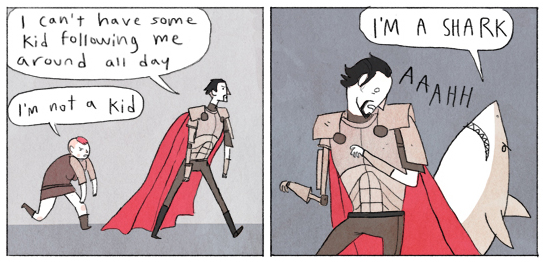
Wait! Before you go, tell me the last book you read that made you laugh out loud. For me, it was Nimona by Noelle Stevenson. Okay, your turn.


It's Cat Video Time!

Play me off, Keyboard Cat!


[Thank you! - Ed.]
[You're welcome. - Jim]

Tuesday, August 9, 2016

Dr. Fell and the Playground of DOOM

Happy Book Birthday to David Neilsen and Dr. Fell!


And Now for the Review


Dr. Fell and the Playground of DOOM is creepy, funny, and perfect middle-grade horror for those kids with a taste for the dark side (Hmmm, tastes like chicken). 

Dr. Fell arrives in the quiet neighborhood of Hardscrabble Street, takes over a long abandoned home, and turns the front yard into the titular playground overnight. The local children are seduced by the endless adventures offered by the playground as it takes the shape of whatever they imagine it to be – rockets, castles, pirate ships, climbing walls, mad tea parties, catacombs, etc. The kids love it, even when the injuries start piling up – sometimes grave trauma. But injuries are no problem for the doctor, who swoops in and performs miraculous feats of medicine behind the closed doors of the formerly abandoned house. In no time, Dr. Fell mesmerizes the entire town (including the parents!), and it's up to the heroic efforts of the three main characters to somehow save the day from Dr. Fell and his ancient horrors.

Author Neilsen's background in storytelling and theater shows in the language which lends itself to quality read-a-loud activities for families, libraries, and schools. This book will find a home among shelves cluttered with R.L. Stine, David Lubar, Adam Gidwitz, and Neil Gaiman.

Just be sure to have a night light handy. 


The Interview Portion of Our Entertainment


How did this story come to you? It's your first book for kids. Did it start out that way, or did you realize that when you were into it?

David Neilsen
The idea for the book came from an illustration by the late children’s illustrator Trina Schart Hyman. It had been hanging on the wall of my in-laws’ for years before I ever really looked at it.  It shows a man in a suit and top hat leering down at a little girl, who looks back at him suspiciously. The man has a large basket strapped to his back out of which are sticking various arms, legs, and heads of little children. It’s labeled “Dr. Fell” and Hyman drew it when asked to create an image from her favorite fable or fairy tale. Curious, I looked up Dr. Fell online and discovered the four-line poem written in 1680 which I’ve included at the beginning of my book.

I loved the picture, and right away all sorts of questions jumped into my head. Who is this guy? What is he doing? What happens when he comes to town? The story began to take form when I went about answering these questions.

From the start, I knew this was a book for kids. It’s actually my second book. My first book, which has yet to be published, caught the attention of an agent who took me on as a Middle Grade/YA author, so I’d already started down the path of writing Middle-Grade fiction when I began to put this story together.

How does your storytelling experience inform your writing? Do you read your work aloud as you draft?

My storytelling and my writing are two sides of the same coin. I have brought stories I’ve written into my work as a storyteller, and have taken stories I crafted as performance pieces and sold them as short stories. I have a theater background, so I do tend to read my work aloud when I’m going over it, to make sure it reads well and isn’t too clunky. I have always read aloud to my kids at night, and I like to think that parents will read my book aloud to their kids. I keep that in mind as I write, and make sure that everything flows the way I want it to. I teach a writing workshop for kids through Writopia Labs and always advise my students to read their work aloud, even if alone in their room, because you may realize that what looks good on the page may not actually sound good out loud.

What horror authors for kids have influenced you? 

Obviously, when you think of children’s horror, you think of R.L. Stine, and while I’ve read several Goosebumps books. I’m more partial to horror of the mind, rather than jump scares and gore. Neil Gaiman’s The Graveyard Book and Coraline are two fantastically creepy tales. I also liked Jonathan Auxier’s The Night Gardener. Recently, I devoured Claire Legrand’s amazing novel, The Cavendish Home for Boys and Girls. I loved the truly disturbing descriptions of the home itself, as well as the darkness into which the plot descends. A great book.

What were the challenges of bringing a Lovecraftian themed story to life in a middle-grade book?

I think Lovecraftian themes are perfect for Middle Grade. Behind the tentacles and the madness inherent within Lovecraft’s work is the overarching theme of Forbidden Knowledge--the truth is worse than you could imagine and there is a terrible price to be paid for learning what you should not have learned. Children at this age are spreading their wings, as it were and their worlds are becoming larger by the second. Our job as parents is to guide that learning in the right directions. With Dr. Fell, there is obviously a terrible secret to uncover, but at what cost? The children are definitely changed by their experience and encounter with Dr. Fell, but changed for the better?

And then, of course, I did have to have some sort of tentacles in there as well. Because I love tentacles.

Is there a sequel?

While there’s nothing officially in development, I think a lot about a sequel. It took me a long time to figure out how to best craft a sequel without breaking the rules I set up in this book. I wasn’t entirely sure one existed. But things fell into place, and I figured out what I wanted to do, and so I’ve started putting notes in order and writing a few chapters. My next book is a stand-alone novel coming next August tentatively titled Beyond the Doors. And I’ve written another book after that also not related to Dr. Fell. But I do hope to return to the bad doctor sooner rather than later. I’m excited to the tell the next chapter of his story.

Cthulhu for President?

Isn’t he already running? I once saw a banner online which read something along the lines of “I’m voting for Cthulhu so that he’ll devour my soul last.” If Cthulhu wins humanity loses, but if you support him, you’ll get a few more days to live. Eating humanity takes time.

Dr. Fell on Tour

David and Dr. Fell are the making the rounds of several other blogs. Here's the list for those that to learn more about the book, the author, and the Evil Dr. Fell. Mwa-ha-ha-ha-ha-ha!

Date
Blog

8/1/16

8/2/16
8/3/16

8/4/16

8/5/16
8/6/16

8/7/16
8/8/16
Middle Grade Ninja
8/9/16
Project Middle Grade Mayhem 

8/10/16
8/11/16
8/12/16
8/13/16

8/14/16

8/15/16

8/16/16

8/17/16
8/18/16
8/19/16

8/20/16
8/21/16
8/22/16

8/23/16
8/24/16

8/25/16
8/26/16
8/27/16

8/28/16


Monday, July 27, 2015

Book Review and Giveaway: MOLLY PEPPER AND THE NIGHT TRAIN, by: Courtney King Walker


Update: Winner chosen by random.org is #2 - poetryinleaves. Thanks for stopping by!

Hi Mayhemers! Marissa here. :)

Today, I'm happy to introduce you to a new middle-grade book from Courtney King Walker. Here is the summary from the back cover of MOLLY PEPPER AND THE NIGHT TRAIN:

"Hidden somewhere in the fog of the San Francisco bay lies Blue Rock Island, home to the bay area's two best-kept secrets: Bell's Bluff, the old, abandoned prison on one side of the island, and the Night Train, a mysterious train ride on the other.

When twelve-year-old Molly Pepper receives a secret invitation promising a night of magic and adventure aboard the Night Train, she is skeptical. In her experience, most promises prove too good to be true. The fact that she lost her mom is proof enough.

Still, Molly gives hope another chance. Together with her loyal friend, Noah Wonderly, they sneak out of the house and follow a string of clues leading tot he Night Train. But when the train stops at Bell's Bluff, Molly discovers the real reason she was invited. There, she starts to wonder if hope and magic not only fix broken promises but make you believe in them again."

And a little bit about the author: " Courtney King Walker grew up in the San Francisco bay area
building rocketships and rafts out of cardboard, hoping to make it to the moon or at least Niagara Falls. But a trip across the border to Tijuana was as exciting as it ever got, so she decided writing was the next best thing. She now lives in the Rocky Mountains with her husband and four children and still dreams of flying to the moon."

This humorous adventure-mystery hits the right mark for middle-grade: a plucky heroine, a winsome best friend, and a magical setting with plenty of adventure. I liked Molly's independence and curiosity and Noah's journey to conquer his fears. Full of tasty foods from doughnuts to cinnamon candy and fun adventures at carnivals and on the night train, the plot carries readers along with Molly as she explores her feelings about her mom's death and learns to regain hope in family and friends.

So if you or the young reader in your life is looking for a fun summer read, pick up MOLLY PEPPER AND THE NIGHT TRAIN. Better yet, enter Project Mayhem's giveaway for a signed paperback. All you have to do is make sure to follow Project Mayhem and then leave us a comment sharing one of your favorite summer reads.

This giveaway is for US addresses only and will be open until Friday 8/7 when I'll post the winner selected by random.org.

Wednesday, September 3, 2014

Constructing a Comic Character


Humorous writing comes naturally to some, while for others even the idea of “writing funny” causes stress. Humor, like any other literary technique, can be an acquired skill when a thorough understanding of the rules and tools available are understood.

The most basic building block of humor is that of the comic premise. In The Comic Toolbox, John Vorhaus states: “The comic premise is the gap between comic reality and real reality. Any time you have a comic voice or character or world or attitude that looks at things from a skewed point of view, you have a gap between realities. Comedy lives in the gap.”

In his 2012 novel, The Hero’s Guide to Saving Your Kingdom, Christopher Healy sets his comic premise within an epic fantasy world populated by the princesses and princes from traditional fairy tales, with an enormous twist that is very accessible to young readers coming of age post-Shrek. Every convention and expectation of the known characters are turned on their heads.

Healy’s story features the princess heroines Snow White, Sleeping Beauty, Cinderella, and Rapunzel. In the traditional telling, each heroine is rescued and falls in love with the handsome, but non-descript, Prince Charming. In Healy’s world, there are four separate Princes that have been lumped together under the generic title Prince Charming by bards that have spread the stories, and each Prince wants his own name recognition. That’s the foundation of the comic premise. The reader is immediately presented with the gap between the expectation that Prince Charming is one perfect, heroic, and handsome man, and the reality of the story, where four Princes are flawed individuals quite removed from the handsome heroic ideal.

The comic premise is given even greater depth by crafting the princesses with personalities and characteristics far different than the traditional. Pushing it further still is the comedic tension created by the oppositional characteristics between each pairing.

For example, Cinderella, having been raised in near captivity by her step-mother, is a young woman who desires action and adventure now that she is a princess. Her Prince Charming, Frederic, is an endearing, but cowardly, fop brought up under fierce protection by a doting father. He has no interest in adventure, but loves Cinderella with true devotion. When Cinderella leaves to seek adventure in the wilds on her own, Frederic, worried for her safety, musters the courage to follow her. Ultimately, Cinderella ends up saving him (and the other Princes Charming), once again reinforcing the gap between comic reality and real reality.

What keeps comic characters interesting, and moves them beyond one-note jokes, is the layering of other elements over the premise to give them depth. Vorhaus provides four specific elements that go into the construction of a comic character.

The first is the Comic Perspective, defined by Vorhaus as, “a character’s unique way of looking at the world, which differs in a clear and substantial way from the ‘normal’ world view.” If we continue looking at Prince Frederic, his Comic Perspective would be that the world is a dangerous place, best avoided at all costs. In contrast, Cinderella’s is that the world is a wonderful place where anything can happen.

The second element is exaggeration. A character that is afraid of the world isn’t in and of himself very funny, but if a writer pushes the limits of that fear so that normal situations become farcical, a space for comedy is created. This description of Frederic from The Hero’s Guide is a fine example of comic exaggeration: “For most of his early years, Frederic was perfectly happy to skip out on pastimes like tree climbing (twisted ankles!), hiking (poison ivy!), or embroidery (pointy needles!).”

Flaws are the third element. These are negative characteristics that create distance between the reader and character, allowing the reader to comfortably laugh at the character without feeling bad. Flaws can also be positive characteristics taken to an annoying extreme. Frederic’s flaws fall into the latter category, as his worst trait is an almost unbearable friendliness and openness to strangers. This might seem to be in opposition to his view of the world as a dangerous place, but again, this creates an interesting conflict within the character. Even when faced with villains, monsters,  and impending doom, Frederic can’t help but be polite. Charming, even.

The final element is Humanity. The character’s humanity gives the reader a reason to care about his outcome. It balances the flaws to enable readers to emotionally engage with the character. Frederic’s humanity is grounded in his romantic love of Cinderella, and the lengths he goes to try and find her. He travels the world, faces battles, giants, and witches and gets so far outside of his comfort zone that readers can’t help but feel for the poor guy, even as they laugh at his total lack of traditional heroic qualities.

Healy does an excellent job of creating complex comic characters, and Frederic is just one example within that story. The characters, both Princes and Princesses, because they are drawn with such specificity, play off of each other in a web of well choreographed, and highly comical, relationships. In the end, Frederic may come the closest to laying claim to the name Prince Charming, but by embracing his entire character he earns a recognition all his own. And gives the reader plenty of laughs while doing so.

Tuesday, April 1, 2014

Happy April Fool's Day: writing humour, by Yahong Chi


Practical jokes, riddles, pranks and puns: these are all real-life sources of humour which almost always guarantee a few chuckles. Who doesn't love a well-planned prank? (Well, besides the victim, probably.) But translating this humour to the written page doesn't always work. When you're trying to make your reader laugh, it's important to note that just making your characters laugh probably won't do the trick.

Because the characters' experience is, to a certain extent, removed from the reader's experience, you'll often find that readers are laughing when characters aren't. As Dee outlined in her post about Star Wars humour, it's often the situation that's being presented which tickles the objective viewer's funny bone. Think about all those funny home videos you've watched; were the people being filmed laughing along with you? And the way a situation is presented can make a difference as well. Some scenes that would be dull in most authors' hands may be funny in the actual author's book.

Furthermore, humour is incredibly subjective, which is a good thing: this means there's all types of humour being written for all types of readers. For example, there's the wacky, absurd humour featured prominently in Louis Sachar's legendary Wayside School series, and the deadpan humour which Gordon Korman is known for. Judy Blume's Fudge series excels at presenting hilarious situations in a way which the reader can join in and laugh at, too.

Now, for some textual examples!


One of my favourite recent middle-grades series is Trenton Lee Stewart's The Mysterious Benedict Society trilogy. His books are full of adventure, friendship and plenty of humour:
(p. 160) Constance, in the meantime, was looking disgusted. "This is a terrible spyglass, Kate. It makes everything look far away."
Kate turned the spyglass around and handed it back to her.
One single sentence is all that's needed to show the mistake Constance has made, and to gently poke fun at her character while contrasting it with the dialogue she's just spoken. This is a great example of simple yet effective contrasting humour.


Tom Angleberger's The Secret of the Fortune Wookie is the third book in his Origama Yoda series, and it features many perspectives from different middle-grade students in the story. This allows us to experience many different POVs, including Murky Kahleel's, who happens to have the type of exuberant personality which translates excellently to writing:
(p. 91) it was the Rug-Boni!!!!!!!!
"Stooky!" I shouted. in case you dont know what a Rug-boni is do you know what a ZAMboni is? a Zamboni is this jacked-up thing they drive around on the ice at a hockey game to make the ice icier or something. Ben told me about it. he watches hockey on TV and used to go see the Roanoke hockey team play before they stopped.
well a Rug-boni is like a Zamboni but for carpets instead of ice!
its like a vacuum cleaner that you ride on!!!!
the only reason I know its called a Rug-Boni by the way is that it says RUG-BONI right on the side of it! draw a picture of it Kellen!
(And then follows a hand-drawn picture of the Rug-Boni.)

Seriuosly, have you ever seen exclamation marks convey a personality so well? Murky's sheer ebullience makes him a highly entertaining read.


The historical fantasy Magic Marks The Spot by Caroline Carlson is another recent MG that I thoroughly enjoyed, featuring magic, hijinks, adventure and also plenty of deadpan humour.
(p. 52 - 53) "Actually," said Hilary, "I'm going to be a pirate."
"Oh, that's brilliant!" Claire hopped up and down again. "It sounds so thrilling. And you could meet all sorts of dashing sailors."
Hilary squirmed. The only sailor she knew particularly well was Oliver, and he was only dashing in the sense that whenever she was near him, she wished he would dash away as quickly as possible.
Here our protagonist's discomfort is paired with a contrast in thought to the other character's dialogue, along with a semi-pun for good measure, and the result is a flash of humour for the reader to enjoy.


How do you write your humour? Alternatively, what kind of humour in middle-grade do you enjoy the most?

-Yahong