
When the differences between chapter books and middle grade novels are blurred, kids and chapter books lose.
Michael G-G here: I found this great piece on the differences between chapter books and middle grade, written by author Marty Mokler Banks. I was particularly interested, because I was recently in my local bookstore and eavesdropped on an exchange between a grandmother and one of the booksellers. The grandmother said her grandchild was 7, and was reading chapter books. The bookseller started bringing out books like Ranger's Apprentice and The Borrowers. An easy mistake: those books do have chapters in them... I wish I'd had the chutzpah to intervene and put the bookseller straight, but I am still too British and into minding my own business, even after 23 years of living in the States! I asked Marty Banks for her permission to rerun her blog post on Project Mayhem, and she graciously agreed. So, here we go--with many thanks to Marty Mokler Banks:
Confused about what to call a chapter book or middle grade? You’re not alone.
Lately, it seems the distinction between chapter books and middle grade is blurred–or even invisible. Google “best” or “greatest” chapter books, and you see lists from organizations as far flung as Goodreads to the esteemed School Library Journal. Commonly found near the top? A Wrinkle in Time, Holes, The Giver and other middle grade classics.
Now picture your average second grader. What seems more appropriate: Captain Underpants or A Wrinkle in Time? Which will encourage his tender, fledgling reading skill? Fan the flames of his reading desire? Give him reading gusto?
I don’t know about you, but I’m going with the dude in the tighty whiteys.
The two excellent books speak to two very different audiences. So why are they lumped together?
“Chapter books and middle grade books are technically two different categories from a publisher’s point of view,” says Emma D. Dryden, founder of drydenbks, a children’s book editorial and publishing consultancy firm. “Even though many books for middle grade readership have chapters, they’re not normally referred to as ”chapter books” by publishers; they are, however, often referred to as “chapter books” by booksellers and librarians, and others, which is why I believe there’s confusion about this.”
Dryden, whose career in the publishing industry has included time as vice president, publisher of Atheneum Books for Young Readers and Margaret K. McElderry Books, explains that from a publisher’s standpoint “…chapter books are those books geared towards readers between the ages of 7—10, and they will be formatted to lots of black-and-white illustrations, the chapters will be short, the type will be large, and there will be a nice amount of white space on the pages; the protagonists in chapter books are customarily about eight- or nine-years-old.”
Thus, chapter books invite the young reader in. They make a point not to intimidate.
Conversely, Dryden says middle grade books “…are geared towards readers between the ages of 8—12, and they may or may not have illustrations, the chapters will be longer, the type will be of a more standard size, there will be less white space on the pages, and the protagonists in middle grade novels are customarily eleven- or twelve-years-old.”
Which makes middle grade books slightly more mature, from format to content. Literary agent Sara Megibow of the Nelson Literary Agency says subject matter speaks to the difference between chapter books and middle grade, but “The key is narrative voice.” For example, a talking animal almost always points to a chapter book, she says.
Lindsay Eland, author of two middle grade novels, agrees that content affects where a book belongs. “I think that too much emphasis is placed on the age of the child reading rather than on their level of comprehension, understanding and maturity.”
Eland explains that her novel Scones and Sensibility (Egmont USA, 2010), “…is seen as middle grade/tween. If someone labeled it as a chapter book, I would be a bit worried. Not for content sake, because there is nothing in the story that could be a red flag for any age, but more for the way it is written, the more complex sentences, plot and length, and I would worry that the reader wouldn’t like it as much—if at all—because they wouldn’t comprehend it.”
That’s the crux of the matter. Each type of book serves a direct purpose—and they’re not the same purpose. And in the end, kids and chapter books lose out when the two types of books are lumped together.
To illustrate, let’s play it forward through the upcoming holiday season.
Consider a well-meaning aunt in Idaho who is told her nephew in New York is reading chapter books. She discovers from lists of “best chapter books” that Holes is a great book. Well of course it is. It’s a gorgeous, exceptional middle grade book. Not knowing there is a difference between that and the chapter books her nephew is capable of reading, the aunt buys Holes as his holiday gift.
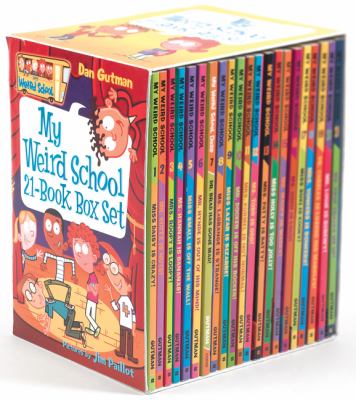
We know what happens next. The nephew, comfortable at the My Weird School stage of literacy, feels only disappointment. To him, the gift signals drudgery and pressure to read beyond his ability. He tosses Holes aside as boring and too hard. And maybe, our young friend even tells himself, I don’t like reading.
And that’s just sad, no matter how it’s categorized.
Thank you so much, Marty--I hope this will encourage a good discussion between our Project Mayhem readers!
 |
| Author Marty Mokler Banks |


