Showing posts with label MG. Show all posts

Thursday, August 18, 2016

Girls Growing Up In Middle Grade Fiction. Period.

Last year I was stuck on my MG about a girl, the star of an all-boys soccer team. During a writing exercise in which I was brainstorming what could have happened that she gets kicked out of her team, I made a list of things that happen at the age of twelve. The first thing on my list was: she gets her period. As soon as that thought formed, all the loose pieces of my story fell into place. Yes! She gets her period, and gets kicked out of her team, but since she's not the quitting kind, she joins another team, a girl's team.

[Sidenote on girls' quitting sports during puberty: Data from the most recent Always Confidence & Puberty Survey*, shows that by the end of puberty, half of girls surveyed (51 percent) will have quit sports. Olympian gold medalist and World Champion Alex Morgan has said, "At age thirteen one of my coaches told me that I wasn’t good enough. As a young girl just wanting to play and do my best, that was difficult to hear. It would have been easy for me to quit - but I wouldn’t be the confident person I am today if I had.” Here's a clip from the #LikeAGirl campaign that inspires me to do my best job as an author to empower kids, especially girls:


Besides the link between puberty and girls’ quitting sports, there’s a dark link between puberty and depression in girls. In The Female Brain, Dr. Louann Brizendine writes that in her studies of depression in women, “One day it struck [her] that male versus female depression rates didn’t start to diverge until females turned twelve or thirteen—the age girls start menstruating. It appeared that the chemical changes at puberty did something in the brain to trigger more depression in women” (2).

Talking about this link between depression and puberty, Karen Houppert, author of The Curse: Confronting the Last Unmentionable Taboo: Menstruation, says, “The likelihood of severe depression doubles for girls in the year after the onset of menstruation… While the physical changes girls go through in puberty happen slowly, when they get their periods, they suddenly have a different body image."]

Eager to get my representation of this experience right, I turned to my trusted companions: books. To my utter disappointment I discovered that in middle grade we can write about pretty much anything, but puberty seems to be the last remaining taboo. Of course there's THE period book, Judy Blume's Are You There God? It's Me, Margaret. Blume's novel has also been one of the most challenged books of all US literature. Judy Blume talks about Margaret, an early bloomer. Rita Williams-Garcia in No Laughter Here tackles not only the issue of puberty in a ten-year old girl, but also the reality of the Female Genital Mutilation that still cripples thousands of girls around the world, including the US.  In the author’s note, Rita Williams-Garcia writes that “every year, approximately two million girls undergo FGM... Although FGM is performed on young girls, materials written for young readers about this topic are scarce."
 What’s even worse, the books that are available are few and, like No Laughter Here, often go out of print. 

In my desire to serve my target audience better by striving to reflect the true experience of growing up in all aspects of the word, I committed myself to read as many books that talk about puberty as I could. My list isn't extensive, by all means. But here are some titles that have used this time in a girls life as an opportunity to create memorable characters and premises. 


Are You There God? It's Me, Margaret, by Judy Blume. Isn't this cover amazing? 


Twelve, by Lauren Myracle, which follows in Margaret's footsteps with a modern day twist


No Laughter Here, by Rita Williams-Garcia, featuring ten-year-old Akilah as she tries to deal with early puberty and her friend's secret 


Real Mermaids Don't Wear Toe Rings, by Helene Boudreau, in which a girl discovers she's a mermaid after she gets her first period. 


Finnikin of the Rock, by Melina Marchetta, in which Evanjeline has the power to travel through dreams when she's on her period (a favorite, even though the series is definitely YA,)


Protector of the Small and Alanna, the First Adventure, both by Tamora Pierce. Keladry and Alanna deal with puberty as they try to become knights 


Period Pieces, by various authors, including Cynthia Leitich-Smith, Jane Kurtz, Uma Krishnaswami, and others. Each short story represents a girl dealing with her first period. The cultural diversity in this volume is just beautiful.


Children read to learn about the world, but ultimately, they read in order to learn about themselves, and to acquire the tools required to navigate life’s challenges. Books are the perfect medium through which children (not only girls, but boys too) can learn that menstruation and puberty aren’t gross or shameful topics relegated to whispered chats in a bathroom in junior high or even elementary school. When authors acknowledge this pivotal moment in life, they have the power to give voice and importance to an event that changes a girl forever. 
Not every middle grade book needs to address puberty, but the positive impact on children upon seeing menstruation realistically portrayed in fiction should be an incentive for all of us striving to reflect the true tween experience in our stories. 

Now it's your turn, my friends: Do you have any books to add to the list?


Thursday, June 25, 2015

BLAZING COURAGE, by Kelly Milner Halls - First Page and Cover Analysis, by Matthew MacNish

Kelly Milner Halls is the author many non-fiction children's books covering topics as diverse as Astronauts, Cryptids, Dinosaurs, and Saving the Baghdad Zoo. Blazing Courage is her first novel. I will be reviewing it next month, but today I wanted to announce its publication, and take a quick look at its cover and first page.

Here is the cover:


I love the look of it! There's a certain kinetic energy to the moment captured here, and with the human character rushing left, possibly toward the fire, and the terror in the horses eyes, it really sets up a tense situation, and entices this reader to want to know what happens inside the book.

Here is the full jacket and the jacket copy:


Since getting a job at Top Tier stables, Annie has had her mind set on just one thing: earning enough money to buy a horse of her own. When she reaches her savings goal, she bids on a horse at an auction and buys Poco, a four-year-old Buckskin mare that Annie couldn't love more. But someone is trying to sabotage Top Tier, and a terrible fire breaks out at the stable. Annie must summon all her courage to save her beloved horse as well as many others in an act of heroism she didn't know she was capable of doing.

Here is the first page:


I really like this opening. I like that that story is not only narrated in first person, but in present tense no less! I used to hate present tense, but after writing a manuscript or two in it myself, I have come to appreciate the immediacy it lends to a tale, and the sense of urgency that can be felt, especially when it comes to scenes of action, which is the kind of scene I'm sure a book like Blazing Courage is full of.

I also love that this first page really captures everything I hope to see in an opening. There is action, and even dialog from two characters whose relationship we can immediately understand, but it also vividly describes a scene in a way that allows me to clearly picture it, and ground myself in a setting that feels at once authentic and believable.

I can almost smell the horses and taste the dust in the air.

What do you think? Do you like stories about animals? Do you like adventures? If so, you may want to check out Kelly Milner Halls' Blazing Courage.

Blazing Courage, published by Darby Creek Publishing, a Lerner imprint, will be released on August 1, 2015, and is written by Kelly Milner Halls and illustrated by Phil Parks. It is the first in a series call Animal Rescues.


Tuesday, November 4, 2014

Iron Hearted Violet, by Kelly Barnhill; First Page and Cover Analysis by Matthew MacNish


I had the pleasure of meeting Kelly Barnhill when I was in the Twin Cities a few weeks ago. We had true Neopolitan Pizza at Punch in Highland Park, with Steve Brezenoff, Bryan Bliss, Sarah Ahiers, and Hannah Kincaid. Kelly was the only Middle Grade author there.

It was a blast. Unfortunately, like a fool, I did not get a photo.

Anyway, as you may know, I'm a fan of Kelly's work, having reviewed The Mostly True Story of Jack for Project Mayhem before, so I was very excited to jump into IRON HEARTED VIOLET the other day.

The cover is absolutely fabulous, what with the gilded, hand drawn lettering, the ominous gray background elements and the pale moon, and the sharp lines. Did I mention there's a little girl, riding a dragon? I don't see how it could get any better, to be honest.


As for the opening page, well, this is where things really get going for me. You can't necessarily tell this from just the first page (and I don't quite yet know where all this is going, as I'm still reading), but this is one of those fascinating tales in which the narrator is actually a character in the story, and it says some very interesting things about point of view.

That said, what really makes this page shine for me, and what would have still made me buy this book had I simply been browsing, is the strong, undeniable sense of character. I cared about Violet the instant I met her, and as the narrator says, it all begins with a story, and Violet's story was not one I'd have been willing to miss.

For what it's worth, the line that ends that paragraph, which didn't quite fit on the first page, is "...wanting. She was the type of child whom a person wanted to impress."

I mean couldn't you just die? Is there anything you wouldn't do for this girl? Not I. I must know how her story ends.

As a bonus, here's a bad photo of the map (I couldn't find it on the internet):


Maps make everything better.

Tuesday, January 28, 2014

The Mostly True Story of Jack by Kelly Barnhill, Review by Matthew MacNish


This was the first book I finished this year, and the first of Kelly Barnhill's novels I've read. Before I get to my thoughts, here is the jacket copy from Goodreads:

Enter a world where magic bubbles just below the surface. . . .

When Jack is sent to Hazelwood, Iowa, to live with his strange aunt and uncle, he expects a summer of boredom. Little does he know that the people of Hazelwood have been waiting for him for quite a long time.

When he arrives, three astonishing things happen: First, he makes friends -- not imaginary friends but actual friends. Second, he is beaten up by the town bully; the bullies at home always ignored him. Third, the richest man in town begins to plot Jack's imminent, and hopefully painful, demise. It's up to Jack to figure out why suddenly everyone cares so much about him. Back home he was practically, well, invisible.

The Mostly True Story of Jack is an eerie tale of magic, friendship, and sacrifice. It's about things broken and things put back together. Above all, it's about finding a place to belong.


I really loved the way this story handled magic. Like it was kind of just there, always running barely beneath the surface, and that it was perfectly normal for some people to be aware of it, and for others to ignore it completely. Although few of them did.

This is Jack's tale, of course, but it's also the story of Hazelwood, and the people who live there. Jack's aunt and uncle and their crazy house with its pair of odd cats and preternaturally intelligent parrot. Jack's first friends ever, Anders, and Wendy and her brother Frankie. And of course the corrupt town patriarch and his son.

Jack leaves his mom and dad and brother behind in San Francisco, but there's something just a bit strange about that too. He can't reach them by phone, and when he tries to send them letters it just doesn't seem to work. It's almost as if they've forgotten him, or that he never existed.

Jack spends a good portion of the book trying to deny everything that seems to be going on in Hazelwood, but eventually it becomes too much to ignore, and with the help of his friends and a trusty but unusual skateboard, he goes investigating.

Barnhill does something very interesting with the voice in this novel. It's told from a 3rd Person POV, and it mostly focuses on Jack, but it does so in an odd kind of passive way that makes you feel like maybe it isn't his story. It's subtle, and very clever, because we eventually discover this is only mostly Jack's story.

Recommended for fans of magic and mystery and readers who enjoy fantasies set in otherwise mundane settings.

Wednesday, January 8, 2014

WORDS on LITERARY PUBLICTY from JULIA DRAKE (eden unger bowditch)


 As we head into the new year, many of us have books out there or plan to get books out into the world. Perhaps it might be helpful to get some words of wisdom from someone in the publicity business. Whether a writer has published her twentieth novel or he's wondering how to get published, it is good to know how to get your book out there and into the hands of readers.


Today, we have the lovely and talented Julia Drake, CEO of Julia Drake PR in Los Angeles. She has worked with many authors and has a wonderful reputation as an honest, devoted, hardworking, and tireless promoter of the writers she works with and loves. I speak from experience. Julia and her team were hired by my publisher to work on The Ravens of Solemano... and I have only glowing things to report. I thought it might be fun to have her as a guest.

 Welcome, Julia!


What can an author do to help with PR? To maximize publicity for your book, a good publicist will try to leverage your entire author platform to gain media coverage instead of merely focusing on publicizing your book. But often authors are not aware of the many resources that are part of their author platform and that could be vital for the success of a PR campaign. An author platform includes an author’s web presence (website, blog, social networks, etc.), previous public speaking engagements/readings, teaching credentials and awards, published stories and articles and any previous media coverage or media connections––anything that's related to an author’s built-in readership.

In addition, an author’s education and professional background, principal and previous occupations other than writing, travel experiences, inspiration for his/her book, and any hobbies aside from writing might offer a wonderful human interest hook for media coverage.

Last but not least, I highly encourage authors to spend some time to compile an email list for their potential audience, including family, friends, colleagues and co-workers, acquaintances, and anyone they have come in contact with during their professional and private life that might be interested in learning about their book. The more comprehensive and detailed that list is, the more firepower a publicist has to orchestrate a successful launch which will build legs for the author’s book, future books, and overall platform.

What are the three most important things to let the world know about a new MG/YA book?

1.    Mom/Dad Bloggers: Once a book takes hold in this community, it can spread like wildfire, so make sure to incorporate a blog tour or PR outreach to blogs into your PR plan. Make sure to study each blog beforehand to get a sense for their review preferences and website/blog traffic to maximize positive coverage.

2.    School librarians and bookstore event coordinators: School librarians and bookstore event coordinators work in tandem to orchestrate school book fairs, book festivals, and author events and will be your biggest advocate if your book fits into their school demographic and offers viable educational themes. Often, school librarians and bookstore program coordinators also maintain their own blogs.

3.    Pre-publication trades and top middle-grade/YA media:

3.1 Pre-publication trades:

·      School Library Journal
  • ALA BookList
  • Publishers Weekly
  • Foreword Magazine


    3.2 Top Middlegrade/YA Media: There are literally hundreds of publications for YA/middle-grade books, with new ones emerging and old ones folding every day, but here are some of the most important ones:

  • The Horn Book Magazine
  • The Children’s Book Council
  • Shelf Awareness
  • YALSA
  • NPR Books
  • Bookpage
  • Girls Life
  • KidsGuide
  • Scholastic Parent & Child
  • Teen Ink
  • The Kids News Network
  • The Reading Life
  • American Girl
  • USA Book News


What is different about promoting MG/YA books? The main challenge, especially for middle grade books, is that to get to your target reader, you have to go through their parents. So in essence, you are marketing your book to the parents, and have to convince them first that your book is a good fit for their child. Although times are changing and more young people are using the Internet at home and in school, parents are still the gatekeepers, so keep that in mind when presenting your book and its benefits to your audience and to media contacts writing for that audience. Make sure to point out any themes/features that speak to national school curriculums and any educational benefits and timely themes (bullying, sexuality, violence, diversity, etc.) aside from pure entertainment value. Also be sure to submit your book for consideration for the Accelerated Reader Program. Accelerated Reader (AR) is a computer-based system for tracking reading in schools. Students earn points for reading AR books, so they are motivated to read AR approved titles and forego titles that are not listed in the program. Demand controls supply, so libraries and bookstores also prefer to carry AR listed books.

How important is having a PR person behind you instead of going the road alone? Publicizing your book is a full time job, so if you are a fulltime writer and have another book you are working on, or maintain another full time job or have family to care for, going this road by yourself can quickly become overwhelming. A good publicist can help you develop your message, brand and platform and advise you on how to position yourself with media and consumers. Your publicist can help you define a targeted list of print, online and broadcast media in local, regional and national markets and will be able to leverage his/her relationships with media in these markets to help get your book through the door and have a better chance at coverage, especially when it comes to high tier media. A good publicist will also help you prep for media interviews and build your brand to work toward a sustainable platform that will continue to create future opportunities for your book and future writing endeavors.


Can you share a funny story? Share something that stands out to you as particularly inventive.

The reason I love what I do is because stories are still what brings us together. There is a magic in this connection. And I feel very fortunate that I see this magic happening right before my eyes. One of my clients, Derek Taylor Kent, is the author of The Scary School Series. He celebrated the launch party for his first book at a small indie bookstore in the Pacific Palisades in CA (which soon after closed its doors). The Scary School series is purportedly penned by Derek, a nine-year-old ghost, so Derek, the author, put an empty chair in the middle of the room, and explained to the attending kids and parents that Derek The Ghost was here to answer questions about the book and what it’s like to be a ghost. Derek, the author, then relayed the ghost’s answers to the kids in some funny way. It was such a simple idea, but it caught like wildfire with the kids, and soon, families formed a line all the way along the bookstore’s storefront, waiting to ask Derek The Ghost a question. It was such a wonderful experience to listen to the kids come up with the most specific and imaginative questions, and watch both kids and adults, anticipating the ghost’s answer. A simple idea brought everyone together in an afternoon that left everyone with the feeling that they had just participated in something magic. 

THANK YOU, JULIA!!!

Monday, November 18, 2013

First Page and Cover Analysis of The Girl Who Circumnavigated Fairyland, by Matthew MacNish


Technically, the title of this book is actually The Girl Who Circumnavigated Fairyland in a Ship of Her Own Making, which is a great, if somewhat long title, but just wouldn't fit as a post title.

Anyway, today I would like to take a look at the fascinating cover and first page of a very interesting middle grade novel. The cover, with the original illustration by Ana Juan, is gorgeous enough in its own right, but as a writer, it's the blurbs that really struck me when I first picked up this book.

The front cover is blurbed by Neil Gaiman, and that, of course, is impressive enough, but turn the book over, and you'll see none other than Tamora Pierce and Holly Black recommending the tale inside. But it doesn't stop there. Crack the book open, and take a peek at the inside jacket flap, and you'll see yet another blurb touting the originality of this story, this one from none other than Peter S. Beagle, who in case you don't recall, wrote this little book called The Last Unicorn.


So anyway, I guess needless to say, my point is that as covers go, I was definitely impressed the moment this book showed up at my house (I won it and its sequel on Facebook, from Liz Szabla, who is the editor at Feiwel and Friends who published the book). With a title as inventive as this book has, I'm not sure it needed so many great blurbs to sell me on its story, but it couldn't have hurt, right?

Now, let's talk about the first page:


Beginning with another lovely drawing, the first chapter is titled Exeunt on a Leopard. What a great title, right? Sure, I had to look the word Exeunt up, but once I knew it was a stage direction, I was in love. From there, we have the chapter sub-title/heading: In Which a Girl Named September Is Spirited Off by Means of a Leopard, Learns the Rules of Fairyland, and Solves a Puzzle.

Well, as you can imagine, from there on out, I was in. I'm actually still reading this novel, and while I'll admit it can be occasionally a bit heavy handed in its verbosity, it's a fantastic tale, filled with some of the most inventive characters and imaginative circumstances I've ever encountered in a book. Certainly highly recommended, in case the cover, blurbs, and first page weren't enough to pique your interest.

Have you heard of this book? If not, how much of a role do covers and blurbs and such play in your decision to read a particular book?

Wednesday, September 25, 2013

The Top Five Roald Dahl Novels, by Matthew MacNish

The wagon outside the cottage where he wrote Danny, the Champion of the World

Today I would like to celebrate the world's greatest children's author (note: this is my personal opinion, and is not meant to disparage Judy Blume, who is obviously amazing, but did not much appeal to me as a boy, because her books were for girls, ew).

Roald Dahl is perhaps the most well known author of middle grade titles in the world. Or at least he was before there was such a thing as middle grade and young adult, and books were either children's books or something else. I don't say this to take anything away from any other authors, and I'm sure my love for his books is influenced by the fact that I was born at the height of his success, but even if you don't consider him the best EVAH, surely you have enjoyed at least one of his tales (and if not, you might want to get on that, like STAT).

Anyway, regardless of where he ranks on the Matthew-MacNish-greatest-children's-authors-in-history-scaleTM, today I would like to share with you my top five favorite Roald Dahl novels, in order, from nearly favorite to very favorite!

Charlie and the Chocolate Factory


Such a wonderful, magical book. From Willy Wonka to the Oompa Loompas, to the eponymous chocolate factory, there is so much imagination in this book. I love it with all my heart. However, while I'm well aware that many people might list this as their favorite Dahl novel, for me it is only my nearly-favorite. Only because there are so many other wonderful ones! Like: 

The BFG


As an adult with the humor bone of a twelve-year-old boy, I can never help but think of the title of this book standing for something very silly. However, while this book is full of fun and silliness, it's actually quite adorable. It also doesn't hurt that it is actually an expansion of a part of my very favorite Dahl book, shown below.

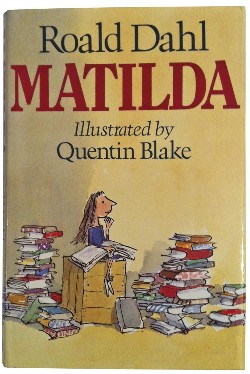
Matilda


Oh Matilda, you precocious little genius you! Matilda is probably my favorite Dahl protagonist. The ways in which she stands up to her situation are so adorable, but also so inspiring. I mean it's all fantasy, of course, but it's also so real. This book also gets a bonus for having one of the best two movie adaptations of a Dahl book (see the next entry for the other one).

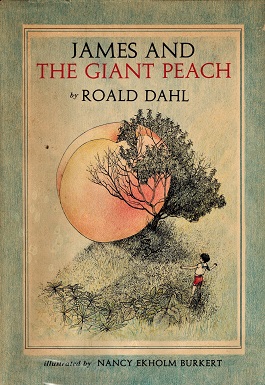
James and the Giant Peach


Other than Gremlins, this is Roald Dahl's first book. It's a story about a small boy who escapes his cruel aunts inside a giant peach filled with giant insects (it's not that simple, obviously, but we're in a hurry here) and then sails it across the Atlantic, by luring a flock of seagulls into towing it. I mean, it all makes perfect sense, right? As wild and ridiculous as it sounds, this is one of the greatest children's stories ever written, and it also has a most excellent film adaptation.

Danny, the Champion of the World


I don't know if I can put my finger on exactly what it is about this book. Perhaps it was the fact that I was about Danny's age when I read it. Perhaps it was the fact that I lost my mother not long after. Perhaps it was the fact that fathers and sons are ... well, fathers and sons. I don't know exactly, but this is my all time favorite Roald Dahl novel, and it's a somewhat less well known one than most, so if you have not read it, I highly recommend you remedy that.

Roald Dahl in 1954

Monday, August 12, 2013

FACE TIME and the YA/MG READER by Eden Unger Bowditch


WHAT TO EXPECT WHEN YOU’RE EXPECTING YOUR NEXT YA/MG BOOK RELEASE

Let’s be honest with ourselves- kids don’t care what the critics say. We can cheer ourselves and pat ourselves on the back, but getting a fabulous review from a critic simply does not impress a kid reader.

Unlike adult fiction (a world where the readers read the reviews and buy accordingly and, thus, books impossible to get through become best sellers because they are the books in vogue to buy) where you can send your book off into the world and visit occasionally, YA books demand full-time attention, loving care, focus, engagement, and presence. Kids want to read, well, a good book, and they will like a book whether a critic tells them to or not. That’s why it can be more of a challenge to write for kids than adults. It is important to tour for any book, but it seems more so with YA/MG. Being out there on the road,speaking to kids, connecting with kids, is truly vital in the world of YA and MG. It is the life’s blood of the YA/MG book. As The Ravens of Solemano (Young Inventors Guild, Book 2) is poised for release in September, my publisher has basically kicked me out of the house and sent me packing. Well, that is not exactly… no, wait…that is exactly true! They have said the spikes in sales and attention on the web were shocking, every time I was on the road for the last book. But last time, I sauntered back to the US months after the release of The Atomic Weight of Secrets to an audience that had to reread the book to remember what to ask. Word of mouth is so important for all books, but more so for kids books. This means kids need to know you’re there. You need to make introductions for your literary baby. Loving care and attention are needed. While The Atomic Weight of Secrets held its own, it was really a neglected child. This time, I am ready to go. ARCs went out last month and events have already been planned. And, unlike with adult books, the long haul is not a fast delivery. A great review can shoot an adult book through the roof, but kids need time to get to know the book. My publisher told me to expect to work hard a lot longer than with books for adults. This was meant to encourage, as well as demand pavement pounding.It means they will stand behind the book much longer than one might expect. They believe that it simply can take longer and that the second book sells the first.
 
So I am ready. After what seems like ages carrying this baby inside of me, Ravens is kicking. I am taking deep breaths and doing yoga stretches. I feel like an expectant mother with a suitcase packed, waiting for labour to begin.

Friday, August 2, 2013

Duality of Tone in MG, by Matthew MacNish


One of the things I love most about reading Middle Grade literature is how nuanced I find it often is, especially when it comes to tone. Take Harry Potter, for example: (which could certainly be argued escalates into YA territory by the end, but there's no question the cupboard under the stairs begins firmly in MG) the tone, for the most part, is light and humorous. The world is full of Weasley Wizard Wheezes, Every Flavored Beans, Bogeys, Hinky-punks, and all other sorts of wonderful nonsense. Just the kind of stuff that gets kids really into a story - truly invested, emotionally.

But ... even from the very beginning, the Wizarding World also contains a darker underbelly. Harry's parents were murdered by a dark wizard. His aunt and uncle and cousin, while somewhat humorous, are also unbelievable cruel and uncaring. Much of the darkest elements such as dementors and killing curses don't come up until later, but my point is that Harry Potter, much like a lot of MG Lit, I find, walks this amazing balance of light and dark, a sort of duality of tone that truly makes for a deeply compelling read.

There are countless examples of this duality. The Graveyard Book, by Neil Gaiman, is a MG novel in which cold blooded murder is committed in the first few pages, and the dark tone of the story stays with the reader throughout, but there is also plenty of humor and love and family, not to mention the somewhat ridiculous but terrific notion of a boy named Nobody who grows up living in a graveyard.

Lemony Snicket and the Series of Unfortunate events is another example. Heck, every Roald Dahl novel ever written pretty much invented this trope, if you could even call it one.

I think this is important, because books and literature are the very best way for young people to become exposed to the world, especially when it comes to some of the darker aspects of it. A picture book that exposes a child to the death of a pet is much better than having to experience such tragedy for real. A chapter book that covers a friend moving away, or divorce, or any other number of topics is a much safer way to explore the emotions that might come up.

Anyway, I'm sure you see my point. Does anyone have any other examples of great MG novels with obvious duality of tone?

Either way: happy Friday! Have a great weekend.

Wednesday, June 26, 2013

Exile, by Shannon Messenger - First Impression, by Matthew MacNish


Before we get started, here is the blurb from Goodreads:

Sophie Foster thought she was safe. Settled into her home at Havenfield, surrounded by friends, and using her unique telepathic abilities to train Silveny--the first female alicorn ever seen in the Lost Cities--her life finally seems to be coming together.

But Sophie's kidnappers are still out there. And when Sophie discovers new messages and clues from the mysterious Black Swan group, she’s forced to take a terrifying risk—one that puts everyone in incredible danger.

As long buried secrets rise to the surface, it’s once again up to Sophie to uncover hidden memories—before someone close to her is lost forever.

In this second book in the Keeper of the Lost Cities series, Sophie must journey to the darkest corners of her luminous world in a sequel that will leave you breathless for more.


Furthermore, you can read Shannon's Project Middle Grade Mayhem blog tour stop for the release of book 1 in this series, or you can read my daughter's impression of the first book.

Anyway, Shannon was kind enough to include my daughter in the informal tour for the ARC of Exile (AKA Keeper 2). So today we get a look at the first page!

It opens with a Preface (not a prologue, because it's a kind of look-ahead), that reads like this:

* * *

Sophie's hands shook as she lifted the tiny green bottle.

One swallow held life and death--and not just for her.

For Prentice.

For Alden.

Her eyes focused on the clear, sloshy liquid as she removed the crystal stopper and pressed the bottle to her lips. All she had to do was tip the poison down her throat.

But could she?

Could she give up everything to set things right?

Could she live with the guilt, otherwise?

The choice was hers this time.

* * *

Pretty epic, right? Certainly just as tense as the opening to Keeper of the Lost Cities. What do you all think? Has anyone read Keeper 1? Are you looking forward to when Exile is released on October 1st this fall?

Tuesday, June 25, 2013

The Cloak Society Review + Giveaway by Shannon O'Donnell


  The Cloak Society 

by Jeramey Kraatz


Blurb:
The Cloak Society: An elite organization of supervillains graced with extraordinary powers. Ten years ago the Cloak Society was defeated by Sterling City's superheroes, the Rangers of Justice, and vanished without a trace. But the villains have been waiting for the perfect moment to resurface. . . .
Twelve-year-old Alex Knight is a dedicated junior member of Cloak who has spent years mastering his telekinetic superpowers and preparing for the day when Cloak will rise to power again. Cloak is everything he believes in.
But during his debut mission, Alex does the unthinkable: He saves the life of a Junior Ranger of Justice. Even worse . . . she becomes his friend. And the more time he spends with her, the more Alex wonders what, exactly, he's been fighting for.

Okay, middle grade book lovers, this is a can't-miss series for all fans of fantasy adventure--that means all of you Percy Jackson fans out there. Full of action, great world-building, and likeable characters, this is a sureto please series. I received an ARC of book 1 and really enjoyed it, so I shared it with  my 10-year-old son (now 11). I had NO IDEA he would respond the way he did! To say he loves this series would be an extreme understatement. He has devoured my book 2 ARC and is already "dying" for book 3. Wow.

The second book, The Cloak Society: Villains Rising will be released by HarperCollins in October.and the e-ARC is currently available from Edelweiss.

And because I know you'll love them, I am going to give away my ARC of the first book to one lucky commenter. Just make sure you're a follower of this blog--here and on Facebook--and leave a comment. I'll announce the winner next week.  Good luck!


Blurb:
Alex Knight was raised as one of the Cloak Society's most fiercely loyal junior supervillains. He proudly dedicated himself to this elite organization—until he met Kirbie. A junior member of the Rangers of Justice, Kirbie opened Alex's eyes to Cloak's true mission. Now, Alex is determined to bring Cloak down. And there's no time to lose.
The Cloak Society has just pulled off the greatest takedown in Sterling City's history. Justice Tower is in ruins. And the city's superheroes, the Rangers of Justice, have vanished.
Alex and Kirbie's only hope for defeating Cloak is to bring together the Junior Rangers and the other junior Cloak members who have turned their back on their former leaders. But after years of hatred and enmity, fighting for the same side is easier said than done.

  
If any of you give these books a try, please let me know what you think.

Have you been shocked by the reaction of a child or students to a particular book or series?