Showing posts with label Heroes & Villains in Middle Grade Literature. Show all posts

Friday, June 23, 2017

Kill the villain? Or save them? by Joanna Roddy


For my last post, I talked about villains and the layering of roles often seen in kids lit: rivals, agents, and the true enemy. I want to continue that discussion and talk about what we as writers do with our villains in the end. 


Disney (and for that matter, most traditional story-telling) tells us that the villain needs to die. Especially the true enemy, especially if they are powerful through magic or supernatural ability. They're too dangerous to live. Lesser villains, like agents, need to be punished, and rivals and bullies need to be humiliated. It's often an eye-for-an-eye system in which just deserts are served up to satisfy the viewer's sense of fairness. In these narratives, good is good, though it may be flawed or misguided; and bad is intentionally bad. The hero must vanquish evil. Ultimately, these stories have a power struggle as the central conflict and the story ends when power ultimately resides with the protagonist. 

Other story-tellers, like Japanese animated fantasy film-maker Hayao Miyazaki, show us villains who are unquestionably bad and clearly set against the protagonist, but the hero's path to overcoming that villain isn't through violence or a show of definitive power. This is because the hero has a different skill-set altogether. Where traditional heroes need to harness their power in physical or magical battle, these alternative heroes are equipped with empathy, loyalty, and kindness. They will still need bravery and perseverance, but the result will be something far different than vanquishing the villain. Rather, the villain can be saved. 


Take for example Spirited Away, Miyazaki's 2003 Oscar-winning film in which the ten-year-old hero, Chihiro, defeats a monstrous spirit feeding on people's greed by simple indifference to its offers of gifts and gold. After returning it to its benign form, she befriends it, taking it as a traveling companion. Later, Chihiro is able to win her freedom from a witch, Yubaba, who is holding her and her parents prisoner, through her wits and monopolizing Yubaba's weak spot: her devotion to her bratty son. Does Chihiro hold the son hostage or threaten him? No. She earlier made friends with him, transforming his selfishness into compassion that then is leveraged in her favor. The story is left with the possibility that Yubaba's love for her ennobled son will lead to her own transformation.


Another example: Tomm Moore's Song of the Sea. Based on Irish folklore, the villain in this film is Macha, the owl witch. She steals people's emotions, keeping them in glass jars while the people themselves are turned to stone. We learn that she does this because her son's broken heart was too painful for her to witness, and, thinking she was giving him mercy, she turned him to stone. Now she is determined to do the same for everyone, including herself. The child protagonists break the jars and the emotions all come flooding out. Macha realizes that allowing oneself to feel things, even great emotional pain, is preferable to feeling nothing and being barely alive. In the end she becomes their ally and her relationship with her son is restored. 
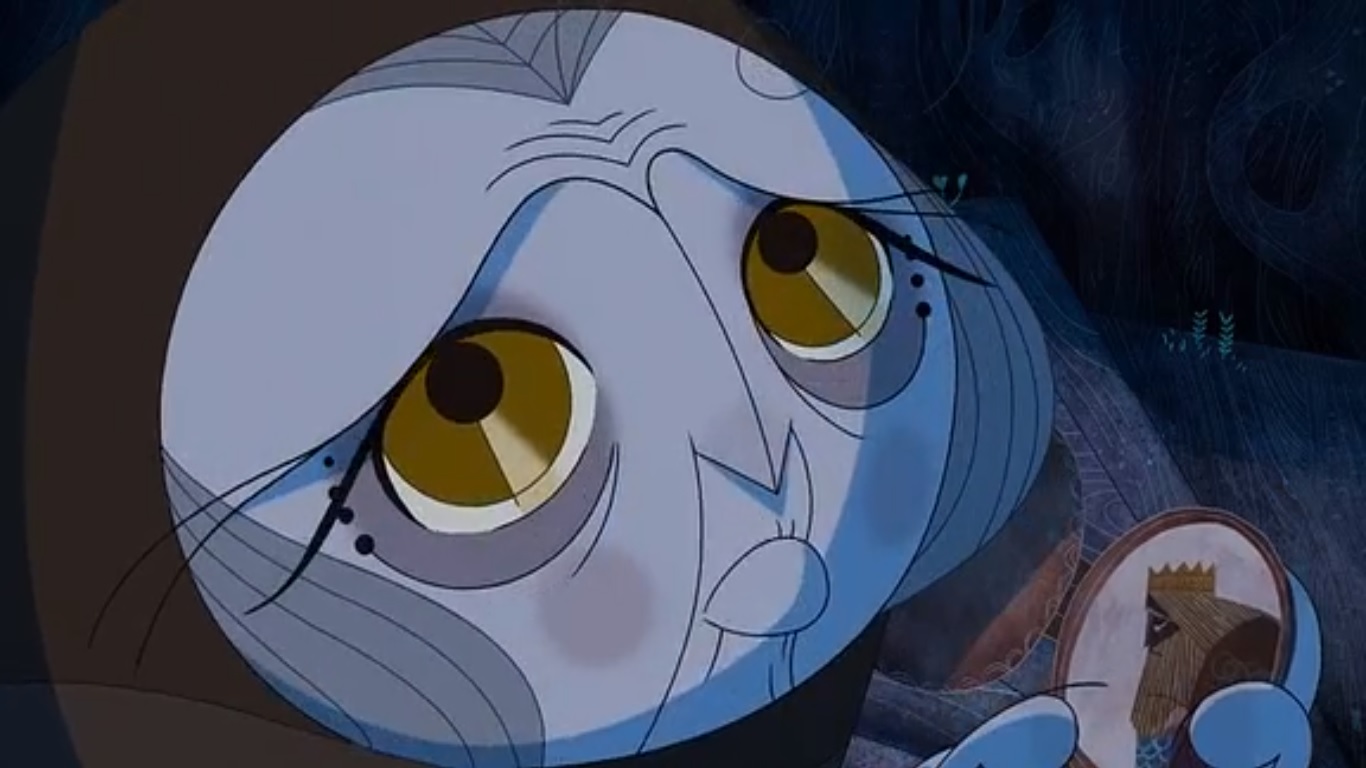
The only irredeemable villains in these films are destructive forces. Miyazaki presents war and pollution again and again in his films as true evils that must be resisted. Moore's Song of the Sea offers only time and the rules of magic as the heroes' greatest enemies. 

I find myself torn. Evil is real. Just look at the news. Kid readers understand this in a pure and simple way, often overlooking the nuance and splitting the world into good guys and bad guys. I think the longing to see justice for wrongdoing is innate. But as writers, I feel we owe it to children to represent the world as it truly is: seemingly evil people have complicated motives, and no one is completely irredeemable. Our choices have power and the possibility to choose good is always there. Some villains will never choose good--that's the power of free will too. 

Typically our heroes destroy the villain in a final showdown in which good prevails against all odds. The hero seems ill-equipped and powerless until that last moment when what is needed to overcome impending doom finally arrives, and they win. But what if instead the thing that arrives against the odds is that elusive magic--the kind we all wish we had--that gives the hero the exact key to unlock the villain's heart and return them to a path of love? Everyone wins. What if we told stories like that, and instilled the belief in children that maybe there's something inside them that can transform the world through love instead of violence? Through peacemaking instead of division. 

Maybe that's idealistic, but doesn't our world need those kind of heroes now more than ever? 

Monday, April 17, 2017

Villains: Rivals, Agents, and Enemies by Joanna Roddy


Antagonists come in many forms: natural disasters, well-meaning friends, or even unwitting coincidence. But I think the most fun to write are villains. 

Project Mayhem has posted some great material about villainy in the past, but I thought I'd revisit the subject with some ideas that have been helpful to me lately.

Many many types of villains have been identified before. But I've noticed lately that there are often three levels of villains that come up within the same novel, especially those with young protagonists. So let's break them down and look at their roles, functions, and pitfalls.


RIVALS:
What they are: Rivals are someone on the same level, or close to it, with the protagonist. They may only serve to drive the protagonist forward as a competitor who poses a true challenge, or they may become a bully who actively causes harm. Rivals are not typically the main threat. They are usually unrelated to the true villain of the story; however, they may be conscripted to become an agent of the greater enemy, or used as a pawn. They may also be somehow redeemed before the end, often as a result of their encounters with the protagonist. 

Examples: Draco Malfoy (Harry Potter), Josie Pie (Anne of Green Gables), Boromir (Fellowship of the Ring), Edmund (The Lion, the Witch, and the Wardrobe), Marion Hawthorne (Harriet the Spy)

Function: The Rival creates situations that test the protagonist, calling out and revealing their strengths, weaknesses, and true character. They also serve as a foil to the protagonist, so that readers become more invested in the main character through seeing their virtues in contrast to the Rival's character flaws. They are a training ground for the climactic confrontation with the greater enemy and create try/fail cycles to track the protagonist's progress. In reality-based fiction, the Rival may be the only intentional human antagonist. 

Pitfalls: Like all villains, Rivals need to have a good reason in their own minds for treating our protagonist the way they do. Just being a spoiled brat or the next best competition isn't enough for them to single out the protagonist. Get inside their head and figure out what pressures, insecurities, and prejudices make them the way that they are. Frenemies, former friends, or family members can make for a much more complex kind of Rival who has both love and hatred at play in how they relate to the protagonist.


AGENTS:
What they are: Agents are tools used by the true enemy to do their evil work. Often they are secret Agents, posing as allies but actually working against the protagonist. Sometimes they are overtly acting as a representative of a greater evil but are clearly motivated by lesser impulses and desires, which can allow for crueler and pettier torments for the protagonist. Sometimes they are corrupted or possessed by evil, or they may be a henchman. Often Agents are in positions of power or inherent trust, which lends to more surprising revelations and to abuses of that power, amplifying the largeness of the overall threat.

Examples: Wormtail/ Peter Pettigrew (Harry Potter), Barty Crouch Jr./ Mad-Eye Moody (Harry Potter), Professor Quirrel (Harry Potter), Luke (Percy Jackson: The Lightning Thief), Saruman (Lord of the Rings), Darth Vader (Star Wars)

Function: Agent villains allow for layers of complexity to the greatest source of antagonism in a novel. They create good plot twists when their motives and loyalties are revealed. They give the reader a sense of the pervasiveness of the evil and the immensity of what the protagonist has to overcome. Agents are often the more interesting villains because their ability to deceive about their true motives gives the reader both good and bad interpretations of their character, heightening the horror of what seemingly good people are capable of. 

Pitfalls: Again, this type of villain needs a strong personal reason for doing what they do. They may believe in the cause of the true enemy, or they may be acting under duress, but their willingness to be used as an Agent has to have that additional personal motivation based on past experiences, beliefs, and circumstances. It can be tricky to keep a secret Agent disguised from your reader while finding that balance of giving them believable flaws, a compelling motivation for what they're doing, and some well-hidden hints before the reveal. Likewise, a too-perfect Agent will automatically be suspect. 


THE ENEMY:
What it is: This is the mastermind, entity, Dark Lord, or true source of evil who will pose the greatest threat to the protagonist, which they must overcome. These are the more traditional villains. 

Examples: Sauron (Lord of the Rings), Voldy (Harry Potter), The White Witch (The Lion, the Witch, and the Wardrobe), The Emperor (Star Wars), Lex Luther (Superman), Kronos (Percy Jackson)

Function: The Enemy's main function is to pose the greatest threat and bring the protagonist to their ultimate limits as they try to overcome that threat. They personify everything the protagonist must reject, and good Enemies actually do make clear the allure of their perspective, or offer such horrific consequences that the reader would understand why the protagonist would capitulate.

Pitfalls: One pitfall here is having only the central Enemy. As you can see from the above, layers of challenges with lesser villains better prepares the protagonist, and in turn the reader, for the final confrontation with the true Enemy. If you do layer in this way, though, you shouldn't just plunk in the Enemy at the end. Threads of the Enemy should be woven throughout the story, and the challenges the protagonist faces should relate in some manner to the ultimate challenge in the climax. Another major pitfall is to make the Enemy one-dimensional. Remember that every villain is a hero in their own eyes--they are a distortion of what goodness and heroism should be, not necessarily the total opposite of it. Understand why they do what they do.

I hope you find this as helpful as I have! Please let us know in the comments if you've noticed this hierarchy before, or if you think there might be other things to add to the levels of villainy. Now go practice your evil laugh. 

Monday, November 23, 2015

Dispatching the Bad Guy by Dianne K. Salerni


One of the challenging aspects of writing MG adventure fiction is killing off the bad guy without having your MG characters actually do the deed. It’s frowned upon for kids to kill people, and rightly so. But what do you do when the villain needs to be offed?

Here are a few ways to tackle the problem:

Not Quite Dead
Percy Jackson uses his pen-turned-into-a-sword to slice his way through adversaries who explode into dust and re-form back in the Underworld. You can’t kill an immortal, after all. Very clever, Rick Riordan! There are a few other ways to put your bad guy into an incapacitated but not-dead state. How about suspended animation? Disabling poison? Turn them into a toad? Carbonite, anyone?

It Was an Accident
You can knock off your villain in a chain of events that is started by your MG character(s) without any intent to kill, but results in the bad guy’s demise by pure chance. You could also call this the Rube Goldberg Method.

Let the Adults Do It
The MG heroes in Brandon Mull’s fantasy adventures usually travel in a group with lots of adults who deliver the fatal blows while the kids fight bravely by their side.

Bring in a Wyvern!
Yes, I really did that. But seriously, make use of a monster, a gaping crevasse in the earth, a crashing space ship, or some other uncontrollable force that is already part of your climactic scene to take out your bad guy.

Hoist by His Own Petard
One of the most satisfying methods of dispatching the antagonist is to have his death be the result of his own greed and villainy.

Actions have consequences, bad dude. You had it coming.

Wednesday, September 3, 2014

Constructing a Comic Character


Humorous writing comes naturally to some, while for others even the idea of “writing funny” causes stress. Humor, like any other literary technique, can be an acquired skill when a thorough understanding of the rules and tools available are understood.

The most basic building block of humor is that of the comic premise. In The Comic Toolbox, John Vorhaus states: “The comic premise is the gap between comic reality and real reality. Any time you have a comic voice or character or world or attitude that looks at things from a skewed point of view, you have a gap between realities. Comedy lives in the gap.”

In his 2012 novel, The Hero’s Guide to Saving Your Kingdom, Christopher Healy sets his comic premise within an epic fantasy world populated by the princesses and princes from traditional fairy tales, with an enormous twist that is very accessible to young readers coming of age post-Shrek. Every convention and expectation of the known characters are turned on their heads.

Healy’s story features the princess heroines Snow White, Sleeping Beauty, Cinderella, and Rapunzel. In the traditional telling, each heroine is rescued and falls in love with the handsome, but non-descript, Prince Charming. In Healy’s world, there are four separate Princes that have been lumped together under the generic title Prince Charming by bards that have spread the stories, and each Prince wants his own name recognition. That’s the foundation of the comic premise. The reader is immediately presented with the gap between the expectation that Prince Charming is one perfect, heroic, and handsome man, and the reality of the story, where four Princes are flawed individuals quite removed from the handsome heroic ideal.

The comic premise is given even greater depth by crafting the princesses with personalities and characteristics far different than the traditional. Pushing it further still is the comedic tension created by the oppositional characteristics between each pairing.

For example, Cinderella, having been raised in near captivity by her step-mother, is a young woman who desires action and adventure now that she is a princess. Her Prince Charming, Frederic, is an endearing, but cowardly, fop brought up under fierce protection by a doting father. He has no interest in adventure, but loves Cinderella with true devotion. When Cinderella leaves to seek adventure in the wilds on her own, Frederic, worried for her safety, musters the courage to follow her. Ultimately, Cinderella ends up saving him (and the other Princes Charming), once again reinforcing the gap between comic reality and real reality.

What keeps comic characters interesting, and moves them beyond one-note jokes, is the layering of other elements over the premise to give them depth. Vorhaus provides four specific elements that go into the construction of a comic character.

The first is the Comic Perspective, defined by Vorhaus as, “a character’s unique way of looking at the world, which differs in a clear and substantial way from the ‘normal’ world view.” If we continue looking at Prince Frederic, his Comic Perspective would be that the world is a dangerous place, best avoided at all costs. In contrast, Cinderella’s is that the world is a wonderful place where anything can happen.

The second element is exaggeration. A character that is afraid of the world isn’t in and of himself very funny, but if a writer pushes the limits of that fear so that normal situations become farcical, a space for comedy is created. This description of Frederic from The Hero’s Guide is a fine example of comic exaggeration: “For most of his early years, Frederic was perfectly happy to skip out on pastimes like tree climbing (twisted ankles!), hiking (poison ivy!), or embroidery (pointy needles!).”

Flaws are the third element. These are negative characteristics that create distance between the reader and character, allowing the reader to comfortably laugh at the character without feeling bad. Flaws can also be positive characteristics taken to an annoying extreme. Frederic’s flaws fall into the latter category, as his worst trait is an almost unbearable friendliness and openness to strangers. This might seem to be in opposition to his view of the world as a dangerous place, but again, this creates an interesting conflict within the character. Even when faced with villains, monsters,  and impending doom, Frederic can’t help but be polite. Charming, even.

The final element is Humanity. The character’s humanity gives the reader a reason to care about his outcome. It balances the flaws to enable readers to emotionally engage with the character. Frederic’s humanity is grounded in his romantic love of Cinderella, and the lengths he goes to try and find her. He travels the world, faces battles, giants, and witches and gets so far outside of his comfort zone that readers can’t help but feel for the poor guy, even as they laugh at his total lack of traditional heroic qualities.

Healy does an excellent job of creating complex comic characters, and Frederic is just one example within that story. The characters, both Princes and Princesses, because they are drawn with such specificity, play off of each other in a web of well choreographed, and highly comical, relationships. In the end, Frederic may come the closest to laying claim to the name Prince Charming, but by embracing his entire character he earns a recognition all his own. And gives the reader plenty of laughs while doing so.

Monday, June 23, 2014

Heroes and Villains #6: The Truce by Dianne K. Salerni

One of my favorite tropes in literature is “a truce” between the heroes and the villains.

Two sides of a conflict realize they must work together against a common enemy or to achieve a common goal -- hero and villain, side by side, each of them using their dominant traits for a good purpose. Well, good in that it advances the plot and provides tension for the reader.

I’m using a writer’s definition of good here.

The tension, of course, comes from our distrust of the villain. Take the Governor’s meeting with Rick in The Walking Dead. I couldn’t have been the only viewer who expected this “truce” was really a trap and that not all the good guys were going to make it out alive.

And we never trusted Gollum, did we? His only reason for serving Frodo was to get that ring back.

But sometimes, we hope for a conversion. Arya had to tolerate the Hound because, in this case, her enemy was her only refuge for safety. It served the Hound’s purpose to keep her safe – she was no good for ransom if she was dead. But there were moments when I wondered whether Arya would be a good influence on him – whether she would awaken whatever kindness remained inside him. There was also the danger that too much of the Hound's darkness would rub off on Arya.

In Gregor the Overlander, the Prophecy of Gray requires the quest participants tolerate a rat among them. Literally, a rat. A giant rat and member of an enemy species. Ripred is smart, fast, and deadly. They need him as a guide, but how far can they trust him, especially if he’s betraying his own kind?

Several of the books in the Artemis Fowl series involve Artemis and the fairy people joining forces. The LEP (Lower Element Police) need Artemis’s criminal genius, and Artemis needs their magic. Through their extended acquaintance, mutual respect develops, providing moral development in our young anti-hero.

In Fablehaven, a devastating betrayal midway through the series is made even more complicated when the unmasked and incarcerated villain becomes the heroes’ only hope of defeating a greater evil. Dare they release someone who has betrayed them once already – and worse, rely on this person to save them?

I have more than one truce arrangement in the Eighth Day series – first with a trio of minor villains in book one, and then with more dangerous ones later in the series. I hadn't even realized the persistence of this running theme in my books until I started to write this post. Guess I really love this idea, huh?

Can you think of a truce between heroes and villains that provides tension in one of your favorite books? Have you ever used one in your own writing?

Assuming that my cover art is approved today, I’ll be back on Thursday – our usual day off – to reveal the cover of The Inquisitor’s Mark here at Project Mayhem. Along with the artwork, we’ll get to hear from the designer himself about his creative process, the thinking behind his design, and see some the preliminary sketches that led to the final thing. I can't wait!

Wednesday, June 11, 2014

Villains and Not-Quite-Villains

The late, great Sid Fleishman said, “The stronger the villain, the stronger the story.” 

Some of the Project Mayhem bloggers have been touching on villains and heroes (click on the "Heroes & Villains in Middle Grade Literature" link down in the right-hand column for more posts). I thought I'd share some thoughts on villains and not-quite-villains.

Use Your Villain

On the surface, this may sound obvious. The whole point of a villain is to make your hero’s life difficult, right? But I’ve found that it’s sometimes easy to forget about the villain when you’re focused on the hero’s actions. The villain sets something in motion and then disappears.

If you get stuck in your writing and can’t figure out what happens next, try checking in with your villain. Is he sitting around, waiting for your hero to act? No! He should be actively trying to thwart your hero, plotting new complications and distractions. Realizing this can be the push you need to get past a slow spot.

I found this helpful for my middle grade historical mystery, The Eyes of Pharaoh. The heroine, Seshta, had done everything she could to track down her missing friend. I couldn't think of a thing for her to do next. But she had tipped off the bad guy while hunting for him. When I realized that would mean the villain was actively plotting against her, I had the inspiration for several big action scenes leading to the dramatic climax.

Not every book has an actual villain, of course. But if you don’t have one, consider adding one. Even if it’s not necessary for the main plot, a villain could add drama as a subplot.

Example: In the Haunted series, each book’s main plot involves Jon and Tania trying to help the ghosts. In book one, I created a minor secondary character, a fake psychic who calls herself Madam Natasha. In The Riverboat Phantom, Madam Natasha figures out that Tania can see ghosts – something Tania desperately wants to keep secret. Madam Natasha uses the secret as a threat, as she demands that the kids share information about the ghosts and give her credit for helping them. In The Knight in the Shadows, the kids go to war with Madam Natasha, determined to expose her as a fraud. This is still secondary to trying to help the ghost, but it adds challenges and emotional drama.

Whether your villain is involved in the main plot or a subplot, he or she doesn’t have to be a diabolical evil genius. He can be a bully at school, a competitor on a sports team, a nasty boss, or even a manipulative sibling or friend. Whatever the “villain” is, his job is to make your hero’s life miserable.

Exercise: look over your work in progress. Do you have a major villain? If so, is the villain as active as possible, aggressively trying to stop, hurt, or kill your hero?

Do you have secondary characters with villainous tendencies? Can you enhance these, so they cause even more trouble?

If you have no villain at all, brainstorm ways to add one.

Villains should also be well-rounded. A villain with good qualities and understandable motives creates a more subtle and complex story. Why is the villain nasty? Are they actually evil, or ignorant, or do their goals just conflict with your hero’s?

Not Quite Villains

Every novel – and most short stories and picture books – will have secondary characters. In general, the longer the book, the more secondary characters you can fit. These can be family members, friends, teachers, aliens, mythical characters, or even pets. Some will be nice. Some will be annoying. Ideally, one or more should be trouble.

Even well-meaning secondary characters can make your main character’s life more complicated. When writing for children, parents are a natural for this role. They may simply want what they see as best for their child – but if that is opposed to what the child wants, it adds complications. These could be strong enough to form the main plot, or could simply be additional challenges the child has to face.

You could have a dad who wants his son to play football, while the son wants to join the band, or parents who don’t want their daughter to date yet, when she’s fallen in love. A parent may be an even greater challenge, if he or she is an alcoholic, seriously ill, or depressed. Then, of course, there’s the issue of a divorced or widowed parent dating!

Example: Milton Hershey: Young Chocolatier (written as M.M. Eboch) is a fictionalized biography about the man who founded Hershey's chocolate company. Milton's father was a charming dreamer who had big – but not good – ideas. He was directly responsible for Milton’s businesses going bankrupt, more than once. Milton was only able to be a successful businessman when he learned to say no to his father.

Don’t forget friends, either! Friends can have their own agenda, use the main character for popularity or access to something or someone, or even secretly be trying to steal the main character’s love interest. Even good friends can give bad advice, be competing for a spot on a sports team or the school play, or have their own problems which act as a distraction.

Example: In The Genie’s Gift, heroine Anise makes a perilous journey to find the Genie Shakayak and get the Gift of Sweet Speech. She starts out with her best friend, Cassim. But when he falls into a trap and nearly gets them both killed, he’s so humiliated he acts like a jerk and demands they turn back. Anise takes off without him and has to make the rest of the trip on her own.

Exercise: go through your work in progress and list every secondary character who has a role beyond a few lines. Make a few notes on each one – what is their basic personality and role in the story? What do they want?

Then, for each secondary character, ask:

•    Could I develop this character more, to make him or her more complicated?
•    How could this secondary character be causing problems for my main character?
•    If the character is already causing problems, could they be even worse?

If you don’t have many secondary characters, consider adding some. What kind of character could add complications and drama? Make sure any new secondary characters fit smoothly into the plot, and don’t feel like they are just shoved in to cause trouble.

Chris Eboch’s novels for ages nine and up include The Genie’s Gift, a middle eastern fantasy, The Eyes of Pharaoh, a mystery in ancient Egypt; The Well of Sacrifice, a Mayan adventure; and the Haunted series, which starts with The Ghost on the Stairs.  Her book Advanced Plotting helps writers fine-tune their plots. 

Monday, May 19, 2014

Heroes and Villains #4: Flaws Make the Hero! by Dianne K. Salerni

So far in the Project Mayhem series Heroes and Villains, there have been only posts about villains. Why is that? Are heroes B-O-R-I-N-G? They shouldn’t be. We’re rooting for them, aren’t we?

What makes an interesting MG hero?

Flaws

A good MG protagonist should have flaws. Kids find it hard to identify with a character who’s too goody-goody – unless the plot quickly throws enough curveballs at them to tarnish the shine. Harry Potter was an awfully good guy, but his schoolwork paled in comparison to Hermione’s, he had a short temper –and also a bad habit of sneaking off to forbidden places. Thank heavens, too, because Cedric Diggory was practically perfect, and look what happened to him! He didn’t have what it took to stand up to the bad guys.

Flaws offer room for growth and the establishment of a character arc. Plus, sometimes it takes the darker, tougher sides of a personality to stand up to the villains.

Excess Virtue

Don’t forget that virtues can also be faults when taken to an extreme. One of my favorite MG heroes, Wallace Wallace from Gordon Korman’s No More Dead Dogs, is 100% honest. Is that a virtue or a fault? Well, you decide. Here’s Wallace’s 8th grade book report (otherwise known as “the inciting incident”):

Old Shep, My Pal by Zack Paris is the most boring book I’ve ever read in my entire life. I did not have a favorite character. I hated everybody equally. The most interesting part came on the last page where it said “The End.” This book couldn’t be any lousier if it came with a letter bomb. I would not recommend it to my worst enemy.
~No More Dead Dogs by Gordon Korman

Mistakes

Middle grade kids make mistakes all the time. They do dumb stuff. Then they lie about it. And when you ask them why, they shrug and say, “I dunno.”

MG readers connect with heroes who make mistakes. Every writer knows to put obstacles in the path of the MG protagonists. But I think some of those obstacles should be the protag’s own doing, the result of his/her own mistakes. Whether it’s because of momentary selfishness, miscalculation, or miscommunication, MG heroes make errors that drive the story forward and propel them into self-discovery and ultimate success.

But, if our heroes are full of faults, virtues-on-steroids, and prone to mistakes, why DO we root for them?

Loyalty

I didn’t know I was going to end here when I started this post, but it kept coming to me as I worked on it. Every MG hero I can think of had a fierce loyalty to something. To friends. To family. To preserving good -- or to right over wrong. (Can you think of any MG hero who did NOT have a loyalty to something that overcame every one of his/her faults and vices – up to and including the classic MG heroes Huckleberry Finn and Tom Sawyer?)

It seems that no matter their faults and mistakes, our heroes are kids we can count on till the end.

In loyalty lies their ultimate strength.