Showing posts with label The Wrinkled Crown. Show all posts

Monday, January 11, 2016

On Humming, by Anne Nesbet

Some years ago, probably at Thanksgiving, my wonderful Aunt(-in-law) Kathy suddenly put her spoon down and said, "Anne! I bet you were a very satisfying baby to feed!"

That seemed a little out of the blue. I'm sure I gave her a nice blank stare.

"Because you hum while you eat!"

"Oh!" I hadn't ever noticed any such thing, but once it had been pointed out, I started listening to myself with about half an ear as I went through everyday life, and sure enough, I always seemed to be humming. Not just when eating, but when walking to school, grading papers, reading books . . . . Oh, dear. Embarrassing!

Except that I've decided not to be too embarrassed, after all, because, upon reflection, my humminess is closely related, for better or for worse, to everything that makes me a writer. In fact, in my latest book, THE WRINKLED CROWN, the heroine starts her life as a "hummy baby"; her world sees this as a curse, but it is the kind of curse that is also a gift.


So here are some of the ways humming and writing overlap:

1. Humming as Theme and Variations. Humming (for me) means taking a little bit of music, and running through all the possible ways that phrase could be bent, modified, reinvented. Humming is all about repetition--but it's also about experimentation. I find myself trying little experiments with my hums: accenting the third beat this time, or running up the scale where usually I run down. When I was first learning to play the piano, I fell in love with Bartók's pieces for children, because they experimented (it seemed to me) in a hummy sort of way: a melody would be accompanied by one set of harmonies, and then the next time it came around, all the chords would be quite different, and then a third time with everything slightly transformed all over again.
You may be wondering what this humminess has to do with writing, but in fact I do the same thing with words. I "hum" phrases, trying different words, changing the sound of things here and there, tweaking and repeating. Sometimes I catch myself saying words aloud, trying out different pronunciations and stresses. It is humming without music, but it makes the language of my stories satisfyingly odd.

2. Humming Makes a Gift of a Bad Memory. I hum because I cannot sing, and I can't sing because I can't remember any of the words: I make them up all over again, a little different every time. I've always had a bad memory for names and exact phrasing. I have friends who have hundreds of poems memorized, and I marvel at such skill--I can hold about two poems in my head, and it takes a lot of concerted effort to keep them there. But here's the thing: my brain prefers to experiment; I have trouble remembering the true words for things, but I create variants of every poem and every story. Unable to stick to the path, I strike off into the unknown. If I'm creative, perhaps it's because I can't remember how not to be. That, too, is humming!

3. Humming Gives Courage in Frightening Places. Once upon a time I found myself walking along a perilously thin track above a perilously steep slope in the Himalayas. I am afraid of heights--I am courageous about slogging along trails uphill all day, but I am a coward in places where one false step could be the end of you. I noticed, however, that the people who lived in that part of Nepal chanted mantras as they walked the scary bits. Humming their way across ledges! I tried it--it works like a charm.

4. Everything Hums! The very universe around us is humming! We use "humming" to describe complicated mechanisms--brains, car engines, classrooms--that are functioning well, purring along, thinking deep thoughts, getting somewhere. When a novel is progressing well, it hums. Humming seems to me a very joyful thing. Remember Winnie-the-Pooh's creation in The House At Pooh Corner, a "Good Hum, such as is Hummed Hopefully to Others"; isn't that what a book is, come to think of it?
---A Good Hum, such as is Hummed Hopefully to Others!---

Sunday, November 8, 2015

Making Folklore from Scratch: Worldbuilding and THE WRINKLED CROWN, by Anne Nesbet

Trumpets! Fanfares! Jumping up and down!
Why all the hullabaloo? Because my new novel for kids comes out this week! It's a fantasy called The Wrinkled Crown, about a girl named Linny who breaks an ancient law, gets her best friend into terrible trouble, and then must travel to the ends of her world to try to set things right.

My first two books (The Cabinet of Earths and A Box of Gargoyles) were both set in the magical old city of Paris, a place that really exists. Of course I added bits and pieces, but the real Paris provided all sorts of wonderful material.

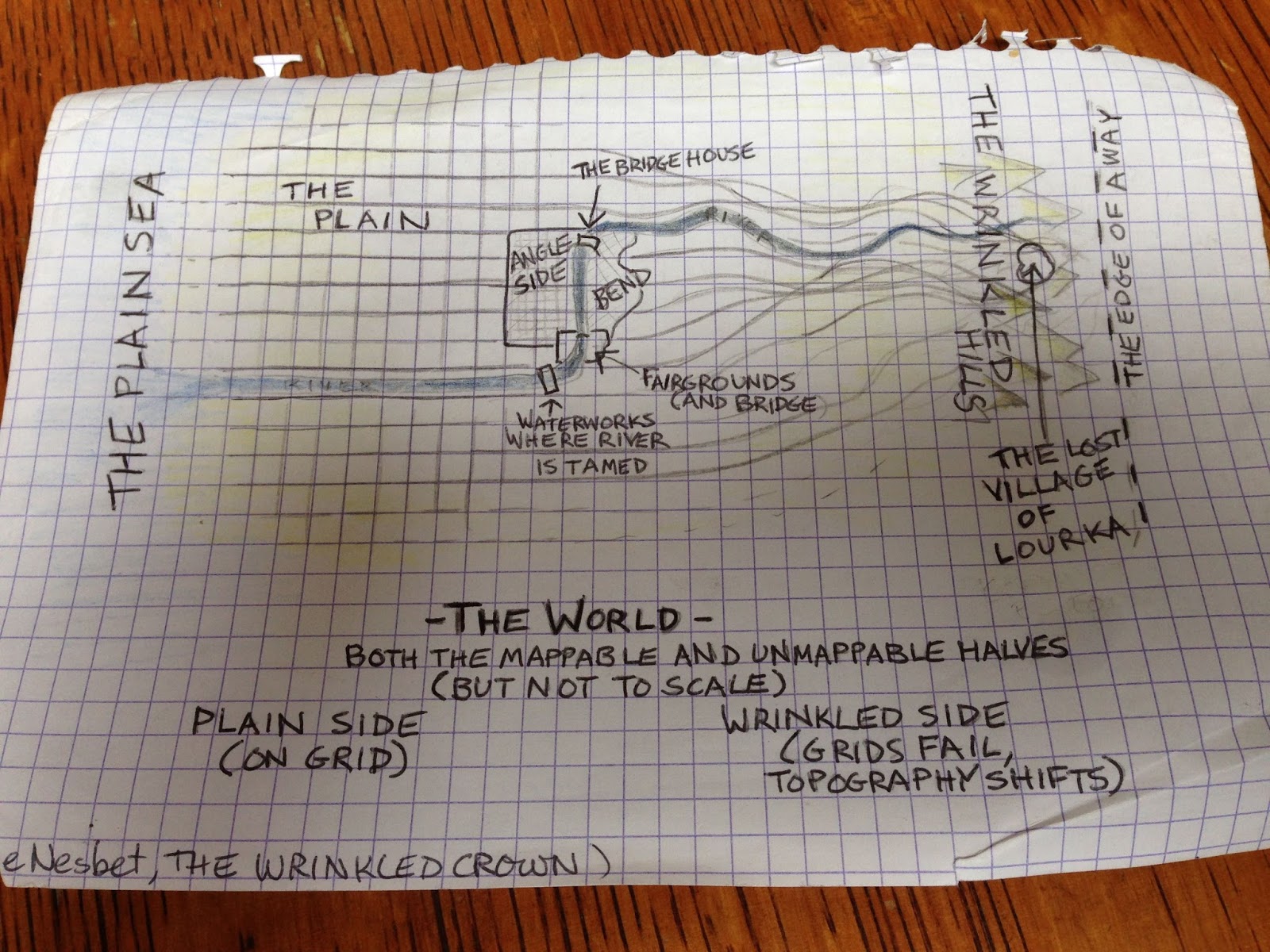
The Wrinkled Crown, however, is set in an entirely made-up universe, and over the last few years I have learned that this process we call "worldbuilding" is a little like building a half-organic, half-mechanical onion from the inside out, layer after complicated layer. There's a lot more to it than simply figuring out where the mountains and rivers go, though in Linny's small but weird universe--a world divided into "wrinkled" and "Plain" regions--both mountains and rivers present some real challenges. In my computer case I still carry around a shopworn sketch I made of her world, "both the mappable and unmappable halves." 
A map of an unmappable place! That's enough to make paradox-loving me as happy as a dry-water clam.

But worldbuilding goes way beyond topography. You also have to build up the culture(s) of the people who live in that world. Linny is born into a village way up high in the wrinkled hills, where magic is everywhere, stories have a somewhat disquieting way of coming true, and music is all-important. In her village, boys are apprenticed to experts to learn the art of making the lourka, a stringed instrument unique to Linny's world. Girls, however, are strictly forbidden even to touch a lourka. This is a big problem for Linny, who is born "hummy" and can't be kept from music . . . .

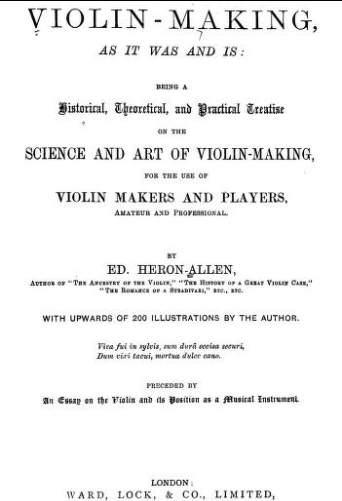
At a relatively early stage in the worldbuilding process, I did a lot of research into instrument making. A friendly local luthier (Joan Balter!) gave me some tips, and then said, "Here's the book we all read at some point!"--and lent me an ancient, crumbling, nineteenth-century tome with an appropriately tome-like title: Violin-Making, As It Was and Is: Being a Historical, Theoretical, and Practical Treatise on the Science and Art of Violin-Making for the Use of Violin Makers and Players, Amateur and Professional (by Edward Heron-Allen, in the 1880s).
From this book I learned about choosing the best trees (maple and pine, preferably from the south side of the forest: "Maple" and "Pine" became the formal names of Linny's twin brothers, though everyone calls them "Maybe" and "Pie"), how long to store the wood (preferably cut in wedges) so that it can cure (for several years), and what sorts of ingredients to put into the varnish (including linseed oil, pressed from the seeds of a plant with small five-petalled flowers: Linny decorates her lourka with one of these "linny flowers").

I made a checklist of such details in order to sneak them into the story wherever I could. And then I moved to the next layer of the worldbuilding onion: what would the folklore of such a place be like? What sayings and proverbs would people use in a place so soaked in music and magic?
  
Here are some of the sayings I came up with--and really, I think they're so handy and helpful that I encourage us all to use them in our everyday life in THIS world! I mean: why not? :)

1. "Not until the feather scorches!"
Meaning: Wait until the right moment to leap, escape, or otherwise make your next move.
Source: Varnish making. Feathers were used to test the temperature of the linseed oil before you added other key ingredients.
A moment from The Wrinkled Crown: "Varnishes can't be hastened, Linny knew from sad experience. If you got impatient and added the juniper gum to the kettle before the linseed oil was really, truly burning hot, unusable glop would be the result.
            Any child of Lourka had heard the expression a million times: 'Not until the feather scorches.'
            Linny sat tight.
            Hang on, hang on, she told herself."
Possible use in our world: Good for muttering to oneself while waiting for the best possible moment to leap into a heated discussion--speak too soon, and the discussion may not yet be quite ready for the addition of your fine ideas. Wait until the feather scorches!

2. "Don't go varnishing flies!"
Meaning: Don't let any little daily unpleasantnesses between you and your loved ones stick around in a permanent way.
Source: Varnish making, again. Lourkas (like some violins) require as many as fifteen coats of varnish. As Linny's father explains, "Got to pick out any dust or little critters stuck there before the next coat goes on. Otherwise you're just varnishing flies, see?"
A moment from The Wrinkled Crown: "'Ah,' said her father. 'And you two went home all quarreled up, letting some little thing fester. That's varnishing flies, Linny, and you oughtn't do it.'"
Possible use in our world: A useful New Year's Resolution, for sure: to dig out the little dings gumming up our friendships before they've set themselves in stone, to do all we can not to go varnishing flies.

3. "Strings and sausages!"
Meaning: The making of lovely things (strings, sausages, and books, for example) can be rather messy and disgusting, when examined closely.
Source: The production of gut strings and sausages, two processes any child raised in the village of Lourka would know something about.
A moment from The Wrinkled Crown: "'It's all strings and sausages around here, have you noticed?' Linny said to the cat. It was a saying from home, used for things that are good and pleasant in themselves, but you don't want to think too much about how they're made. 'You don't know where lourka strings come from--well, never mind.'
            That lovely jam and those lovely eggs, paid for by the magician's awful weapons! It made her determined, all over again, to find her way out of this house."
Possible use in our world: "Wow, how calm you always seem, Elizabeth, as you raise your two sets of triplets and publish that weekly column on meditation practices!"
            "Ha! Well! If only you knew: It's all strings and sausages, strings and sausages!"

What expressions from fictional worlds do you find yourself using, in your everyday life?


(I, for instance, still say "going tharn" about freezing in the face of something scary or overwhelming: a phrase I picked up from Watership Down, by Richard Adams.)