Showing posts with label The writing life. Show all posts

Monday, July 30, 2018

Twenty Years of Writing: The Stats by Caroline Starr Rose

See this? It's a rejection from my editor Stacey, written in 2008! She didn't buy a book from me until 2013.

I first started writing the summer of 1998
. Back then, I was a teacher on break with three months stretching before me. After years of dreaming, I decided it was finally time to dig in and try to write a book.

For eleven years I wrote, submitting my four novels and six picture books almost exclusively to editors.* This was back in the snail mail querying age. Remember the anticipation you experienced as a child waiting for birthday presents to arrive in the mail? That was me for about a decade.

In spring 2009, I won a contest at a local writing conference. At the last minute, I’d decided to send in my middle-grade historical novel-in-verse. It was my best work, but I wasn’t sure how it would be received alongside pieces meant for the adult market.**  My prize included a one-on-one with an editor who specialized in fantasy, sci-fi, and women’s fiction, a world apart from my writing. She took one look at my manuscript and asked, “Why don’t you have an agent yet?”

Part of my very high-tech submission records and some artwork from my son.

That’s when I started subbing to agents in earnest, sending three to five queries at a time. By May, I'd gotten my first full request. In June I got two more. In July another two. In September, yet another two.

By October, I’d had ten agents request fulls and two ask for partials. One agent liked my story, but felt some significant changes were necessary. I thought through her suggestions but took things in another direction, coming up with an entirely new, stronger ending. In the days I spent revising, two more agents requested fulls, bringing my total to twelve. I contacted the first agent, telling her I’d made changes to the story, though not along the lines she’d suggested. If she was still interested, I told her, I’d be happy to send it, but I also wanted her to know two more agents were reading the newer version. She graciously told me she’d love to see the story if the other two agents passed. One did. One didn’t.

Writing stats from 1998 to 2010, when I signed with my first agent:

10 manuscripts (4 novels, 6 picture books)
211 rejections from editors (2 fulls and 1 partial requested)
12 contests/grants (1 win)
75 rejections from agents (12 fulls and 2 partials requested)

With my first agent I sold two books, May B. (novel #4, which subbed to eleven editors and had 3 offers. It  was orphaned when Random House closed Tricycle Press.  The book was days from its ARC printing. Six weeks later, it was picked up by another Random House imprint, Schwartz and Wade, and went through three more rounds of edits), and Over in the Wetlands (picture book #5, which sold to Schwartz and Wade with zero rejections). After reworking several manuscripts, I officially retired most of them and drafted my verse novel, Blue Birds.

In 2013, I was on the hunt again for an agent. I submitted to three agencies and got two offers. I've been with Tracey Adams of Adams Literary ever since.


Writing stats for the last five years:

7.5 manuscripts (1.5 novels, 6 picture books -- 3 of these manuscripts have been officially retired)
5 sales (3 novels, 2 picture books...the second picture book I hope to be able announce soon-ish!)
2 anthology pieces, including an overhauled chapter from novel #2...the one Stacey rejected in 2008!
3 grants / 2 contests (with no wins)
55 rejections


Some thoughts

You could look at these numbers and get pretty discouraged. 14 years to see a book on the shelf? Regular rejection with 7 books sold? I can look at these numbers -- even knowing things worked out in the end -- and feel the same. I know plenty of people with a shorter apprenticeship. I've got lots of friends far more prolific. All sorts of authors I debuted with in 2012 have published far more than I have. Here's the thing: Your process is yours. Your journey is yours. Each book finds its way on its own.

Two truths kept me going before I sold my first book (and aren't bad to remember now):
  • I have something unique to say (even when I'm not sure what that is).
  • My work can only improve if I keep at it.
Rejection continues to be a part of the process. That's just how it goes.

The writing life (and the publication process) is a long-road, long-view, long-term journey. There's no other way to look at it.

So, my friends, if you are on this journey, too, take heart. There is no right way. There's no quick fix. There is no easy road. There is a fair dose of frustration and disappointment. But there is joy and satisfaction, too.

Here's to all the good work ahead. Here's to the next twenty years.


*Because an agent isn’t a necessity in the children's market (but is a REALLY GOOD IDEA), I figured submitting to an agent was an extra, unnecessary step. Perhaps not my smartest move, but it also was not detrimental, as my writing wasn't yet ready for a sale or representation. These were my apprenticeship years.

**I also wasn't sure if anyone would understand what I was trying to do with this verse thing. A few months before I had submitted the first ten pages to an editor at a children's conference. She clearly was unfamiliar with the form and thought it was a rather mature picture book that was missing its ending!

Thursday, February 22, 2018

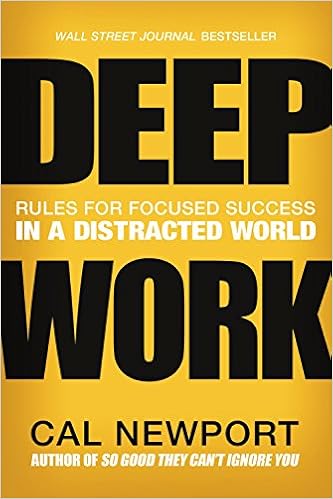
Deep Work and A Digital Declutter by Caroline Starr Rose


In the fall of 2016, I read Deep Work: Rules for Focused Success in a Distracted World. In it author Cal Newport suggests that many of us are engaged in shallow work — putting out small fires and meaningless wheel-spinning — that keeps us from engaging in the focused, planned-for time that true work really needs.

It was the sort of book I couldn’t keep quiet about. I took notes in my bullet journal, posted about it on my blog a couple of times, talked it up with author friends and even my agent. I also signed up for Cal’s e-newsletter to keep his concepts fresh.

A the end of December, Cal mentioned a Digital Declutter experiment he wanted to conduct to collect information for his next book. The declutter would be about “confront[ing] life directly, without the dulling mediation of a screen, allowing you to rediscover which activities and behaviors really provide value in your life, and which are mindless distraction.”

Well. I love a challenge. I love the chance to try something hard in an attempt to learn something new. Add to this the opportunity to really put into practice the concepts in Deep Work, and I was all in.

The guidelines:

Though the break wasn’t spelled out specifically, participants were encouraged to “interpret [the Declutter] in a way that makes the most sense for both your personal and professional constraints.” However, Cal did suggest these things:

If possible

  • “Don’t log into any social media accounts.”
  • “Don’t read news online.”
  • “Don’t use the internet for entertainment. In more detail: Don’t web surf. Don’t browse YouTube videos. Ignore clever links lurking in email forwards. Though I hate to suggest it, take a break from blogs as well.”
  • “If you’re a heavy text message user, consider serious restrictions on when you read and respond to these messages.”
  • “It’s likely too prohibitive to ignore personal email accounts during this entire period, but you probably shouldn’t check them constantly.”

I figured a social media break wouldn’t be too hard. I do this already every July. To remind myself of this promise in down moments, I took Facebook, Twitter, and Instagram off my phone.

I rarely read news online, unless I catch sight of important breaking news. I thought this one would be easy.

I follow a handful of blogs via email. All in all, I assumed I’d be fine taking a break.

I really only text two friends (and the occasional family member who needs a ride or sends me ridiculous emojis [the second would be my husband]). I let everyone know I’d check in less often.

Email, I knew, would be a big challenge. I’ve never been good at limiting the number of times I check, and I’ve wanted to change this — have tried to change this often. My goal was to check in after the kids leave for school, before I head to the gym or out for a run. I’d take a quick peek before lunch and a final read before I shut down for the day. 

Book stats: This was the hard one. After a wonderful boost in sales last fall from the podcast I recorded at the Read Aloud Revival, I’d fallen back into the (bad) habit of habitually checking my Amazon and Penguin Random House Author Portal numbers. This is not helpful, whether the numbers are “good” or “bad”, and can affect the way I approach my work. I welcomed the break from this information.

Finally, I decided I wouldn’t listen to audiobooks while walking the dog, running, or cleaning. I love getting to read while doing mundane tasks, but I also know this can block out times to think and process. Last fall I took a break from audiobooks when I did my week without reading (as I said, I really like challenges) and had brought back the audiobook with gusto. Ideally I hoped to come away from this time with the desire for silent walks a few times a week.

My ultimate hope was to come out on the other side with new insight and a renewed desire for the focused, planned-for time that deep work (and rich living) need.

The results:

January was a good, good month. In a lot of ways, I feel like I was waiting for the Digital Declutter and just didn’t know it. My overall visceral response to the experiment was relief.

That alone is telling.

The guidelines “protected” me from wasting time and letting my mind feel scattered. My online sessions were quite brief without blogs, social media, or tracking book information. I deleted many more emails than I read (leading me to unsubscribe from a handful of industry reads and blogs I realized I didn’t miss). I had large pockets of time for thinking about my manuscript and life and for not thinking at all, for just being. I’m the sort of person who craves silence, but I discovered last month I’m often quick to drown it out. As much as I missed my audiobooks, the stillness felt like a reintroduction to an old friend.

Did I hold to everything perfectly? Here are some specifics:

social media: Having the apps off my phone was hugely helpful. I’ve gone back to the Instagram app, but have only visited a couple of times. I have no need to reinstate Twitter and Facebook. Looking at them occasionally on my computer will be more than enough.

It was tricky when I got an email saying someone tagged me in a photo. I wanted to see! But I stayed away, logging into Facebook once to download something and another time just to see how many notifications I had. (It was a lot. Further confession: I checked my Twitter numbers once, too). Still, I received several FB group discussion emails, where I could read the discussion starter. I probably deleted 2/3s of these emails and read the rest.

Social media sites are very sly (read manipulative) when your visits slow down. I got numerous emails inviting me to see the notifications I’d missed or asking if I needed help logging back on.

online news: More than once I started reading a story only to realize what I was doing. That’s precisely the point of an experiment like this! I saw how quickly mindlessness can take over. I want to be able to consciously make my own choices online and not feel lured in. Being aware of the autopilot tendency is a good thing. I did allow myself to read a few articles that were industry / work related (like this exciting story!)

email: This was by far the hardest. I had committed to checking three times a day but rarely held to it. More typical was four or five times. Admittedly, this was far less often than usual. I really would like to continue aiming for the three-a-day check, even if I don’t hit the mark. Those messages can wait, and so can I.

audiobooks: I was shocked how little I missed these, as they make up a huge part of my day. Maybe it was knowing I could go back to them this month, but I’m pretty convinced it was the quiet that I needed and appreciated. It was brain rest and brain food. I’d like to keep one walk a day audiobook-free.

book stats: I checked my Amazon and Penguin Random House Author Portal numbers twice. It did nothing positive for me. I know (and have known for a while) how this information is the opposite of helpful most of the time. My goal is to check in once a month, just to get a sense of where things are. These numbers are never the full picture, anyway. They should have no place in my life other than as an occasional tidbit of information.

blogs: I let myself read 3-4 posts that were book / writing related. I really didn’t miss blogs I regularly read, apart from this one, which, I confess, I overindulged in during my first few days out of the declutter.

Moving forward

My biggest takeaway from this experiment is how much influence my digital activities have on my mental state. I have no desire to return to feeling scattered and harried, if I can help it — and I can help it, at least when it comes to my technological choices.

I also want to stay present while I’m online. Too many times I’ve found myself unsure how I’ve gotten to a particular site or why I’m even there.

Finally I want to be sure to allow myself time for quiet, even if I don’t feel I want or need it. This experiment has shown me I definitely do.

Deep work is most possible when I consciously make time and space for it. I’ve had the time, but what I didn’t fully realize was how mentally cluttered my space had become. 

Here’s to more purposeful digital choices — ones that enhance life, not hinder it.


Thursday, December 21, 2017

Are you seldom disappointed or do you hold to wild hope? by Caroline Starr Rose


My writing space. Isn't it cozy?

A few years ago I recorded a podcast with author Tsh Oxenreider. As we talked about submissions and rejection, Tsh mentioned the idea of “it’s just business, it’s not personal” not being an entirely helpful or true way to look at the writing life, at least in her experience. “It’s business and it’s personal” is more accurate, she said. It’s personal because not only has she invested in what she’s created, a piece of writing grows out of who she is.

This is absolutely spot on in my experience, too. An author has hope for her work, wild hope that it will connect with an agent or an editor who believes in it as she does. That wild hope must also run through the writing itself. The creative act cannot hold back. It cannot be guarded or careful or tame. For me, both writing and the writing life must be all in.

Being all in has its risks. There is the possibility of rejection. (Not just the possibility. In this line of work the reality of rejection is always present.) There is the possibility that even books that sell won’t go the way you hoped or planned. Elizabeth Gilbert says “creativity asks you to enter into realms of uncertain outcome.”

Your job is to create. You don’t get to decide the rest.

Uncertain outcomes mean sometimes you’ll be hugely disappointed. It’s important to let yourself acknowledge this, to let yourself grieve the work that didn’t have the future you’d hoped. This is hard and painful and so disappointing. But I rather do this than not hope at all.

Recently a friend told me she’d read Tony Hillerman’s memoir, Seldom Disappointed. The quote comes from something his mother told him: Blessed are those who expect little; they are seldom disappointed. He carried this idea into his writing life, a place he had huge success.

It’s interesting that just days after this conversation I started re-reading Anne of Green Gables and in it found Mrs. Hillerman’s advice, almost word for word, this time in the voice of Mrs. Rachel Lynde.

It’s Anne’s response to Rachel’s words that I prefer:

“You set your heart too much on things, Anne,” said Marilla with a sigh. “I’m afraid there’ll be a great many disappointments in store for you through life.” 

“Oh, Marilla, looking forward to things is half the pleasure of them,” exclaimed Anne. “You mayn’t get the things themselves; but nothing can prevent you from having the fun of looking forward to them. Mrs. Lynde says, ‘Blessed are they who expect nothing for they shall not be disappointed.’ But I think it would be worse to expect nothing than to be disappointed.”


I'd rather be disappointed than lose hope. This mindset isn't an easy one, I know. I just turned in a new project that I'm trying to hold loosely, whatever the answer may be. But at the same time, I hold out hope that it's exactly what my editor wants from me. If I hold back hope, I hold back heart, the very thing my writing needs.

Wednesday, October 25, 2017

Defining Success: Authors Weigh In by Caroline Starr Rose

Do shiny stickers mean success?

I’ve been thinking a lot lately about how I personally measure success.

When I first was published, I figured if I could reupholster the couch and pay for my boys’ glasses and eventual braces, that was success. These markers sound goofy now, but at the time they represented visible ways my work contributed to my family. They were tangible. Evident.

I recovered the couch when my first book sold. I've been able to keep my boys in glasses and contacts, and earlier this year paid off the second set of braces (thank you, May B., for still selling strong, and thanks, Mom and Dad, for helping out along the way).

By that early definition, I've arrived.

But over the years my definition of success has morphed and changed. If a book of mine stayed in print, that was success (so far, so good). And the ultimate success was earning out — when a book makes back its advance and an author is paid royalties. (Never mind the fact that only 15-25% of all books published actually do this -- and as of this date, only one of my titles has.)

Is meeting readers a way to define success?

When Blue Birds published, my measure shifted: if I was pleased with my work and my editor was pleased with it, that was success. This feels more reasonable, more attainable through hard work, but in the end, is it enough? Perhaps for my own level of satisfaction, but the honest truth is if I want to sell more books, my prospects are much more likely if I've had earlier titles that have done well in the marketplace.

What's difficult -- and maybe even unrealistic -- about using publishing markers as signs of success is they're out of my control. That's where the tension comes in. Because, honestly, how can success be legitimate if sales aren't strong? But how is such a mindset sustainable throughout a (hopefully) long, probably varied career? Is it ridiculous to hope every project will be successful? Is success more of a general, over the course of a lifetime thing?

Is the day to day work the truest measure of success?

I asked some friends, from the newly to the broadly published, how they defined success (anonymously, so they could be candid). There is so much wisdom here.

  • Success is being comfortable with the reality that not everyone who reads your book will like it. In fact, some readers will hate it, despite how much others LOVE it. Realize and embrace that certainty early.
  • At first, I just wanted to get an agent. I felt that I wouldn't be successful unless I achieved that. But when I got an agent, my success meter moved. I just wanted to be published. Then when I got published, I just wanted to be published AGAIN. I have to remind myself not to forget where I've come from. Now, I like to imagine I feel success when I've protected my writing time and had fun getting some words down in a day. To me, that's the measure of success.
  • Success for me means feeling that I have put forth my best effort to tell a meaningful story. That effort may, and probably does, involve many rewrites before it's printed on pages for the public to read. And the stories that don't make it to press are still successful, in my eyes, if I've put forth my best effort.
  • For me, writing is what I want to do as my job, and I need to make a living. So success means making enough money from writing or writing-related activities (teaching, critiquing) to support myself. That often means seeing myself as an employee who has to do what the boss wants, even though I'm a freelancer. But I encourage other people to remember that making money, or even being published, does not have to be their goal. If you want to write for the joy of writing, that's fantastic. Just remember what your goal is, and don't get distracted by other people's definitions of success.
  • Success is meeting the little goals you set for yourself and feeling good about it whether or not anyone else ever notices what you have done.
  • I'd like to be noble and say success as a writer is simply about doing what you love and loving what you do, with no outside factors taken into account. Critics? Meh. Sales numbers? Who cares? This is art, by golly. It's unquantifiable. But if I'm being honest with myself, I do to some degree base my success on what other people think of my work and how well it sells. This is my career. I want to do well and I didn't write my books just for myself. Writing is about communicating and connecting to someone other than yourself, so outside opinion does matter to some extent. So I strive to create the very best for both myself and my audience and I feel successful when I've pleased both. I also really like it when my work can pay the bills.
This last is perhaps my favorite.

  • I’ve been thinking a lot about this question. It’s a hard one for me, mostly because it changes from day to day, and for all those years when I hadn’t sold a second book, I had some seriously disarranged notions on the subject. Mostly I think those years taught me that a certain powerful flavor of success is maintaining that particular brand of faith that kept me writing in those years before I had a contract at all. It’s easy to feel successful when you have a book coming out. It’s a lot harder when you feel like nothing is happening and you have to keep creating every day when nothing might come of it. That’s how success looks to me today. When you can find it in yourself to keep blowing that little ember deep down inside you, the one that keeps you putting words on the page when there’s no earthly reason but the making of them. Success is making something beautiful when there’s no one to see it but you.
How do you define success? Please share in the comments below!


Monday, August 21, 2017

7 Ways to Make the Most of a Writing Retreat by Caroline Starr Rose

Adorable Boo, my writing companion.

Last year my husband took our boys to the Mountain West Basketball Tournament, giving me four days with the house to myself. I planned to use the time as a stay-at-home writing retreat, just Boo and me and fiendish typing. 

It was spectacular. 

I decided I needed to be prepared but open when it came to this writing time. While I hoped Jasper and the Riddle of Riley's Mine would be back in my possession, I couldn’t plan on that happening (It wasn’t. I worked on it anyway and was thrilled with what I accomplished). My goal was to have a sense of how I wanted to use the four days, but not be so rigid that I missed a creative opportunity. I ended up splitting the time between two projects, one in its very beginnings and the other nearing its end. 

planned ahead about regular commitments and how I’d handle them. For example, I got up at roughly the same time I would have had my family been home. I kept my Thursday running date and attended church on Sunday. But I made room for flexibility, skipping the gym on Friday and going to a book signing Saturday afternoon. As for meals, I pulled a few things out of the freezer, cooked twice (with leftovers for when my family returned), and even ordered pizza one night. 

Most importantly, I knew I needed to have realistic, relaxed expectations while still committing to hard work. I am not a fast writer and never will be. With four days stretching before me, it would have been very easy to convince myself I’d do super-fantastic, out-of-character things, like write 10,000 words a day. Not happening, ever. Instead I focused on these things:


  •  I decided not to serve my ego (those 10,000 words) or my anxiety (worry I wouldn’t accomplish anything), but simply show up and enjoy the work.
  •  I told myself it was more important to be productive instead of producing. (In other words, I didn’t have to have loads to show for all the time I put in. Creativity isn’t always something that can be measured. I’m learning to be okay with this.)
  • I strongly believe that every writing moment teaches me. That makes it worth it, whether it’s eventually cut or kept, whether it sells or doesn’t.

The view from our retreat house balcony. Isn't it gorgeous?

Every September my critique group meets for a writing retreat. We rent a house in town, plan out who will make dinner what night, do a bit of critiquing in the evenings, watch a movie together, and spend the rest of our time in creative work. 

The years I've been on deadline, I've made quantifiable! Great! Leaps and bounds! with my writing. During the other years, not so much. But here's the thing: those slower retreats were still creatively important, whether I produced much or not. Have I believed that during the retreat itself? Nope. I haven't. I'm still learning to trust in the moment that every writing experience teaches me something.

I have no deadline this time around, but I do have a project underway -- the one mentioned above, in its early beginnings (and honestly not much further along than it was a year and a half ago, during my stay-at-home retreat). It would be easy to head into the week with my ego and anxiety kicked up in high gear. Instead, I hope to apply what I learned while I worked alone: to stay prepared but open, relaxed and willing to work, ready to learn from each moment as it comes.

What words of wisdom can you share about writing retreats?

Monday, June 19, 2017

Writing About the Writing by Caroline Starr Rose


I write historical fiction, so the idea of keeping a notebook to gather my research and questions about a new project isn’t a new one. But over the years my notebooks have expanded into something other than just a collection of historical tidbits. They’ve become an on-going private conversation where I can noncommittally explore the fragile beginnings of a new idea or work out troublesome knots once the story’s under way. 

In other words, my notebooks are teaching me the importance of writing about the writing.


My novel Jasper and the Riddle of Riley’s Mine didn’t yet exist when it sold as part of a two-book deal. For a few weeks I was thrilled with my good fortune, but then panic settled in. I pulled out my notebook and scribbled down my worries: I’m not very good at plotting and have never created with a deadline. There’s pressure knowing I’ve sold something I haven’t even begun. Then I made myself try and answer these worries, to the best of my ability. Plot comes, I wrote. It can be discovered in character development and drafting. My agent and editor believe I can do this. If I can’t see this in myself right now, I can borrow their belief. I returned to this page in my notebook throughout the drafting process any time I needed a little courage.

The word “writing” is sometimes a heavy load for me to carry. My mind fills with word counts and productivity — the opposite of how my projects often progress. I’ve allowed myself to replace “writing” with terms that don’t hold so many expectations. Now I explore. Create. Discover. Tinker. Wonder. Practice. 

This might mean figuring out what’s working with a premise and what isn’t. Or creating a list of historical details I need to further study. Some days it includes questions I have about a story’s timeline and plot or notes on characters — their secrets, their fears, the stories they tell themselves to make sense of the world — and their relationships with others. My notebook becomes a running commentary, an in-the-moment chance to reflect.

There was a particular scene in Jasper that I just couldn’t get right. Each time I’d turn it back in to my editor she’d point out what wasn’t working. One day I set aside the manuscript and returned to my notebook. I needed to hear from the characters in that scene — how their lives before this moment had influenced how they saw themselves, how their experiences had shaped their choices. Using first person, I wrote quick character sketches of both men. I realized one felt cheated, like he was owed something. The other was guarded and afraid. Knowing this opened up the scene in an entirely new way, allowing me to see how these two would interact and how they’d treat Jasper, the kid who’d stumbled in on their conversation.


In going back over my notes, I witness a book slowly taking shape. Each page records challenges that I eventually find my way through. Writing about the writing becomes a promise that someday my book will come together. Though it might be hard to believe in the moment, I hold the proof my story has made it this far, that it will reach the end. 


Tuesday, June 6, 2017

On Reminding Ourselves To Embrace Uncertainty by Stephen Bramucci


I started my career writing about what I called "non-itinerary based travel." That means trips with no plans, no agenda. My personal travel technique was all instinct -- following my nose, asking questions, making a hash of things and living to tell the tale.This wasn't just my favorite way to see the world, it was my favorite way to live. No plans, no reservations, just meeting life head on. 


As much as I hate to admit it, life has changed since those days. With age has come a certain... mellowing. There's also a little more desire for safety and security. Over the past five years, I've spent plenty of nights flooded by the sort of self-induced anxiety that I used to scoff at: 

  • Where is my career going?
  • Where is this book going?
  • When will I ever pay off my grad school debt?
  • What will the profession of "writer" look like when I'm seventy?


In short, I've needed a plan. An agenda. An itinerary. Sometimes, it's come in useful:

  • I have an agent who helps me plan a career. 
  • I have an editor who helps me shape my stories.
  • I have a billing plan that deducts loan payments from my paycheck.

Other times no amount of planning can help:

  • I have no idea what it will mean to be a writer in 33 years (though I'll still be making those loan payments).

But lately, through a massive convergence of factors, I've also had to give up having a plan. At least a solid one.

  • This week, the sequel to my first novel is due. I've never written a sequel before. 
  • Next week, I'm moving into a home which I'll be part owner of. I've never owned a home before. 
  • July 22, I'm getting married. I've never been married before. 
  • August 1, I have a book launch. I've never had a book launch before. 
  • September 7, I go on book tour. I've never gone on book tour before. 
  • October 23, I have a baby due. I've never been a dad before. 

That's a lot. I'm exhausted just writing it all. You can't plan for all those things at once. It's like a cat, that keeps slipping away every time you think you have your arms around it. My current existence is strewn with forgotten details, like breadcrumbs, and the only light by which I'll ever see them will be shone after the fact. As in, "Oh no! I forgot to hire a wedding DJ!" -- spoken mid-wedding. 

As I type this post, I'm overwhelmed. And tired. And pushed to the max. But I'll tell you this: I've also remembered how freaking invigorating it is to not know the whole itinerary. Uncertainty carries with it a special thrill. 


So what does this all have to do with craft? Last week, I said to my girlfriend, "I guess I should have outlined every beat of this sequel beforehand. That's what a smart writer would have done." 

But if writing is about finding joy, I have to admit that my joy has never come through having a rigid outline. I like improvisation and fluidity. I wrote my novel The Danger Gang and the Pirates of Borneo! without an outline and I wrote the sequel much the same way. Instead, I  surprised myself on every page and -- more importantly -- the characters surprised me. The sequel features a major mistake by one of the protagonists, made out of vanity. I don't know if it ever would've happened had I outlined. 

Writing, as we all know, contains multitudes. There are a million ways to write and if they work, they work. But my recent tsunami of dramatic life changes has reminded me that sometimes not knowing exactly what's coming next is fun for me. And I want writing to feel fun. 

At the moment, the current mantra in writing and life is found in this quote by E.L. Doctorow:

“Writing is like driving at night in the fog. You can only see as far as your headlights, but you can make the whole trip that way."


Editor's Note: On his Twitter bio, Stephen Bramucci describes himself as Editor + vagabond-at-large for Uproxx Life (Travel, Food, Adventure). Lover of derring do. His first novel, The Danger Gang and the Pirates of Borneo  is out on August 1st. You can visit his new website HERE