Showing posts with label writing craft. Show all posts

Monday, April 10, 2017

Chris Eboch on Wrapping up a Story with Bookends

A story can be circular.
Strong stories have a distinct beginning (introducing the main character and problem), middle (where the character tries to solve the problem), and end (where the character succeeds or fails, and possibly learns a lesson).

A story can feel especially satisfying if the end clearly echoes the beginning. Perhaps a character has gone on a journey, and at the end he returns home. Maybe she starts by struggling with some physical task, like hitting a baseball, and at the end she succeeds. Or he’s resisting a change, such as a new sibling, and the story ends with them connecting.

When the final setting or situation is similar to the opening, creating “bookends” to the middle, the pattern feels satisfying. It also ensures that the story is tied together and hasn’t wandered off on tangents.

Carolyn Meyer often uses a prologue and epilogue as bookends for her historical fiction. Cleopatra Confesses (Simon & Schuster) includes a prologue where Cleopatra hears that her enemy, Octavian, is at the gates of Alexandria. The body of the novel shows her remembering her life as she waits. In the Epilogue, Octavian has arrived, demanding her surrender.

An Echo, Not a Copy

While the ending echoes the beginning, it shouldn’t duplicate it. With a few exceptions, a story requires change. Quite likely, a problem has been solved. Hopefully, the main character has grown. The traveler returns with a new appreciation for his home. The girl who thought hitting a baseball was impossible is satisfied with her progress. The boy who wanted nothing to do with the new baby appreciates the advantage of having a sibling. They haven’t just solved the problem; they’ve changed how they feel about the situation.

Bookend scenes may illustrate the changes by using a scene or language similar to, but slightly different from, the opening. If you open with a girl trying to hit a baseball, close with her back at the same park, swinging at a baseball again. Try making the circumstances as similar as possible, with the same weather and other characters present.

The bookend format doesn’t work if you end at a different point, such as with the character at home telling her parents what happened, even if the problem was solved in the same way. You want the echo of a similar scene. This can help you figure out where to end, so you don’t stop too early or drag on too long.

You can also experiment with using similar language, with small shifts to show what’s changed. In the opening scene of Uma Krishnaswami’s The Grand Plan to Fix Everything (Atheneum), the narrative reads, “Two happy sighs float off the couch....” Of course, something quickly intrudes on this happiness. But after a madcap adventure, the narrative concludes, “There are many kinds of sighs. The one Dini sighs now is wrapped in contentment.”

Nonfiction and Art Bookends

Bookends can work with all kinds of writing, including nonfiction. In Jennifer McKerley’s early reader Amazing Armadillos (Random House), the book begins and ends at the same point in the yearly cycle of the armadillo’s life, but with a twist. The beginning features an adult armadillo, while the end shows her pups in the same situation.

Shirley Raye Redmond’s Pup’s Prairie Home (Picture Window Books) starts with the lines, “Pup and his mom lived in a prairie dog town. Their home was a deep dark hole in the ground.” Although his mother insists this is the best place for him, Pup wants a more exciting home. He changes his mind after a close call with a hawk and ends by saying, “A deep, dark hole is the best home for a prairie dog pup like me.”

Illustrators can use bookends as well. In Robin Koontz’s wordless picture book Dinosaur Dream (Putnam Juvenile), the story begins and ends with the child sleeping in bed, framing the dream adventure with dinosaurs.

Using bookend scenes is one form of showing rather than telling. The reader can see how things have changed, and whether or not the change has satisfied the main character. This typically suggests the theme, so you don’t need to explicitly point out the lesson learned.

Bookends aren’t necessary for every story, but by thinking about bookends, you may find a natural ending point for your story. Don’t end too early, before you’ve had a chance to echo the beginning. And don’t go on too long, traveling past the natural bookend. With bookends, you can illustrate the change in the character or situation subtly but clearly, while using a repetition pattern that’s especially appealing to children.


Chris Eboch is the author of over 40 books for children, including nonfiction and fiction, early reader through teen. Her novels for ages nine and up include The Eyes of Pharaoh, a mystery in ancient Egypt; The Well of Sacrifice, a Mayan adventure; The Genie’s Gift, a middle eastern fantasy; and the Haunted series, about kids who travel with a ghost hunter TV show, which starts with The Ghost on the Stairs. 

Chris's writing craft books include You Can Write for Children: How to Write Great Stories, Articles, and Books for Kids and Teenagers, and Advanced Plotting.

Learn more at www.chriseboch.com or her Amazon page, or check out her writing tips at her Write Like a Pro! blog.

Monday, October 3, 2016

Writing Funny on Purpose by Jim Hill


“Humor can be dissected, as a frog can, but the thing dies in the process, and the innards are discouraging to any but the pure scientific mind.” – E.B. White 

Writing funny takes a knack, but like any craft, there are techniques you can learn to let your silly out. The trick is, well there are a lot of tricks, but maybe the most important one is listening. Listening to what makes you laugh, and how that might be a bit different than the gut-buster your friends and family love.

What I'm saying is, humor is subjective with a side order of formulaic and a twist of the absurd. Like the infamous line about obscenity, "I know it when I see it."

[INSERT FUNNY CAT VIDEO HERE - Ed.]
[No. - Jim]

Maybe funny is a mindset. A way of looking at and responding to the world that is intentionally off-kilter. If writing reflects the real world–art imitates life–then writing funny on purpose breaks the rules of physics. The angle of incidence does not equal the angle of reflection. The degree to which you alter that formula defines the humor, taking it from the subtlest satire to the broadest slapstick. The world recorded by way of a funhouse mirror.

Back to listening. And by listening, I mean reading (but also I mean listening). Learning to be funny means exposing yourself to the funny. Fortunately, we live in a golden age of exposing yourself. [JIM! - Ed.] With content-on-demand finding comedy has never been easier. Better still, the spectrum of comedic voices is much broader than it was back in your grandparent's day when Uncle Milty was "the man" on that one TV channel. Which means you can find the things that make you laugh and learn from them, the same way you discover how to be a Newbery Award winner by reading your Kate DiCamillo collection into dog-eared, high-lighted, broken-spine relics of devotion. Or is that just me?

I'll get you started with a few of my favorites.

Finally, The Funny Links

The Comic Toolbox – Although it fulfills its promise to provide the rules and structure of comedy, this book also sneaks in quite a bit about writing in general. Vorhaus' light tone and banter walk the reader through a progression of comic tools to instruct on the techniques and provide the vocabulary of critique and analysis.

What Are You Laughing At? – If you've ever wondered if comedy can be scientifically analyzed, this is the book for you. Dan O'Shannon breaks down the ha-has of humor the same way Nate Silver attacks polling data. It's a deep study, but well worth the time. Perfect for the Ravenclaw that wants a little more Hufflepuff in their writing.

(Not So) Rando Resources That I Found

Now that you're a comedy expert, in the same way that you're an architect because you built that LEGO Fallingwater with your nephew, it's time to hear from the professionals.

Poking a Dead Frog – In this book, Mike Sacks interviews a wide array of comedy writers. There's a lot of background on breaking into TV or film, but there's also kernels of humor truisms and nuggets of hilarity. Most of the interviews are short, perfect for my attention span, so this book makes an excellent bathroom reader. [Jim, I'm scheduling a meeting for you with HR. - Ed.]

Funny Business – Subtitled "conversations with writers of comedy," Leonard Marcus pitches this collection at younger readers and includes many favorites of the middle-grade set. Beverly Cleary, Norton Juster, Daniel Pinkwater, and Jon Scieszka, to list a few.

By Ken Levine – Ken Levine wrote episodes of MASH and Cheers. That ought to be enough of a comedy pedigree to get your attention. His blog features a lot of behind-the-scenes craft-based stories about what goes into writing sitcoms, and that stuff translates into middle-grade humor very easily. Worth checking for his Friday Questions, if nothing else.

The Writers Panel – This podcast isn't always focused on comedy, but there are almost always great insights into serving an audience well-crafted stories. And even when something isn't a straight-up comedy there's often humor in the mix. Ben Blacker and the panelists dig deep. Have a notebook handy.

WTF with Marc Maron – NSFW, but if you can get beyond that issue, Maron's interviews with comedians both contemporary and legendary are fantastic. Almost never craft focused, but if you're wondering about how to be funny, getting a look into the mind of funny people might help.

Congratulations, You Are Now Hilarious


So that's it. Go forth and be funny.

[Really? That's it? - Ed.]
[Fine. - Jim]

What's Made You Laugh Lately?


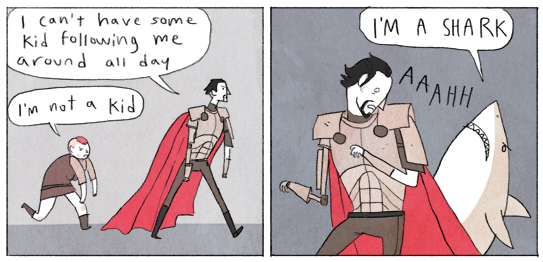
Wait! Before you go, tell me the last book you read that made you laugh out loud. For me, it was Nimona by Noelle Stevenson. Okay, your turn.


It's Cat Video Time!

Play me off, Keyboard Cat!


[Thank you! - Ed.]
[You're welcome. - Jim]

Monday, August 3, 2015

Evolution of a Writing Process by Donna Galanti


My writing resource bookshelf
I wrote my first book organically five years ago (which remains hidden in a shoebox). I got up Monday through Friday and free-wrote from 4:30am to 6:30am and in seven months I had that first novel.

My second book: written organically in the wee early morning hours but with a basic story idea.
My third book: written with a detailed outline, character worksheets, professionally edited.
My fourth book: written with a detailed outline, character worksheets, story bible, and went through several editing, agent, and beta reader passes.
My fifth (and last book): written under a contract with a 10-page outline, extensive character worksheets, story bible, character arc/series arc outline, went through in-depth revision process with developmental and copy editors. 


Pheww…that all sounds exhausting when I read it.
My notes from one book
I dreamed of flinging away the processes and getting back to writing organically with my sixth book like I had when I wrote my first book. I romantically imagined myself in the dark morning hours all alone facing white pages. Tubs of coffee. Notepads and slippers and unbridled words. I would wander and discover. I would let my muse drive me (in the tradition of Shakespeare in Love). I would escape into the fiction dream and live on words alone!

And it was glorious. I rose like a Phoenix in the golden sky. I gave new life to old wings.

Then I crashed and burned. 

My story fell apart. Wonderful and fantastical events and creatures came to life….that had nothing to do with the story of the main character’s transformation. Too much was happening. Too many people had secrets. Too many characters had no purpose. Too many events had no meaning.

Wait a minute…what was this story about?? 

I had lost it. And I realized why.

Because I had evolved and I couldn’t go back. Like first kisses. First dates. A firstborn child. You can never go back and experience it the same way ever again. You know what happens and how it works. You can’t un-know it. And with this, came the knowledge that I am not a write-by-the-seat-of-my-pants gal. I need structure and organization and a path to THE END.

At first I was sad but then I realized if I hadn’t evolved my writing wouldn’t have either. I wouldn’t have strengthened my craft and knowledge about how to write a good story. 

I couldn’t de-evolve. So I decided to embrace my evolution.

Yeah. It's like that. All at once.
I looked back at my last novel and realized something. When I submitted that novel to my publisher within a six month time frame, I knew it was the tightest and most polished draft I had ever written. I’d brought all that I had learned over the past few years in one massive punch. I’d fully accessed my writer’s toolbox – a box now full to the brim with knowledge I’ve gained from editors, deconstructing books, classes, conferences, and my own application. And I suddenly knew that I had not written this book alone – many people contributed to my success of it.

And along this evolutionary path I discovered the writing process that works for me in this order:

1. Create a detailed story outline that is solid and ties in the main character arc across the plot points.

2. Write a pitch paragraph that includes the premise of the story. What is this story about?

3. Create character worksheets and journal in each character’s voice.

4. Do what world building I can (the rest will be found along the way). Draw a map. Create a story bible of setting, creatures, magical elements, history, etc.

5. At the beginning of each chapter create a guide to keep me on track which includes this information:
*Main character’s goals of each chapter/scene
*What main character’s discovers in each scene and how it propels him forward
*What we can learn about other characters in each scene
*What we can learn through dialogue about other characters
*World building goals in each scene
*Outer turning point: in each scene which things change that everyone can understand
*Inner turning point: in each scene which the scene’s point of view character also changes as a result.

6. At the end of each chapter write a one-line sentence about it so when the book is complete I will have a strong synopsis (and that’s good for back cover copy too).

7. Create a revision guide and add in specific things to check for when the first draft is done related to:
*Narrative flow
*Backstory (where and when to have)
*Repetition (with words and scenes)
*Setting consistency
*Pacing and tension
*Plot holes
*Timeline of events
*Character development relating to consistency with speech.
*Character reactions. Ask: How would each character react in each moment?

8. In writing, allow for discovery but check that it ties into the MC’s character arc and story premise.

This process may not be organic but it did allow for organic discovery within the parameters of the story. With my most recent book I wrote on a tight deadline, I had new characters show up and old characters leave. I combined characters. I changed how information was found. But all the magic that burst on the page was aligned with the plot points and connected to the growth of the main character. 

And I learned that what I so longed for again no longer worked for me. And the myth of the angst-filled, free-flowing, genius writer hanging his hat alone in his cave is just that – a myth. We can write alone but we can’t get published alone. And I’m glad.

Sometimes you get what you need, not want you want. And that’s a good thing.

I wonder what kind of writer I will evolve into next?

How have you evolved in your writing process? 

Pens up. **Chink**