Thursday, November 9, 2017

Why My Rejection List Is Not Long Enough, by Kell Andrews

I showed my 12-year-old daughter my rejection folder. I was trying to encourage her as she tried out for the seventh-grade volleyball team for the first time, and she was afraid she wouldn't make the team. We scrolled through the email folder —hundreds of messages.

Thank you for your submission
Thank you for your patience
No reflection on your work
No reflection on you
I don't feel passionate
I don't feel connected
Not a fit at this time
Not a fit for my list
Sorry for the delay
Sorry for the news
Sorry


In the not-long-ago Old Days, writers kept files of paper rejections, scrawled and typed and stuffed in SASES. Sometimes they burned them. Sometimes they wallpapered rooms with them.

I keep my email rejections in a file. I have so many that when I select the "move to folder" option for any email, my email program helpfully suggests the Rejections folder.

And these are only the responses I've actually received. There's no way to keep the no-responses rejections, except in the spreadsheet I use to track them. Except in how it feels to have the hope of a submission just fade away with no word, over and over. But I keep submitting, over and over.

When my daughter saw my rejection folder, she was sad for me.

"Sorry," she said, the word that was in just about every message in the file. The list seemed endless, but really it just went back to 2008.

"I'm not sorry," I said. "I wish the list were longer. I wish there were more. I wish I started earlier."

My rejection list will only get longer because I'm still writing and still submitting. No matter how successful a writer is, rejections keep coming, although they may be farther apart and they may be about different things.

It's been 11 years since I decided to really try to achieve this writing dream I'd always had, nine since I submitted my work. I've sold some books and stories along the way, but I wish my rejection list were 10 years longer, or 20.

My daughter did not make the volleyball team. Hers is a story of rejection so far, the first of many that are inevitable. I hope there are triumphs mixed in. There will be.

Because she has started.


Monday, November 6, 2017

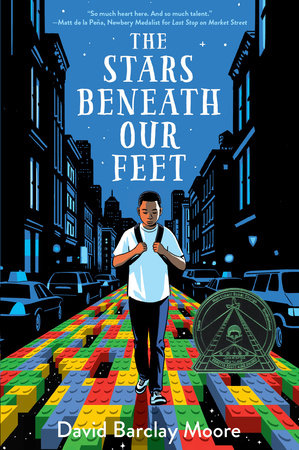
Marvelous Middle Grade Monday: THE STARS BENEATH OUR FEET by David Barclay Moore

THE STARS BENEATH OUR FEET by David Barclay Moore (Knopf, September 2017)

One of the most encouraging changes in publishing over the past several years is that big houses are actively acquiring and publishing novels in response to #WeNeedDiverseBooks. What's more, these titles are seeing significant success in the marketplace. Angie Thomas's The Hate You Give has been on the NY Times bestseller list for months!

(I'd like to give a shout out to our very own Linda Williams Jackson, whose Midnight Without a Moon is going to be followed by A Sky Without Stars in January 2018!)

Therefore, I was delighted to receive a copy of The Stars Beneath Our Feet by David Barclay Moore. From the eye-catching cover, to the eye-opening story about a boy in the public housing projects in Harlem, this novel did not disappoint.

What It’s About:

“Lolly’s having a hard time knowing how to be without his older brother around. Seems like he’s either sad or mad. The thing that helps most is building. His mom’s girlfriend gave him two huge bags of Legos, and Lolly’s working on an epic city—a project so big it outgrows his apartment.

But there are dangers outside. Older guys who harass Lolly and then jump him and his friend Vega.

What would Jermaine want him to do? Get with a crew and take revenge?
Or build a different kind of world for himself?
Lolly’s going to have to figure this one out on his own.

Things I Liked:

If part of the power of books is to take you to different times and different places, places in which you probably will never set foot, and show you the breadth and depth of humanity, then The Stars Beneath Our Feet succeeds brilliantly.

I was immediately captivated by Wallace “Lolly” Rachpaul, who lives in the St. Nicholas Projects in Harlem. His older brother has been murdered, and his parents are separated. Lolly feels grief, anger, and alienation. Building a town out of Legos, first in his apartment and later at his after-school program, takes him out of these dark places.

This is a novel with many plots and subplots. It’s about friendship, it’s about accepting differences, and it’s about standing on the precipice of young adulthood and facing a fork in the road.

I was gripped by the subplot which has Lolly and his growing friendship with a girl called Big Rose, whom no one seems to like or understand. Lolly initially sees her as an interloper in the storage room in which he builds his city, but then as they build together, he begins to see her talents. Although Rose claims she is not autistic, she is clearly on the spectrum, with a gift for looking at a building and then exactly recreating it in Lego. Lolly and Rose develop a friendship, visiting buildings in Manhattan and studying architecture.

Life in undeniably hard for Lolly and the other kids in his neighborhood, but they do have dreams and hopes, even if the weight of the world looks set to overpower them. I resonated with the following conversation between Lolly and his best friend, Vega:
"I think it must be hard to be a real artist," Vega said.
"What you mean?"
"Well, if we was different, you know, been born with money... It's just... making good art and music ain't really expected of us. That type of work is unexpected.
"Yeah," I said. "It wasn't meant for us. But I still think you'll be a good violinist. You are now!"
It smelled like rain. I turned up toward the sky and could see heavy clouds.
"Lolly, I think you'll be a good architect. Or whatever you wanna do."
"Thanks, Vega. We both know I won't ever be nothing." (page 185)
By the end of this gripping and luminous novel, we discover that these downbeat words of Lolly's do not ring true. Great stuff!

About the Author:
DAVID BARCLAY MOORE was born and raised in Missouri. After studying creative writing at Iowa State University, film at Howard University in Washington, D.C., and language studies at l’Université de Montpellier in France, David moved to New York City, where he has served as communications coordinator for Geoffrey Canada’s Harlem Children’s Zone and communications manager for Quality Services for the Autism Community. He has received grants from the Ford Foundation, the Jerome Foundation, Yaddo, and the Wellspring Foundation. He was also a semi-finalist for the Sundance Screenwriters Lab.
David now lives, works, and explores in Brooklyn, N.Y. You can follow him online at DavidBarclayMoore.com, on Twitter at @dbarclaymoore, and on Instagram at dbarclaymoore.
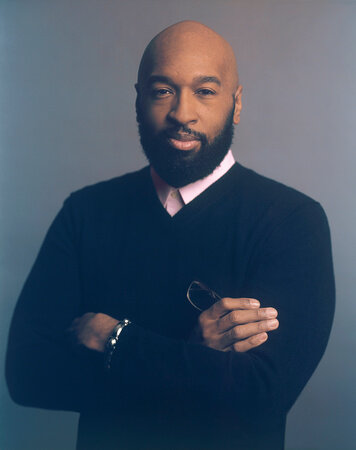
Photo by Timothy Greenfield Sanders


Thursday, November 2, 2017

What Keeps Me Going by Paul Greci


The morning of the Equinox Marathon

When I first started writing fiction 15 years ago, I didn’t consciously think about success. Instead, I was swept away by the writing process, and hoped I could finish a first draft of a novel. In other areas of my life, I’ve been pretty self-disciplined when it comes to learning new skills, and that same self-discipline helped me to keep writing.

Lately, I’ve had a little bit of external success in the publishing world. And, I contribute much of that success to internal factors: not giving up, putting forth my best effort, and growing a thick skin while facing hundreds of rejections over the years.

A friendly gathering of the thick-skinned (photo: Paul Greci)
  
It’s true that I worked hard to find an agent. And, like James discussed in his recent post (Handling Rejection), for me, that involved a lot of rejection. I had multiple rounds of agents reading four different manuscripts of mine over the course of four years before I found my agent, Amy Tipton.

I’ve been working with Amy for six years. Two years and two manuscripts went by before we celebrated our first sale, Surviving Bear Island. And then four more years went by before we celebrated our second and third sales.

Whether I have a book under contract to write or not, I’m still showing up to write and wearing my thick skin when it’s needed. I’m focusing on the story I’m writing, fascinated by the process, and that process involves confronting the fears, uncertainties and uneasiness that come and go in the course of creating a story. I don’t think that discomfort will ever go away, and when I think deeply about it, I don’t want it to go away. It is part of the equation that pushes me forward. It is part of the creative process.

Paul Greci is the author of Surviving Bear Island, a 2015 Junior Library Guild Selection and a 2016 Scholastic Reading Club Selection. Forthcoming in 2018 is the yet to be titled sequel to Surviving Bear Island published by Move Books. In 2019, Paul's first young adult novel, The Wild Lands will be published by Macmillan.

Monday, October 30, 2017

Signs


Although I wanted to write a novel for as long as I could remember, I wrote my first one in November 2007. That year was special. My baby had just turned one-year old, and I was at the end of my twenties. I’ve always been a challenge driven person, and with the THIRTIES looming over my shoulder, I was searching for a sign of what to do with my life (because mothering 4 children under 6 and 2 dogs wasn’t enough?). You see? I believe in signs, that if we’re unsure of which way to go, and if we ask for guidance, we’ll get it.
And I did.
Reading my favorite blog, I came across a vague mention to NaNoWriMo, a writing competition that pushed you to write a novel in a month.
Competition?
Writing a novel?
Sign me up! It was November 6, and when I went to the NaNoWriMo website, I realized I’d lost six precious day to try to achieve this feat! But have I mentioned that I’m very driven, especially by competition (I’m a proud Slytherin after all)?
And then there was the sign… You see? I couldn’t just ask for a sign and then ignore it. Otherwise, how could I expect to get help when I needed it next? Because I knew there would be a next time. Have I mentioned I had four kids under the age of six?
So, with a pounding heart and starry eyes, I opened a new document and poured out my heart and years of assimilated clichés on it. Day by day I wrote just enough to reach my word count. Each day, I was surprised by the words that flowed without effort, and other times, by the words that I wrenched out of my mind and heart after the kids were in bed and my eyes were heavy with exhaustion. When November 30th arrived, I typed the magical words, THE END, just with enough time to validate my word count and get my NaNoWriMo certificate.
Friends, I haven’t stopped writing since. But I wasn’t content only with writing, then I wanted to make my writing better. So I signed up for classes; I found a critique group. I read more voraciously than ever before. I went to conferences where I met amazing friends.
Now that the forties are welcoming me with open arms, I’m grateful for that sign, that little nudge to take the plunge and start writing already.
If you’re waiting for a sign to start writing, or doing the thing you’ve been wanting to do for a long time but you’re not sure if you can, consider these humble words your sign.
Write the story.
Do the thing.
Dare!
There’s never a perfect time when everything aligns to make things possible. We re-arrange responsibilities and obligations; we put fear and doubts aside, and make things possible even when all the odds are stacked against us.
Whether you’re doing a full NaNo (fifty thousand words) or a modified version, take advantage of the creative energy in the air. Believe me! It’s a real thing. I love the feeling of typing alone in my office in the early morning or the middle of the night, knowing that around the world, thousands of believers in the magic of words and story are doing the same thing.

Tell me in the comments if you’ll be participating, and what your goals are. If you want, find me on the NaNo website and add me as your “buddy;” we’ll cheer each other up. My user name is cheboricuas, and I have a good feeling about this November. Let’s end the year with a bang! 

Wednesday, October 25, 2017

Defining Success: Authors Weigh In by Caroline Starr Rose

Do shiny stickers mean success?

I’ve been thinking a lot lately about how I personally measure success.

When I first was published, I figured if I could reupholster the couch and pay for my boys’ glasses and eventual braces, that was success. These markers sound goofy now, but at the time they represented visible ways my work contributed to my family. They were tangible. Evident.

I recovered the couch when my first book sold. I've been able to keep my boys in glasses and contacts, and earlier this year paid off the second set of braces (thank you, May B., for still selling strong, and thanks, Mom and Dad, for helping out along the way).

By that early definition, I've arrived.

But over the years my definition of success has morphed and changed. If a book of mine stayed in print, that was success (so far, so good). And the ultimate success was earning out — when a book makes back its advance and an author is paid royalties. (Never mind the fact that only 15-25% of all books published actually do this -- and as of this date, only one of my titles has.)

Is meeting readers a way to define success?

When Blue Birds published, my measure shifted: if I was pleased with my work and my editor was pleased with it, that was success. This feels more reasonable, more attainable through hard work, but in the end, is it enough? Perhaps for my own level of satisfaction, but the honest truth is if I want to sell more books, my prospects are much more likely if I've had earlier titles that have done well in the marketplace.

What's difficult -- and maybe even unrealistic -- about using publishing markers as signs of success is they're out of my control. That's where the tension comes in. Because, honestly, how can success be legitimate if sales aren't strong? But how is such a mindset sustainable throughout a (hopefully) long, probably varied career? Is it ridiculous to hope every project will be successful? Is success more of a general, over the course of a lifetime thing?

Is the day to day work the truest measure of success?

I asked some friends, from the newly to the broadly published, how they defined success (anonymously, so they could be candid). There is so much wisdom here.

  • Success is being comfortable with the reality that not everyone who reads your book will like it. In fact, some readers will hate it, despite how much others LOVE it. Realize and embrace that certainty early.
  • At first, I just wanted to get an agent. I felt that I wouldn't be successful unless I achieved that. But when I got an agent, my success meter moved. I just wanted to be published. Then when I got published, I just wanted to be published AGAIN. I have to remind myself not to forget where I've come from. Now, I like to imagine I feel success when I've protected my writing time and had fun getting some words down in a day. To me, that's the measure of success.
  • Success for me means feeling that I have put forth my best effort to tell a meaningful story. That effort may, and probably does, involve many rewrites before it's printed on pages for the public to read. And the stories that don't make it to press are still successful, in my eyes, if I've put forth my best effort.
  • For me, writing is what I want to do as my job, and I need to make a living. So success means making enough money from writing or writing-related activities (teaching, critiquing) to support myself. That often means seeing myself as an employee who has to do what the boss wants, even though I'm a freelancer. But I encourage other people to remember that making money, or even being published, does not have to be their goal. If you want to write for the joy of writing, that's fantastic. Just remember what your goal is, and don't get distracted by other people's definitions of success.
  • Success is meeting the little goals you set for yourself and feeling good about it whether or not anyone else ever notices what you have done.
  • I'd like to be noble and say success as a writer is simply about doing what you love and loving what you do, with no outside factors taken into account. Critics? Meh. Sales numbers? Who cares? This is art, by golly. It's unquantifiable. But if I'm being honest with myself, I do to some degree base my success on what other people think of my work and how well it sells. This is my career. I want to do well and I didn't write my books just for myself. Writing is about communicating and connecting to someone other than yourself, so outside opinion does matter to some extent. So I strive to create the very best for both myself and my audience and I feel successful when I've pleased both. I also really like it when my work can pay the bills.
This last is perhaps my favorite.

  • I’ve been thinking a lot about this question. It’s a hard one for me, mostly because it changes from day to day, and for all those years when I hadn’t sold a second book, I had some seriously disarranged notions on the subject. Mostly I think those years taught me that a certain powerful flavor of success is maintaining that particular brand of faith that kept me writing in those years before I had a contract at all. It’s easy to feel successful when you have a book coming out. It’s a lot harder when you feel like nothing is happening and you have to keep creating every day when nothing might come of it. That’s how success looks to me today. When you can find it in yourself to keep blowing that little ember deep down inside you, the one that keeps you putting words on the page when there’s no earthly reason but the making of them. Success is making something beautiful when there’s no one to see it but you.
How do you define success? Please share in the comments below!