Showing posts with label Villains. Show all posts

Friday, June 23, 2017

Kill the villain? Or save them? by Joanna Roddy


For my last post, I talked about villains and the layering of roles often seen in kids lit: rivals, agents, and the true enemy. I want to continue that discussion and talk about what we as writers do with our villains in the end. 


Disney (and for that matter, most traditional story-telling) tells us that the villain needs to die. Especially the true enemy, especially if they are powerful through magic or supernatural ability. They're too dangerous to live. Lesser villains, like agents, need to be punished, and rivals and bullies need to be humiliated. It's often an eye-for-an-eye system in which just deserts are served up to satisfy the viewer's sense of fairness. In these narratives, good is good, though it may be flawed or misguided; and bad is intentionally bad. The hero must vanquish evil. Ultimately, these stories have a power struggle as the central conflict and the story ends when power ultimately resides with the protagonist. 

Other story-tellers, like Japanese animated fantasy film-maker Hayao Miyazaki, show us villains who are unquestionably bad and clearly set against the protagonist, but the hero's path to overcoming that villain isn't through violence or a show of definitive power. This is because the hero has a different skill-set altogether. Where traditional heroes need to harness their power in physical or magical battle, these alternative heroes are equipped with empathy, loyalty, and kindness. They will still need bravery and perseverance, but the result will be something far different than vanquishing the villain. Rather, the villain can be saved. 


Take for example Spirited Away, Miyazaki's 2003 Oscar-winning film in which the ten-year-old hero, Chihiro, defeats a monstrous spirit feeding on people's greed by simple indifference to its offers of gifts and gold. After returning it to its benign form, she befriends it, taking it as a traveling companion. Later, Chihiro is able to win her freedom from a witch, Yubaba, who is holding her and her parents prisoner, through her wits and monopolizing Yubaba's weak spot: her devotion to her bratty son. Does Chihiro hold the son hostage or threaten him? No. She earlier made friends with him, transforming his selfishness into compassion that then is leveraged in her favor. The story is left with the possibility that Yubaba's love for her ennobled son will lead to her own transformation.


Another example: Tomm Moore's Song of the Sea. Based on Irish folklore, the villain in this film is Macha, the owl witch. She steals people's emotions, keeping them in glass jars while the people themselves are turned to stone. We learn that she does this because her son's broken heart was too painful for her to witness, and, thinking she was giving him mercy, she turned him to stone. Now she is determined to do the same for everyone, including herself. The child protagonists break the jars and the emotions all come flooding out. Macha realizes that allowing oneself to feel things, even great emotional pain, is preferable to feeling nothing and being barely alive. In the end she becomes their ally and her relationship with her son is restored. 
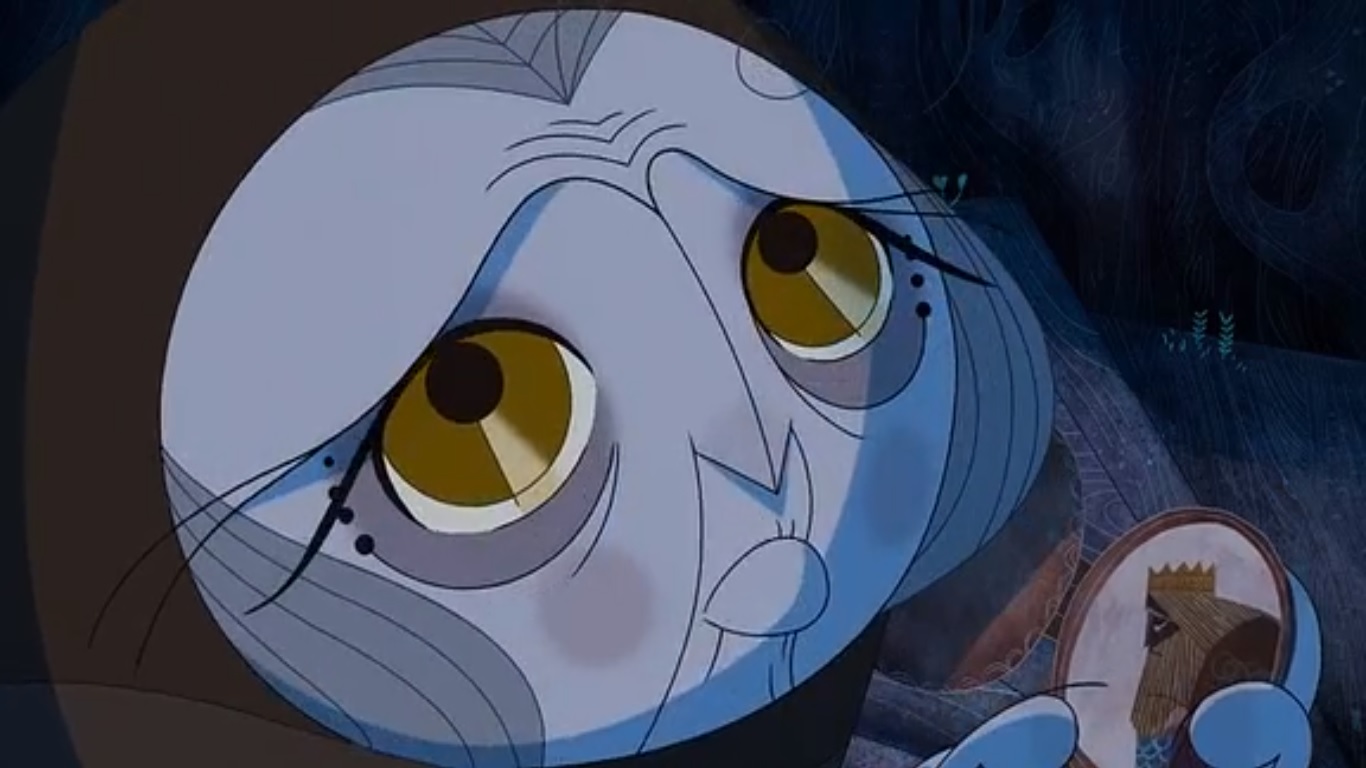
The only irredeemable villains in these films are destructive forces. Miyazaki presents war and pollution again and again in his films as true evils that must be resisted. Moore's Song of the Sea offers only time and the rules of magic as the heroes' greatest enemies. 

I find myself torn. Evil is real. Just look at the news. Kid readers understand this in a pure and simple way, often overlooking the nuance and splitting the world into good guys and bad guys. I think the longing to see justice for wrongdoing is innate. But as writers, I feel we owe it to children to represent the world as it truly is: seemingly evil people have complicated motives, and no one is completely irredeemable. Our choices have power and the possibility to choose good is always there. Some villains will never choose good--that's the power of free will too. 

Typically our heroes destroy the villain in a final showdown in which good prevails against all odds. The hero seems ill-equipped and powerless until that last moment when what is needed to overcome impending doom finally arrives, and they win. But what if instead the thing that arrives against the odds is that elusive magic--the kind we all wish we had--that gives the hero the exact key to unlock the villain's heart and return them to a path of love? Everyone wins. What if we told stories like that, and instilled the belief in children that maybe there's something inside them that can transform the world through love instead of violence? Through peacemaking instead of division. 

Maybe that's idealistic, but doesn't our world need those kind of heroes now more than ever? 

Monday, April 17, 2017

Villains: Rivals, Agents, and Enemies by Joanna Roddy


Antagonists come in many forms: natural disasters, well-meaning friends, or even unwitting coincidence. But I think the most fun to write are villains. 

Project Mayhem has posted some great material about villainy in the past, but I thought I'd revisit the subject with some ideas that have been helpful to me lately.

Many many types of villains have been identified before. But I've noticed lately that there are often three levels of villains that come up within the same novel, especially those with young protagonists. So let's break them down and look at their roles, functions, and pitfalls.


RIVALS:
What they are: Rivals are someone on the same level, or close to it, with the protagonist. They may only serve to drive the protagonist forward as a competitor who poses a true challenge, or they may become a bully who actively causes harm. Rivals are not typically the main threat. They are usually unrelated to the true villain of the story; however, they may be conscripted to become an agent of the greater enemy, or used as a pawn. They may also be somehow redeemed before the end, often as a result of their encounters with the protagonist. 

Examples: Draco Malfoy (Harry Potter), Josie Pie (Anne of Green Gables), Boromir (Fellowship of the Ring), Edmund (The Lion, the Witch, and the Wardrobe), Marion Hawthorne (Harriet the Spy)

Function: The Rival creates situations that test the protagonist, calling out and revealing their strengths, weaknesses, and true character. They also serve as a foil to the protagonist, so that readers become more invested in the main character through seeing their virtues in contrast to the Rival's character flaws. They are a training ground for the climactic confrontation with the greater enemy and create try/fail cycles to track the protagonist's progress. In reality-based fiction, the Rival may be the only intentional human antagonist. 

Pitfalls: Like all villains, Rivals need to have a good reason in their own minds for treating our protagonist the way they do. Just being a spoiled brat or the next best competition isn't enough for them to single out the protagonist. Get inside their head and figure out what pressures, insecurities, and prejudices make them the way that they are. Frenemies, former friends, or family members can make for a much more complex kind of Rival who has both love and hatred at play in how they relate to the protagonist.


AGENTS:
What they are: Agents are tools used by the true enemy to do their evil work. Often they are secret Agents, posing as allies but actually working against the protagonist. Sometimes they are overtly acting as a representative of a greater evil but are clearly motivated by lesser impulses and desires, which can allow for crueler and pettier torments for the protagonist. Sometimes they are corrupted or possessed by evil, or they may be a henchman. Often Agents are in positions of power or inherent trust, which lends to more surprising revelations and to abuses of that power, amplifying the largeness of the overall threat.

Examples: Wormtail/ Peter Pettigrew (Harry Potter), Barty Crouch Jr./ Mad-Eye Moody (Harry Potter), Professor Quirrel (Harry Potter), Luke (Percy Jackson: The Lightning Thief), Saruman (Lord of the Rings), Darth Vader (Star Wars)

Function: Agent villains allow for layers of complexity to the greatest source of antagonism in a novel. They create good plot twists when their motives and loyalties are revealed. They give the reader a sense of the pervasiveness of the evil and the immensity of what the protagonist has to overcome. Agents are often the more interesting villains because their ability to deceive about their true motives gives the reader both good and bad interpretations of their character, heightening the horror of what seemingly good people are capable of. 

Pitfalls: Again, this type of villain needs a strong personal reason for doing what they do. They may believe in the cause of the true enemy, or they may be acting under duress, but their willingness to be used as an Agent has to have that additional personal motivation based on past experiences, beliefs, and circumstances. It can be tricky to keep a secret Agent disguised from your reader while finding that balance of giving them believable flaws, a compelling motivation for what they're doing, and some well-hidden hints before the reveal. Likewise, a too-perfect Agent will automatically be suspect. 


THE ENEMY:
What it is: This is the mastermind, entity, Dark Lord, or true source of evil who will pose the greatest threat to the protagonist, which they must overcome. These are the more traditional villains. 

Examples: Sauron (Lord of the Rings), Voldy (Harry Potter), The White Witch (The Lion, the Witch, and the Wardrobe), The Emperor (Star Wars), Lex Luther (Superman), Kronos (Percy Jackson)

Function: The Enemy's main function is to pose the greatest threat and bring the protagonist to their ultimate limits as they try to overcome that threat. They personify everything the protagonist must reject, and good Enemies actually do make clear the allure of their perspective, or offer such horrific consequences that the reader would understand why the protagonist would capitulate.

Pitfalls: One pitfall here is having only the central Enemy. As you can see from the above, layers of challenges with lesser villains better prepares the protagonist, and in turn the reader, for the final confrontation with the true Enemy. If you do layer in this way, though, you shouldn't just plunk in the Enemy at the end. Threads of the Enemy should be woven throughout the story, and the challenges the protagonist faces should relate in some manner to the ultimate challenge in the climax. Another major pitfall is to make the Enemy one-dimensional. Remember that every villain is a hero in their own eyes--they are a distortion of what goodness and heroism should be, not necessarily the total opposite of it. Understand why they do what they do.

I hope you find this as helpful as I have! Please let us know in the comments if you've noticed this hierarchy before, or if you think there might be other things to add to the levels of villainy. Now go practice your evil laugh. 

Wednesday, March 26, 2014

Heroes & Villains #1: Four Villain Archetypes, by Matthew MacNish

Here at Project Middle Grade Mayhem, we're starting an informal series focused on Heroes & Villains in Middle Grade Literature. We'll be sharing some of our favorite examples, maybe some poor examples (and why they didn't work), and writing about and discussing heroes and villains, and why they are so important to story, whose most important aspect has always been character.

Today is the first post in the series.

Villains and Antagonists have long been interwoven in the annals of fiction, and while they're not always the same thing, sometimes they are, sometimes they aren't, sometimes it matters and sometimes it doesn't. Point is, they're awesome characters (or entities) and often play a pivotal role in that old muse-esque keystone: STORY.

Myth and tale and epic and adventure, what we really do, all of us, is tell stories. And what's the most important part of any story? Well, characters, obviously.

Carl Jung wrote a lot about archetypes in his studies of the human psyche, and of course the human psyche is tightly knotted up with the psychology of story, (and I covered some of his archetypes on my personal blog, reverse order search link). However, this post will be more about my own inventions, not based on any truly empirical study of the topic, but more on my own anecdotal experience as an avid reader.

And with that, here is an unofficial of the four most common (arche)types of villains I have found in (mostly) middle grade novels:
  • The False Villain (actually this one needs to come last, because it's the best)
  • The Sympathetic Humanized Antognist
  • The Beast
  • The Entity
So reversing that order, because it's becoming a theme at this point, let's get started with:

 THE ENTITY.

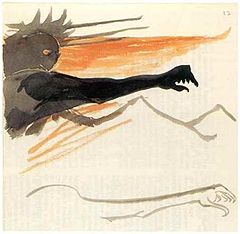
Tolkien's own Drawing of Sauron, creative commons license
Sauron does not technically come from a Middle Grade novel, and while there is some graphic violence portrayed in the film adapations, and the novels themselves are marketed as adult, I feel perfectly comfortable discussing The Lord of the Rings on PMGM, because I read it as a very young boy, and there is honestly nothing in the books that could outdo the imagination of a lad of ten (with the possible exception of Elves).

So, on to our (arche)type. Sauron has always represented to me a very universal example of evil, villainy, and antagonist-hood. He is the perfect non-character example of a villainous entity, because his presence permeates the books, even though he never really exists on page. I loved what he stood for as a boy, and I love it still, but now that I'm a professional writer, I'm begrudgingly willing to admit there is a certain weakness to this kind of villain.

For one thing, he's not a person. He's not even personified, beyond a minor (ahem) attempt at giving him an eye, but more importantly (and this somewhat more broadly applies to modern fiction than to its historical counterparts like Tolkien) he's never even given a chance to be sympathized with. This makes for far too simple reading in modern times (note that with some background research into Middle Earth, one discovers a bit more of Sauron's past and motivations, but one basically still hates him).

Next?

THE BEAST

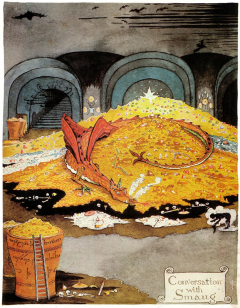
Tolkien's own Drawing of Smaug, also creative commons license
Not to spam this post with Tolkien examples (but I dare you to dare me to come up with one for all four of these archetypes), but I feel that Smaug makes a great example of a Beast type Villain/Antagonist. In an MFA literature sense, he doesn't make much of an antagonist, because he only shows up at the very end of the book, but in The Hobbit, I would argue he very much does make a great villain, because the threat of his presence permeates the entire narrative.

What makes him a Beast type? Well, technically Tolkien personified his most famous dragon in a lot of ways, giving him speech, giving him cunning, giving him even riddles, but Smaug never fully equates with the humanity of a human villain, because we never really sympathize with him to the level that we otherwise might.

Next?

THE SYMPATHETIC HUMANIZED ANTAGONIST

Ralph (pronounced Rafe) Fiennes (pronounced Fine) as Voldy, another common license image
Okay, I get it, you maybe (probably) balk at that description of Lord Voldemort, and I understand that, because Ms. Rowling did a brilliant job of making us earn our right to hate him, but she also sprinkled in a lot of right to forgive him for his wrongs, if you read the Harry Potter series as carefully as I did.

He's a monster, to be sure, or at least he becomes one during the historical parts of the Harry Potter backstory, but he's also a human being, or starts out as one (a twisted, warped individual example perhaps, but a human being nonetheless).

Lord Voldemort is probably not the best example of a humanized Major Villain/Head Antagonist in children's lit, but he may be one of literature's best known examples anyway. And even if he isn't the quintessential case, his servant most certainly is:

THE FALSE VILLAIN

Alan Rickman as Severus Snape
in Harry Potter and the Order of the Phoenix (common license)

SPOILER ALERT: Snape dies at the end. SPOILER ALERT: Professor Severus Snape is not the bad guy. END SPOILERS. He does, however, serve as a great false villain (and sometimes as a great true antagonists--see the difference?) throughout the Harry Potter novels.

I would probably even argue that Snape is the greatest false villain ever written. At least in children's literature (Gollum or Darth Vader might give him a run for his money otherwise). He's perfect because he's nasty, and smelly, and he has greasy hair, but he's even better because especially on a second read through, you discover just how clever and wonderful he is.

Snape is motivated by love (and also a little by hate) but even with his love lost, he still has the loyal dedication to Dumbledore, a man he clearly also loves and respects, and it is this loyalty that drives him to assist Harry when he must, as tedious and annoying as it is for him.

< . . . >

Anyway, that's my little list. Sorry my selections only come from two authors, but those were the best examples that came to mind. Feel free to share your own examples in the comments!