Showing posts with label writing tips. Show all posts

Thursday, January 19, 2017

A NEW YEAR...OF CHALLENGES


First, I want to thank Kell for her awesome advice in her 5 January post. She is a pro and it shows! I thought I'd chime in on a few things I've learned the hard way. 

The idea of New Years is daunting. It's fresh, unsullied, massive, and anything is possible. Unlike simply saying we will start tomorrow, the New Year is a big empty space. The first thing we want to do is make big promises to fill it. It’s the New Year, ready for us to tackle whole. Um…let’s take a step back. I know, for me, when I start making the mental stack of things that I want to do, the stack turns into a giant mountain that seems to represent the impossible. And a mountain of things IS impossible. But it is made up of individual things that are not. There are lessons to be learned from mountains. Here are three things to remember as you head into your new year promises:

1.     THE DEADLINE: LET IT BE YOUR FRIEND
Ah, deadlines. The bane of existence for many. For me, I take them as a welcome gift. I can appreciate them as a guide towards accomplishment. Instead of seeing deadlines as looming, consider them as something to beat. As a once-editor, I have a deep-seated fear of tardiness. Having to edit and place late articles is a miserable task. There is always the question- will the writer/photographer/reviewer/artist come through? As an author, I find that I tend to beat the deadlines given to me by my publishers. This year was tricky. I have had two manuscripts due to two different publishers, both books coming out this year. Straddling deadlines is a challenge, but I quickly realized that one of the demands, a book with a co-author, was simply unrealistic. Normally, there is about 18 months from manuscript to release. This book was a quick query and contract thing and is slated for release in December, 2017. This means very little time to write. The timing was terrible. I was grading and finishing final edits on the third Young Inventors Guild book. My co-author, Salima Ikram, Egyptologist extraordinaire, needed to spend most of the fall semester on digs and at Yale and traveling to amazing places. No way were we getting the text, let alone the artwork in by October. In addition, we are working with Steve Parke (the artist who did the covers of all three YIG books) who had his book on Prince (he was Prince’s art director for many years) released over this Christmas holiday. I took a deep breath and told my publisher that we could not do it. We’d need more time. Salima, from the caves of somewhere, concurred. Holding my breath, a let out a sigh of relief when they said they’d give us until March. Hurray! There was no reprieve for the YIG3 manuscript so I enlisted my daughter as reader/editor/moral support and we read through the manuscript together and turned it in. This was intense and emotional (both because it is the third in a trilogy and I had to cut out 250 pages I originally thought were important but now see that the team at Bancroft was right and the book will be better for it) but we got it done. The ARC is out. The book shall come.

In addition to books being prepped for publishing, I have a book series I really, really want to write. I know a publisher interested, but I am trying to be smart and not make promises that will kill me. That said, keeping in mind that a deadline can be my friend, I have built into my schedule a deadline. I will not even look at the manuscript (I am chomping at the bit to write) until after March. Then, I will give myself a deadline. I know I will work better, and more often, if I have a goal.

So lesson here:

-       Be realistic. Deadlines can sometimes be adjusted. Don’t be afraid to ask for more time. Be prepared to be denied or for a possible change in release date, but there is no harm in asking your editor if it is possible.
-       Be ready. If a deadline cannot be adjusted, do not feel the looming, but feel the goal.
-       Be committed. If you do not yet have a publisher and you have a book you want to write, give yourself a realistic deadline and honor it. This will get that collection of ideas into a manuscript.

2.     THE DETERMINATION: MOUNTAIN CLIMBING IS NOT THE ANALOGY
If you have made a list of the seventeen books you want to write and now feel paralyzed, take a step back from that mountain. I know this feeling. It is miserable. If you feel there are so many things you want to do but cannot ever finish them all, don’t. Once again, take things into smaller bits you can swallow.

So, the lesson here is:

-       Make a list. Look at all of your project ideas and make a list. Once you have these down, by title/working title or idea, each one is a separate thing.
-       Make an order. This is a way to prioritize you work. Do not feel bound by what is already partially written or in order of when you started, make the order of what you are most excited to write and start there.
-       Make time. Once you know where you want to start, give yourself some time to work. Maybe consider a deadline. It works for me.

3.     THE DRAFT: FOR YOUR EYES ONLY?
Once you begin writing, decide who you are writing for. I do not believe we can create books in a vacuum. Books are for readers and you will need readers either to read a draft or to read as you work. For me, I read my work aloud to my sleeping husband, beg my children to look at chapters, ask friends to read ARCs, and I feel this gives life to what I write. Do not be afraid to have people make comments counter to what you think is what you want. Sometimes, it makes you all the more determined to stick with the plan. Sometimes it gives you ideas for a better plan.

So the lesson here is:
-       Draft it. As you write, mistakes happen. Changes will happen. Edits and alterations and your direction may shift. Do not be concerned with making the first draft perfect. Just get it down on paper or onto the virtual page.
-       Don’t be afraid. Now that you can look at the one idea, play with it. Enjoy writing bits of it as it slowly (or quickly) turns into your manuscript.
-       Do it! You will be surprised how much pleasure you will get out of writing if it doesn’t feel like part of an insurmountable task. It is not a task. It is writing.

HAPPY NEW YEAR!!!!!!!!!!!!!!!!!!!
-Eden


Monday, April 27, 2015

Thoughts on Scrivener, by: Marissa Burt


Photo Credit: Barry Gregg 2011
I am knee deep in revisions on my yet-to-be-titled fourth book, the sequel to A SLIVER OF STARDUST, The writing process for each manuscript has been very different. For my first novel, STORYBOUND, I wrote snippets on the odd afternoons I had to myself, patching together a myriad of scenes to make the final book. The drafting of my second novel, STORY'S END, is a bit of a blur. My husband and I had just moved across the country to a two bedroom apartment with a four-year-old, one-year-old, and a newborn in tow. What comes to mind is frenetic sleep-deprived writing marathons fueled by coffee in the corner booth of the Panera near our apartment. Out of all my books, STORY'S END is probably my favorite, not least because I remember the writing of it so foggily that it's like reading someone else's work.

I drafted my third novel, A SLIVER OF STARDUST,in small chunks of writing time, 30-45 minutes a day, but, having learned from the endless rounds of revision STORYBOUND needed, I did work from a general outline. I wanted to try a different approach with this latest book. I wasn't ready to work from a heavily detailed outline, but I did want an alternative to my cluttered stacks of Post-its and spiral bound notebooks full of scribblings. So I turned to Scrivener.

And then as soon as I watched the tutorial I turned off my computer and quit for the day. Seriously. The tutorial is daunting and makes it seem as though writing a novel with pen and ink would be easier. But, having already invested my $40, I forged ahead, and I'm so glad I did. I am quite certain I don't use even a third of all the features (that would mean revisiting the tutorial - gasp!), but the ones I do use I've found to be a great help and want to highlight them here:

The visual layout. I love that the screen is customizable and includes the Binder View which I use to organize scenes within chapters.


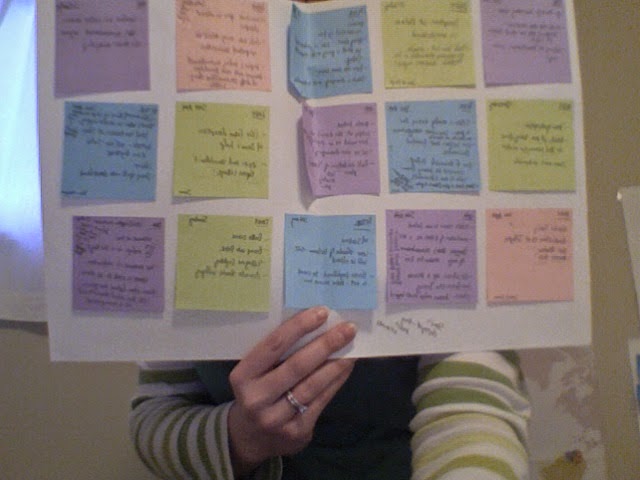
The corkboard feature that allowed me to stay with the general Post-it outline that's worked well for me in the past and yet include much more detail.


The way I can import content from the internet that I want to reference while worldbuilding.


The templates for setting and character development were very helpful in the early stages of drafting. As my story got going, I used these features less, but they helped with unwelcome writer's block.


The project targets window that allowed me to see my total word count creep up and my session word count go down.


Editing within the project was very streamlined. Because of the outline structure, it was easy to move whole scenes around without worrying about losing text or having to skim through an entire document to find the scenes.

At the end of drafting, I compiled and exported my manuscript to MS Word to do a final read through there. While the process itself was streamlined, there were a few odd formatting things that ultimately needed attention. I'm guessing that if I revisited the tutorial I could remedy this, but I think I'll save that for the next book. Because, yes, I liked Scrivener enough to use it again. In my opinion, it's well worth it.

What about you, fellow writers? Any Scrivener users with tips to share?

Wednesday, March 18, 2015

Finding the Perfect Name, by: Marissa Burt

Naming characters is one of my favorite things about the writing process. Sometimes characters pop into my head with a fully formed name. Other times, it takes some time to get to know them first. I am drawn to unusual names, old-fashioned sounding names, or names with specific meanings. Often, names that were on my potential-baby-names list while pregnant make it into my books. :)

Today I wanted to share my favorite go-to name sites. First, The Baby Name Wizard. This is full of a wealth of information: suggestions of what names pair well together, popular meanings of names, and my favorite, the Name Voyager, which graphs the popularity of names over time.


The Social Security Website also has popular name lists by year, so you can see if a name you've chosen would fit in well with your story.


The public library is also a good source for naming resources. They have fat stacks of topical baby-name books, so you can find names with mythological roots, for instance. 

What about you, fellow Mayhemers? How do you find the perfect name for your characters? Any go-to resources to share? 

Wednesday, January 21, 2015

Feeling Stuck Creatively? by: Marissa Burt

Chapa Traffic Jam in Maputa, by A Verdade
licensed for re-use at Creative Wikimedia commons
For me, the term writer's block is a synonym for perfectionism. I feel blocked when I'm waiting for the perfect thing: whether it's the perfect plot-point, a perfectly well-rounded character, or even the perfect writing environment (Hello, Person-in-the-comfy-chair-at-Starbucks: you are in my spot!)

I've learned to not freak out when I'm feeling stuck, and instead remind myself that every step, however small, is a step forward for my writing. So here are my favorite things to do when I'm feeling stuck:

1. Breathe in the story. I often do this when I'm brainstorming a new project. I will immerse myself in the story world. Sometimes that means checking out all the steampunk movies I can find from the library. Or cooking my character's favorite food. Or attending an event my character would be interested in. For my current work-in-progress, I've been channelling my inner Disney Channel and spent a whole afternoon re-watching THE PRINCESS DIARIES 1&2. I don't approach these activities looking for something specific to put in my story - I mainly want to be inspired by the atmosphere of my story.

2. Play with the setting. I like to re-visit kindergarten days and pull out old magazines, scissors, and paste to make collages. But nowadays, there's Pinterest, and it's super easy to accomplish this same goal by pinning images that inspire my setting.

3. Interview the characters. There are hundreds of templates online for character interviews. I always drag my feet on this one, because it seems so silly, but then when I actually do it: it's amazing! My characters go from flat and frenetic to motivated, well-rounded individuals.

4. Rework a specific scene. If the plot is stale or forced, I'll try re-writing the scene from a different angle, attempting a different character's point of view or 1st person instead of 3rd. I think like an actor that never performs a scene the same way twice and change setting or time of day or supporting characters to see where that takes the story. I'll ask What If? and Why? questions and recall Peter Jackson's advice in the special features on THE LORD OF THE RINGS DVDs (Yes, I've watched all however-many-hours-of-them. Twice). Is this scene moving the story forward? If not, it gets cut.

Beautiful. Isn't it?
5. Raise the stakes. I imagine the worst possible outcome would be for my main character at the moment, and then write that scene. Poor characters. I'm sorry. Here. You can have the cushy Starbucks chair.

6. Write or Die. Besides being an awesome bumper-sticker phrase, this is my go-to website on the days when I loathe my story and think every plot-point is boring, every character stale and carboard-y. I feel like no one will ever want to read my writing - I don't even want to read it. Then I click over to Write or Die (the freebie trial version is awesome), and let pressure do its thing. Some of my most unexpected plot twists have come from Dr. Wicked's Writing Lab.
http://writeordie.com/
And all these things may not add to my word count, but they do move my story forward. They are the  work of writing. So get rid of the perfectionism, and aim for perseverance instead. Every step, however small, is a step forward on your writing journey.

How about you, Mayhemers? What are your favorite go-to tips for getting un-stuck?

Thursday, September 25, 2014

This Is Why You Should Always Carry a Notebook


A common writer’s tip is to carry a notebook and pen at all times so when inspiration strikes you’ll be ready, and that perfect word, sentence, paragraph, or page won’t escape forever if it falls through the cracks in your memory, failing to reappear once you’ve hunkered down to write in earnest.

It’s a good tip, one I’ve meant to follow for a number of years now but somehow never managed to put into practice. I usually have a pen on me (blue ballpoint—for some reason, I’ve always hated writing with black ink), but a little notebook has never made its way into my purse. Perhaps it stems from an unconscious desire not to add yet another item to my already cluttered handbag. Or since I HATE writing by hand (anyone who’s ever seen my handwriting can probably guess why), perhaps I’ve unknowingly developed an aversion to notebooks over the years.

Whatever the reason, my failure to tuck even the tiniest matchbook-sized pad of paper onto my person has led me to utilize some pretty odd writing surfaces when something pops into my head that I just have to scribble down. Over the years, I’ve resorted to writing on:

  • The sides and bottoms of the cardboard tissue box I keep in the car
  • The blank pages in the backs of old paperbacks (which I then have to rip out before passing the book along to a friend or donating it to the local library sale)
  • The labels of water bottles (the back of the label is blank for many brands, so if you rip it off the bottle, this makes a decent, if somewhat small, writing surface)
  • The insides of gum wrappers
  • The blank side of old receipts I’ve tossed into my purse (it’s amazing how many of these are for Chinese take-out)
  • The blank side of old movie or concert tickets (why do I even still have these?!)
  • The price tags ripped off clothing purchases
  • Post-it notes stolen off any nearby desk (usually I’ll write on both the front and back of these, and I need about five to ten of them if I’m writing anything substantial, and then I have to try to keep them in order)
  • Paper napkins
  • Paper cups
  • Paper plates
  • The margins of take-out menus (I think we’ve established I eat a lot of take-out)
  • The labels of vitamin bottles

Yeah, it would be a lot easier just to get a notebook. And maybe clean my purse.

Lol, am I the only one who writes on strange items? Do you carry a notebook or, like me, do you have to get creative when it comes to spontaneous writing surfaces?

photo credit: benleto via photopin cc