Wednesday, August 12, 2015
Would Harriet The Spy Fly Today? by Michael Gettel-Gilmartin
The other day, on a road trip with my wife and without our kids, my wife groped in our book bag and pulled out her old copy of Harriet The Spy. "Oh," she exclaimed. "I used to love that book."
"Um," I replied, wondering whether to confess. "I don't think I've ever read it..."
Of course, it was soon decided that my wife would read it aloud to me--a real-live audio book!
It was, I admit, quite humorous in places because, well, Harriet is quite the character. But I did find several things discomfiting about the novel (which was published in 1964) from a modern standpoint.
For one, Harriet is very mean. She often refers to other people as 'fat.' Even when her notebook is discovered by the other children, and all the mean things she has written about them come out into the open, she feels herself wronged, and decides to get revenge. In her revenge list, she writes things like
"Laura Peters: Her hair. Cut it off. Or make a bald spot.... Janie: Break her little finger... Sport: call him a sissy and tell everyone he reads cook books..."
Maybe I'm just being too sensitive, but I do wonder if a novel like Harriet the Spy would be published today.
Have you ever reread a classic, or a favorite story from your youth, and seen it with new eyes? If so, leave a comment about the experience.
Monday, August 10, 2015
In Praise of Prickles by Kell Andrews
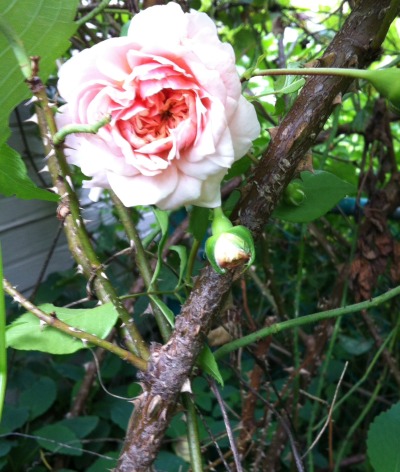
| Not every thorn has its rose. |
I'm reading her Dalemark Quartet for the first time, and it strikes me again how prickly her characters are. From The Spellcoats (Book Three):
Robin wrung her hands. ... It annoys me when she does.The narrator Tanaqui is not nice. She isn't patient or kind. She sulks when she doesn't get her way, she teases her brother and snaps at her sister, and she turns out to be a hero in the end. Even then, she's still not nice.
"We can go away down the River and find somewhere better to live," I said. It was the most exciting thing I had ever said. I had always wanted to see the River. ...
"But the Heathens!" Robin said, wringing away. I could have hit her.
In Jones's most popular novel, Howl's Moving Castle, Howl is vain, lazy, and not very brave, but it's Sophie who we root for as she becomes less nice. Disguised as an old woman, she discovers her inner curmudgeon -- commandeering and no-nonsense, where once she was timid and compliant. She gains an edge. This is character growth in the world of Diana Wynne Jones, and that's why I love it.
Middle-grade characters are often so nice. They do the right thing. They even feel the right thing. They have flaws, but their flaws are the kind of answers they could give to a potential employer who asked them their biggest weakness in a job interview.
"I'm too much of a perfectionist."We have a higher expectation of morality from children. Everyone must play together, everyone is invited, everyone should be nice. This higher expectation is doubled for child characters -- there is a lot of "should" in children's literature, and readers like it too, and not just parents. When I was a kid, I adored perfect princess Sara Crewe but couldn't warm to sickly, fretful Mistress Mary Quite Contrary. And I still love a transcendentally good character -- Auggie Pullman in Wonder, Felicity Pickle in A Snicker of Magic.
"I care too much about how others think and feel."
"I have many unique qualities and quirks that are not always appreciated."
"Other people are intimidated by my intelligence and competence, as well as my world-saving magical gifts."
Readers want to spend time with likeable characters. They want to see themselves in characters they wish they were -- mirrors and windows, yes, but mirrors that show a particularly flattering reflection or a windows that let in the most attractive light. Who wouldn't rather be Harry Potter rather than jealous, dim Ron or know-it-all Hermione? Ron and Hermione have prickles. Harry is nice, as well as being the Boy Who Lived, Hogwarts Champion, the Griffindor Seeker, and all-around BMOC. Maybe that's why Rowling's Harry Potter is more popular than Jones's Christopher Chant.
Children's literature past and present has its share of Pollyannas, including the title character from Eleanor H. Porter's novel whose is synonymous with unshakeable optimism and goodness. Maybe that's why middle-grade characters with prickles stand out, and why I like them so much. Even when you're saving civilization, your little brother might still get on your nerves. Probably especially then.
Who are some of your favorite prickly characters?
Thursday, August 6, 2015
Magic Realism or Fantasy? What's the Difference? by Joy McCullough-Carranza
In a recent blog
post describing what sort of manuscripts I’d like to work with as a mentor in
the Pitchwars contest, I specified that I’d like magic realism, but not
fantasy. Immediately I began to get questions. What’s the difference? Why had I
said I didn’t want fantasy, but then listed Flora
& Ulysses as one of my favorite books? Isn’t that fantasy? After all,
squirrels that write poetry on typewriters are pretty fantastical.
But I'd call Flora & Ulysses magic realism.
So I thought I’d
unpack the difference between fantasy and magic realism, as I see it anyway.
These terms are fluid, and perhaps it all falls on a spectrum, with completely
realistic novels on one side and completely fantastical novels on the other.
But I think it’s useful to understand the distinction for a couple reasons. For
one thing, it’s not uncommon for agents or editors to say they’re looking for
one or the other in their submissions. Agents are extremely unlikely to reject a
query because the author has miscategorized their manuscript, and publishers
will figure out how to market a book. But on the other hand, a query shines
more brightly when the author clearly understands where they fall in the
market.
Also, there can be a cultural misunderstanding around the term magic realism. A blog post at Tor.com recounts a well-known author at a convention who referred to “Magic realism—which we all know is just fantasy written by a Latin American author!”
It’s true that some of the most
famous magic realism has come from Latin America. But not all Latin American
fiction with magic is magic realism, and not all magic realism is based in
Latin American cultures. To assume either is culturally ignorant.
So what is magic realism? For one
thing, it’s firmly grounded in the real world, and deals with real people
grappling with real world conflicts. The elements of magic are employed (with a
light hand) to illuminate those characters and their real world struggles. The
magical elements in magic realism do not tend to have rules and systems around
how they occur. And they’re usually presented side by side with the realistic
elements, as though the magic is completely ordinary (which, in turn, can
elevate the ordinary to magical). I love magic realism in MG because I think
this is how so many kids live day to day (before their imaginations get squashed, anyway) – magic is
ordinary, and the ordinary can be magical.
Fantasy is a really broad category,
encompassing a huge array of sub-genres.
We can probably agree that anything that takes place in a completely
imagined world populated by fantastical creatures or talking animals or witches
and wizards is fantasy. It gets trickier to draw the line when we consider
books that are set firmly in this world, but contain magic or supernatural
elements. These are often called contemporary fantasies or urban fantasies.
So let’s consider a few different
books and decide where they fall. (Feel free to argue in the comments if you
think I’m off-base. There aren’t hard rules in all this.)
STORYBOUND
by Marissa Burt – A girl in our world opens a magical book and ends up in a
completely different world, where she attends a school for fairytale
characters. Other elements of note: talking animals, very systematic magic,
instructed in a special school. VERDICT: FANTASY
THE EIGHTH DAY
by Dianne Salerni – A boy in a world that seems very much like our own discovers
he is a rare sort of person who lives in an eight day week, and that some
people 
CENTAUR RISING by Jane Yolen - Set firmly in the real world in the 1960’s, a farm girl’s horse gives birth to a baby centaur. While the focus of the story is on real world people with real world problems, the presence of the mythological creature, together with the fact that that creature is regarded as extraordinary, all say fantasy to me. VERDICT: FANTASY
THE CABINET OF EARTHS
by Anne Nesbet - When I asked Project Mayhem contributors if any of them had
written magic realism, Anne Nesbet mentioned that a number of reviewers had
called The Cabinet of Earths magic realism. I haven’t read it yet, and would
be curious to hear what some who have read it think. In magic realism, the
magical is treated as ordinary, and in this book, it sounds like the magic
cabinet is seen as quite extraordinary. So I’d lean fantasy, but couldn't say for sure without reading. VERDICT: STILL OUT
DEADWOOD by Kell
Andrews - A story firmly grounded in the real world, in which a spirit tree (so
named not for mystical reasons, but because messages of school spirit are
carved into the trunk) uses text messages to communicate with kids about lifting
a curse on their town. I’m looking forward to reading this. It sounds like it
could be contemporary fantasy or magic realism, depending on how extraordinary the
tree seems to the characters it interacts with. VERDICT: STILL OUT
WHEN THE BUTTERFLIES CAME by Kimberly Griffiths Little – Tara is struggling with her mom’s depression and the death of her grandma when butterflies start to follow her. (Right away, this is a nod to the butterflies that follow a character in the magic realism classic One Hundred Years of Solitude.) The butterflies are there, propelling Tara forward and illuminating her journey, but the focus always stays on Tara’s real world stakes and goals. VERDICT: MAGIC REALISM
To be clear, I don’t believe
writers should let genre distinctions color what they’re writing in any way. Tell the
story that needs telling in the strongest possible way. And if you write something that defies categories, that's awesome! But in the interest of
understanding where your work fits in the market, and targeting the best
possible people to help you get it read, it could be helpful to know whether
you’re writing fantasy or magical realism.
Do you define magic realism in another way? Do you think I've miscategorized one of the books above? What are some MG titles you consider magic realism?
Wednesday, August 5, 2015
Sketch Your Journey by Robert Lettrick
Every book is an exploratory journey. An author
will bushwack the path and readers will follow, hopefully enjoying the
scenery, characters and even the pitfalls they encounter along the way. For both the writer and the reader, a book is very
much a cerebral trip, but to paraphrase Albus Dumbledore, just because it’s happening
inside your head that doesn’t mean it’s not real.
When I travel to new places, I like to bring along a blank notebook. It's a great way to capture not just what I see, but also what I feel. The emotional connections that make the trip worthwhile. Why should the journey of writing a book be any different?
Many famous children’s
book authors found that sketching and scribbling helped them conceptualize and flesh out the
worlds they were creating. For instance:
JK Rowling
Beatrix Potter
Lewis Carroll
Sketching and jotting down ideas in notebooks can provide you with a deeper understanding of your characters and the worlds they inhabit. It can provide you with a blueprint to return to during the editing process, or inspiration should you decide to write a sequel. And you don't have to be a great artist because this can be for you and you alone. But if you like what you see, why not share sections with your followers via social media to enrich their reading experience?
Sure, there are technological alternatives to a physical notebook, such as Word and Scrivner, but as an exercise, try taking pencil to paper to capture your journey in a more artistic, personal way. You may just love the result.
Monday, August 3, 2015
Evolution of a Writing Process by Donna Galanti
![]() |
| My writing resource bookshelf |
I wrote my first book organically five years ago (which remains
hidden in a shoebox). I got up Monday through Friday and free-wrote from 4:30am
to 6:30am and in seven months I had that first novel.
My second book: written organically in the wee early morning hours but with a
basic story idea.
My third book: written with a detailed outline, character worksheets, professionally edited.
My fourth book: written with a detailed outline, character worksheets, story bible, and went through several editing, agent, and beta reader passes.
My fifth (and last book): written under a contract with a 10-page outline, extensive character worksheets, story bible, character arc/series arc outline, went through in-depth revision process with developmental and copy editors.
My third book: written with a detailed outline, character worksheets, professionally edited.
My fourth book: written with a detailed outline, character worksheets, story bible, and went through several editing, agent, and beta reader passes.
My fifth (and last book): written under a contract with a 10-page outline, extensive character worksheets, story bible, character arc/series arc outline, went through in-depth revision process with developmental and copy editors.
Pheww…that all sounds exhausting when I read it.
![]() |
| My notes from one book |
I dreamed of flinging away the processes and getting back to
writing organically with my sixth book like I had when I wrote my first book. I romantically imagined myself in the dark morning hours all alone facing
white pages. Tubs of coffee. Notepads and slippers and unbridled words. I would
wander and discover. I would let my muse drive me (in the tradition of
Shakespeare in Love). I would escape into the fiction dream and live on words
alone!
And it was glorious. I rose like a Phoenix in the golden
sky. I gave new life to old wings.
Then I crashed and burned.
My story fell apart. Wonderful and fantastical events and
creatures came to life….that had nothing to do with the story of the main
character’s transformation. Too much was happening. Too many people had
secrets. Too many characters had no purpose. Too many events had no meaning.
Wait a minute…what was this story about??
I had lost it. And I realized why.
Because I had evolved and I couldn’t go back. Like first kisses.
First dates. A firstborn child. You can never go back and experience it the
same way ever again. You know what happens and how it works. You can’t un-know
it. And with this, came the knowledge that I am not a write-by-the-seat-of-my-pants gal. I need structure and organization and a path to THE END.
At first I was sad but then I realized if I hadn’t evolved my writing wouldn’t have either. I wouldn’t have strengthened my craft and knowledge about how to write a good story.
I couldn’t de-evolve. So I decided to embrace my evolution.
![]() |
| Yeah. It's like that. All at once. |
I looked back at my last novel and realized something. When
I submitted that novel to my publisher within a six month time frame, I knew it
was the tightest and most polished draft I had ever written. I’d brought all
that I had learned over the past few years in one massive punch. I’d fully accessed
my writer’s toolbox – a box now full to the brim with knowledge I’ve gained
from editors, deconstructing books, classes, conferences, and my own application.
And I suddenly knew that I had not written this book alone – many people
contributed to my success of it.
And along this evolutionary path I discovered the writing
process that works for me in this order:
1. Create a detailed story outline that is solid and ties in the main character arc across the plot points.
2. Write a pitch paragraph that includes the premise of the story. What is this story about?
3. Create character worksheets and journal in each character’s voice.
4. Do what world building I can (the rest will be found along the way). Draw a map. Create a story bible of setting, creatures, magical elements, history, etc.
5. At the beginning of each chapter create a guide to keep me on track which includes this information:
*Main character’s goals of each chapter/scene
*What main character’s discovers in each scene and how it propels him forward
*What we can learn about other characters in each scene
*What we can learn through dialogue about other characters
*World building goals in each scene
*Outer turning point: in each scene which things change that everyone can understand
*Inner turning point: in each scene which the scene’s point of view character also changes as a result.
1. Create a detailed story outline that is solid and ties in the main character arc across the plot points.
2. Write a pitch paragraph that includes the premise of the story. What is this story about?
3. Create character worksheets and journal in each character’s voice.
4. Do what world building I can (the rest will be found along the way). Draw a map. Create a story bible of setting, creatures, magical elements, history, etc.
5. At the beginning of each chapter create a guide to keep me on track which includes this information:
*Main character’s goals of each chapter/scene
*What main character’s discovers in each scene and how it propels him forward
*What we can learn about other characters in each scene
*What we can learn through dialogue about other characters
*World building goals in each scene
*Outer turning point: in each scene which things change that everyone can understand
*Inner turning point: in each scene which the scene’s point of view character also changes as a result.
6. At the end of each chapter write a one-line sentence
about it so when the book is complete I will have a strong synopsis (and that’s
good for back cover copy too).
7. Create a revision guide and add in specific things to check for when the first draft is done related to:
*Narrative flow
*Backstory (where and when to have)
*Repetition (with words and scenes)
*Setting consistency
*Pacing and tension
*Plot holes
*Timeline of events
*Character development relating to consistency with speech.
*Character reactions. Ask: How would each character react in each moment?
8. In writing, allow for discovery but check that it ties into the MC’s character arc and story premise.
7. Create a revision guide and add in specific things to check for when the first draft is done related to:
*Narrative flow
*Backstory (where and when to have)
*Repetition (with words and scenes)
*Setting consistency
*Pacing and tension
*Plot holes
*Timeline of events
*Character development relating to consistency with speech.
*Character reactions. Ask: How would each character react in each moment?
8. In writing, allow for discovery but check that it ties into the MC’s character arc and story premise.
This process may not be organic but it did allow for organic
discovery within the parameters of the
story. With my most recent book I wrote on a tight deadline, I had new characters show up and old
characters leave. I combined characters. I changed how information was found.
But all the magic that burst on the page was aligned with the plot points and
connected to the growth of the main character.
And I learned that what I so longed for again no longer
worked for me. And the myth of the angst-filled, free-flowing, genius writer
hanging his hat alone in his cave is just that – a myth. We can write alone but
we can’t get published alone. And I’m glad.
I wonder what kind of writer I will evolve into next?
How have you evolved in your writing process?
Pens up. **Chink**
Subscribe to:
Posts (Atom)
_cover.jpg)