Showing posts with label books about writing. Show all posts

Monday, December 12, 2016

Morning Pages One Year In by Caroline Starr Rose


Last December a friend whose life circumstances had kept her from writing for quite some time mentioned she'd started Morning Pages. She was almost 100 days in, and for the first time in years had found she was looking forward to returning to the page.

For those of you unfamiliar with the practice, Morning Pages is a discipline developed by Julia Cameron, author of the classic how-to on creative recovery, The Artist's Way. I've had a copy of the book for almost ten years, but have never read past the first few chapters. Listening to my friend talk about moving toward her work with new joy and expectation, I thought about trying The Artist's Way again. Maybe I could use regular journaling as a discipline in my own writing life.

The book is meant to be read as a self-led course, one chapter a week. Participants commit to two things: the Artist Date, a weekly experience meant to fill the creative well (what Cameron describes as "assigned play"), and the Morning Pages, a three-page handwritten daily exercise meant to reconnect the artist with creativity.

It's been almost a year since that conversation and my decision to give Morning Pages a try. While I haven't always been consistent with my weekly reading (and even less so with the Artist Date), I have loved my own version of Morning Pages.* The practice has become a key part of my morning.

There are no rules about the writing. Because of this I've been free to use the exercise in any way I like. Sometimes I simply type out everything I'm thinking. The Morning Pages then become a place for me to process and set aside the thoughts I might not have known were bothering me. I also write about the things I want to accomplish or need to remember, an impromptu daily list of sorts. Other times I use the writing to prime the pump for my work later in the day. I've used it to brainstorm the last few lines in a picture book and as a place to figure out a revision plan of attack. This blog post, which has become the most popular ever in six plus years of blogging on my personal blog, started in one of those ten-minute sessions. Some mornings I write as I might in a traditional journal. And when I'm truly stuck, I keep my virtual pencil moving by typing one of Julia's affirmations: I am competent and confident in my creative work (yes, this is a little corny, but it's a good thing to "hear" myself say!).

Do any of you write Morning Pages? I'd love if you'd share your thoughts in the comments below.


* Ten minutes of typing on weekdays

Wednesday, September 3, 2014

Constructing a Comic Character


Humorous writing comes naturally to some, while for others even the idea of “writing funny” causes stress. Humor, like any other literary technique, can be an acquired skill when a thorough understanding of the rules and tools available are understood.

The most basic building block of humor is that of the comic premise. In The Comic Toolbox, John Vorhaus states: “The comic premise is the gap between comic reality and real reality. Any time you have a comic voice or character or world or attitude that looks at things from a skewed point of view, you have a gap between realities. Comedy lives in the gap.”

In his 2012 novel, The Hero’s Guide to Saving Your Kingdom, Christopher Healy sets his comic premise within an epic fantasy world populated by the princesses and princes from traditional fairy tales, with an enormous twist that is very accessible to young readers coming of age post-Shrek. Every convention and expectation of the known characters are turned on their heads.

Healy’s story features the princess heroines Snow White, Sleeping Beauty, Cinderella, and Rapunzel. In the traditional telling, each heroine is rescued and falls in love with the handsome, but non-descript, Prince Charming. In Healy’s world, there are four separate Princes that have been lumped together under the generic title Prince Charming by bards that have spread the stories, and each Prince wants his own name recognition. That’s the foundation of the comic premise. The reader is immediately presented with the gap between the expectation that Prince Charming is one perfect, heroic, and handsome man, and the reality of the story, where four Princes are flawed individuals quite removed from the handsome heroic ideal.

The comic premise is given even greater depth by crafting the princesses with personalities and characteristics far different than the traditional. Pushing it further still is the comedic tension created by the oppositional characteristics between each pairing.

For example, Cinderella, having been raised in near captivity by her step-mother, is a young woman who desires action and adventure now that she is a princess. Her Prince Charming, Frederic, is an endearing, but cowardly, fop brought up under fierce protection by a doting father. He has no interest in adventure, but loves Cinderella with true devotion. When Cinderella leaves to seek adventure in the wilds on her own, Frederic, worried for her safety, musters the courage to follow her. Ultimately, Cinderella ends up saving him (and the other Princes Charming), once again reinforcing the gap between comic reality and real reality.

What keeps comic characters interesting, and moves them beyond one-note jokes, is the layering of other elements over the premise to give them depth. Vorhaus provides four specific elements that go into the construction of a comic character.

The first is the Comic Perspective, defined by Vorhaus as, “a character’s unique way of looking at the world, which differs in a clear and substantial way from the ‘normal’ world view.” If we continue looking at Prince Frederic, his Comic Perspective would be that the world is a dangerous place, best avoided at all costs. In contrast, Cinderella’s is that the world is a wonderful place where anything can happen.

The second element is exaggeration. A character that is afraid of the world isn’t in and of himself very funny, but if a writer pushes the limits of that fear so that normal situations become farcical, a space for comedy is created. This description of Frederic from The Hero’s Guide is a fine example of comic exaggeration: “For most of his early years, Frederic was perfectly happy to skip out on pastimes like tree climbing (twisted ankles!), hiking (poison ivy!), or embroidery (pointy needles!).”

Flaws are the third element. These are negative characteristics that create distance between the reader and character, allowing the reader to comfortably laugh at the character without feeling bad. Flaws can also be positive characteristics taken to an annoying extreme. Frederic’s flaws fall into the latter category, as his worst trait is an almost unbearable friendliness and openness to strangers. This might seem to be in opposition to his view of the world as a dangerous place, but again, this creates an interesting conflict within the character. Even when faced with villains, monsters,  and impending doom, Frederic can’t help but be polite. Charming, even.

The final element is Humanity. The character’s humanity gives the reader a reason to care about his outcome. It balances the flaws to enable readers to emotionally engage with the character. Frederic’s humanity is grounded in his romantic love of Cinderella, and the lengths he goes to try and find her. He travels the world, faces battles, giants, and witches and gets so far outside of his comfort zone that readers can’t help but feel for the poor guy, even as they laugh at his total lack of traditional heroic qualities.

Healy does an excellent job of creating complex comic characters, and Frederic is just one example within that story. The characters, both Princes and Princesses, because they are drawn with such specificity, play off of each other in a web of well choreographed, and highly comical, relationships. In the end, Frederic may come the closest to laying claim to the name Prince Charming, but by embracing his entire character he earns a recognition all his own. And gives the reader plenty of laughs while doing so.

Tuesday, February 11, 2014

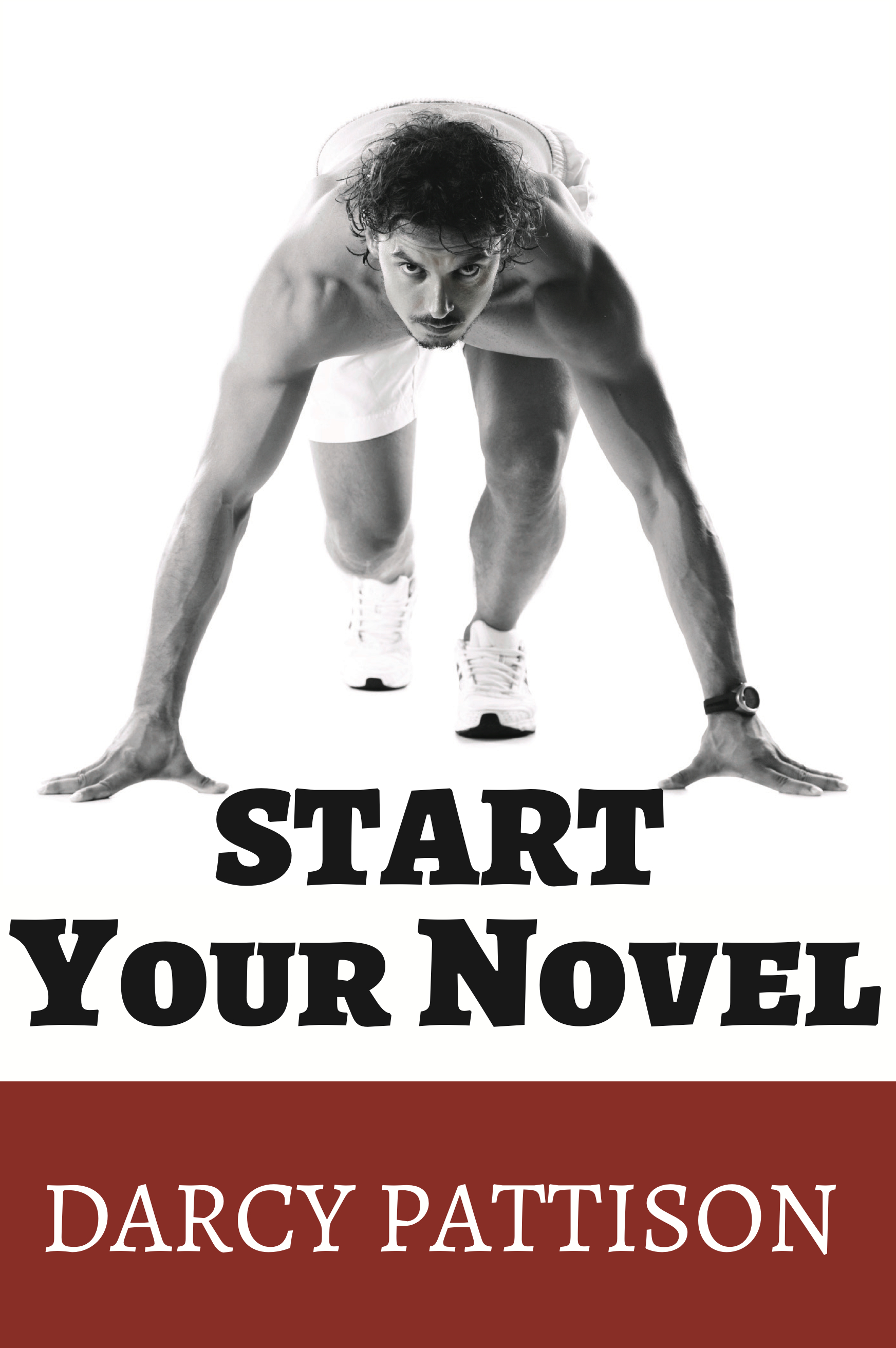
START YOUR NOVEL: SIX WINNING STEPS TOWARD A COMPELLING OPENING LINE, SCENE, AND CHAPTER by Darcy Pattison

The one thing I can count on when starting a new manuscript is the feeling I’ve never written a book before. Because each of my stories has to find its own way, and I can always use a refresher course on this thing called writing, I decided to use writing guru Darcy Pattison’s latest book, START YOUR NOVEL, as my guide when drafting a new book during National Novel Writing Month last November.

Darcy opens her book by stating everything a first chapter must accomplish:

  • grab your reader’s attention
  • ground your reader in the setting
  • intrigue the reader with a character
  • give the reader a puzzle to solve
  • set the pace

The first chapter sets the stage for the rest of the book. The first sentence builds on the first page builds on the first chapter. And to grab an editor’s attention, all three must shine.

I consider myself a “plotser” (or “planster”, as Darcy would say) -- someone who doesn’t fully plot a story but also doesn’t fly by the seat of her pants. Darcy says her approach might feel overly rigid to pantsters or too loosey-goosey to plotters. For me, her system feels like the perfect fit.

So you have an idea for a story? Now’s the time to brainstorm possible scenes. Next Darcy suggests studying the “29 Plot Templates” to decide which structure might best tell your story. Will your book be a quest? A story of escape? One about an underdog or forbidden love? “Each plot pattern would require a different set of scenes, emotions, motivations.” The approach you take will affect how you let your possible scenes play out.

Darcy then briefly discusses exploring your protagonist with one key element in mind: your character’s pain. “What is the character most afraid of; what could make the character hurt the most? Of course, you must make your character face this very thing.”

Now you’ve got some possible scenes and a structure for these scenes to unfold. With your character’s pain pinpointed (and the things you know she must face to bring about change), you have the beginnings of your character’s arc.

scene ideas + plot pattern + character arc = the beginnings of your book

Because you’ve not yet committed hours and hours to writing at this point, there is plenty of freedom to play with your ideas: adding scenes, deleting them, changing a character’s motivation or the type of story you’d like to tell. As someone who’s written a few books and many more “trunk manuscripts,” I appreciated this experimental phase. It’s something I need to do more of before my drafting begins.

“The function of a first draft is to find your story. The function of the next few drafts is to find the best way to tell that story.”

To that end, Darcy spends much of her book showing authors how to experiment with different approaches. For example, what type of sentence structure might you use to start your book? Darcy identifies twelve types of opening sentences*, gives examples of each, and then tries each type for her own novel-in-progress. In pushing herself to study her opening from different angles, she’s able to find the best way to tell the story.

As I planned and then drafted my NaNo novel, this book was an invaluable guide. And once I've given it a few months to breathe, I’ll pull Darcy’s revision book, NOVEL METAMORPHOSIS, off my shelf.

What books do you recommend for starting a new piece of writing?

*Here are a few to consider:
  • It was... It is... This is...
  • viewpoint on life
  • mid-action
  • dialogue
  • landscape
  • misleading lines

Monday, July 15, 2013

CREATE YOUR WRITER PLATFORM by Chuck Sambuchino


Create Your Writer Platform: The Key to Building an Audience, Selling More Books and finding Success as an Author -- Chuck Sambuchino

www.chucksambuchino.com

I’ve read several books on author platform but have to confess never fully grasping the term until reading Chuck Sambuchino’s CREATE YOUR WRITER PLATFORM. At its simplest level, a platform is an author’s visibility and reach -- the framework an author has and continues to build that let’s others know of his or her work.

Sambuchino describes his book as “a guide for all the hardworking writers out there who want a say in their own destinies.” Though there is no one-size-fits-all approach to establishing a platform, Sambuchino says the need for platform cannot be ignored, even for those of us who write fiction. The book is divided into three sections: The Principles of Platform, The Mechanics of Platform, and Author Case Studies. At the end of each chapter, literary agents weigh in on the chapter’s topic, giving readers perspectives outside of the author’s. One of the most helpful aspects of the book is the Case Study section, where twelve different authors from a variety of genres (memoir to self help, fiction to reference) reflect on the choices they made in building their platforms -- what worked, what they wish they’d done differently, what they believe makes them stand out from others in their field.

Sambuchino is also quick to say “this is a resource for those who realize that selling a book is not about blatant self-promotion.” It is more about relationships, the sharing of expertise, and supporting others along the way. Though written for the aspiring author, a lot of things resonated with me, a newly published author, such as the wisdom behind an author newsletter, establishing an “events” page on my blog, and always, that kindness and generosity go a long way.

Other books I can recommend that deal with author platform:
GET KNOWN BEFORE THE BOOK DEAL - Christina Katz
BOOKLIFE: STRATEGIES AND SURVIVAL TIPS FOR THE 21ST-CENTURY WRITER - Jeff Vandermeer

What are your feelings on and/or experiences with author platform?

Friday, September 30, 2011

Reading about Writing

So I finally went out and bought myself a copy of Stephen King's On Writing. I devoured it in about a day. (Confession: This is the first book by SK I've ever read. I know! I know! What have I been thinking? I will remedy this fact soon, believe me!)

At any rate, maybe because writing is such a solitary profession, or it could be that a writer's imagination is wired to find "kindred spirits" in books - whatever the reason - I now feel like Stevie (yes, he calls himself that in the book) is my new BFF, wise mentor, and witty grammatical go-to-guy all rolled into one. Observe:

"Put your desk in the corner, and every time you sit down there to write, remind yourself why it isn't in the middle of the room. Life isn't a support-sytem for art. It's the other way around." (pg. 101)

SK's sage words stand on their own, but he doesn't leave it there. Later on, this warning against letting your writing consume your life will seem to be at odds with a reminder to take what we're doing seriously:

"You can approach the act of writing with nervousness, excitement,
hopefulness, or even despair - the sense that you can never completely put on the page what's in your mind and heart. You can come to the act with your fists clenched and your eyes narrowed, ready to kick ass and take down names. You can come to it because you want a girl to marry you or because you want to change the world. Come to it any way but lightly. Let me say it again: you must not come lightly to the blank page." (pg. 106)

ON WRITING is full of this kind of brilliance that spot-on names the tension we feel as writers, articulates the challenges of creating stories, and passes out English-teacherish lessons on quality writing. Don't wait as long as I did to give this a read.

And, do share: what other writing books can't you live without?

P.S. Thanks, Stevie! Looking forward to meeting up again when I reread your book.