Showing posts with label creative writing. Show all posts

Monday, December 7, 2015

When Dawn and Dusk Merge by Paul Greci


The sun at its high point in the sky taken from my deck.

It’s that time of year up north where dawn merges with dusk.
By Solstice the length of our day will be about 3 hours and 40 minutes (10:58 to 2:40).


Luckily, I’ve come to love all the low-angle lighting that accompanies winter.
Sometimes the forest is pink.
  
My writing time is typically 5 to 6:30, then I need to get ready for work.

That darkness, at its best, is like a creative blanket wrapped around me.

At its worse it’s a yawn factory.
Taken from my driveway.

Obviously, you don’t need a long winter to be a writer. I guess what I’m saying is that by embracing what you have, you free up your energy to put into what is in front of you whether that is writing, or child care, or teaching, or anything really.

On the surface, it sounds simple, but I think it’s an ongoing challenge in mindfulness to be present enough to fully engage with what’s right in front of you. At least, it is for me.

Taken from my deck.
As a special education teacher I often have to go from meetings with parents, teachers, or administrators, or writing student goals right into teaching. Being able to turn off the previous task, even though it is often unfinished with a deadline attached to it, and focus on the students in front of me is key.

I try to approach my writing-time the same way, by closing the shutters on what is coming next in my busy day.

 For whatever reason, winter brings this reflective side of me to the surface. The black windows I see when I look beyond my computer screen keep me focused, and the dawn-dusk lighting for the rest of the day, helps to keep me in a reflective space.

On the power line just up the hill from our house.
What do you do to access your creativity and stay in it? And/or, what do you do to make it more likely you’ll be more present with what is in front of you?

 In book news, Surviving Bear Island is now available in an EBook and the Hard Cover is having a Second Printing.
 

Monday, July 13, 2015

LOST DOG: Last Seen on Page 275 by Eden Unger Bowditch


Okay, it’s true. I lost the dog. I was somewhere on page 350 and suddenly realized- where is Ralph? The last time I saw him was at the castle. Now that we are on the streets of Cairo, the dog is nowhere to be found.

Luckily, we are in the modern era and I was able to search the manuscript and find Ralph. I brought him home- though I would have gladly offered a search reward if I had been facing a perusal of ink-stained pages instead.

Has anyone misplaced a character before? It is amazing how lost one can get in one’s own book. I remember, during the The Ravens of Solemano editing era, while waiting for my editor to send his usual litany of detailed and ever-helpful comments, I was sent a brief email that asked if I wanted to choose a birthday or simply have a character celebrate two birthdays in a period of four months. Oops.

I think of books I’ve read in which a character simply disappears and never returns. Poor character, lost in the ether with no conclusion to bring her home.  Going back through great swaths of text can sometimes be more of a challenge than putting up mental signs for a lost dog.  I can search ‘Ralph’ or ‘dog’ and find him. But when there is an event that must be followed by another, it gets trickier and more challenging. When a search must be initiated Instead of whistling through pages, it is more like being a detective trying to discern who and what happened when and how. Searching requires finesse and wits, which, for me, can be a challenge to find, as well. How many hours have you spent trying to get the words right to Google a book or a film or a quotation or an event or country? The search request must done over and over until you get the wording right to call forth the information needed.

Marissa Burt’s super-awesomely helpful post,  “Thoughts on Scrivener,” Monday, April 27,2015 (read it, if you have not already) struck home for me. I am surrounded by little pieces of paper with notes I can barely read, but which are desperately necessary to retain some modicum of attention to names and places, times and events. To remember who went where and when, I now have birthdays, names, histories, and spots of time on notes to myself. I plan someday to follow Marissa’s lead and move into the 21st century with virtual Post Its, but until then, I have paper to keep me on the straight and narrow.
So, with the dog safely back in the arms of his boy, I am ready to send the first draft of the third book in the Young Inventors Guild trilogy to my editor- though pressing the ‘send’ button is something I feel like offering a reward for someone else to do.

Tuesday, March 26, 2013

The Writing Life: On Pushing Through

For those of you who have read my posts here or on my own blog, Caroline by line, you've probably noticed a certain theme -- I find writing hard. Sometimes I feel like a high diver who is afraid of heights. Don't get me wrong: I love what I do and am so fortunate to be an author (I mean, pinch me!). But almost daily there are challenges I face in this writing gig, and almost all of them come from within.

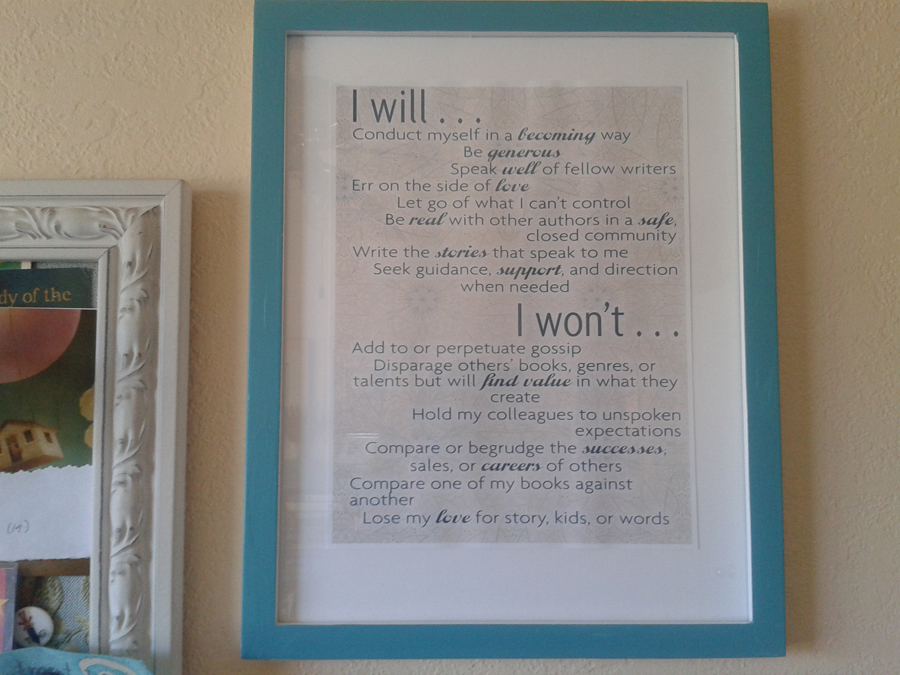
That's why I surround myself with things like this.
The lines about making good art are notes I took while listening to Neil Gaiman give the commencement address at The University of the Arts. 14 Ways to Make Mediocre Art comes from Emily Freeman at Chatting at the Sky (get your own cool copy here). The framed note I received in a packet of thank you letters after a school visit. "It's okay to be scared to write," it says. "I am too!"

To the right of my desk I've pinned this quote on the wall:
“Know that it is good to work. Work with love and think of liking it when you do it. It is easy and interesting. It is a privilege. There is nothing hard about it but your anxious vanity and fear of failure.
And when you work on your writing remember these things. Work with all your intellegence and love. Work freely and rollickingly as though talking to a friend who loves you. Mentally thumb your nose at the know-it-alls, jeerers, critics, doubters.”  -- IF YOU WANT TO WRITE, Barbara Ueland
Then there is this mini-poster I made, a response to all the thoughts rolling around in my head during my debut year. (Email me if you'd like your own copy!)
And other quotes I gather like sea shells, to pull out and examine when I need a boost:
"To make art is to sing with the human voice. To do this you must first learn that the only voice you need is the voice you already have. Art work is ordinary work, but it takes courage to embrace that work, and wisdom to mediate the interplay of art and fear." -- ART AND FEAR: OBSERVATIONS ON THE PERILS (AND REWARDS) OF ARTMAKING, by David Bayles and Ted Orland
"I am convinced that fear is at the root of most bad writing... . Good writing is often about letting go of fear and affectation. Affectation itself, beginning with the need to define some sorts of writing as 'good' and others sorts as 'bad,' is fearful behavior. Good writing is also about making good choices when it comes to picking the tools [words] you plan to work with." -- ON WRITING, Stephen King 
"Be an unstoppable force. Write with an imaginary machete strapped to your thigh. This is not wishy-washy, polite, drinking-tea-with-your-pinkie-sticking-out stuff. It’s who you want to be, your most powerful self. Write your books. Finish them, then make them better. Find the way. No one will make this dream come true for you but you." -- Laini Taylor
"Being an artist means: not numbering and counting, but ripening like a tree, which doesn't force its sap, and stands confidently in the storms of spring, not afraid that afterward summer may not come. It does come. But it comes only to those who are patient, who are there as if eternity lay before them, so unconcernedly silent and vast. I learn it every day of my life, learn it with pain I am grateful for: patience is everything." -- LETTERS TO A YOUNG POET, Rainer Maria Rilke 
How do you encourage yourself when writing is hard?

Wednesday, August 29, 2012

AUDITION AND SUBTRACTION -- Interview and Giveaway!

Welcome to Amy Fellner Dominy, author of AUDITION AND SUBTRACTION, a tween novel releasing September 4! 

Audition & Subtraction

What inspired you to write this story?

In a word: Desperation. 

About five years ago, I was really struggling as a writer. I got stuck halfway through a book and felt lost, hopeless and wondered if I’d ever write anything decent.  It was in this mindset that I came across an article suggesting I search my mind for an emotionally charged memory and use that as a jumping off point for a story.  So I did.  

What came to mind was the day my best friend showed up to lunch with a guy.  It may sound small, but when he sat with us my world tilted.  Forever, really.  I was losing my best friend to a guy and relationships were starting to shift in scary (and exciting) ways.  I wrote that as a scene and though it never made it into the book, Audition & Subtraction had been born. 

What was your publication process like, from initial idea to sale?

I wrote the first draft in 2007.  It was a mess! I rewrote it again but before I could put the finishing touches on the book, my computer hard drive crashed and I lost the files.  After OyMG sold, my editor wondered if I had any other books that were similar.  Talk about good incentive!  I retyped the whole book and finished the edits. The book went to my agent near the end of 2010.  She liked it but she wanted some pretty major rewrites. I worked hard for about two months and sent back a new version early 2011.  My editor loved the changes and I was thrilled to get a contract with a release date of fall 2012. 

So, I guess you could say it was 5 years from start to shelf.

What books have shaped you as a reader and writer, from childhood to the present?

Growing up, I loved contemporary stories about girls like me.  Of course Judy Blume was my hero and maybe that’s why I still love reading and writing contemporary.  I also found myself drawn to books with strong characters.  One of my favorite books of all time is Watership Down. The characters are all rabbits, but to me they’re as real as any people I know.  Even now, I like books with strong characters I can relate to.  I also have to admit I’m a romantic at heart. Add an angsty romance to the mix and I’m hooked.  Favorites include Pride and Prejudice and Jane Eyre. 

What is one thing people misunderstand about writing tween fiction?

Sometimes I’m surprised when adults ask why I don’t write real books—meaning adult books.  It’s as if writing for kids isn’t important, or less important in some way.  I completely disagree.  Even now, when I think back to the books that changed my life, they’re the books I read when I was young. To me, those were the important books because they helped shape me…helped me to shape who I am today.  I wish more adults would read young.  I think they’d find themselves quite surprised by the depth and quality of writing out there. 

Are you working on anything new?

I just finished a book I’m calling BAD KAT. Think high-school theater, an old romance that never died, challenging the roles we’re told to play…and a black spandex catsuit. Keep your fingers crossed the book finds a home—I’m so excited about how it turned out. 

Giveaway

Bloomsbury has offered an advance reader copy (ARC) of AUDITION AND SUBTRACTION to one Project Mayhem reader. To enter, follow Project Mayhem and comment below, sharing one thing you'll take from this interview. Contest closes Thursday, September 6.

Connect with Amy here:


Monday, April 23, 2012

Un-Walk-Away-Able


A woman in my book club claims she has finished every book she has ever started.  It's a personality tick of hers. She has to know what happens. It doesn't matter how bad the writing is or how uninteresting the story, she will slog through hundreds of tedious pages until she gets to the very end.

I must confess: I don't have that type of dedication. If a book doesn't grab me within the first four or five chapters
—okay, sometimes even within the first one or two—I'm outta there. Often it has nothing to do with the quality of the writing. Sometimes I just don't like or connect with the main character early on. Sometimes the storyline just isn't my cup of tea. And, okay, sometimes it is the writing. Let's face it, we all have certain writing styles we like better than others.

I recently started a new release that came highly recommended by friends and had strong online reviews. But it was a genre I don't typically read
—science fiction—and I really struggled through the first fifty pages or so. Several times I nearly walked away from the book altogether. Generally, I don't believe in sticking with a book you're not enjoying. Time is precious. We all have other things we could be doing—spending time with family, working on books of our own, reading something we actually do like. Why waste your time on a book that just isn't speaking to you?

As writers, I think we need to keep in mind that the first several chapters are crucial. A slow or uninteresting beginning or a story that takes too long to take off can be a deal breaker. I've heard some people describe a book by saying, "Well, it gets really good if you stick with it about ten chapters" or "about a hundred pages or so." In my mind, that's a problem. Because let's face it, many readers (and editors and agents) aren't going to hang around that long. And especially in middle grade, where attention spans can be a bit tenuous, a story needs to snag readers pretty quickly. This, of course, is the reasoning behind the often-heard advice that a book should start as close in time as possible to the main action of the plot, to avoid overly long beginnings or unnecessary tangents. Other good techniques for those early pages: start with a bang (or a shock), offer up a particularly colorful or intriguing or amusing character or voice, raise a mystery or question that compels the audience to read onward for answers. The goal is to create a story that the reader will find it very hard to walk away from.

Of course, sometimes I have to eat my own words. That book I was struggling through? Around page 65, it gets really good. Some characters come together who have wonderful interaction and chemistry, and the action picks up considerably. I flipped page after page and flew through the rest of the book.

Okay, I guess some books are worth sticking with until the end :)

At what point do you walk away from a book? And what makes you do so?


photo credit: JD Hancock via photopin cc

Friday, March 23, 2012

It Was a Dark and Stormy Night…


The deadline is fast approaching for one of my favorite writing contests of all time—the annual Bulwer-Lytton Fiction Contest. You all know who Edward George Bulwer-Lytton is. Yes, you do!! Even if you don't realize you do. Who hasn't heard the famous line, "It was a dark and stormy night"? This is the opening line of Mr. Bulwer-Lytton's 1830 novel, PAUL CLIFFORD. Well, it's actually part of the opening line. The full line is:

"It was a dark and stormy night; the rain fell in torrents—except at occasional intervals, when it was checked by a violent gust of wind which swept up the streets (for it is in London that our scene lies), rattling along the housetops, and fiercely agitating the scanty flame of the lamps that struggled against the darkness."

Somehow, somewhere in time, Mr. Bulwer-Lytton's stormy opener became the poster child for bad, cliched opening lines, a stigma I think is perhaps rather a little unfair, seeing as he also coined the poetic and popular "the pen is mightier than the sword," among other well-known adages. Still, in tribute to Bulwer-Lytton's (in)famous opening sentence, Professor Scott Rice of the San Jose University English Department hosts the annual Bulwer-Lytton Fiction Contest, which the competition's website describes as "a whimsical literary competition that challenges entrants to compose the opening sentence to the worst of all possible novels."

The contest, nearly 30 years running, has produced some absolute whoppers of opening lines. Here's a sampling:


The bone-chilling scream split the warm summer night in two, the first half being before the scream when it was fairly balmy and calm and pleasant for those who hadn't heard the scream at all, but not calm or balmy or even very nice for those who did hear the scream, discounting the little period of time during the actual scream itself when your ears might have been hearing it but your brain wasn't reacting yet to let you know.
--Patricia E. Presutti, Lewiston, New York (1986 Winner)

She wasn't really my type, a hard-looking but untalented reporter from the local cat box liner, but the first second that the third-rate representative of the fourth estate cracked open a new fifth of old Scotch, my sixth sense said seventh heaven was as close as an eighth note from Beethoven's Ninth Symphony, so, nervous as a tenth grader drowning in eleventh-hour cramming for a physics exam, I swept her into my longing arms, and, humming "The Twelfth of Never," I got lucky on Friday the thirteenth.
--Wm. W. "Buddy" Ocheltree, Port Townsend, Washington (1993 Winner)

Paul Revere had just discovered that someone in Boston was a spy for the British, and when he saw the young woman believed to be the spy's girlfriend in an Italian restaurant he said to the waiter, "Hold the spumoni--I'm going to follow the chick an' catch a Tory."
--John L. Ashman, Houston, Texas (1995 Winner)

Through the gathering gloom of a late-October afternoon, along the greasy, cracked paving-stones slick from the sputum of the sky, Stanley Ruddlethorp wearily trudged up the hill from the cemetery where his wife, sister, brother, and three children were all buried, and forced open the door of his decaying house, blissfully unaware of the catastrophe that was soon to devastate his life.
--Dr. David Chuter, Kingston, Surrey, England (1999 Winner)
They had but one last remaining night together, so they embraced each other as tightly as that two-flavor entwined string cheese that is orange and yellowish-white, the orange probably being a bland Cheddar and the white . . . Mozzarella, although it could possibly be Provolone or just plain American, as it really doesn't taste distinctly dissimilar from the orange, yet they would have you believe it does by coloring it differently.
--Mariann Simms, Wetumpka, Alabama (2003 Winner)

Folks say that if you listen real close at the height of the full moon, when the wind is blown’ off Nantucket Sound from nor’ east and the dogs are howlin’ for no earthly reason, you can hear the awful screams of the crew of the “Ellie May,” a sturdy whaler Captained by John McTavish; for it was on just such a night when the rum was flowin’ and, Davey Jonesw be damned, big John brought his men on deck for the first of several screaming contests.
--David McKenzie, Federal Way, Washington (2009 Winner)

The deadline for entries is April 15, which their website is quick to point out is "a date that Americans associate with painful submissions and making up bad stories." But even if you're not interested in entering, I strongly recommend you spend some time reading over the opening lines of past winners at the contest's website (click on "Lyttony of Grand Prize Winners"), for both a good laugh and some great examples of truly creative writing. Here, too, is the line-up of 2011 winners.

And yes, I suppose there is a lesson in all this, about the importance of a really fabulous opening line. Personally, I love opening lines that grab you in some way, whether they're really gripping, surprising, or raise an intriguing question that compels you to read further for answers. Remember, your opening line sets the tone for everything that follows—the entire book—and it can really grab readers—or really put them off. So, it's probably worth investing a little extra time to make sure it has the desired effect. :)


photo credit: Alphafish DMPaine via photopin cc

photo credit: fd via photopin cc