Showing posts with label Neil Gaiman. Show all posts

Tuesday, December 9, 2014

The MG Novel Hidden in a Christmas Carol by Jim Hill

A disclaimer. The title of this piece is only there to lure you in, to catch your fancy long enough to get to the real point. Gentle reader, consider yourself advised.

‘Tis the season of A Christmas Carol, the ATM of American theater. Production companies large and small trot it out annually, secure in the knowledge that the funds it generates between Thanksgiving and New Years will keep the lights on in April. Dickens crafted a redemption story that predates the felonious Grinch, inspired a thousand variations (I’m looking at you, Magoo), and that has political resonance as timely today as it was in 1843.

I attended Trinity Reps’ current run this past weekend. As always I was caught up in the story, the imaginative staging, and the engaging performances. I was also inspired by the hidden middle grade novel waiting to be told. I mean, it’s just lying there waiting for a clever writer to put pen to paper and breathe life into it.

Which begs the question writers are so often asked: Where do you get your ideas?

If writers were paid a few bucks every time they hear that question they’d have a nice little coffee-shop-annuity.

Before I started writing with intent, the thing I was most afraid of was not having enough ideas. I knew I had one story I wanted to write, but what if I never came up with another one?

Here’s the thing. Once I committed to writing that one story down on paper (okay, screen…) the flood gates opened. Ideas are everywhere, and I had awakened my senses to them. An eighth color was added to the rainbow.

So what happened? I dared to observe the world and ask questions of it. Curiosity kicked down the doors of fear, and gave birth to a thousand mangled metaphors.

Have you thought about that hidden middle grade novel tucked away in a Christmas Carol? I wonder if we’re thinking about the same one.

I took a week long workshop at the Cape Cod Writers Conference with Sara Pennypacker. When asked “the question” she was ready, primed even, with her answer. Ideas are everywhere. She walked us through a trip she took to the grocery store and catalogued a series of ideas triggered by asking a simple question – why?

Why is the wheel on this cart wobbly?
Why is that person only buying candy?
Why did that car come from Ohio to this particular store?

The world is a grocery store stocked with pyramids of cans. Why is the can opener. Fill your cart.

Now that I think about it, there are at least three middle grade stories waiting to hatch out of a Christmas Carol. How’s your list coming?

I just completed Picture Book Idea Month, or PiBoIdMo, and have a brand spanking new list of thirty one ideas ready for some serious writing time in order to turn them into actual stories. One idea a day for the month of November, plus a bonus I couldn’t resist from October 31st.

I was in a bookstore (shocking I know) and overheard this amazing piece of dialogue:
"For once, can't we just live in a castle? We haven't lived in a castle in my WHOLE LIFE. Not one single time.”
Boom. My brain exploded with possibilities. Why would a character say that? To whom are they speaking? What’s the answer?

Ideas are everywhere. But ideas are not books. Yet.

Neil Gaiman has a wonderful essay on this topic. Of course. The bits of genius he doles out have stayed with me. It’s about asking questions, like Sara said, and paying attention to the answers, and following the breadcrumb trail that leads to the next question. And writing it down.
“The Ideas aren't the hard bit. They're a small component of the whole. Creating believable people who do more or less what you tell them to is much harder. And hardest by far is the process of simply sitting down and putting one word after another to construct whatever it is you're trying to build: making it interesting, making it new.”
A Christmas Carol has been around for a long time. Surely I’m not the first writer to see it and ask questions about things hinted or futures made bright. I’m not even going to Google it to see. We’re a community of idea generators, ideas are easy.

Look how far I’ve come. From the fear of never having another idea, to the realization that ideas are easy. Easy like a Sunday morning.

Pay attention. Ask questions. Question the answers. Follow the clues.

Write it down.

Oh. That middle grade novel in a Christmas Carol? I’m not going to tell you. If you get the chance, see the show, read the book, or catch the movie and ask your own questions.

You can thank me in your acknowledgement page.

Friday, June 6, 2014

The Luck of Reading The Luck Uglies: Review of an Adventurous Debut Novel by Paul Durham


There are books we all hope to find that do more than simply tell a story. These books take us with them. They take us with them on the adventure and we feel like we know the world around us when we go. And these are rare treasures we keep and pass along. Author Paul Durham’s first MG/YA novel, The Luck Uglies, is one of those rare books.

An adventure and an introduction to Village Drowning and all its inhabitants, The Luck Uglies has a timeless feel, as if it might just as believably come from the hidden library in a castle as from the work of a modern writer.  It is both clever, never underestimating the intelligence of the young reader, and exciting, never forgetting that everyone loves a good adventure.
 
We were able to catch Paul Durham in the midst of all the excitement of The Luck Uglies. While there are heaps of questions I could list, like Rye O'Chanter, we will have to be content with a few at a time:

1. Who are a few of your favorite authors and/or books (few people have just one!) that might have inspired some of your writing? 

 There are so many great middle grade authors and books it is indeed difficult to narrow it down, but I always find myself coming back to the same examples.
The Chronicles of Prydain series by Lloyd Alexander has stayed with me ever since I was a child. I’ve reread the series twice as an adult and it still holds up as compelling reading. Its five books tell a story that is timeless and epic in scope, and yet the storytelling remains intimate and accessible.
A more contemporary favorite is The Graveyard Book by Neil Gaiman. This was one of those books that just knocked me over when I read it because it was so good. It's hard to call it a children's book because, really, it's for everybody. It is exactly the type of book that inspires me to be a better writer.
2. You mention that you started telling the story to your kids. Who were your first characters? 
Rye O'Chanter was the very first character to make it onto the page. This seems so fitting because she was heavily inspired by my own daughter, who prompted my to write The Luck Uglies in the first place. Of course, Rye needed cohorts, so her little sister Lottie and her best friends, Folly and Quinn, weren't far behind. 
 •
3. There is such a rich Village Drowning history the reader can sense. Can you give us a few things about the place that aren't in the book? 
That's such a great question--I often think of Village Drowning as its own "character." Like any character, there are things about it that even I haven't discovered yet, but here are two tidbits I can share. Beneath the streets of the village, there is a place even older than the Spoke that the link rats call home. Also, in addition to the bogs and river, Drowning is bordered by a brackish body of water called the Great Eel Pond. Enormous culverts drain water from the pond under, rather than over, the village. Needless to say, Drowning remains damp even under the best of circumstances. 
 •
4. Is this the beginning of a journey for Rye? Are there more Luck Ugly book coming? 
Yes, I'm happy to report that this is just the start of Rye's journey. The Luck Uglies is a trilogy, with more books to come in spring 2015 and 2016. I'm finishing Book 2 right now.

Durham weaves a tale that truly brings you into Rye O’Chanter’s strange and mysterious world. The story makes you wish the book would not end so you can uncover more secrets that promise to be hidden there.

- eden unger bowditch

Monday, November 18, 2013

First Page and Cover Analysis of The Girl Who Circumnavigated Fairyland, by Matthew MacNish


Technically, the title of this book is actually The Girl Who Circumnavigated Fairyland in a Ship of Her Own Making, which is a great, if somewhat long title, but just wouldn't fit as a post title.

Anyway, today I would like to take a look at the fascinating cover and first page of a very interesting middle grade novel. The cover, with the original illustration by Ana Juan, is gorgeous enough in its own right, but as a writer, it's the blurbs that really struck me when I first picked up this book.

The front cover is blurbed by Neil Gaiman, and that, of course, is impressive enough, but turn the book over, and you'll see none other than Tamora Pierce and Holly Black recommending the tale inside. But it doesn't stop there. Crack the book open, and take a peek at the inside jacket flap, and you'll see yet another blurb touting the originality of this story, this one from none other than Peter S. Beagle, who in case you don't recall, wrote this little book called The Last Unicorn.


So anyway, I guess needless to say, my point is that as covers go, I was definitely impressed the moment this book showed up at my house (I won it and its sequel on Facebook, from Liz Szabla, who is the editor at Feiwel and Friends who published the book). With a title as inventive as this book has, I'm not sure it needed so many great blurbs to sell me on its story, but it couldn't have hurt, right?

Now, let's talk about the first page:


Beginning with another lovely drawing, the first chapter is titled Exeunt on a Leopard. What a great title, right? Sure, I had to look the word Exeunt up, but once I knew it was a stage direction, I was in love. From there, we have the chapter sub-title/heading: In Which a Girl Named September Is Spirited Off by Means of a Leopard, Learns the Rules of Fairyland, and Solves a Puzzle.

Well, as you can imagine, from there on out, I was in. I'm actually still reading this novel, and while I'll admit it can be occasionally a bit heavy handed in its verbosity, it's a fantastic tale, filled with some of the most inventive characters and imaginative circumstances I've ever encountered in a book. Certainly highly recommended, in case the cover, blurbs, and first page weren't enough to pique your interest.

Have you heard of this book? If not, how much of a role do covers and blurbs and such play in your decision to read a particular book?

Tuesday, March 26, 2013

The Writing Life: On Pushing Through

For those of you who have read my posts here or on my own blog, Caroline by line, you've probably noticed a certain theme -- I find writing hard. Sometimes I feel like a high diver who is afraid of heights. Don't get me wrong: I love what I do and am so fortunate to be an author (I mean, pinch me!). But almost daily there are challenges I face in this writing gig, and almost all of them come from within.

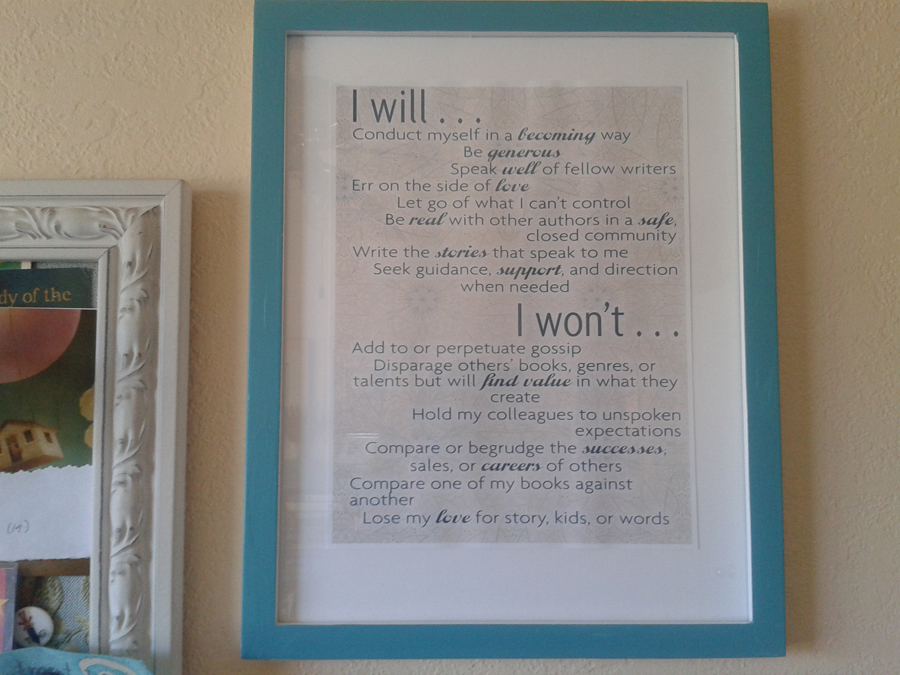
That's why I surround myself with things like this.
The lines about making good art are notes I took while listening to Neil Gaiman give the commencement address at The University of the Arts. 14 Ways to Make Mediocre Art comes from Emily Freeman at Chatting at the Sky (get your own cool copy here). The framed note I received in a packet of thank you letters after a school visit. "It's okay to be scared to write," it says. "I am too!"

To the right of my desk I've pinned this quote on the wall:
“Know that it is good to work. Work with love and think of liking it when you do it. It is easy and interesting. It is a privilege. There is nothing hard about it but your anxious vanity and fear of failure.
And when you work on your writing remember these things. Work with all your intellegence and love. Work freely and rollickingly as though talking to a friend who loves you. Mentally thumb your nose at the know-it-alls, jeerers, critics, doubters.”  -- IF YOU WANT TO WRITE, Barbara Ueland
Then there is this mini-poster I made, a response to all the thoughts rolling around in my head during my debut year. (Email me if you'd like your own copy!)
And other quotes I gather like sea shells, to pull out and examine when I need a boost:
"To make art is to sing with the human voice. To do this you must first learn that the only voice you need is the voice you already have. Art work is ordinary work, but it takes courage to embrace that work, and wisdom to mediate the interplay of art and fear." -- ART AND FEAR: OBSERVATIONS ON THE PERILS (AND REWARDS) OF ARTMAKING, by David Bayles and Ted Orland
"I am convinced that fear is at the root of most bad writing... . Good writing is often about letting go of fear and affectation. Affectation itself, beginning with the need to define some sorts of writing as 'good' and others sorts as 'bad,' is fearful behavior. Good writing is also about making good choices when it comes to picking the tools [words] you plan to work with." -- ON WRITING, Stephen King 
"Be an unstoppable force. Write with an imaginary machete strapped to your thigh. This is not wishy-washy, polite, drinking-tea-with-your-pinkie-sticking-out stuff. It’s who you want to be, your most powerful self. Write your books. Finish them, then make them better. Find the way. No one will make this dream come true for you but you." -- Laini Taylor
"Being an artist means: not numbering and counting, but ripening like a tree, which doesn't force its sap, and stands confidently in the storms of spring, not afraid that afterward summer may not come. It does come. But it comes only to those who are patient, who are there as if eternity lay before them, so unconcernedly silent and vast. I learn it every day of my life, learn it with pain I am grateful for: patience is everything." -- LETTERS TO A YOUNG POET, Rainer Maria Rilke 
How do you encourage yourself when writing is hard?

Wednesday, October 17, 2012

Writing for Different Ages

From The Simpson's, hosted at Librarified
So, ever since I was asked to join Project Mayhem (was it over a year ago? wow) I always wondered: why me? No, I'm kidding. I know I'm awesome, of course they'd love me.

But there is that thing. It's about content. I'm not published. I'm not agented. And the only two manuscripts I've completed are both (I think, I'm no marketing guru) Young Adult Literature.

So why am I part of a Middle Grade blog?

Well the good news is that I do have a project in the works. It's an ambitious one. I'm happy to say it will be a Middle Grade book (or hopefully a series of them), but unfortunately, it's a bit of a secret, and that's all I can say.

However, the whole question has got me thinking: how many authors are there out there who write both YA and MG, and are not only commercially successful at it, but artistically as well?

I use the Neil Gaiman picture from the Simpson's episode, because I know I have personally enjoyed not only his adult novels, but also at least one Middle Grade novel he's written: The Graveyard Book. Yet, there are obviously very few writers out there who have his level of success.

Of course, you have series like Harry Potter, by J.K. Rowling, or Percy Jackson, by Rick Riordan, which I think can both be successfully argued evolve from MG into YA by the time they end, but again, such a thing is rare.

There are some friends and darlings of the blogosphere who write both, like Laura Pauling, and Shannon Messenger, and then there are some more famous authors who I've never met, like Scott Westerfield, and Patrick Ness, but I guess my point is (more a question than a point, but bear with me here) do you think it's a viable aspiration to hope to write both?

And whether or not you do (or don't) do you know of any writers who are thriving at it that I haven't mentioned?

Either way, you never know. I haven't had success with my YA work yet, so maybe it turns out that it was never my thing, and I'll only have to worry about MG, but for the time being, I am definitely curious to hear what all our readers think.

And if you're not sure what you think, that's okay. Here are some resources of other people's opinions.

Shannon's agent Laura Rennert on writing blockbuster MG and YA fiction.

Michele Acker interviews some agents about MG and YA Sci-Fi and Fantasy.

Claire Legrand muses on the differences between the two for WriteOnCon.

Sally Apokedak covers the basic differences on Vonda Skelton's blog.

C. Lee McKenzie writes about how the line can be blurred at Carrie Butler's blog.

Otherwise, that's all I have for now. What do you all think?

Friday, May 18, 2012

First Page Analysis: The Graveyard Book, by Neil Gaiman


In case you can't quite read that, it says:
There was a hand in the darkness, and it held a knife.

Probably one of the better opening lines I've ever read, especially for a wacky, spooky, moving MG novel. I suppose you might expect nothing less from a master like Neil Gaiman, and I probably wouldn't blame you, but because of something I heard him say at WFC last fall, I wanted to focus on this book for a moment today.

Neil Gaiman and Connie Willis did a panel together, in which they basically just had a conversation about writing, and life, and books, and writing. The entire thing was absolutely fascinating, but one thing Neil said really stuck with me. He said (I'm paraphrasing here): "The Graveyward Book was the only book I ever wrote that actually ended up a better story on the pages than it had been in my head."

As writers, I think we all know what he means by that. At the time, I'd read this book a few years before, and I'd enjoyed it, but I hadn't been a serious writer at the time, so I decided to revisit it. The whole thing is truly a joy, but I want to focus on the first page (or the first 200 words or so, since there are illustrations).

There was a hand in the darkness, and it held a knife.

The knife had a handle of polished black bone, and a blade finer and sharper than any razor. If it sliced you, you might not even know you had been cut, not immediately.

The knife had done almost everything it was brought to that house to do, and both the blade and the handle were wet.

The street door was still open, just a little, where the knife and the man who held it had slipped in, and wisps of nighttime mist slithered and twined into the house through the open door.

The man Jack paused on the landing. With his left hand he pulled a large white handkerchief from the pocket of his black coat, and with it he wiped off the knife and his gloved right hand which had been holding it; then he put the handkerchief away. The hunt was almost over. He had left the woman in her bed, the man on the bedroom floor, the older child in her brightly colored bedroom, surrounded by toys and half-finished models. That only left the little one, a baby barely a toddler, to take care of. One more and his task would be done. 

So, how bout that first line, eh? "There was a hand in the darkness, and it held a knife." Ominous, isn't it? It's an interesting first line too. It doesn't give us that much information, but it certainly sets the tone for this spooky novel.

And the second paragraph? Wow, that's quite a knife. This line tells us that perhaps something deeper is going on here. To me, it hints at the supernatural, which we soon discover is par for the course in this novel, but it also showcases Mister Gaiman's extreme talent for saying so much in so few words.

Then, in the third paragraph, things get dark, fast. And yet, this is a middle grade novel, so the darkness is subtle, and oh so clever. For adult readers, we can probably immediately infer that murder has been done, but for younger readers, it might not be so obvious until they come back to it.

From there, we meet the man Jack, a most interesting kind of killer, and things just get stranger and stranger ...

... has anyone read The Graveyard Book? What did you think of the opening? I don't know if it's quite A Tale of Two Cities, but I would still argue that this is one of the better first pages in modern literature. What do you all think?

I could go on for much longer analyzing this page, but I thought it would be more interesting to open a discussion.