Showing posts with label research. Show all posts

Tuesday, July 19, 2016

6 Ways Unicycling Is Like Writing by Jim Hill

My family gave me a unicycle for Father's Day. They might be trying to kill me. Thirty days later, I'm still alive – Ha! – and covered in wisdom. Or maybe those are bruises. Whatever. The point is, I've discovered that learning to ride my one-wheeled-antagonist is a lot like writing a novel. Strap on your helmet and wrist guards, and I'll explain.


A photo posted by @heyjimhill on

1. It Seems Like a Good Idea at First
Unbridled optimism might be the first sign you could be a writer or a unicyclist. You're sure in your heart-of-hearts that this new undertaking is a great idea, and you can definitely get it done if you work hard enough. This feeling is followed by the realization that...

2. You Have No Idea What You're Doing
Whether saddling up for the first time or staring at the blank screen while the cursor pulses in silent judgment, you quickly realize you're clueless about how to begin. Congratulations! You're on your way! To the emergency room. Or maybe the Newbery Award. I'm just saying prepare yourself for anything at this point, is all.

A video posted by @heyjimhill on

3. Research is Key
Write what you know is a cute aphorism, but maybe a bit of a lie. Unicycle what you know is straight-up crazy talk. Research is your friend, the Tom to your Huck, the Martin to your Lewis. I wouldn't even have been able to get on that cyclopean-death-steed if I hadn't googled and YouTubed beforehand. The same can be said about writing. Do I know which fork to use first at a State Dinner, or the melting point of human flesh? No, no I don't. But the internet does. If that fails, your friendly, neighborhood librarian is just an email away. (Raise your hand if you think the NSA has you flagged for some "necessary" search topics. Yup, me too.)

4. It's Hard to Tell Where You're Headed
Plotter or pantser, sometimes you wander off the main road and end up in the garden. Ask yourself, "Is that poison ivy?" and "is anything happening in this scene that moves the plot forward?"

Atop the mono hoop-of-shame, you have to activate your core to stay on course. So, what is the core of your writing? The characters. What do the characters want, what do they need, and what's in their way? When you're face down in the hydrangea, take a moment to check in with your characters, and they'll pull you out of the weeds. (I may have sprained my metaphorical ankle with this one.)

5. Sometimes You Fall on Your [REDACTED]


A video posted by @heyjimhill on


This is the part of Hero's Journey when the hero faces abject failure and almost quits, but then somehow beats the odds to return with the elixir. The elixir, in this instance, being a large bottle of Advil.

Writing has similar, less (physically) painful pitfalls. You will hit them. Good crit partners will be there to ask if you're okay and get you back up and pedaling toward a resolution in no time.

6. Butt In Chair (or Seat)
Yolen's Law gets the job done on the page and on the road. You're not going to get better thinking about writing or riding. You're going to get better by doing them. A novel is a big, intimidating goal. Mastering the single-wheeled-conveyance-of-clowns-and-doom is too. I'm nowhere near joining the circus, but I am better than I was yesterday. So don't sit down to write a novel, sit down to write the next sentence, the next paragraph, and the next scene. You can get a lot accomplished with just two pages a day. Keep track. Celebrate your progress. Jump for joy.

Meanwhile, if you need a unicyclist that's good for about eight to ten feet at a time, I'm available.

A video posted by @heyjimhill on

Monday, January 4, 2016

The Creative Value of a Binge by Kell Andrews

My winter vacation comes to an end, and with it the end of a binge -- not the usual holiday eating indulgence (although plenty of Christmas cookies were involved) but of a lengthy reading binge spent immersed in Regency romance. I started with Austen, went deep into the Georgette Heyer catalog, then branched out into modern writers, then back to Austen.
The holiday binge is over.

As after most binges, I've ended feeling slightly overindulged -- I've had enough younger brothers with gambling problems, dukes with rakish reputations, and haute ton society gatekeepers to last me another six months. I also have completed a crash course in rule-bound historical romantic tension, which is just what I need for the YA historical fantasy I'm writing.

Prolonged reading binges are how I became literate in the fantasy genre and in the middle-grade category. Until those self-directed educations, I read primarily adult literary fiction, and I haven't gone back yet. Deep and wide immersive reading is form of research for fiction writers, and for me a purely pleasurable one. I had to know the voice and rhythms before I could find my own. I needed to learn the tropes and conventions so that I could avoid or deploy them purposefully, rather than falling into them inadvertently.

Binges are the modern way of consuming media. Binge TV watching started with broadcast marathons, then exploded with DVD box sets. Now digital streaming has turned video consumption from a rationed-out, once a week television appointment to on-demand indulgence. Netflix and Amazon now release whole series at once, and Amazon boasts that its series are "bingeworthy." Why watch one episode at a time when you can watch two or three in a night or a whole series in a weekend?

That kind of immediate gratification is the same for books -- finish one book by an author, then download the rest of the backlist or series. It's how many experience video gaming -- a weekend spent in MMORPG. They're all vicarious forms of living, from which we emerge slightly bleary-eyed, but with a sense of having lived in these imagined worlds and genres.

The difference between a binge that saps energy or feeds creativity is how you feel when it's over. Does it leave you with a hangover or an afterglow? Do you feel as drained as if you were really the one battling invaders, solving murder mysteries, or saving the world, or are you energized to create something new?

For fiction writer, an uninterrupted immersion is just what many of us need -- especially in the form of a binge of inspired writing, whether National Novel Writing Month, a writers' retreat, or just a really good writing day when we somehow quadruple our usual output. For me, my writing binge lasted from August through October, when I wrote 75,000 words, before I fell back into a reading cycle. I've used that extended reading cycle to recharge my creative juices so I can finish this manuscript and try to make it a book.

Today I am back at work, back in the real world after a vacation binge of family and fiction. I'm back to reading middle-grade fantasy (right now The Wrinkled Crown by Mayhemmer Anne Nesbet), and my writing will likely each go back to an hour a day, which is enough to get me where I need to go if I keep working consistently. But I can only do it because I let my creative spirit vacation somewhere else, for just a little while.

(And it probably is time to cool it on the Christmas cookies.)

Thursday, July 2, 2015

Research: Diving Right In! by Anne Nesbet

Forgive me if I look like my mind is elsewhere; I just got back from a research trip to the East Coast, and I'm still more or less lost in the year 1941. This is a great time for me to be diving into research for a new project, because I just turned in a fairly final revision of CLOUD & WALLFISH (the East Berlin novel coming out from Candlewick in 2016). In fact, I started this trip with a couple of days in Boston, where I had the thrill of meeting my Candlewick editors, Kaylan Adair and Allison Cole, in person for the first time. They are just as perceptive and wonderful and kind in real life as they seem in email. I really love all my editors--I feel deeply grateful for the chance to work with such brilliant and dedicated people.

So it was with a light heart (and many pens and notebooks) that I jumped into my tiny little blue rental car and drove up to Maine, the epicenter of my mother's childhood.
 Although you can find lobster rolls for sale some places, my family's Maine is not the rocky coast the state is so famous for, but rather the rocky farming country inland from Portland. My project this past week was reading through a whole year's worth (1941!) of the local newspaper, which is kept in Hogwarts-sized volumes at the Sanford-Springvale Historical Society.
I find that reading right through an extended run of a newspaper submerges you into that time and place: you learn what world events looked like from the point of view of southern Maine; you find out which children brought their "dental certificates" into class and were allowed, therefore, to "add another brick to Humpty Dumpty's wall"; you read about haying contests and aluminum drives
and "honor guests" at parties and broken legs and train accidents and union work and forest fires and the virtues of drinking milk
and patriotic pageants and draftees' letters home from Georgia and new longjohns with "Stretchy Seats"
and the movies showing that week and new books at the library and . . . well, really, there isn't much you don't hear about! Reading through the newspaper this way is a very intense version of sitting on the porch and listening to your mother chat with all her cousins, which was an important part of our summers when I was little.

The thing about this stage of research is that you don't know yet what's going to be valuable for your story and what's just Fool's Gold, like the mica that's everywhere in the Maine woods.
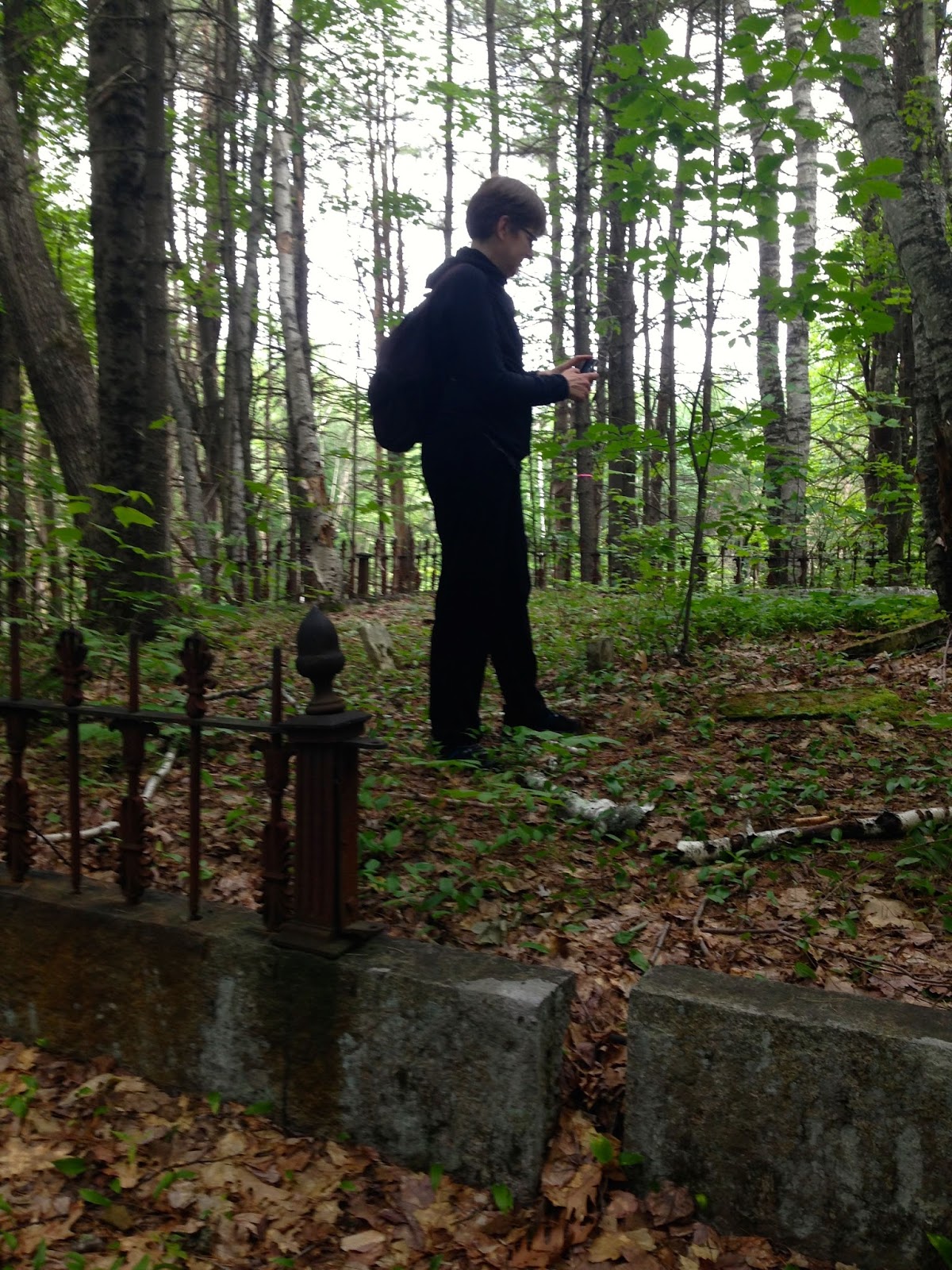
 For this wonderful moment you get to be omnivorous and gobble it all up; the sorting can wait. I gobbled up the houses and trees and dirt roads, too. I took my daughter to see the family cemetery, down in the woods.
We had the Shaw's Ridge ice cream I had seen advertised in the newspapers in 1941 (more gobbling!). It was disorienting; it was a week of living in two different times at once. It was magical.

All my novels have required a surprising amount of research. I suspect this must be the case for most writers!
Even THE WRINKLED CROWN, which is set in an entirely imaginary world, sent me digging through old books to find out how instruments are made, and how to season wood properly. CLOUD & WALLFISH took me back to 1989, via the old diaries we kept when we lived in East Germany and the many newspaper clippings and books we had collected there. And now this new project has brought me home to my mother's Maine.

What kinds of things have you found yourself looking up recently? 

I do wish you joy in your research, in all the times and all the places!

Wednesday, April 16, 2014

Researching Historicals - Down the Rabbit Hole


“One Breakfast Cape - $3.00” What is a breakfast cape, you may ask? I’m going to tell you if you didn’t ask, but first, I wanted to share something I’ve learned about historical research. Be warned-once you start down the path of research, you may disappear in a rabbit hole of discovery you don’t ever want to leave!

Even though I’ve always loved history, and took several history classes in college, I’d never done research at a history museum archives until recently, and it was more amazing than I ever imagined. I can’t recommend it enough for the fascinating bits of information you can find, which can add incredible detail to your stories. My trip wasn’t even related to a story, though it did spark a story idea. My daughter had to research a Civil War event for a history project, and because she’s not yet sixteen, this particular facility required that I stay with her and help. To give some background on what we found, her project was on a major exhibition in our city to raise money for the war. The archives had twelve boxes of material on the exhibit, from lists of items donated (in beautiful handwriting) to actual tickets people purchased. She had already found a book on the event, but seeing the items from the event gave life to it in a way the book did not.

It was easy enough to get copies of newspaper articles about the event, but we also found a newspaper in the archives that was only printed for the event by the people involved, and detailed the events of each day. It was quite a find, because the newspaper had never been scanned and made available anywhere else.

Here’s one of the tidbits from the paper:
“A gentleman requests us to apologize to the lady, whose dress he trod on and ripped off the skirt, last evening. He is diffident, and she appeared so very angry, he was afraid to express his regret. He hopes she did not break the China vase she dropped during the incident.”

I love this, because I can picture it vividly.

Here’s another:
“There was an incipient fire at Greenwood Hall on Monday evening, creating quite a sensation. The decorations of a chandelier caught fire, falling upon one of the refreshment tables and setting things thereon in a blaze. In a trice it was denuded of its sweet contents, the flames smothered under shawls and cloaks, (not the first time these articles have covered “hidden fires”), but soon order was restored, and the table resumed to its former state.”

With these two descriptions, a writer could add such detail to a story to bring the reader right into the event. I wouldn’t have been able to imagine these on my own.

So if you are writing a historical and have a chance to get hold of some primary source material, you may find some real treasures.

And the breakfast cape? It was one of the items donated. After some further research, we discovered it was a very common item of women’s clothing from the mid 19th century, usually knitted, and worn by ladies when at home (not to be confused with an opera cape.)


Happy research!


~ Dee Garretson